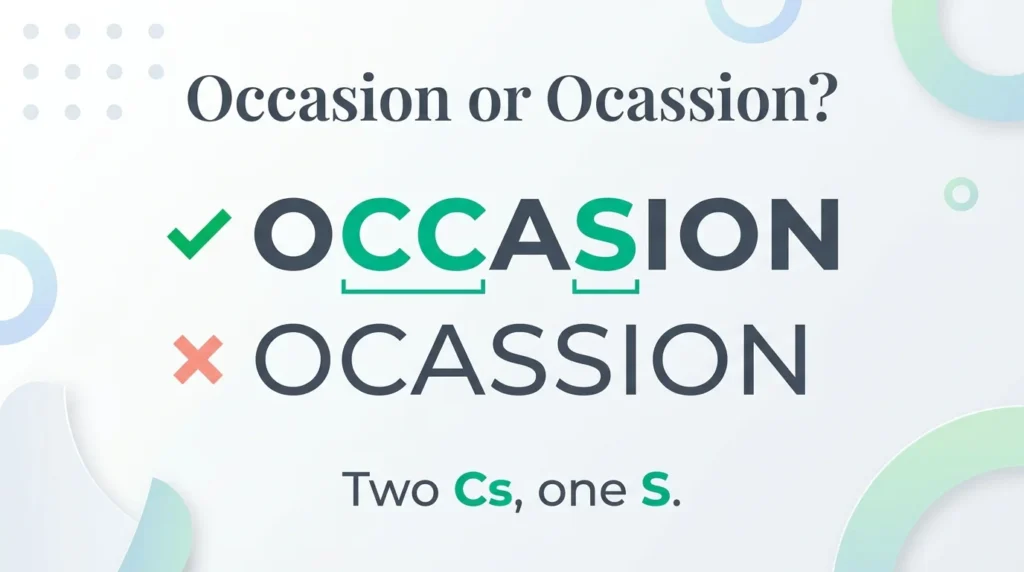

The difference between occasion and ocassion is a matter of spelling, not meaning. Only occasion is the correct standard English form.
What Does Occasion Mean?
Occasion is a noun used for an event, a particular time, or a situation in which something happens. Depending on the context, it can also mean an opportunity or reason for an action.
Examples:
- The wedding was a memorable occasion.
- We have met on several occasions.
- This is a special occasion for our family.
- Her remarks gave us occasion to reconsider the decision.
The word can describe both happy celebrations and ordinary or serious situations.
What Does Ocassion Mean?
Ocassion is an incorrect spelling of occasion. It is not a standard alternative, and it should not be used in edited English.
For example:
- Incorrect: We celebrated this special ocassion.
- Correct: We celebrated this special occasion.
The intended meaning is understandable in the incorrect sentence, but the spelling needs to be corrected.
The Main Difference
| Feature | Occasion | Ocassion |
|---|---|---|
| Spelling | Correct | Incorrect |
| Standard English word | Yes | No |
| Meaning | Event, time, situation, or opportunity | No separate standard meaning |
| Suitable for formal writing | Yes | No |
| Correct plural form | Occasions | Not applicable |
| Example | It was a happy occasion. | It was a happy ocassion. |
The important point is that these are not two words with different meanings. Occasion is the correct word, while ocassion is a spelling error.
The Core Rule
The Rule in Simple English
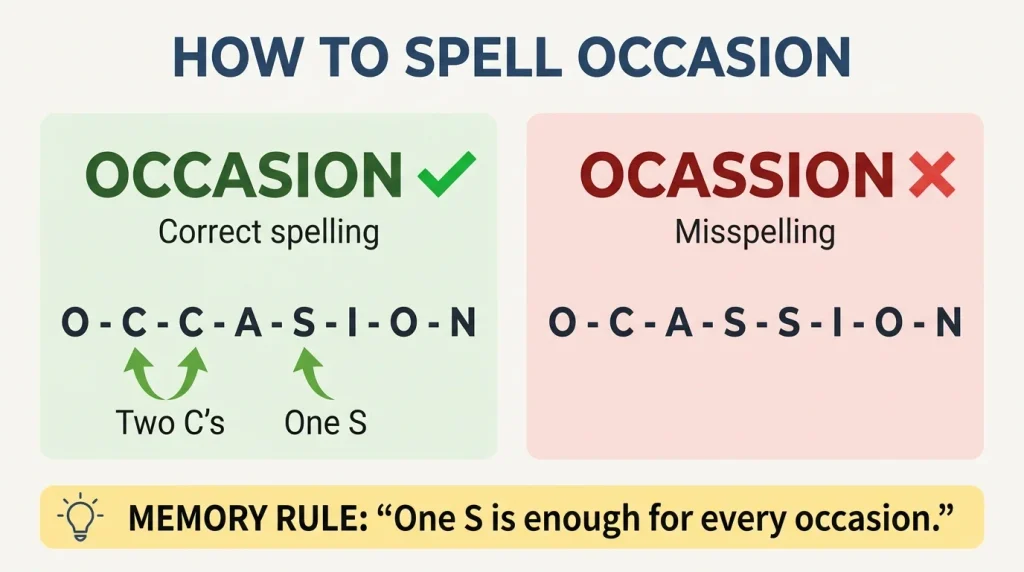
Write occasion, with two Cs and one S.
The correct letter sequence is:
o-c-c-a-s-i-o-n
The incorrect spelling adds an extra S and leaves out one of the Cs:
o-c-a-s-s-i-o-n
Remember that the correct word contains CC followed by ASION, not ASSION.
Why the Rule Works
English spelling does not always follow pronunciation exactly. When people hear occasion, the middle sounds can blend together, making it easy to forget which consonant is doubled.
The solution is to memorize the written form rather than guess the spelling from the sound.
Also remember that the related words occasional and occasionally retain the same double-C, single-S pattern.
- Occasion — noun
- Occasional — adjective
- Occasionally — adverb
How to Use It
Common Usage
Use occasion whenever you refer to an event, a particular time, or a relevant situation.
1. To describe a special event
The graduation ceremony was a proud occasion for everyone.
2. To describe a particular time
On this occasion, we decided to stay at home.
3. To mean sometimes
We occasionally eat dinner at a restaurant. In this sentence, occasionally means from time to time.
4. To refer to an opportunity or reason
There was no occasion to criticize her decision.
5. To describe repeated events
We have discussed the issue on several occasions.
Less Common or Special Usage
Occasion can also function as a verb meaning to cause something to happen, although this use is less common in everyday conversation.
Example:
The unexpected delay occasioned considerable concern.
Here, occasioned means caused. This is a legitimate use of the word, not a spelling variation.
Correct Examples
The following examples demonstrate the correct spelling in different contexts.
- Her birthday was a wonderful occasion.
- We bought new clothes for the special occasion.
- The family gathered to celebrate the happy occasion.
- On this occasion, everyone arrived on time.
- I have visited that city on several occasions.
- This formal occasion requires appropriate clothing.
- The ceremony was an important occasion for the community.
- We rarely get an occasion to meet all our friends together.
- The manager thanked everyone who attended the occasion.
- She occasionally works late when a project is urgent.
- The invitation explained the purpose of the occasion.
- We saved the photograph to remember the special occasion.
Notice that occasion remains correctly spelled whether the sentence describes a celebration, a meeting, a formal event, or a particular instance.
Incorrect vs Correct
| ❌ Incorrect | ✅ Correct | Why |
|---|---|---|
| special ocassion | special occasion | The correct word has one S. |
| happy ocassion | happy occasion | The S should not be doubled. |
| formal ocassion | formal occasion | Use the standard spelling. |
| on this ocassion | on this occasion | The phrase requires the correct noun. |
| a memorable ocassion | a memorable occasion | Only occasion is standard. |
| wedding ocassion | wedding occasion | Remove the extra S. |
| several ocassions | several occasions | The plural also has one S in the base word. |
| special occassion | special occasion | Do not add an extra S. |
| occassional event | occasional event | The adjective follows the same pattern. |
| occassionally late | occasionally late | The adverb is spelled occasionally. |
These errors can be corrected by checking the consonant pattern before submitting or publishing your writing.
Why People Make This Mistake
There are several reasons why people write ocassion instead of occasion.
1. Confusing Double Letters
Writers may remember that the word contains a doubled consonant but place it in the wrong position. The correct doubled consonant is C, not S.
2. Writing From Memory
When writing quickly, people sometimes reproduce the general appearance of a word without recalling its exact letter sequence.
3. Pronunciation Does Not Reveal the Spelling
The pronunciation of occasion does not make its spelling pattern obvious. Hearing the word is not always enough to determine which letter should be doubled.
4. Typing Too Quickly
An extra letter may appear when typing messages, social media captions, invitations, or emails without proofreading.
5. Repeating an Existing Error
If someone repeatedly sees a misspelling online, it may begin to look familiar. Familiarity, however, does not make an incorrect spelling standard English.
Common Mistakes
Mistake 1: Doubling the S Instead of the C
Incorrect: It was a memorable ocassion.
Correct: It was a memorable occasion.
How to avoid it: Check the middle of the word. Occasion contains CC and a single S.
Mistake 2: Assuming the Spelling Changes in the Plural
Incorrect: We celebrated several special ocassions.
Correct: We celebrated several special occasions.
How to avoid it: Add -s to the correctly spelled noun: occasion becomes occasions.
Mistake 3: Misspelling Related Words
Incorrect: We occassionally organize special events.
Correct: We occasionally organize special events.
How to avoid it: Learn the word family together: occasion, occasional, occasionally.
Mistake 4: Assuming the Incorrect Form Is a Regional Variation
Ocassion is not an accepted American or British spelling. Both varieties use occasion.
How to avoid it: Use occasion regardless of which standard English variety you write.
Occasion or Ocassion in Real English
In real-world writing, the correct spelling matters wherever accuracy and readability are important.
- Correct and natural: “Thank you for inviting me to this special occasion.”
- Incorrect spelling: “Thank you for inviting me to this special ocassion.”
The second sentence communicates the intended message, but its spelling is incorrect. A reader can usually understand it without difficulty, yet it should be corrected in polished writing.
You may encounter ocassion in search queries, comments, informal posts, or unedited documents. Its appearance in these places does not make it an accepted spelling.
The safest choice is always occasion when you mean an event, time, situation, or opportunity.
American vs British English
There is no spelling difference between American and British English for this word.
| English variety | Correct spelling |
|---|---|
| American English | Occasion |
| British English | Occasion |
| Canadian English | Occasion |
| Australian English | Occasion |
Do not change the spelling to ocassion for a particular audience or region.
Comparison Table
| Feature | Occasion | Ocassion |
|---|---|---|
| Status | Standard English | Misspelling |
| Part of speech | Primarily a noun; also a verb | No standard grammatical role |
| Meaning | Event, time, situation, or opportunity | No independent standard meaning |
| Double consonant | CC | Incorrectly doubles S |
| Plural | Occasions | Not a correct form |
| Related adjective | Occasional | Occassional is incorrect |
| Related adverb | Occasionally | Occassionally is incorrect |
| Recommended use | All standard English writing | Avoid |
Memory Trick
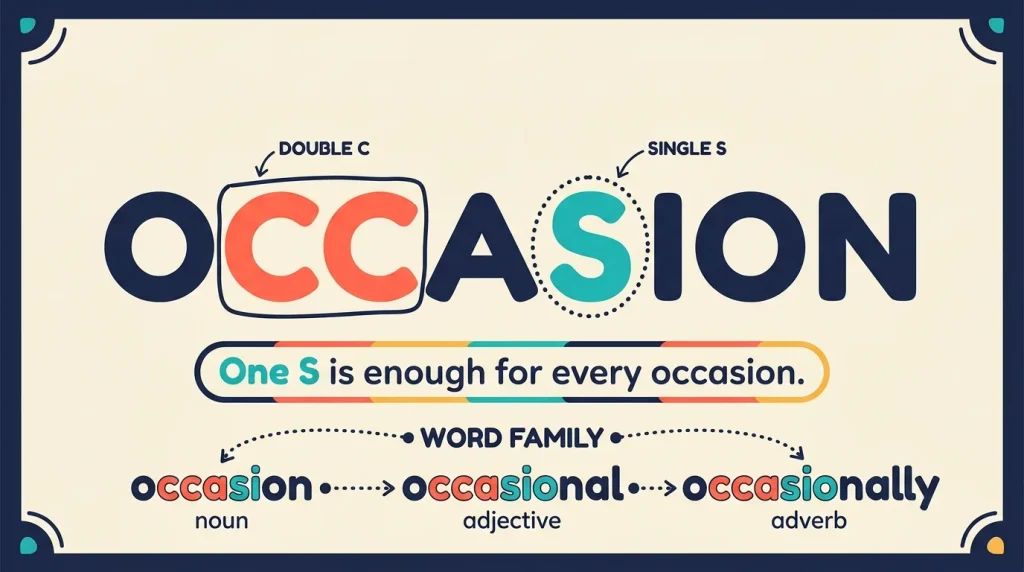
Remember this sentence:
“One S is enough for every occasion.”
Now look at the spelling:
O C C A S I O N
- Two Cs:
CC - One S:
S - Ending:
ION
Think of the double C as the part you must protect when spelling the word. If you are about to type ocassion, pause and check whether you have doubled the wrong consonant.
Another useful method is to memorize the phrase “special occasion.” Because this phrase appears frequently in invitations and everyday writing, it provides a practical spelling reminder.
ALSO READ: Usage vs. Useage: Which Spelling Is Correct?
Real-Life Examples
At Work
Correct: The meeting is an important occasion to recognize the team’s achievements.
Incorrect: The meeting is an important ocassion to recognize the team’s achievements.
In an Email
Correct: Thank you for including me in this special occasion. I look forward to attending.
Incorrect: Thank you for including me in this special ocassion.
In Conversation
Correct: We usually dress formally for special occasions.
Correct: On this occasion, let’s try something different.
At School or University
Correct: The graduation ceremony was a memorable occasion for the students.
Incorrect: The graduation ceremony was a memorable ocassion for the students.
On Social Media
Correct: Celebrating a beautiful occasion with the people who matter most.
Incorrect: Celebrating a beautiful ocassion with the people who matter most.
These examples show that the spelling remains the same in professional, educational, personal, and informal contexts.
Expert Tips
- Memorize the letter sequence. Learn
OCCASIONas a complete spelling rather than trying to reconstruct it each time. - Remember the double C. The word starts with
occ, which is a useful visual clue. - Learn related forms together. Practise occasion, occasional, occasionally, and occasions as a group.
- Use spellcheck as a backup. A spelling checker can flag ocassion, but always review the suggested correction.
- Proofread high-visibility writing. Check invitations, business emails, résumés, school assignments, and published articles before sending them.
- Practise the phrase, not just the word. Writing “special occasion” and “on this occasion” helps reinforce the correct spelling in context.
ALSO CHECKOUT: Batton or baton with meanings.
Quick Summary
The correct spelling is occasion, while ocassion is a misspelling. Occasion can mean a special event, a particular time, a situation, or an opportunity. It is used in expressions such as “special occasion,” “on this occasion,” and “on several occasions.” The spelling stays the same in American and British English.
The most useful memory trick is “One S is enough for every occasion.” The correct word contains two Cs and one S. Related words such as occasional and occasionally follow the same pattern. When writing an email, invitation, assignment, or article, choose occasion and proofread the sentence to make sure the spelling is correct.
Frequently Asked Questions
1. Which is correct: occasion or ocassion?
Occasion is the correct standard English spelling. Ocassion is a misspelling.
2. Is ocassion a real English word?
No. Ocassion is not a standard English word with an independent meaning. It is an incorrect spelling of occasion.
3. How do you spell occasion correctly?
Spell it O-C-C-A-S-I-O-N. The word has two Cs and one S.
4. What does occasion mean?
An occasion is an event, a particular time, a situation, or an opportunity. For example, a graduation ceremony can be described as a special occasion.
5. Why do people spell occasion as ocassion?
People may remember that the word contains a doubled consonant but mistakenly double the S instead of the C. Fast typing and unfamiliarity with the spelling can also contribute to the error.
6. Is occasion spelled differently in American and British English?
No. Both American and British English use occasion. Neither variety uses ocassion as the standard spelling.
7. What is the plural of occasion?
The plural is occasions. For example: “We have met on several occasions.”
8. How do you spell occasional and occasionally?
The correct forms are occasional and occasionally. Both retain the double C and single S found in occasion.
9. Is “special occasion” correct?
Yes. “Special occasion” is a standard expression for an important or noteworthy event, such as a wedding, anniversary, or graduation.
10. What is the easiest way to remember occasion?
Use the phrase “One S is enough for every occasion.” Remember the spelling OCCASION: two Cs and one S.
Mini Quiz
Test your understanding of occasion and ocassion.
| # | Question | Answer | Explanation |
|---|---|---|---|
| 1 | Choose the correct spelling: occasion or ocassion. | Occasion | Occasion is the standard spelling. |
| 2 | Fill in the blank: The wedding was a wonderful ____. | Occasion | The noun refers to an event. |
| 3 | Correct this phrase: “a special ocassion.” | A special occasion | The word has one S. |
| 4 | Which is correct: occasions or ocassions? | Occasions | The plural is formed by adding S to occasion. |
| 5 | Fill in the blank: We ____ visit our relatives on weekends. | Occasionally | Occasionally means from time to time. |
| 6 | Is “ocassion” an accepted British spelling? | No | British English uses occasion. |
| 7 | How many Cs are in occasion? | Two | The spelling begins with OCC. |
| 8 | How many Ss are in occasion? | One | The word does not contain double S. |
| 9 | Correct this sentence: “This is an important ocassion.” | This is an important occasion. | Replace the misspelling with the standard form. |
| 10 | Choose the correct adjective: occasional or occassional. | Occasional | The adjective retains the double C and single S. |
Final takeaway: Write occasion, not ocassion. Two Cs, one S, every time.
STEP 4 — RESEARCH & CONTENT INTELLIGENCE REPORT
This section is editorial research, not part of the WordPress article.
1. Search Intent Analysis
Primary intent: Informational and spelling correction.
The searcher wants to determine which spelling is correct and use it confidently.
| Intent | Reader expectation |
|---|---|
| Primary | Is it occasion or ocassion? |
| Secondary | What does occasion mean? |
| Spelling | How many Cs and Ss does the word contain? |
| Usage | How is occasion used in a sentence? |
| Error correction | How should common misspellings be corrected? |
| Learning | What is an easy way to remember the spelling? |
The desired outcome is simple: the reader should immediately identify occasion as correct and understand why ocassion should be avoided.
2. SERP Analysis
A sample of current search results for the exact keyword and close variants shows a consistent spelling-correction intent.
- Dominant result intent: Correct spelling, word meaning, examples, and memory tricks.
- Recurring content patterns: Quick-answer paragraphs, side-by-side comparison tables, example sentences, and FAQs.
- Common questions: Which spelling is correct? Is ocassion a word? How do you spell occasion? Does the spelling differ between American and British English?
- Featured Snippet opportunity: A concise answer stating that occasion is correct and ocassion is a misspelling.
- Related search themes: Occasion meaning, special occasion, occasions plural, occasional, and occasionally.
- AI Overview relevance: A direct definition paired with an explicit spelling distinction gives search systems a clear, concise explanation to summarize.
The reviewed results include pages focused on the exact spelling comparison, while the Cambridge Dictionary provides authoritative definitions and usage examples for occasion.
Which is Correct?
+2
Research limitation: This is a sampled search-results review, not a comprehensive audit of all ranking positions, live People Also Ask questions, or personalized search features. No ranking or Featured Snippet placement is guaranteed.
3. Competitive Content Analysis
The sampled pages generally provide the correct spelling and a simple mnemonic. Their recurring weaknesses, which the article aims to avoid, include:
- Repeating the same spelling answer across multiple sections.
- Adding unnecessary sections to a simple spelling question.
- Providing repetitive examples that do not teach different uses.
- Treating a misspelling as though it were a separate word.
- Making overly broad claims about grammar or pronunciation.
The article instead emphasizes the immediate answer, practical usage, the word family, meaningful corrections, and a short quiz.
4. Content Gap Analysis
| Reader need | How the article addresses it |
|---|---|
| Immediate correction | Answers the spelling question directly beneath the H1. |
| Meaning beyond celebrations | Covers events, particular times, situations, and opportunities. |
| Word-family consistency | Explains occasion, occasional, occasionally, and occasions. |
| Practical correction | Includes examples from emails, workplaces, education, and social media. |
| Regional uncertainty | Clarifies that American and British English use the same spelling. |
| Retention | Provides a mnemonic and a 10-question quiz. |
These are useful coverage choices for the target query. They should not be interpreted as verified gaps across every competing page.
5. Question Map
Primary questions
- Which spelling is correct?
- What does occasion mean?
Answered in the quick answer and opening sections.
Secondary questions
- How is occasion spelled?
- What is its plural?
- What are its related word forms?
Answered in the core rule and word-family sections.
Confusion and error questions
- Why do writers use ocassion?
- How can the spelling mistake be corrected?
- Is the incorrect form a regional variant?
Answered in the mistake analysis and comparison tables.
Usage and decision questions
- How is occasion used naturally?
- Is it suitable for formal writing?
- Does American or British English change the spelling?
Answered in the real-English, usage, and regional sections.
Learning questions
- What is the easiest memory trick?
- How can readers test their understanding?
Answered in the mnemonic and mini quiz.
6. Topical Coverage Map
| Semantic dimension | Coverage |
|---|---|
| Spelling | Primary focus |
| Meaning | Event, time, situation, opportunity |
| Grammar | Noun and less common verb use |
| Word formation | Occasions, occasional, occasionally |
| Context | Personal, educational, and professional writing |
| Naturalness | Correct spelling versus understandable error |
| Regional variation | American and British English |
| Common mistakes | Incorrect double-S pattern and related misspellings |
| Learning support | Mnemonic, examples, quiz |
Pronunciation is not a major article section because the central question concerns written spelling, not how the word is spoken. The dictionary confirms the pronunciation and the word’s range of meanings.
Pronunciation in English
+1
7. Keyword & Query Coverage
The main keyword occasion or ocassion is addressed directly in the H1, opening answer, comparison table, and FAQs.
Related queries are incorporated naturally through the following topics:
- Occasion vs. ocassion
- Correct spelling of occasion
- Occasion meaning
- Special occasion
- On this occasion
- Occasions plural
- Occasional vs. occasionally
- Common occasion spelling mistakes
The recommended approach is to prioritize clarity and semantic relevance rather than repeat the exact keyword unnaturally throughout the article.
8. Featured Snippet Opportunities
Opportunity 1 — Direct spelling answer
Occasion is the correct spelling. Ocassion is a misspelling. The correct word contains two Cs and one S.
Best location: immediately beneath the H1.
Opportunity 2 — Comparison table
A compact table showing spelling, status, and meaning can answer comparison queries quickly.
Opportunity 3 — Memory trick
“One S is enough for every occasion” offers a short, memorable response to spelling-learning queries.
Opportunity 4 — FAQ
The question “Which is correct: occasion or ocassion?” directly matches the primary intent.
These are potential snippet formats, not predictions of search placement.
9. AI Overview & Entity Coverage
The important linguistic concepts and relationships are:
- Occasion: The standard English word.
- Ocassion: A misspelling of occasion.
- Occasions: The plural noun.
- Occasional: The related adjective.
- Occasionally: The related adverb.
- Special occasion: A common phrase referring to a noteworthy event.
- On occasion: An expression meaning sometimes, though not often.
The relationship between these forms provides context without confusing the correct word with its misspellings. The definitions and usage distinctions align with dictionary coverage.
10. Final Content Advantage
The article is designed around five practical benefits:
- It answers the spelling question immediately.
- It distinguishes an incorrect spelling from a genuine alternative word.
- It explains the meaning and grammatical use of occasion.
- It helps readers avoid related errors in occasions, occasional, and occasionally.
- It reinforces learning through a mnemonic, realistic examples, and a quiz.
The strongest editorial decision is to keep the page focused. Because this is primarily a spelling-correction query, the article should prioritize accuracy, fast answers, and useful examples instead of artificial length or unnecessary linguistic detail.