
What does assume mean?
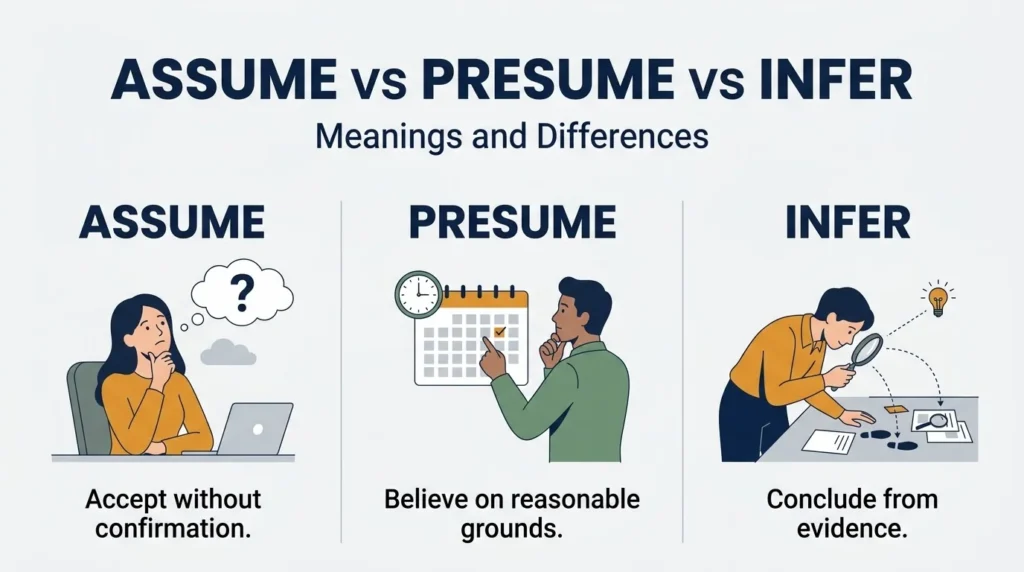
To assume something is to accept it as true without knowing for certain that it is true. The belief may come from an expectation, a previous experience, an incomplete understanding, or an untested idea.
Examples:
- I assumed the meeting had been postponed because nobody sent a reminder.
- Don’t assume that a quiet employee has nothing to contribute.
- We assumed the new software would work with our existing system.
In each example, the person accepts an idea without necessarily verifying it.
Assume has other meanings, too. It can mean taking on a responsibility, role, or position.
- Maya assumed responsibility for the delayed shipment.
- He assumed the role of project coordinator.
These meanings are correct but are separate from the belief-related distinction between assume, presume, and infer.
What does presume mean?
To presume something is to believe it is likely to be true or to accept it as true on reasonable grounds, an established expectation, or an accepted rule.
Examples:
- I presume you’ve already received the revised schedule.
- Given her experience, we presumed she would understand the procedure.
- The law may presume a particular fact unless sufficient evidence establishes otherwise.
Presume often sounds more formal or deliberate than assume, particularly in professional, academic, and legal contexts. However, it is also used in ordinary conversation.
It does not mean that the belief must be correct. A presumption can be challenged or disproved.
The word also appears in presumptuous, which describes someone who takes too much for granted or acts as though they have a right or authority they may not have.
For example:
– It would be presumptuous of me to decide on your behalf.
What does infer mean?
To infer something is to reach a conclusion from information, evidence, observations, or clues.
Examples:
- From the sudden drop in sales, we inferred that customers were dissatisfied.
- I inferred from his short reply that he was in a hurry.
- Researchers inferred the animal’s diet from the condition of its teeth.
Unlike assume, which emphasizes accepting an idea, infer emphasizes the reasoning that leads to a conclusion.
An inference can still be wrong. The available evidence might be incomplete, misleading, or open to another interpretation.
The Main Difference
The central difference is the relationship between a belief and the information supporting it.
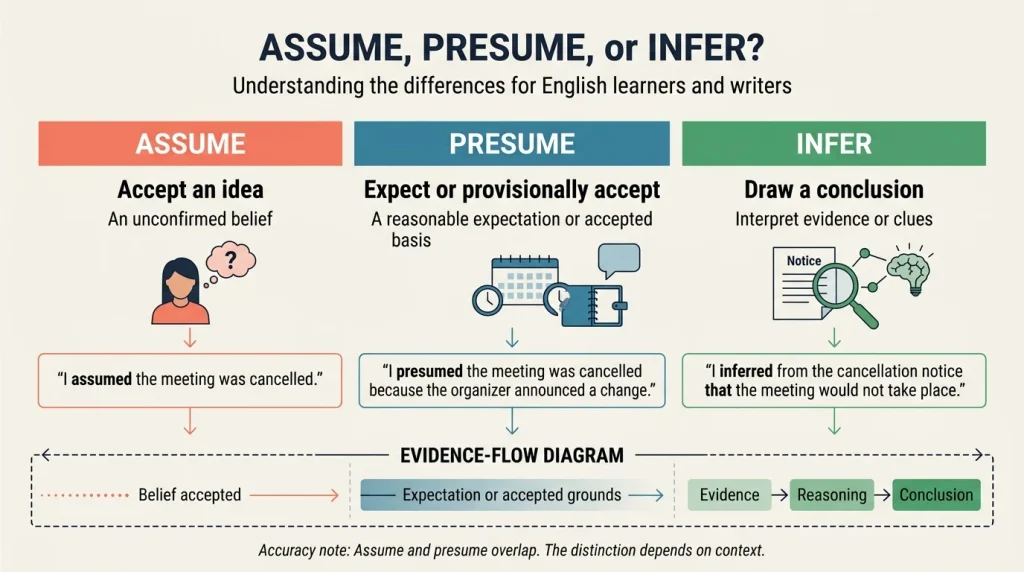
ASSUME — Accept
You accept an idea as true without having confirmed it.
“I assumed the office was closed.”
PRESUME — Expect
You believe something is likely or accept it on reasonable grounds.
“I presumed the office was closed because it was a public holiday.”
INFER — Conclude
You interpret evidence or clues to reach a conclusion.
“I inferred that the office was closed from the locked doors and empty parking lot.”
These are practical distinctions, not rigid rules about how much evidence each word requires. Assume and presume can express nearly the same belief in some contexts. The emphasis and context determine which is more precise.
One situation, three different meanings
Imagine that a colleague has not joined an online meeting.
- Assume: “I assumed she had forgotten.” You accepted an explanation without confirming it.
- Presume: “I presumed she was dealing with another urgent task.” You considered that explanation likely, perhaps because of her responsibilities.
- Infer: “I inferred from her message about a system outage that she was unable to join.” You used specific information to reach your conclusion.
All three sentences are grammatically correct. The difference lies in the reasoning each sentence communicates.
The Core Rule
The rule in simple English
Use this quick guide:
- Assume when you want to emphasize an unconfirmed belief.
- Presume when you want to emphasize a reasonable expectation or an accepted basis for believing something.
- Infer when you want to emphasize a conclusion drawn from evidence or clues.
For example:
“I assumed the delivery would arrive today.”
“I presumed the delivery would arrive today because the company had confirmed the dispatch date.”
“I inferred from the tracking information that the delivery would arrive today.”
The three sentences describe related beliefs, but the second and third explain the basis for the belief more explicitly.
Why the rule works
The verbs emphasize different parts of the thinking process:
- Assume focuses on accepting a proposition.
- Presume focuses on treating something as likely or provisionally true.
- Infer focuses on deriving a conclusion from information.
This distinction is useful because the strength of a belief and the quality of the evidence behind it are not the same thing. Someone can strongly assume something without evidence, while another person can carefully infer a conclusion that later turns out to be mistaken.
There is no universal evidence scale in which every presumption is stronger than every assumption. Context, convention, and the speaker’s intended meaning matter.
How to Use Assume, Presume, and Infer
Common usage
All three verbs can introduce a clause beginning with that.
- I assume that the figures are accurate.
- We presume that the applicant meets the requirements.
- The investigators inferred that the alarm had been disabled.
In ordinary English, that is often omitted when the meaning remains clear:
- I assume you’re ready.
- I presume you’ve spoken to her.
- They inferred he was responsible.
The verbs can also be used in the past, present, and future-related constructions.
- Present: I assume the room is available.
- Past: We presumed the room was available.
- Present perfect: She has inferred the answer from the clues.
- Modal construction: We can infer the likely cause from the test results.
Pay attention to the grammatical pattern as well as the meaning.
Less common or special usage
Assume responsibility or a role
Here, assume means to take something on, not to believe something.
- The director assumed responsibility for the decision.
- She assumed office in January.
Presume innocence
In legal contexts, presume can refer to a rule or starting position that applies unless the relevant standard of evidence or procedure changes it.
– A defendant is presumed innocent unless guilt is established through the applicable legal process.
This is not simply a guess about what is probably true; it describes a legal principle.
Infer from information
The preposition from often identifies the evidence used to reach a conclusion.
– We inferred from the temperature readings that the equipment was overheating.
You can also use infer that to state the conclusion directly.
– We inferred that the equipment was overheating.
Correct Examples
The following examples demonstrate how each word works in natural English.
Examples with assume
- I assumed the workshop started at nine because that was the usual schedule.
- Don’t assume everyone has read the updated policy.
- We assumed the backup system would activate automatically, but we tested it before relying on it.
- She assumed responsibility for explaining the delay to the client.
- The researcher initially assumed that the two results were comparable.
Examples with presume
- I presume you would prefer to receive the report before Friday.
- Given the successful trial, the team presumed the revised process would work at a larger scale.
- We presume that applicants have supplied accurate information, although the details may be checked.
- May I presume that you agree with the proposed changes?
- The court may presume certain facts when the relevant legal requirements are met.
Examples with infer
- From the repeated error messages, the technician inferred that the installation had failed.
- Readers can infer the character’s anxiety from her repeated questions.
- We inferred from the sales figures that the promotion had attracted new customers.
- The interviewer inferred that the candidate had prepared carefully from the specific examples in her answers.
- Scientists inferred changes in the environment from the evidence preserved in the sediment.
Notice that assume can describe taking on responsibility, while presume and infer in these examples describe beliefs or conclusions. The correct meaning depends on how the verb is used in the sentence.
Incorrect vs. Correct
The most important mistakes involve using the wrong word for the intended reasoning, not spelling the words incorrectly. Since assume and presume overlap, some sentences below are less precise rather than strictly ungrammatical.
| Less suitable for the intended meaning | Better choice | Why |
|---|---|---|
| From the footprints, we assumed that someone had entered. | From the footprints, we inferred that someone had entered. | Inferred highlights the conclusion drawn from evidence. |
| I inferred you would be available because I expected you to be. | I presumed you would be available because I expected you to be. | Presumed better emphasizes an expectation. |
| Don’t infer that everyone agrees without checking. | Don’t assume that everyone agrees without checking. | The warning concerns accepting an unverified belief. |
| The data directly states the conclusion, so we assumed it from the results. | We inferred the conclusion from the results. | Infer describes reasoning from the data. |
| I presumed she had forgotten, but I had no particular reason for thinking so. | I assumed she had forgotten, but I had no particular reason for thinking so. | Assumed more directly expresses an unverified belief. |
| We assumed from the test results that the machine was overheating. | We inferred from the test results that the machine was overheating. | Inferred emphasizes interpreting the results. |
| I inferred that you had received the email because I normally expect replies. | I presumed that you had received the email because I normally expect replies. | Presumed better fits an expectation, though the original is possible in a suitable context. |
| The manager inferred responsibility for the project. | The manager assumed responsibility for the project. | Assume responsibility is the established expression for taking responsibility. |
| We presumed the cause from the readings alone. | We inferred the cause from the readings. | The second version makes the evidence-based reasoning clearer. |
| I assumed from her expression that she was disappointed. | I inferred from her expression that she was disappointed. | Inferred emphasizes reading a conclusion from a clue. |
The original sentences are not all grammatically wrong. Several are possible English but communicate a different emphasis. In careful writing, choose the verb that most accurately represents the process behind the belief.
Why People Confuse These Words
Their meanings overlap
All three verbs can occur when someone does not know something with absolute certainty. A person may accept an idea, consider it likely, or draw a conclusion without having direct confirmation.
Because the outcomes can look similar, speakers sometimes treat the verbs as interchangeable.
For example, if a colleague does not reply, you might assume that they are busy, presume that they are busy, or infer that they are busy from other information. The words become easier to distinguish when you explain why you reached the conclusion.
The distinction is about reasoning, not certainty alone
It is tempting to think that assume means low confidence, presume means medium confidence, and infer means high confidence.
That is too simple.
An assumption can be held with great confidence. A presumption can be tentative. An inference can be strong or weak depending on the quality of the evidence.
The useful distinction is the kind of mental process being emphasized, not a fixed percentage of certainty.
Infer is sometimes confused with imply
These two words describe different sides of communication.
- Imply: A speaker or writer suggests something, directly or indirectly.
- Infer: A listener or reader draws a conclusion from what was communicated.
Example:
“The manager implied that the deadline might change.”
“I inferred from the manager’s comments that the deadline might change.”
The manager does the implying; the listener does the inferring.
Common Mistakes
Mistake 1: Treating assume and presume as completely different
There is a useful difference in emphasis, but the words overlap substantially.
“I assumed you had finished the report” and “I presumed you had finished the report” are both acceptable. The first is a general statement of belief; the second may sound more like an expectation.
Correction: Do not force a distinction where the context does not support one. Choose presume when the sense of reasonable expectation or accepted grounds matters.
Mistake 2: Using infer when you mean suggest
Incorrect for the intended meaning: “Are you inferring that I lied?”
If you mean that someone is indirectly suggesting that you lied, use:
“Are you implying that I lied?”
If you mean that you are drawing a conclusion about what the person said, infer may be appropriate.
Mistake 3: Believing that an inference must be correct
An inference is a conclusion based on evidence, not a guarantee of truth.
For instance, seeing wet pavement might lead you to infer that it rained. A street-cleaning vehicle or a burst pipe could explain the same observation.
Correction: When evidence is incomplete, use careful language such as “the evidence suggests,” “we may infer,” or “this could indicate.”
Mistake 4: Confusing infer with assume in analytical writing
In a report, saying “we assumed the equipment had failed” and “we inferred that the equipment had failed” tells the reader something different about the analysis.
The first describes an accepted premise or belief. The second indicates that the conclusion was derived from information.
Correction: Be explicit about whether the conclusion was taken for granted or reached by analyzing evidence.
Assume, Presume, and Infer in Real English
In actual English, the boundaries are flexible rather than absolute.
Correct and natural: “I assume you’ve seen the update.” This is a common way to express an unconfirmed belief.
Correct and natural: “I presume you’ve seen the update.” This can sound slightly more deliberate or formal, although it is also used conversationally.
Correct and natural: “I infer from your response that you’ve seen the update.” This emphasizes that the response provides evidence for the conclusion. Depending on the context, it may sound unnecessarily analytical in casual conversation.
The key is not to replace every occurrence of one word with another. Ask what you want to communicate.
- If you are accepting an idea, assume is often a straightforward choice.
- If you are expressing an expectation or relying on an accepted basis, presume may be more precise.
- If you are explaining what evidence leads you to conclude, infer is usually the clearest choice.
Formal vs. Informal Usage
Formal usage
Presume and infer are particularly useful in formal contexts when the reasoning behind a conclusion matters.
- “We presume that the submitted figures are accurate, subject to verification.”
- “The findings allow researchers to infer a relationship between the two variables.”
In legal writing, presume may also refer to a formal rule or legal starting point.
Assume is equally acceptable in formal English, especially when describing an assumption made for the purposes of an analysis:
– “For this calculation, we assume that demand remains constant.”
Everyday usage
Assume is a natural, general-purpose choice in ordinary conversation.
- “I assumed you were already on your way.”
- “Don’t assume I know what you’re thinking.”
Presume can sound more measured, formal, or emphatic, depending on the sentence.
Infer is natural when someone is interpreting clues, comments, or information, but it can sound technical when the situation is simple.
– “I inferred from his tone that he was annoyed.”
In a casual conversation, “I could tell from his tone that he was annoyed” might sound more relaxed.
Comparison Table
| Feature | Assume | Presume | Infer |
|---|---|---|---|
| Core meaning | Accept as true | Believe likely or accept on reasonable grounds | Draw a conclusion |
| Main emphasis | Belief or acceptance | Expectation or presumption | Reasoning from information |
| Evidence | May be limited, absent, or unverified | Often some grounds or accepted expectation | Evidence, clues, or information |
| Part of speech | Verb | Verb | Verb |
| Typical register | Everyday and formal | Everyday and often formal | Everyday, academic, and analytical |
| Common pattern | Assume that something is true | Presume that something is true | Infer that something is true; infer it from evidence |
| Special meaning | Take on a role or responsibility | Legal presumption; presume too much | Interpret information to reach a conclusion |
| Example | I assumed the store was open. | I presumed the store was open because of the holiday schedule. | I inferred the store was open from the lights and activity inside. |
Memory Trick
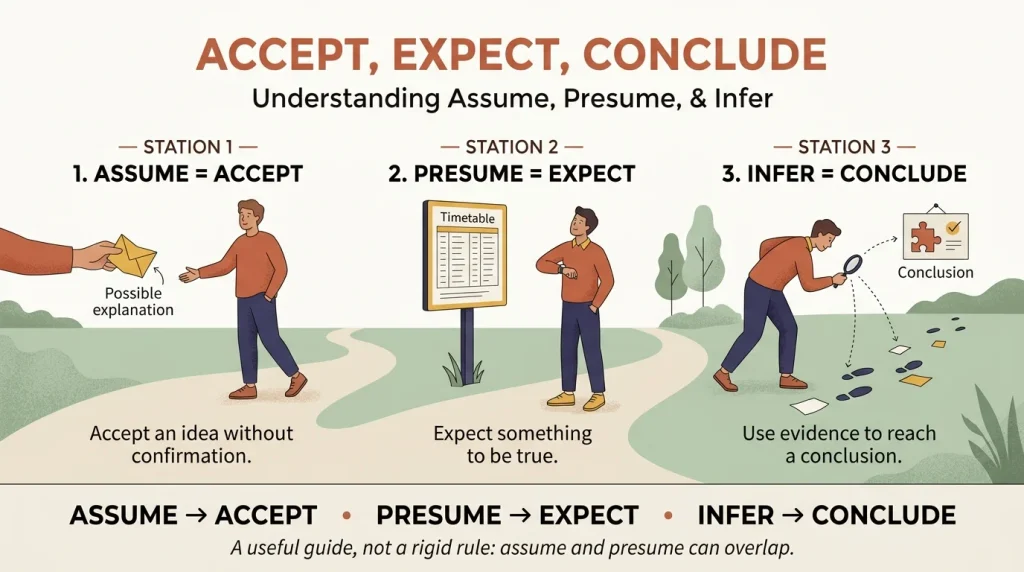
Remember three words: Accept, Expect, Conclude.
ASSUME = ACCEPT
Accept an idea without confirming it.
PRESUME = EXPECT
Expect something to be true or likely on reasonable grounds.
INFER = CONCLUDE
Use information or clues to reach a conclusion.
This is a memory aid, not a rigid rule. When assume and presume overlap, either may be correct. The distinction between a belief and a conclusion drawn from evidence is often more important.
Real-Life Examples
At work
Suppose a team member misses a deadline.
- Assume: “I assumed she was still working on the draft.”
- Presume: “I presumed she needed extra time because the client had requested changes.”
- Infer: “I inferred from the version history that she had revised the draft yesterday.”
The third sentence explains what information supports the conclusion. The first two describe beliefs with different emphases.
In an email
“I presume you’ve had an opportunity to review the attached proposal.”
This is a polite, somewhat formal way of expressing an expectation. If you do not know whether the recipient has reviewed it, you can avoid implying that they have:
“Have you had an opportunity to review the attached proposal?”
The choice of verb can influence tone, so use a direct question when you need confirmation rather than relying on a presumption.
In conversation
“I assumed you were bringing the tickets.”
This expresses an expectation that was not confirmed.
“I inferred from your message that you were bringing the tickets.”
This explains that the message led you to that conclusion.
Both are natural, but they communicate different reasons for the belief.
| ALSO READ: Usage vs. Useage: Which Spelling Is Correct? |
|---|
At school or university
“In the experiment, we assumed that the temperature remained constant.”
This states an assumption used in the analysis.
“From the observed pattern, we inferred that the reaction rate had increased.”
This describes a conclusion based on observations.
In academic writing, making this distinction helps readers evaluate which statements are premises and which are conclusions supported by the results.
Expert Tips
1. Ask what you know versus what you think. If you have accepted an idea without checking it, assume is a strong starting point.
2. Look for an expectation or accepted basis. If you are relying on established circumstances, a convention, or a reasonable expectation, consider presume.
3. Identify the evidence before choosing infer. Ask yourself, “What did I observe or read that led me to this conclusion?” If you can identify that reasoning, infer may be the most accurate verb.
4. Do not confuse confidence with evidence. Saying “I strongly assume” is possible; it does not turn the assumption into an inference.
5. Use the correct verb pattern. You can assume or presume a fact, assume responsibility, infer a conclusion, and infer something from evidence.
6. Distinguish implication from inference. The person communicating may imply something; the person interpreting the message may infer it.
7. Avoid overstating conclusions. If the evidence is weak, say “I inferred,” “I suspect,” or “the evidence suggests,” as appropriate. An inference is not proof by itself.
Quick Summary
Assume, presume, and infer are related verbs, but they highlight different ways of arriving at a belief. Assume is the general choice when someone accepts an idea as true without confirming it. Presume often expresses a reasonable expectation or a belief accepted on particular grounds. Infer emphasizes reaching a conclusion by interpreting evidence, clues, or information. The difference between assume and presume is one of emphasis, not an absolute division: both can be correct in the same sentence. The most useful test is to ask whether you are accepting an idea, expecting it to be true, or drawing a conclusion from evidence. Also remember that imply means to suggest, whereas infer means to draw a conclusion.
Frequently Asked Questions
1. What is the difference between assume, presume, and infer?
Assume means to accept something as true without confirmation. Presume means to believe something is likely or accept it on reasonable grounds. Infer means to draw a conclusion from evidence or information. The distinction is about the reasoning behind the belief.
2. Are assume and presume synonyms?
Yes. They overlap in meaning and can both mean to accept something as true without complete proof. Presume often places more emphasis on expectation, probability, or accepted grounds, but this is a tendency rather than a strict rule.
3. Is presume more formal than assume?
Presume often sounds more formal or deliberate, especially in legal, professional, and academic contexts. However, both words are acceptable in formal and informal English. The best choice depends on meaning, context, and tone.
4. Does infer mean guess?
Not exactly. A guess may be based on little or no evidence. An inference is a conclusion drawn from information, observations, or clues. Inferences can still be uncertain or incorrect, so the word does not guarantee that a conclusion is true.
5. Can you infer something without direct proof?
Yes. An inference often involves drawing a conclusion from indirect evidence rather than direct confirmation. For example, you might infer that a meeting has ended because the room is empty and the chairs have been rearranged. Other explanations may still be possible.
6. What is the difference between imply and infer?
To imply is to suggest something through words or actions. To infer is to interpret those words or actions and reach a conclusion.
Example: “She implied that the plan might change, and I inferred that we should delay the announcement.”
7. Is it correct to say “I presume so”?
Yes. “I presume so” is a correct expression meaning that you believe something is likely to be true or accept it as an expectation.
Example:
“Will the office be open tomorrow?”
“I presume so, but I haven’t checked the holiday schedule.”
8. Can assume mean take responsibility?
Yes. Assume can mean to take on responsibility, a duty, a role, or a position.
Example: “The new manager assumed responsibility for staff training.”
This is a separate meaning from accepting an idea as true.
9. Can an inference be wrong?
Yes. An inference depends on how the available evidence is interpreted. Missing information or an alternative explanation can lead to a mistaken conclusion. The word describes the reasoning process, not the guaranteed accuracy of the result.
10. Which word should I use in academic writing?
Use assume for a premise accepted for the purposes of an analysis, presume for an expectation or accepted presumption, and infer for a conclusion derived from observations or results. In research writing, clearly distinguishing assumptions from findings makes your argument easier to evaluate.
ALSO READ: Batton or baton
Mini Quiz
Choose the best answer for each question. The answers and explanations appear in the final two columns.
| # | Question | Answer | Explanation |
|---|---|---|---|
| 1 | I ___ the shop was open because I hadn’t checked its hours. (assumed / inferred) | assumed | The speaker accepted an idea without checking it. |
| 2 | From the unusual noise and vibration, the engineer ___ that a component was loose. (presumed / inferred) | inferred | The conclusion was drawn from observations. |
| 3 | Given the published schedule, I ___ the office would open at nine. (presumed / implied) | presumed | The speaker expresses an expectation based on an established schedule. |
| 4 | Which word means “suggest indirectly”: infer or imply? | imply | A person implies; another person may infer the intended meaning. |
| 5 | Complete the phrase: “She assumed ___ for the mistake.” | responsibility | Assume responsibility means to take responsibility. |
| 6 | True or false: Every inference is correct if it is based on evidence. | False | Evidence can be incomplete or misinterpreted. |
| 7 | The reader used the character’s actions to ___ that she was worried. (infer / presume) | infer | The reader drew a conclusion from clues in the story. |
| 8 | “I ___ you’ve already sent the invoice, but I’ll confirm it.” (assume / imply) | assume | The speaker has an unconfirmed belief. |
| 9 | Which sentence emphasizes a conclusion from evidence? A. “I assumed he was tired.” B. “I inferred he was tired from his repeated yawning.” | B | The second sentence explicitly identifies the evidence behind the conclusion. |
| 10 | Can both “I assumed you were busy” and “I presumed you were busy” be correct? | Yes | The words overlap; presumed may emphasize expectation, but both can be natural. |
STEP 4 — RESEARCH & CONTENT INTELLIGENCE REPORT
1. Search Intent Analysis
Primary intent: Informational word comparison.
The searcher wants to understand the meanings of assume, presume, and infer, determine how they differ, and select the appropriate verb for a particular sentence.
Primary intent
Understand the meanings and differences among all three verbs.
Secondary intent
Learn grammatical patterns, usage distinctions, and examples of correct word choice.
Practical intent
Resolve uncertainty when writing emails, reports, academic work, and everyday messages.
Learning intent
Remember the distinction and avoid confusing inference with assumption or implication.
The reader’s central decision is: Am I accepting an idea, expecting it to be true, or drawing a conclusion from evidence?
The article addresses this decision immediately and then reinforces it through contextual examples, a comparison table, FAQs, and a quiz.
2. SERP Analysis
The current search review identified several pages directly targeting the three-word comparison, alongside older explanatory material about related distinctions. The most relevant examples include recently published comparison articles and established grammar guidance on imply versus infer.
Dominant result intent
The observed results predominantly address informational comparison intent. Common page structures include:
- A short definition of each verb.
- A side-by-side comparison table.
- An explanation of evidence and probability.
- Examples demonstrating the three words in sentences.
- Common mistakes and frequently asked questions.
- A mnemonic or short practice exercise.
Recurring explanations
The most common explanatory pattern is:
- Assume: accept something as true.
- Presume: believe something is likely or reasonable.
- Infer: reach a conclusion from information.
This is a useful foundation, but it needs qualification. The distinction between assume and presume is not absolute. Some results risk presenting a tendency as a strict rule, particularly when they imply that presumptions always have stronger evidence behind them.
grammerhouse.com
+3
Search features and question themes
| Search feature | Research assessment |
|---|---|
| Direct-answer opportunity | Strong: all three definitions can be explained concisely. |
| Comparison-table opportunity | Strong: meaning, reasoning, evidence, and usage fit a compact table. |
| People Also Ask themes | Likely relevant questions include the difference between assume and presume, whether infer means guess, and how imply differs from infer. These are topic-based question opportunities, not a verified live PAA inventory. |
| Related-search themes | Assume vs. presume; presume vs. infer; imply vs. infer; examples of assume, presume, and infer. |
| Featured Snippet opportunity | A short definition, comparison table, or direct FAQ answer could serve as a candidate answer format. |
| AI Overview themes | The core semantic relationship is well suited to a concise synthesis. Actual AI Overview presence and wording were not independently verified in this review. |
Main weaknesses to address
- Overly rigid evidence distinctions: Evidence is useful for understanding the difference, but the three words do not form a fixed certainty scale.
- Insufficient explanation of overlap: Assume and presume are sometimes treated as more distinct than natural usage supports.
- Limited contextual decision-making: Definitions alone do not always help a reader choose a verb in a real sentence.
- Neglect of adjacent confusion: Imply versus infer is an important related distinction.
- Insufficient attention to tone: A grammatically correct choice may be more formal or analytical than the situation requires.
These observations describe the reviewed search sample rather than every current result or a verified ranking position.
3. Competitive Content Analysis
The strongest general approach to this topic is a definition-first article with examples and a clear comparison table.
The main opportunities for differentiation are conceptual rather than structural.
| Content dimension | Common limitation | Approach in this article |
|---|---|---|
| Definitions | Definitions may be correct but too compressed. | Each word is explained through its meaning and practical context. |
| Assume vs. presume | The distinction can be presented as absolute. | The overlap is stated explicitly. |
| Evidence | The words may be ranked by supposed evidence strength. | The explanation focuses on reasoning and emphasis. |
| Sentence examples | Examples may illustrate meaning without explaining why a word fits. | Contrasting examples identify the reasoning behind each choice. |
| Grammar | The comparison may overlook other meanings of the verbs. | Includes assume responsibility, assume a role, and relevant clause patterns. |
| Related vocabulary | Imply and infer may be conflated. | Explains the speaker/listener distinction. |
| Learning experience | A table may be the only practical learning aid. | Adds a mnemonic, real-life scenarios, FAQs, and a ten-question quiz. |
| Naturalness | Formality may be confused with correctness. | Separates correctness, naturalness, and contextual precision. |
The intended competitive advantage is not a greater number of words. It is better explanation of the boundary between the concepts.
4. Content Gap Analysis
The following are genuine educational opportunities identified in the reviewed material and addressed by the article.
Gap 1 — The overlap between assume and presume
What readers need: To know whether two different verbs are both acceptable in the same sentence.
Why it matters: Readers may incorrectly assume that every occurrence requires a single uniquely correct answer.
How the article addresses it: It explains that the words overlap, provides paired examples, and distinguishes emphasis from grammatical correctness.
Gap 2 — Evidence versus certainty
What readers need: A way to understand inference without believing that every inference is correct.
Why it matters: A conclusion can be evidence-based and still be mistaken.
How the article addresses it: It explains the sequence of evidence, reasoning, and conclusion and uses alternative explanations to show why an inference may fail.
Gap 3 — The difference between implying and inferring
What readers need: To distinguish what a person communicates from what another person concludes.
Why it matters: The two verbs are closely related and commonly confused. Established grammar guidance makes the distinction clear: a speaker implies, while a listener or reader infers.
How the article addresses it: It provides direct definitions, contrasting sentences, a common-mistake explanation, and an FAQ.
Gap 4 — Correctness versus naturalness
What readers need: To know not just whether a sentence is grammatical but whether a verb expresses the intended meaning naturally.
Why it matters: Infer can be grammatically correct but overly analytical in a casual exchange, whereas assume may be more conversationally direct.
How the article addresses it: The article discusses context, register, and alternatives without labeling valid English as automatically incorrect.
Gap 5 — Grammatical patterns and additional meanings
What readers need: To understand how the words work outside the central comparison.
Why it matters: A reader who encounters “assume responsibility” may mistakenly apply the belief-related definition to every use of assume.
How the article addresses it: It explains the additional meaning, common clause patterns, and the use of from with infer.
5. Question Map
| Question category | Important question | Where the article answers it |
|---|---|---|
| Primary | What do assume, presume, and infer mean? | Immediate answer and definitions |
| Primary | What is the main difference? | The Main Difference |
| Secondary | What grammatical patterns do the verbs use? | How to Use Assume, Presume, and Infer |
| Secondary | Does presume sound more formal? | Formal vs. Informal Usage |
| Confusion | Why are the words confused? | Why People Confuse These Words |
| Confusion | Are assume and presume synonyms? | Common Mistakes and FAQ 2 |
| Confusion | What is the difference between imply and infer? | Confusion section and FAQ 6 |
| Usage | Which verb fits an evidence-based conclusion? | Core Rule and Correct Examples |
| Usage | Can assume mean take responsibility? | Special Usage and FAQ 8 |
| Error | Is an inference always correct? | Common Mistakes and FAQ 9 |
| Error | Is presume always more evidence-based than assume? | Core Rule and FAQ 2 |
| Decision | Which word should I use in a particular sentence? | Decision guide, examples, and comparison table |
| Learning | How can I remember the distinction? | Memory Trick |
| Learning | Can I test whether I understand the difference? | Mini Quiz |
The question map connects the principal search needs to explicit sections rather than leaving important distinctions scattered throughout the article.
6. Topical Coverage Map
Meaning and semantics
Core
Definitions and distinctions among the three verbs.
Grammar and word patterns
Core
That-clauses, infer from, assume responsibility, and verb forms.
Evidence and reasoning
Core
Belief, expectation, evidence, inference, and uncertainty.
Naturalness and context
Core
Everyday, professional, academic, and legal examples.
Common errors
Core
Word substitution, overgeneralization, and imply/infer confusion.
Memory and learning
Supporting
Mnemonic, examples, FAQs, and quiz.
Other dimensions were deliberately not expanded into separate sections:
- American versus British English: No meaningful distinction between the core meanings was identified that warrants a dedicated comparison.
- Pronunciation: Not essential to resolving the main semantic question.
- Etymology: Historical origins would add little to the practical word-choice decision.
- Spelling correction: All three forms are standard spellings; the central challenge is meaning and usage rather than spelling.
This selective coverage keeps the page focused on search intent.
7. Keyword & Query Coverage
The article naturally incorporates the main query, “assume vs presume vs infer meanings,” through its title, immediate answer, individual definitions, comparison table, and FAQs.
It also addresses closely related semantic queries within the explanatory text.
| Query theme | Coverage |
|---|---|
| Assume vs. presume vs. infer meanings | Direct answer and definitions |
| Difference between assume and presume | Overlap, expectations, and contextual examples |
| Difference between presume and infer | Expectation versus conclusion from evidence |
| Assume meaning and examples | Definition, examples, and alternative meaning |
| Presume meaning and examples | Definition, formal contexts, and legal use |
| Infer meaning and examples | Evidence-based reasoning and contextual examples |
| Assume vs. infer | Unconfirmed belief versus evidence-derived conclusion |
| Imply vs. infer | Speaker versus listener distinction |
| Correct use of assume, presume, and infer | Sentence patterns, comparison table, and quiz |
| Assume responsibility meaning | Additional meaning and examples |
The SEO approach emphasizes complete semantic coverage rather than repeating the main keyword at an arbitrary density.
8. Featured Snippet Opportunities
These sections offer concise answer formats that search engines could potentially extract. Inclusion does not guarantee a featured snippet.
Opportunity 1 — Direct definition
Target question: “What is the difference between assume, presume, and infer?”
Candidate answer: Assume means to accept something as true without confirmation; presume means to believe it is likely or accept it on reasonable grounds; infer means to draw a conclusion from evidence or information.
Opportunity 2 — Comparison table
Target question: “Assume vs. presume vs. infer: which should I use?”
The compact comparison table presents meaning, evidence, usage, and examples in a format that is easy to scan.
Opportunity 3 — Related vocabulary
Target question: “What is the difference between imply and infer?”
The answer distinguishes suggesting information from drawing a conclusion based on information.
Opportunity 4 — Short FAQ
Target question: “Are assume and presume synonyms?”
The FAQ directly states that the words overlap while explaining their usual difference in emphasis.
9. AI Overview & Entity Coverage
The article establishes a clear semantic relationship among the three target verbs and the processes they describe.
| Concept or entity | Relationship represented |
|---|---|
| Assume | Acceptance of an idea as true without confirmation |
| Presume | Belief or expectation accepted on reasonable grounds |
| Infer | Conclusion derived through interpretation of information |
| Assumption | A belief or premise taken as given |
| Presumption | An accepted or expected proposition, including certain legal contexts |
| Inference | A conclusion reached from observations, evidence, or clues |
| Imply | Communication that suggests something indirectly |
| Evidence | Information that can support or challenge an inference |
| Certainty | A separate dimension from the process used to reach a belief |
This coverage supports semantic understanding by clarifying both similarities and distinctions.
The most important relationship is not simply that the words are synonyms. It is that they describe different emphases within the broader process of forming and interpreting beliefs.
The article also provides contextual signals that help disambiguate uses of assume, including its meaning of taking responsibility or a role.
No claim is made that a particular AI Overview currently cites or favors this article.
10. Final Content Advantage
The proposed page offers five practical advantages:
- Immediate clarity: The reader receives the three definitions before encountering extended explanations.
- Accurate nuance: The article avoids inventing a rigid distinction between assume and presume.
- Real-world applicability: Examples cover workplace communication, emails, academic writing, legal language, and everyday conversation.
- Error prevention: The page addresses confusion between implication and inference, the misuse of evidence-related verbs, and the difference between grammatical correctness and naturalness.
- Active learning: The mnemonic and ten-question quiz help readers apply the distinction rather than simply memorize definitions.
The strategic objective is to create a useful reference for readers who need to understand the words, evaluate their own sentences, and make more precise choices in future writing.