
Smooth is the standard spelling in modern English. It works as both an adjective, meaning even or free from roughness, and a verb, meaning to make something even or remove wrinkles. Smoothe is a rare alternative spelling recorded in some references, but it is not the normal choice in contemporary writing. For emails, essays, websites, and professional documents, use smooth unless you are quoting a historical source or reproducing a name exactly.
What Is the Difference Between Smoothe and Smooth?
The difference is primarily one of spelling and usage, not meaning. In ordinary modern English, smooth is the established form, while smoothe is uncommon and generally best avoided.
The word smooth can describe a physical surface, a pleasant voice, an easy process, or a situation without major problems. It can also describe the action of making something even or less rough.
For example:
- Adjective: The wooden table has a smooth surface.
- Verb: Please smooth the paper before you draw on it.
- Figurative adjective: We had a smooth journey to the airport.
- Figurative verb: The manager tried to smooth out the disagreement.
In each example, smooth is sufficient. Adding an e is unnecessary in ordinary contemporary writing.
Why Does the Difference Matter?
Using the standard spelling helps readers focus on your message instead of questioning your word choice. This is especially important when writing for work, school, customers, or an audience learning English.
Consider these situations:
- At work: “We expect a smooth transition” looks polished and professional.
- In an email: “I’ll smooth out the details before Friday” communicates the intended action clearly.
- In an academic essay: “The treatment produced a smooth surface” uses the conventional spelling.
- On a website: Consistent spelling makes content easier to edit and maintain.
- In an English exam: Choosing smooth avoids a spelling choice that may be marked incorrect.
The distinction is useful because smoothe can look plausible even though it is not the usual modern form. Recognizing the standard spelling prevents an avoidable error.
The Core Rule: Use “Smooth” as Both an Adjective and a Verb
Standard spelling: smooth
Use smooth to describe a quality or to name the action of making something even, flat, or easier.
Usually avoid: smoothe
Although this spelling has been recorded as a rare alternative, it is not the conventional form for everyday modern English.
You do not need to add a final e to turn smooth into a verb. The word already functions as a verb without any spelling change.
How to Use “Smooth” Correctly
Smooth as an adjective
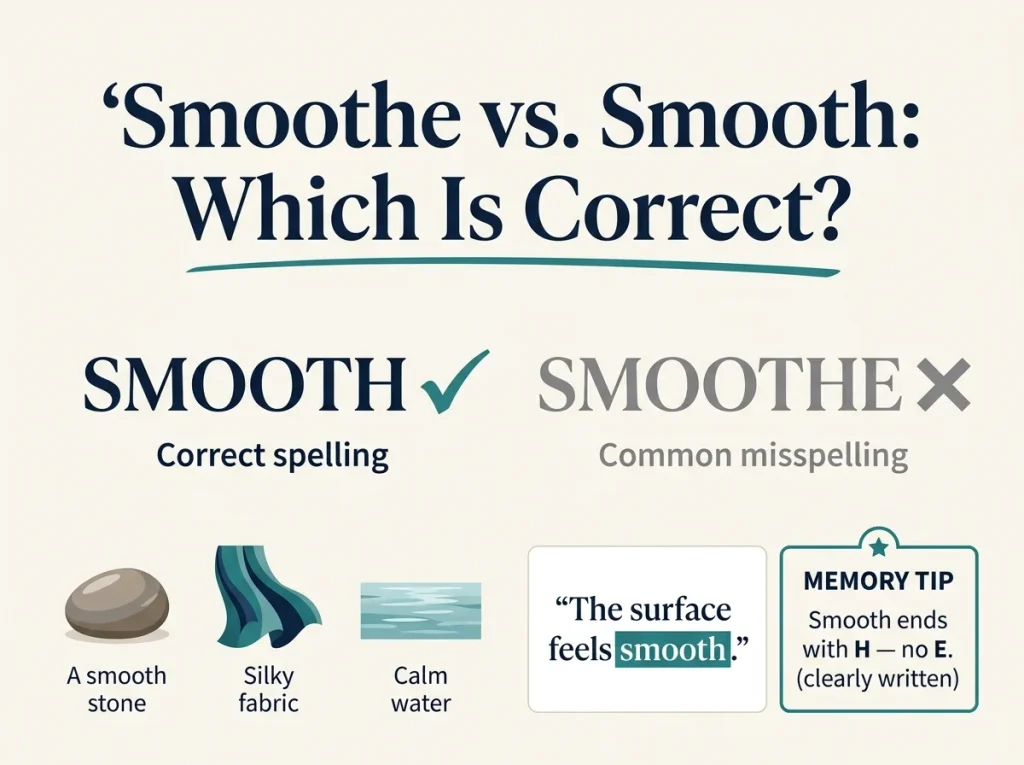
An adjective describes a person, thing, quality, or condition. Smooth is commonly used for surfaces without bumps, substances without lumps, movements without sudden changes, and experiences without difficulties.
Examples:
- The stone has a smooth surface.
- Stir the sauce until it becomes smooth.
- We enjoyed a smooth flight home.
- The new software offers a smooth user experience.
- Her presentation had a smooth, confident delivery.
The meaning depends on the noun being described. A smooth surface is physically even, whereas a smooth process proceeds without significant difficulty.
Smooth as a verb
A verb expresses an action or state. As a verb, smooth means to make something even, flatten wrinkles, spread a substance over a surface, or reduce difficulties.
Examples:
- Smooth the fabric before cutting it.
- He smoothed his hair in front of the mirror.
- Use sandpaper to smooth the wooden edges.
- The team worked to smooth out the delays.
- The coordinator helped smooth over a disagreement.
Notice that the spelling remains smooth whether it describes a quality or expresses an action.
Smooth in its other word forms
The base word also has several related forms. Learning them together makes it easier to spell the word correctly in different sentences.
| Word form | Grammatical role | Example |
|---|---|---|
| Smooth | Adjective or base verb | The surface is smooth. |
| Smooths | Present-tense verb | She smooths the paper. |
| Smoothed | Past tense or past participle | He smoothed the cloth. |
| Smoothing | Present participle or gerund | She is smoothing the edges. |
| Smoothly | Adverb | The system runs smoothly. |
| Smoothness | Noun | The smoothness of the finish is impressive. |
| Smoother | Comparative adjective or noun, depending on context | This fabric feels smoother. |
| Smoothest | Superlative adjective | This is the smoothest finish. |
A gerund is a verb form ending in -ing that functions as a noun, as in “Smoothing the surface takes time.” A participle is a verb form used in verb constructions or to describe something, as in “The surface is being smoothed.”
For standard contemporary writing, remember this pattern:
smooth → smooths → smoothed → smoothing
And when describing how an action happens, use smoothly, not smoothely.
Correct Examples of “Smooth” in Everyday English

The following examples show how smooth works in different settings, from informal conversation to professional and academic writing.
- Everyday conversation: “The new road is much smoother than the old one.”
- Text message: “Hope your presentation goes smoothly today!”
- Email: “We are working to ensure a smooth handover.”
- Workplace meeting: “Let’s discuss how to make the approval process smoother.”
- Customer service: “Our goal is to provide a smooth checkout experience.”
- School assignment: “The polished surface was smooth to the touch.”
- Academic writing: “The procedure produced a smooth transition between the two phases.”
- Social media: “A smooth morning routine makes the day easier.”
- Home improvement: “Sand the board until the edges feel smooth.”
- Cooking: “Whisk the mixture until it has a smooth consistency.”
- Beauty and personal care: “Apply the cream and smooth it gently over your skin.”
- Project management: “Clear responsibilities helped the launch run smoothly.”
Each sentence uses an established form of the word. None requires the spelling smoothe.
Incorrect vs. Correct: 10 Common Examples
In the table below, the incorrect versions use smoothe where ordinary modern writing calls for smooth. The corrections also explain how the word functions in each sentence.
| ❌ Incorrect | ✅ Correct | Why |
|---|---|---|
| The table has a smoothe finish. | The table has a smooth finish. | Smooth is the standard adjective. |
| Please smoothe the paper. | Please smooth the paper. | Smooth already functions as a verb. |
| We had a smoothe journey. | We had a smooth journey. | Use the standard adjective to describe an easy journey. |
| She tried to smoothe her dress. | She tried to smooth her dress. | The verb does not require a final e. |
| The meeting went smoothe. | The meeting went smoothly. | Smoothly is the conventional adverb for describing how the meeting went. |
| He smoothed the rough edge. | He smoothed the rough edge. | The correct past-tense spelling is smoothed. |
| She is smootheing the surface. | She is smoothing the surface. | Add -ing directly to smooth, dropping no final e. |
| We need a smoothe transition. | We need a smooth transition. | Smooth transition is the standard expression. |
| The machine operates smoothely. | The machine operates smoothly. | The adverb is spelled smoothly. |
| They want to smoothe out the problem. | They want to smooth out the problem. | The phrasal verb is smooth out. |
A phrasal verb combines a verb with a word such as out or over to create a particular meaning. In smooth out the problem, the expression means to resolve or reduce difficulties.
Why People Make This Mistake
The spelling smoothe looks reasonable at first glance. English spelling patterns are not always consistent, so writers sometimes apply a familiar pattern where it does not belong.
1. Confusion with words ending in silent e
Words such as breathe and clothe have a final e. A writer may assume that smooth needs the same ending to function as a verb.
However, English does not use one universal rule for forming every verb. Smooth is already an established verb, so adding e is unnecessary.
2. Overgeneralizing spelling rules
Some English verbs change their spelling when endings are added. For example, make becomes making because the final e is dropped.
Writers may remember this pattern but apply it incorrectly to smooth. The better approach is to learn the actual forms of the word rather than guessing from the spelling of another word.
3. Pronunciation does not reveal the spelling
Smooth is pronounced /smuːð/ in both standard British and American English. The final sound is the voiced “th” heard in this, rather than the unvoiced sound heard in thin.
An extra written e does not create a useful pronunciation distinction in ordinary contemporary use. Because the forms look similar and are not normally distinguished in speech, a writer may not notice the spelling error while composing a sentence.
4. Autocomplete and spellcheck can be misleading
Typing tools do not always explain why a form is preferred. A rare word, product name, or unusual spelling may appear in a suggestion or escape detection in a particular context.
A tool’s failure to flag smoothe does not automatically make it the best choice. When in doubt, check the word in a reputable dictionary and consider whether the form belongs in contemporary standard English.
5. Translation can encourage direct spelling guesses
English learners sometimes translate a word from another language and then construct an English spelling based on how the translated word sounds or functions. This can lead to unnecessary extra letters.
Instead, learn smooth with a short example such as “smooth the paper.” Seeing the word used as a verb helps establish that the base form does not change.
Common Mistakes Checklist
Use this checklist when proofreading your own writing.
- Adding an unnecessary e: Write smooth surface, not smoothe surface. Remember that the standard adjective has no final e.
- Assuming a verb needs a longer spelling: Write smooth the fabric. The base word already works as a verb.
- Misspelling the past tense: Use smoothed, with -ed added to smooth.
- Using the wrong adverb: Write the process ran smoothly, not the process ran smoothely.
- Confusing smooth with smoothen: Both smooth and smoothen are used as verbs, but smooth is usually the simpler, more familiar choice in general writing.
- Trusting a brand spelling as a general rule: A product or company may use Smoothe as part of its name. Preserve that spelling when referring to the name, but do not assume it is the normal spelling in a sentence.
- Ignoring the sentence’s meaning: Check whether you need an adjective, verb, or adverb. For example, “a smooth process” and “the process ran smoothly” use different grammatical forms.
Smoothe vs. Smooth in Real English
Grammatically correct
Smooth is unquestionably the standard spelling in examples such as “The surface is smooth,” “Please smooth the paper,” and “We expect the project to run smoothly.” It functions as an adjective and a verb, while smoothly is the normal adverb. The spelling does not change simply because the word describes a quality rather than an action. These forms are suitable for everyday conversation, formal correspondence, and academic prose.
Grammatically possible but unusual
Smoothe has been recorded as a rare alternative spelling, especially in discussions of historical or variant English forms. Its existence in a reference or older text does not make it the normal choice today. If you encounter it in a quotation, preserve the original spelling when accuracy requires it. Outside such a context, using smoothe can look like a typographical error, even if the intended meaning is obvious.
Natural, everyday English
In everyday English, people say “smooth the sheets,” “smooth out the wrinkles,” “smooth over the disagreement,” and “the plan went smoothly.” These phrases sound conventional because they use the established spelling and familiar word combinations. When writing naturally, choose the form that readers expect rather than trying to make the word look more like a verb. In most situations, the simplest solution is to write smooth or smoothly, depending on the sentence.
American vs. British English
There is no meaningful standard American-versus-British spelling difference for this pair. In both varieties, smooth is the normal spelling, and smoothe is not the conventional choice in contemporary writing.
| Feature | American English | British English |
|---|---|---|
| Standard adjective | smooth | smooth |
| Standard base verb | smooth | smooth |
| Past tense | smoothed | smoothed |
| Standard adverb | smoothly | smoothly |
| Recommended everyday spelling | smooth | smooth |
The pronunciation is also essentially the same in standard American and British English. You do not need to choose a different spelling based on your audience’s location.
Formal vs. Informal Usage
The spelling recommendation remains the same in both formal and informal English: use smooth.
- Formal writing: “The revised procedure will facilitate a smooth transition between departments.”
- Business communication: “We aim to ensure that the implementation proceeds smoothly.”
- Informal conversation: “That went smoothly!”
- Casual messaging: “Hope everything goes smoothly tomorrow.”
In relaxed conversation, you may occasionally hear expressions such as “It went smooth.” This is an informal use of the adjective in a position where standard edited English generally prefers the adverb smoothly. For professional writing, academic work, and examinations, It went smoothly is the safer conventional choice.
Comparison Table: Smooth, Smoothe, Smoothly, and Smoothen
These forms are easy to confuse because they share the same root or a similar appearance. Their grammatical roles are different.
| Word | Meaning or function | Recommended use |
|---|---|---|
| Smooth | An adjective meaning even or easy; also a verb meaning to make even or easier | Use normally |
| Smoothe | Rare alternative spelling of smooth | Avoid in ordinary modern writing |
| Smoothly | Adverb describing how something happens | Use when describing an action |
| Smoothen | Verb meaning to make or become smooth | Valid, but often less concise than smooth |
| Smoothness | Noun describing the quality of being smooth | Use to name the quality |
| Smoother | Comparative adjective or a noun for a tool or substance that smooths | Choose according to context |
Smooth vs. smoothen
Smoothen is a legitimate verb, unlike the ordinary nonstandard use of smoothe. Both smooth and smoothen can express the act of making something smooth.
For example:
- “Use fine sandpaper to smooth the surface.”
- “Use fine sandpaper to smoothen the surface.”
Both sentences are understandable, but smooth the surface is the more concise and familiar choice for many general-purpose contexts. The exact preference can vary by region and subject area.
Smooth vs. smoothly
The difference here is grammatical rather than a spelling variation.
- “The presentation was smooth.” — Smooth describes the presentation.
- “The presentation went smoothly.” — Smoothly describes how it went.
A useful rule is to use smooth to describe a thing or condition and smoothly to explain how an action happens.
Real-Life Situations: Which Form Should You Choose?
During a job interview
Suppose an interviewer asks how you managed a complicated project.
A natural response is:
“The team communicated clearly, which helped the project run smoothly.”
Here, smoothly describes how the project ran. Writing smoothe would be an unnecessary spelling variation.
In a workplace email
You are preparing to transfer responsibilities to a colleague.
Write:
“I have organized the files and documented the remaining tasks to ensure a smooth handover.”
The adjective smooth describes the intended quality of the handover.
In a text message
A friend is preparing for an important examination.
Write:
“Good luck tomorrow! Hope everything goes smoothly.”
The adverb smoothly describes how the day is expected to proceed.
In an academic assignment
You are describing a laboratory experiment.
Write:
“The sample was polished until the surface became smooth.”
The adjective describes the resulting surface. If you describe the action instead, you could write, “The technician smoothed the surface.”
In a customer support response
A customer reports difficulty completing an online purchase.
Write:
“We have updated the checkout process to provide a smoother experience.”
Smoother compares the updated experience with the earlier one. The spelling still contains no extra e.
Practice Quiz: Smoothe vs. Smooth
Test your understanding before moving on.
Quick grammar check
0 of 5 answered
1. Please _____ the paper before drawing.smoothesmoothsmoothly
2. The new system is running _____.smoothsmoothesmoothly
3. The fabric feels very _____.smoothsmoothesmoothly
4. She _____ the wrinkles from her shirt.smoothesmoothedsmoothly
5. Which spelling is preferred in a professional email?smoothe transitionsmooth transitionsmoothely transition
Check answers
FAQ
Is “smoothe” a real word?
Smoothe has been recorded as a rare alternative spelling of smooth. However, it is not the standard spelling used in contemporary everyday English. For normal writing, choose smooth.
Does “smoothe” have a different meaning from “smooth”?
Not in ordinary contemporary usage. The rare variant is associated with the same basic word, rather than a distinct modern meaning that requires a different spelling.
Is “smoothe” ever acceptable?
It may appear in historical texts, quotations, or proper names and stylized branding. Preserve it when reproducing a source or name accurately. Otherwise, smooth is the appropriate choice for standard modern writing.
Why does “smooth” not need an e at the end?
Because smooth already functions as both an adjective and a verb. English does not require every verb to end in a silent e. Adding one is unnecessary for this word’s ordinary modern forms.
Is “smoothes” correct?
Smoothes is recorded as a variant of the third-person singular verb form in some references, but smooths is the straightforward choice for contemporary general writing. For example, “She smooths the fabric” is a conventional sentence.
Is “smoothen” correct English?
Yes. Smoothen is a legitimate verb meaning to make or become smooth. However, smooth is often more concise and familiar. For example, “Smooth the edges” is usually a simple alternative to “Smoothen the edges.”
Should I write “smooth” or “smoothly” in a sentence?
Use smooth to describe a noun or to express the action of making something smooth. Use smoothly to describe how an action happens.
- “The ride was smooth.”
- “The car moved smoothly.”
Is “smoothe out” correct?
For ordinary modern English, write smooth out. For example, “We need to smooth out the scheduling problems.” The phrasal verb means to resolve difficulties or make a situation easier.
Is “smooth sailing” or “smoothe sailing” correct?
The conventional expression is smooth sailing, meaning progress without significant difficulties. For example, “After the initial delays, the rest of the project was smooth sailing.”
Is “smooth” a noun, adjective, or verb?
Smooth is commonly an adjective and a verb. It can also be used as a noun in certain specialized or informal contexts. The related noun smoothness is the usual word for the quality of being smooth.
How do I remember the correct spelling?
Remember this simple phrase: “Smooth has no extra e.” You can smooth a page, describe a smooth surface, and hope that a project goes smoothly. All three use established modern forms.
Quick Summary
Smooth is the standard spelling in contemporary English. It functions as an adjective describing something even, polished, or free from difficulty, and as a verb meaning to make something even or to reduce problems. Smoothe is a rare recorded alternative, but it is not the conventional choice for everyday writing. Use smooth, smooths, smoothed, and smoothing for the main verb forms, and use smoothly when describing how an action happens. The same spelling recommendation applies in American and British English. When writing emails, essays, business documents, or social posts, choose smooth unless you are preserving a historical spelling or a proper name.