

Do you know whether to use adapt or adopt? Although these two words look and sound similar, they have different meanings. Adapt means to change or adjust something to suit a new situation, while adopt means to accept, choose, or start using something as your own. For example, you adapt to a new environment, but you adopt a new habit. Understanding this difference will help you avoid confusion in everyday conversations, academic writing, and professional communication.
What Is the Difference Between Adapt and Adopt?
The main difference between adapt and adopt is the action they describe.
- Adapt: To change, modify, or adjust something so it becomes suitable for a particular situation or purpose.
- Adopt: To accept, choose, or take something as your own, or begin using it.
Both words are verbs, meaning they describe actions. However, they are not interchangeable.
Consider these two sentences:
- She had to adapt to her new workplace.
- She decided to adopt a new working method.
In the first sentence, she adjusts herself to a different working environment. In the second, she chooses and starts using a different method.
The distinction is simple: Adapt means adjust; adopt means accept or take on.
Why Does the Difference Between Adapt and Adopt Matter?
Choosing the wrong word can change the meaning of your sentence. Sometimes, the reader may understand your intention, but the sentence will communicate a different action from the one you intended.
For example:
- The company adapted a new policy.
- The company adopted a new policy.
The second sentence means the company accepted and began using a new policy. The first suggests that the company modified something to make it suitable, although it would need more context to clarify what was adapted.
Knowing the difference matters in several situations:
- Academic writing: Researchers adopt theories and methods but adapt procedures to suit their studies.
- Business communication: Companies adopt new policies and adapt their operations to changing conditions.
- Everyday conversations: People adapt to new environments and adopt new habits.
- Education: Teachers adopt teaching strategies and adapt lessons to students’ needs.
- Professional writing: Using the correct verb helps communicate whether something was accepted or modified.
The two words can even appear in the same sentence when both actions happen.
For example: The school adopted a new teaching system and adapted it for younger students.
The school first accepted the system and then modified it to suit its learners.
ALSO READ: Fourty vs Forty: Which Spelling Is Correct?
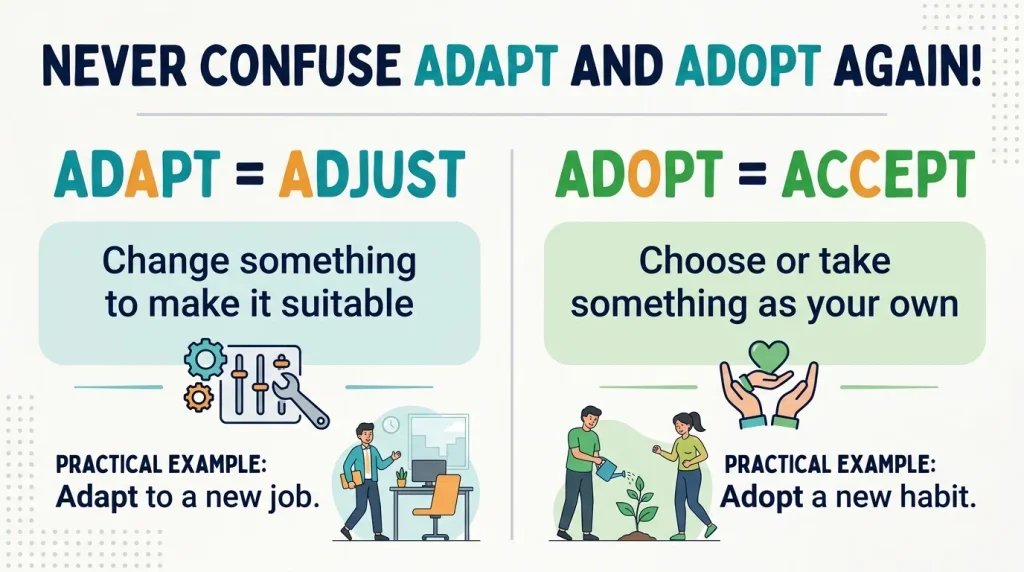
The Core Rule: Adapt = Adjust, Adopt = Accept

Remember these two simple rules:
ADAPT = CHANGE OR ADJUST TO FIT
ADOPT = CHOOSE, ACCEPT, OR TAKE AS YOUR OWN
| Word | Basic meaning | Example |
|---|---|---|
| Adapt | Change or adjust | Adapt to a new environment. |
| Adopt | Accept or start using | Adopt a new approach. |
An easy way to remember:
- If you are changing something to make it suitable, use adapt.
- If you are choosing or accepting something, use adopt.
How to Use Adapt Correctly
The verb adapt is used when someone or something changes to become suitable for new conditions, requirements, or purposes.
It has several common uses.
1. Adapt to a New Situation
Use adapt to when someone or something adjusts to a different environment, condition, or circumstance.
Examples:
- Children usually adapt to new school environments.
- It took me several weeks to adapt to my new job.
- Animals adapt to changes in their surroundings.
- She quickly adapted to living in another country.
Notice the preposition to. It commonly follows adapt when introducing the situation or conditions someone adjusts to.
2. Adapt Something for a Specific Purpose
Use adapt something for when you modify it to make it suitable for a particular purpose or audience.
Examples:
- The teacher adapted the lesson for younger students.
- We adapted the office space for remote working.
- The designer adapted the website for mobile users.
- The company adapted its products for international customers.
Here, something is changed to make it more suitable for a particular use.
3. Adapt Something to Meet Requirements
You can also use adapt something to when explaining the requirements or conditions that a modification is intended to meet.
Examples:
- The company adapted its services to meet customer needs.
- We adapted the equipment to suit the available space.
- The school adapted its curriculum to accommodate different learning abilities.
4. Adapt a Book, Story, or Film
In creative and entertainment contexts, adapt means to change an existing work into another form.
Examples:
- The director adapted the novel into a film.
- The television series was adapted from a popular book.
- The writer adapted the original story for the stage.
The original work is changed to make it suitable for a different format.
How to Use Adopt Correctly
The verb adopt means to accept, choose, or take something as your own. It can also refer to legally becoming the parent of a child who is not biologically yours.
Here are its most common uses.
1. Adopt a New Idea or Approach
Use adopt when you accept an idea, opinion, strategy, or approach and decide to follow it.
Examples:
- The company adopted a new marketing strategy.
- She adopted a different approach to solving the problem.
- The manager adopted my suggestion.
- The government adopted a new policy.
In these examples, the person or organisation chooses to accept something.
2. Adopt a Habit or Lifestyle
You can use adopt when you begin following a particular habit, routine, or way of living.
Examples:
- He adopted a healthier lifestyle.
- I have adopted a habit of reading every morning.
- Many people adopt environmentally friendly practices.
- She adopted a more positive attitude.
The focus is on choosing to take up a particular behaviour or practice.
3. Adopt a Child or Pet
One of the most familiar meanings of adopt relates to taking a child into your family through the legal adoption process.
It is also commonly used when taking an animal into your home and accepting responsibility for its care.
Examples:
- The couple decided to adopt a child.
- They adopted a little girl last year.
- We adopted a dog from an animal shelter.
- My neighbours want to adopt a kitten.
You cannot use adapt in these situations because the intended meaning is taking someone or an animal into your family.
4. Adopt a Law, Rule, or Policy
In official and professional contexts, adopt means formally accepting or approving something.
Examples:
- The council adopted a new regulation.
- The committee adopted the proposed resolution.
- The organisation adopted stricter safety guidelines.
- Parliament adopted the new legislation.
The organisation or authority accepts the rule or proposal for use.
Correct Examples of Adapt and Adopt in Sentences
The following examples show how both words work in different real-life situations.
Examples Using Adapt
- Conversation: It took me some time to adapt to the weather in Canada.
- Email: We may need to adapt the schedule to accommodate your availability.
- School: Teachers should adapt their teaching methods to students’ learning needs.
- Workplace: Our team quickly adapted to the new management system.
- Social media: Learning to adapt to change is an important life skill.
- Academic writing: The researchers adapted the original questionnaire for their study.
- Business: The company adapted its products to meet local market requirements.
- Travel: I found it difficult to adapt to the local food at first.
- Entertainment: The director adapted the historical novel into a television series.
- Personal development: She has learned to adapt to unexpected challenges.
Examples Using Adopt
- Conversation: My brother wants to adopt a puppy.
- Email: We have decided to adopt your suggested approach.
- School: The school adopted a new examination policy.
- Workplace: Our department adopted a flexible working schedule.
- Social media: I recently adopted a daily exercise routine.
- Academic writing: The researchers adopted an established theoretical framework.
- Business: The company adopted a new customer service strategy.
- Family: They decided to adopt a child after several years of consideration.
- Government: The government adopted new environmental regulations.
- Personal development: He adopted a more disciplined approach to his studies.
Incorrect vs. Correct: Adapt vs Adopt
These examples highlight common mistakes and explain why one word is more appropriate than the other.
| ❌ Incorrect | ✅ Correct | Why |
|---|---|---|
| I need to adopt to my new job. | I need to adapt to my new job. | You adjust to a new situation. |
| She adapted a new strategy. | She adopted a new strategy. | She chose and started using a strategy. |
| The company adopted its products for local customers. | The company adapted its products for local customers. | The products were modified to suit customers. |
| They adapted a child. | They adopted a child. | Adoption refers to legally taking a child into a family. |
| He adopted to the cold weather. | He adapted to the cold weather. | The person adjusted to the weather. |
| The committee adapted the proposal. | The committee adopted the proposal. | If the committee accepted the proposal, adopted is correct. |
| We adopted our lesson plans for younger students. | We adapted our lesson plans for younger students. | The lesson plans were modified for the students. |
| She adapted a healthier lifestyle. | She adopted a healthier lifestyle. | She chose to follow a healthier way of living. |
| The council adapted the new regulation. | The council adopted the new regulation. | The council formally approved the regulation. |
| The director adopted the novel into a film. | The director adapted the novel into a film. | The original work was changed into another format. |
| I want to adapt a dog from the shelter. | I want to adopt a dog from the shelter. | You take the dog into your care. |
| The business adopted its services to meet new demands. | The business adapted its services to meet new demands. | Its services were modified to meet requirements. |
Important: Not every sentence in the left column is automatically incorrect in every possible context. For example, a committee could adapt a proposal if it modified the proposal rather than simply accepting it. The intended meaning determines the correct verb.
Why Do People Confuse Adapt and Adopt?
There are several reasons these words are commonly mixed up.
1. Similar Spelling
Both words contain five letters and share four of them:
- Adapt
- Adopt
Only the middle vowel changes. Because their written forms are so similar, readers and writers may accidentally select the wrong word.
2. Similar Pronunciation
Both words have two syllables and stress the second syllable.
- Adapt: uh-DAPT
- Adopt: uh-DOPT
Their similar sounds make them easy to confuse, particularly when someone is speaking quickly or learning English.
3. Both Words Relate to Change
This is a particularly important source of confusion.
Both verbs can appear when someone responds to something new.
However, the actions are different:
- Adapt describes changing or adjusting to something.
- Adopt describes choosing or accepting something.
For example:
The company adopted a new system and adapted it to its business requirements.
Both words are correct because they describe two different actions.
4. Overgeneralisation
Some learners assume that because both words involve something new, they can be used interchangeably.
This is incorrect.
Learning a new habit is adopting it. Getting comfortable with a new environment is adapting to it.
5. Autocorrect and Spellcheck
Both adapt and adopt are correctly spelled English words. A spellchecker may not identify the mistake if you select the wrong word but spell it correctly.
For example, “I adopted to my new workplace” may not trigger a spelling warning because adopted is a real word.
You must check the meaning, not just the spelling.
6. Translation Interference
English learners sometimes translate these verbs from their first language. If one word in their native language can express both acceptance and adjustment, they may find it difficult to recognise the English distinction.
Learning the two meanings separately and practising them in context is a more reliable approach.
Common Mistakes Checklist
Check these mistakes before using adapt or adopt.
- Writing adopt to instead of adapt to: Use adapt to when describing adjustment to a situation. Remember that adopt normally takes a direct object, such as a policy or method.
- Using adapt for accepting a new idea: If you choose or accept an idea, use adopt. Use adapt only when you modify it.
- Confusing adopting a habit with adapting to a habit: You adopt a habit when you begin following it. You adapt to a situation when you adjust to it.
- Using adapt for taking a child or pet into a family: The correct verb is adopt.
- Using adopt for changing a book into a film: Use adapt because the original work is transformed into another format.
- Assuming both verbs are interchangeable: They describe different actions. Check whether you mean adjustment or acceptance.
- Trusting spellcheck alone: Both words are correctly spelled, so spellcheck may not recognise the wrong choice.
- Ignoring the object of the verb: Ask yourself what is happening to the object. Is it being changed or accepted?
Adapt vs Adopt in Real English
Understanding how these words work in natural English is just as important as memorising their definitions.
1. Grammatically Correct: Adapt
Adapt is grammatically correct when describing adjustment or modification. For example, “She adapted to her new workplace” means she became comfortable with the different conditions. Similarly, “The teacher adapted the lesson for beginners” means the lesson was changed to suit the learners. Both constructions are natural in everyday and professional English.
2. Grammatically Correct: Adopt
Adopt is correct when someone accepts, chooses, or starts using something. For example, “The company adopted a new policy” means the company accepted and put the policy into use. Likewise, “They adopted a puppy” means they took responsibility for the animal. These uses are natural in both casual conversations and formal writing.
3. Grammatically Incorrect for the Intended Meaning: Adopt To
The construction “adopt to a new environment” is generally incorrect when the intended meaning is to become accustomed to that environment. The natural expression is “adapt to a new environment.” However, adopt can be followed by a noun directly, as in “adopt a new lifestyle.” Remember that choosing a word with the right spelling does not guarantee that it expresses the intended meaning.
4. Natural Everyday English: Both Words Can Describe the Same Subject
A person, company, or organisation can both adapt and adopt, but the meaning changes. For example, “The company adopted a new strategy” means it chose the strategy. “The company adapted its strategy” means it modified the strategy. Both sentences are natural English. The difference is not formality; it is the action being described.
American vs. British English: Is There a Difference?
There is no meaningful spelling difference between American and British English for adapt and adopt.
Both varieties use the same spelling and basic meanings.
| Feature | American English | British English |
|---|---|---|
| Adapt | Correct | Correct |
| Adopt | Correct | Correct |
| Adapt to a situation | Correct | Correct |
| Adopt a policy | Correct | Correct |
| Adapted a novel into a film | Correct | Correct |
| Adopted a child | Correct | Correct |
Pronunciation can vary slightly by accent, particularly in the vowel sounds. However, this does not change the meaning or spelling of either word.
Formal vs. Informal Usage
Both adapt and adopt are suitable for formal and informal communication. Their meanings remain the same regardless of the setting.
Formal English
Use adapt when discussing adjustments to procedures, research, systems, or organisational requirements.
Example: The research team adapted the methodology to accommodate the revised study conditions.
Use adopt when discussing the formal acceptance of a policy, strategy, recommendation, or framework.
Example: The board adopted the proposed financial management policy.
Informal English
Use adapt in everyday conversations about getting used to something new.
Example: I’m still trying to adapt to my new routine.
Use adopt when talking about taking up a new habit, choosing an approach, or bringing a pet into your family.
Example: We decided to adopt a little puppy.
Neither word is restricted to formal or informal English.
Adapt vs Adopt: Comparison Table
| Feature | Adapt | Adopt |
|---|---|---|
| Part of speech | Verb | Verb |
| Main meaning | Change or adjust | Accept or take on |
| Main action | Modification | Selection or acceptance |
| Common expression | Adapt to change | Adopt a strategy |
| With a new environment | Adapt to it | Not normally appropriate |
| With a policy | Modify a policy | Accept a policy |
| With a habit | Adjust to a habit | Begin following a habit |
| With a child | Not appropriate | Adopt a child |
| With a pet | Not appropriate | Adopt a pet |
| With a book or novel | Adapt into a film | Not appropriate for this meaning |
| Common preposition | To, for, into | Usually takes a direct object |
| Related noun | Adaptation | Adoption |
Related Words: Adaptation and Adoption
Understanding the related nouns can make the distinction even easier.
Adaptation
Adaptation is the noun form of adapt. It refers to the process of adjusting or modifying something to make it suitable for a new situation or purpose.
Examples:
- The adaptation of the novel received positive reviews.
- Climate adaptation is important for vulnerable communities.
- The company made several adaptations to its existing software.
The noun adaptation can also describe a feature or characteristic that helps an organism survive in its environment.
Adoption
Adoption is the noun form of adopt. It refers to the act or process of accepting, choosing, or taking something as one’s own.
Examples:
- The adoption of new technology improved productivity.
- The couple completed the adoption process.
- The adoption of the new policy was approved by the board.
Remember:
- Adapt → Adaptation
- Adopt → Adoption
Real-Life Situations: Adapt or Adopt?
Here are five practical situations showing which word to use.
1. During a Job Interview
Interviewer: How do you handle changes in the workplace?
Candidate: I try to adapt quickly to new responsibilities and working conditions.
The candidate uses adapt because the question concerns adjusting to changing circumstances.
2. During a Business Meeting
Manager: Which marketing strategy should we follow?
Employee: I suggest we adopt the strategy that performed best during the previous campaign.
The employee uses adopt because the company is choosing a strategy.
3. In an Academic Assignment
Student: Why did you change the original research questionnaire?
Researcher: We adapted it to make the questions easier for participants to understand.
The questionnaire was modified, so adapted is correct.
4. In a Text Message
Friend: How is your new city?
You: It’s great! I’m still adapting to the weather and lifestyle.
The speaker is getting used to a new environment.
5. In a Family Conversation
Parent: Have you decided what to do about the puppy?
Child: Yes! We want to adopt it and give it a loving home.
The family is taking the animal into its care, so adopt is correct.
How to Remember Adapt vs Adopt
The easiest way to remember the difference is to connect each word with another familiar word.
Adapt = Adjust
Both words describe changing something to make it suitable.
Adopt = Accept
Both words are associated with choosing, accepting, or taking something on.
Remember these two examples:
- Adapt to a new environment.
- Adopt a new lifestyle.
You can also use this simple decision-making process:
- Are you changing or adjusting something? Choose adapt.
- Are you accepting or choosing something? Choose adopt.
- Are you taking a child or pet into your family? Choose adopt.
- Are you changing a book into a film? Choose adapt.
If you remember just one thing, remember this: Adapt means adjust; adopt means accept.
Practice Quiz: Adapt or Adopt?
Test your understanding with these questions.
- She quickly ______ to her new school.
- The company decided to ______ a new marketing strategy.
- They want to ______ a child.
- The teacher had to ______ the lesson for younger students.
- It took me a few weeks to ______ to the new routine.
- The committee will ______ the proposed guidelines.
- The director plans to ______ the novel into a film.
- He has ______ a healthier lifestyle.
- Businesses must ______ to changing market conditions.
- The government decided to ______ a new environmental policy.
Choose the correct answers:
-
- Adapt
-
- Adopt
-
- Adopt
-
- Adapt
-
- Adapt
-
- Adopt
-
- Adapt
-
- Adopted
-
- Adapt
-
- Adopt
Quick Summary
Adapt and adopt are similar-looking verbs with different meanings. Adapt means to change, adjust, or modify something to make it suitable for new conditions or purposes. For example, you adapt to a new workplace or adapt a lesson for beginners. Adopt means to accept, choose, or start using something as your own. For example, you adopt a new strategy, habit, policy, or pet. The easiest way to remember the difference is adapt = adjust and adopt = accept. Both words are used in American and British English and are appropriate in formal and informal communication. Always consider the intended action before choosing between them.
1. What is the main difference between adapt and adopt?
Adapt means to change or adjust something to suit a new situation. Adopt means to accept, choose, or start using something as your own. For example, you adapt to a new environment but adopt a new lifestyle.
2. Is it adapt to or adopt to?
Use adapt to when describing the process of adjusting to a situation.
Correct: She is learning to adapt to her new job.
Do not use adopt to when you mean becoming accustomed to something.
3. Can I use adapt and adopt in the same sentence?
Yes. Both words can appear together when describing different actions.
Example: The company adopted a new system and adapted it to meet customer requirements.
The company accepted the system and then modified it.
4. Is adopt the same as accept?
Their meanings overlap, but they are not always interchangeable. Adopt means to accept, choose, or take something on as your own. Accept generally means to receive or agree to something.
For example, you adopt a new policy but accept an invitation.
5. Can you adapt a person?
Yes. A person can adapt to new conditions, environments, or circumstances. For example, “Children often adapt quickly to new surroundings.” You can also say someone adapts their behaviour to suit a particular situation.
6. Do you adopt or adapt a new habit?
You adopt a new habit when you decide to start following it.
Example: She adopted a habit of exercising every morning.
You might also adapt to a new routine after changing your daily schedule.
7. Is it adopt a policy or adapt a policy?
Both are correct, but they have different meanings.
- Adopt a policy: Accept and put a policy into effect.
- Adapt a policy: Modify an existing policy to suit particular requirements.
8. Is it adapt or adopt a child?
The correct word is adopt. It means to legally take a child into your family and become their parent.
Example: The couple decided to adopt a child.
9. What is the difference between adaptation and adoption?
Adaptation is the process of changing or modifying something to suit new conditions. Adoption is the process of accepting, choosing, or taking something as your own.
Example: The adaptation of the novel was successful, while the adoption of the new policy improved workplace safety.
10. Is it adapt or adopt a new language?
It depends on the intended meaning.
- Adopt a language can mean choosing to use a particular language.
- Adapt to a new language means adjusting to using or hearing it in a new environment.
For example, an immigrant may adapt to living in a country where another language is spoken.
11. Are adapt and adopt used differently in American and British English?
No significant difference exists in their standard spelling or core meanings. Both American and British English use adapt for adjustment and adopt for acceptance or taking something as one’s own.
12. What is the easiest trick to remember adapt and adopt?
Remember two simple associations:
- Adapt = Adjust.
- Adopt = Accept.
If you are changing something to make it suitable, use adapt. If you are choosing or accepting something, use adopt.


