Have you ever wondered whether to say “on Tuesday morning” or “in the Tuesday morning”? Choosing the right preposition can be confusing, especially when talking about a particular day and time.
The good news is that the rule is straightforward: “on Tuesday morning” is the standard expression when referring to a specific Tuesday morning. By contrast, “in the Tuesday morning” is not normally correct when used as a standalone time expression.
However, there are a few related expressions worth understanding. This guide explains the difference, provides practical examples, and shows you how to use in, on, and at correctly.
Read also: Did You Had vs Did You Have: Which One Is Correct?
On Tuesday Morning or In the Tuesday Morning?
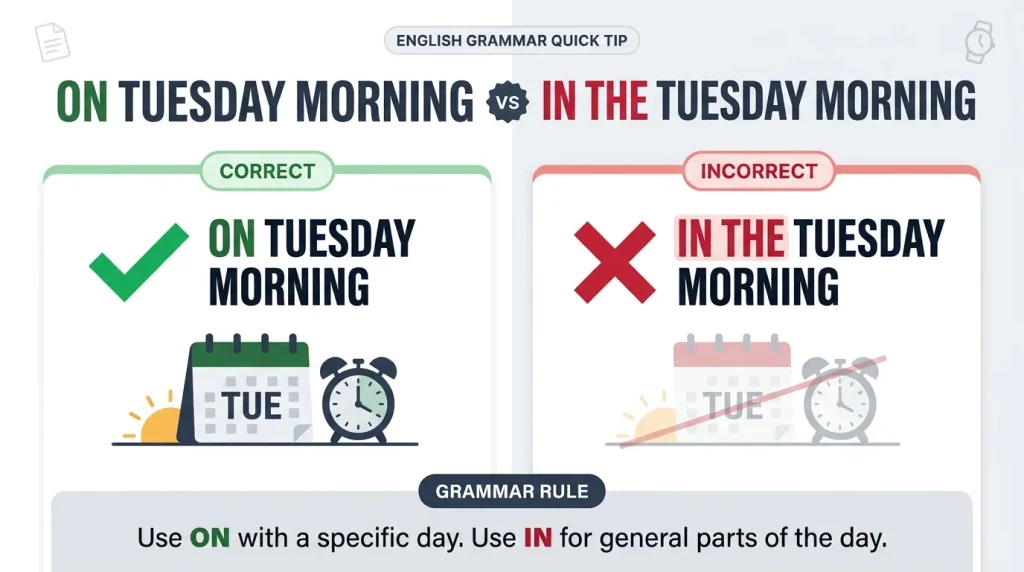
Use “on Tuesday morning” when referring to a particular Tuesday morning.
- Correct: I have a meeting on Tuesday morning.
- Incorrect: I have a meeting in the Tuesday morning.
Why? We generally use on with specific days and dates. Meanwhile, in is used with broader periods, such as months, years, and parts of the day.
For example:
- In the morning: I usually exercise in the morning.
- On Tuesday morning: I have a doctor’s appointment on Tuesday morning.
- At 9 a.m.: The appointment starts at 9 a.m.
There is also a related expression: “on the Tuesday morning after the storm.” In this sentence, the is correct because it identifies a particular Tuesday morning.
What Is the Difference Between On Tuesday Morning and In the Tuesday Morning?
The main difference is the preposition used to describe a specific day.
On Tuesday morning is the natural and standard choice because on is used with days and specific dates. For instance, you can say, “We are leaving on Tuesday morning.”
On the other hand, in the Tuesday morning does not normally work as a standalone time expression. English speakers generally say “in the morning” or “on Tuesday morning,” depending on the meaning.
Consider these examples:
| Expression | Correct? | Explanation |
|---|---|---|
| On Tuesday morning | Yes | Refers to a specific day and part of the day |
| In the Tuesday morning | No, not for this meaning | Not a standard standalone time expression |
| In the morning | Yes | Refers to mornings generally |
| On the Tuesday morning after the storm | Yes | Identifies a particular Tuesday morning |
| In the Tuesday morning meeting | Yes | Here, in relates to the meeting, not the time expression |
Therefore, remember this simple distinction: use on for a particular Tuesday morning and in for mornings in general.
Also checkout: Froze vs Frozen: Meaning, Difference, and Correct Usage
When to Use On Tuesday Morning
Use on Tuesday morning when you are talking about something happening on a particular Tuesday.
The preposition on commonly appears with days of the week, specific dates, and day-plus-part-of-day expressions.
1. Talking About a Specific Tuesday
When an event is scheduled for Tuesday morning, use on.
Examples:
- I will visit my grandmother on Tuesday morning.
- The manager has arranged an interview on Tuesday morning.
- We are travelling to Lahore on Tuesday morning.
- She has an important exam on Tuesday morning.
In each example, the speaker identifies a particular Tuesday rather than mornings in general.
2. Making Plans and Appointments
Similarly, use on when arranging appointments, meetings, or other activities.
Examples:
- Can we meet on Tuesday morning?
- The doctor is available on Tuesday morning.
- Our training session begins on Tuesday morning.
- They plan to announce the results on Tuesday morning.
As a result, on Tuesday morning is especially common in everyday conversations and professional communication.
3. Referring to a Past Tuesday
The same rule applies when describing something that happened in the past.
Examples:
- I received your message on Tuesday morning.
- We arrived at the airport on Tuesday morning.
- The weather changed suddenly on Tuesday morning.
- He called me on Tuesday morning.
Notice that the tense does not change the preposition. Whether the event is in the past or future, on Tuesday morning remains correct.
See also: Family and Friends vs Friends and Family: Which Is Correct?
When to Use In the Morning
Use in the morning when referring to mornings generally or to an unspecified morning.
Unlike on Tuesday morning, this expression does not identify a particular day.
Examples:
- I feel more productive in the morning.
- She drinks coffee in the morning.
- Birds usually sing in the morning.
- We go for a walk in the morning.
Furthermore, in the morning can refer to a morning that is understood from the context.
For example:
- I will call you in the morning.
- The package should arrive in the morning.
These sentences do not specify which day. However, the listener may already know the relevant date from the conversation.
Can You Say In the Morning on Tuesday?
Yes. “In the morning on Tuesday” is grammatically correct.
For example:
- I will visit the office in the morning on Tuesday.
Nevertheless, “on Tuesday morning” is usually shorter and more natural.
Compare the two:
- Natural and concise: I will visit the office on Tuesday morning.
- Correct but less concise: I will visit the office in the morning on Tuesday.
Therefore, when you want to express the day and time together, on Tuesday morning is generally the better choice.
Why Is In the Tuesday Morning Usually Incorrect?
The confusion happens because English uses in with the expression “in the morning.” However, adding a specific weekday changes the construction.
For example:
- General time: I work in the morning.
- Specific day: I work on Tuesday morning.
The phrase in the morning is already a complete time expression. When you add a weekday to identify a particular morning, English normally uses on.
However, the word in is not always wrong near the words Tuesday morning. Consider this sentence:
“I attended the workshop in the Tuesday morning session.”
This sentence is correct because in refers to the session, not directly to Tuesday morning as a time expression.
Likewise, this sentence is correct:
“We met on the Tuesday morning after the conference.”
Here, the identifies a particular Tuesday morning. Thus, the problem is not the word the itself; it is the use of in the Tuesday morning as a standalone time phrase.
Common Mistakes: Incorrect vs. Correct Examples
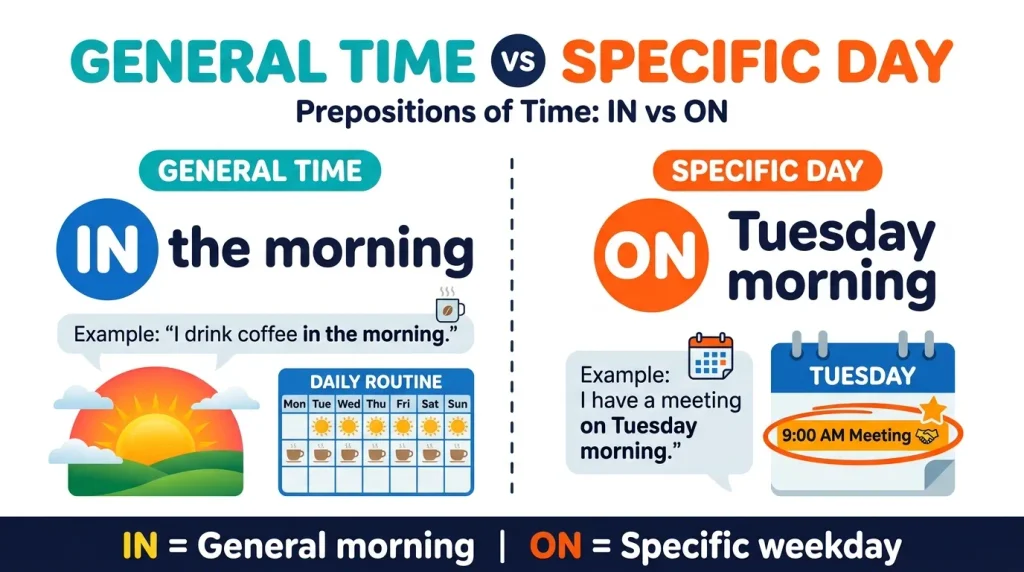
The following examples show how to choose the right preposition in everyday English.
| Incorrect or less natural | Correct or more natural |
|---|---|
| I will see you in the Tuesday morning. | I will see you on Tuesday morning. |
| She has an interview in Tuesday morning. | She has an interview on Tuesday morning. |
| We are leaving in the Tuesday morning. | We are leaving on Tuesday morning. |
| The meeting is in Tuesday morning. | The meeting is on Tuesday morning. |
| He called me in Tuesday morning. | He called me on Tuesday morning. |
| I have an exam in the Monday morning. | I have an exam on Monday morning. |
| They arrived in Wednesday morning. | They arrived on Wednesday morning. |
| We will travel in Friday morning. | We will travel on Friday morning. |
| I usually exercise on the morning. | I usually exercise in the morning. |
| She drinks tea on the morning. | She drinks tea in the morning. |
| I will call you on the morning. | I will call you in the morning. |
| We met in the Tuesday morning after the storm. | We met on the Tuesday morning after the storm. |
Remember that the final example includes the correctly. The phrase refers to a specific Tuesday morning after a particular event.
Why Do English Learners Make This Mistake?
There are several reasons why learners confuse in and on when talking about time.
1. Memorising In the Morning
Many learners know the expression in the morning. Consequently, they use the same preposition when adding a weekday.
However, English uses a different construction for a specific day: on Tuesday morning.
2. Translating Directly From Another Language
Some languages use one preposition for several time expressions. As a result, learners may translate their native-language structure directly into English.
Unfortunately, English prepositions do not always follow predictable translation patterns. It is better to learn common expressions as complete phrases.
3. Confusing General and Specific Time Expressions
Another common problem is failing to distinguish between a general morning and a particular morning.
For clarity, compare these examples:
- General: I enjoy reading in the morning.
- Specific: I have a class on Tuesday morning.
Once you understand this distinction, choosing the correct preposition becomes much easier.
In, On, and At: The Difference Between These Prepositions
Although this article focuses on Tuesday morning, understanding in, on, and at will help you avoid other common mistakes.
| Preposition | Main use | Examples |
|---|---|---|
| In | Months, years, seasons, and general parts of the day | in July, in 2026, in winter, in the morning |
| On | Days, dates, and specific day-plus-part-of-day expressions | on Tuesday, on 15 June, on Tuesday morning |
| At | Exact times and certain fixed expressions | at 9 a.m., at noon, at midnight, at night |
Use In for Longer or General Periods
Use in with months, years, seasons, and general parts of the day.
Examples:
- My birthday is in November.
- They moved here in 2022.
- Flowers bloom in spring.
- I usually read in the evening.
Use On for Days and Dates
Use on when referring to a particular day or date.
Examples:
- We have a meeting on Monday.
- Her birthday is on 12 August.
- The shop is closed on Sunday.
- I will see you on Tuesday morning.
Use At for Exact Times
Use at when specifying an exact time or using certain established time expressions.
Examples:
- The train leaves at 8 a.m.
- The meeting starts at noon.
- I woke up at midnight.
- We usually have dinner at night.
Therefore, a useful way to remember the difference is:
- In the morning
- On Tuesday morning
- At 9 a.m.
Is Tuesday Morning Correct Without On?
Yes. In many situations, you can say “Tuesday morning” without using on.
For example:
- I will call you Tuesday morning.
- We are leaving Tuesday morning.
- The meeting is scheduled for Tuesday morning.
This construction is especially common in American English. However, it is also understood and used elsewhere.
Both of the following sentences are correct:
- I will see you on Tuesday morning.
- I will see you Tuesday morning.
The version with on is a standard choice, while the version without it is a natural alternative in many contexts.
Are There Any Differences Between American and British English?
The basic rule is the same in American and British English: “on Tuesday morning” is correct.
However, there can be a difference in everyday usage. American English commonly omits on before days in expressions such as Tuesday morning.
For example:
- American English: I’ll call you Tuesday morning.
- British English: I’ll call you on Tuesday morning.
This is a general tendency, not a strict rule. Both versions can be understood across English-speaking regions, and the use of on is not incorrect in American English.
Most importantly, neither variety normally uses in the Tuesday morning as a standalone expression for a specific Tuesday.
Formal vs. Informal Usage
The expression “on Tuesday morning” works in both formal and informal English.
In professional communication, it is a clear and reliable choice.
Formal examples:
- The interview has been scheduled for Tuesday morning.
- The committee will meet on Tuesday morning.
- Please submit the documents by Tuesday morning.
Informal examples:
- I’ll see you on Tuesday morning.
- Let’s grab coffee on Tuesday morning.
- Are you free on Tuesday morning?
In casual conversation, speakers may also leave out on, as in “See you Tuesday morning.” Nevertheless, the full expression remains appropriate in formal writing.
Special Cases and Exceptions to Remember
Although the main rule is simple, a few related expressions can cause confusion.
1. On the Tuesday Morning After the Storm
This expression is correct because the identifies a particular morning.
Example:
- The roads were still wet on the Tuesday morning after the storm.
2. In the Tuesday Morning Meeting
This construction is also correct, but the meaning is different.
Example:
- We discussed the budget in the Tuesday morning meeting.
Here, in is used with meeting. It does not introduce Tuesday morning as a time expression.
3. Tuesday Morning Without On
This is a natural alternative, particularly in American English.
Example:
- I’ll send you the report Tuesday morning.
4. In the Morning on Tuesday
This is grammatically correct, although it is usually less concise.
Example:
- We will leave in the morning on Tuesday.
For a smoother sentence, you can simply say, “We will leave on Tuesday morning.”
Real-Life Situations: Which Expression Should You Use?
Here are a few practical situations to help you choose the right expression.
| Situation | Natural sentence |
|---|---|
| Scheduling an appointment | I have a doctor’s appointment on Tuesday morning. |
| Talking about a daily habit | I exercise in the morning. |
| Arranging a business meeting | The manager will meet us on Tuesday morning. |
| Giving an exact time | The meeting starts at 10 a.m. |
| Describing a past event | I received the email on Tuesday morning. |
| Referring to an unspecified morning | I will finish the work in the morning. |
| Making casual plans | Let’s meet Tuesday morning. |
| Referring to a particular event | We met on the Tuesday morning after the conference. |
As these examples show, the correct choice depends on whether you mean a general morning, a specific day, or an exact time.
Checklist: How to Choose the Correct Preposition
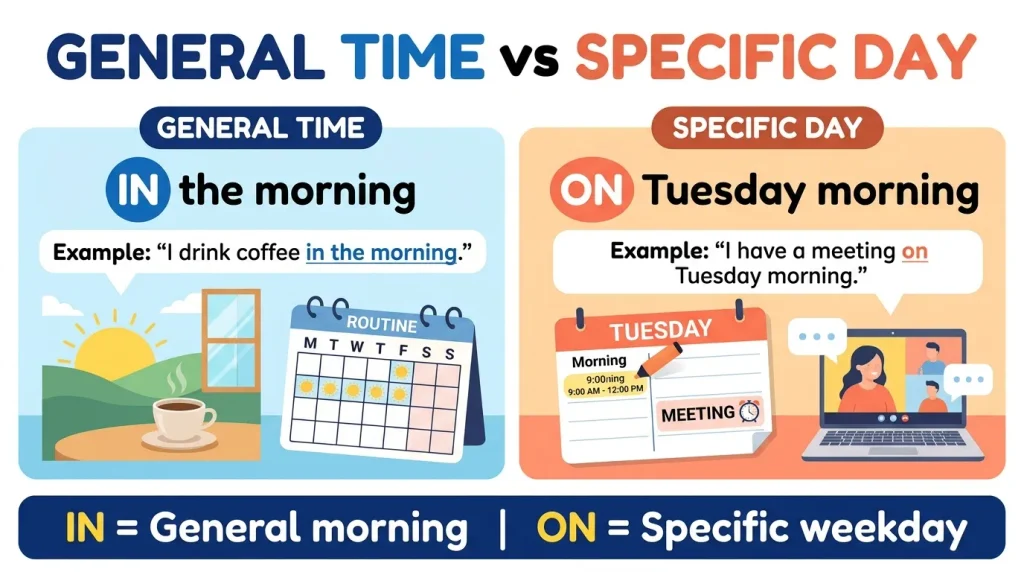
Before using a time expression, ask yourself what you want to describe.
- Are you talking about mornings in general? Use in the morning.
- Are you referring to a particular Tuesday? Use on Tuesday morning.
- Are you mentioning a specific date? Use on.
- Are you giving an exact time? Use at.
- Are you referring to a particular Tuesday morning after an event? Use on the Tuesday morning after….
With these simple distinctions, you can avoid most common mistakes involving time prepositions.
Frequently Asked Questions
1. Is it on Tuesday morning or in the Tuesday morning?
“On Tuesday morning” is the correct standard expression when referring to a specific Tuesday morning. The phrase in the Tuesday morning is not normally used as a standalone time expression.
2. Why do we say on Tuesday morning?
We use on because English generally uses this preposition with days and specific dates. Therefore, on Tuesday morning is the natural way to identify an event happening on a particular Tuesday.
3. Is in the morning correct?
Yes. “In the morning” is correct when referring to mornings generally or to an unspecified morning.
For example: “I like to read in the morning.”
4. Can I say in the morning on Tuesday?
Yes. The expression is grammatically correct. However, on Tuesday morning is usually shorter and more natural.
5. Is Tuesday morning correct without on?
Yes. You can say Tuesday morning without on, particularly in American English.
For example: “I’ll call you Tuesday morning.”
6. Is on Tuesday morning formal or informal?
It is suitable for both formal and informal situations. You can use it in emails, business meetings, everyday conversations, and academic writing.
7. Can I say on the Tuesday morning?
Yes, when the context identifies a particular Tuesday morning.
For example: “On the Tuesday morning after the wedding, we travelled home.”
8. Is in the Tuesday morning meeting correct?
Yes. In this sentence, in refers to the meeting. It is not being used to introduce Tuesday morning as a time expression.
9. Do British and American English use different prepositions?
No. The basic rule is the same in both varieties. However, American English commonly omits on in expressions such as Tuesday morning.
10. What is the difference between in, on, and at?
Use in for broader periods and general parts of the day, on for days and dates, and at for exact times.
For example: in the morning, on Tuesday morning, at 9 a.m.
Practice Quiz: Test Your Understanding
Choose the correct preposition in each sentence.
1. I have an important meeting ___ Tuesday morning.
- A. In
- B. On
- C. At
2. She usually drinks coffee ___ the morning.
- A. In
- B. On
- C. At
3. The train leaves ___ 8 a.m.
- A. In
- B. On
- C. At
4. We visited our relatives ___ Monday morning.
- A. In
- B. On
- C. At
5. I will call you ___ the morning.
- A. In
- B. On
- C. At
6. The roads were flooded ___ the Tuesday morning after the storm.
- A. In
- B. On
- C. At
7. The workshop begins ___ noon.
- A. In
- B. On
- C. At
8. They moved to Canada ___ 2024.
- A. In
- B. On
- C. At
Quiz Answers and Explanations
- B. On — Use on with a specific weekday and part of the day.
- A. In — Use in the morning for a general time expression.
- C. At — Use at with exact times.
- B. On — Monday morning identifies a particular day.
- A. In — The sentence refers to an unspecified morning.
- B. On — The phrase identifies a particular Tuesday morning after the storm.
- C. At — At noon is the standard expression.
- A. In — Use in with years.
Summary: On Tuesday Morning vs. In the Tuesday Morning
The correct standard expression is “on Tuesday morning,” not “in the Tuesday morning,” when referring to a specific Tuesday.
Here are the main rules to remember:
- Use on Tuesday morning for a particular Tuesday.
- Use in the morning for mornings generally or an unspecified morning.
- Use at 9 a.m. for an exact time.
- You can say Tuesday morning without on in natural English.
- Use on the Tuesday morning after the storm when identifying a particular morning.
- In the Tuesday morning meeting is also correct because in refers to the meeting.
Ultimately, the easiest way to remember the rule is: in the morning, on Tuesday morning, and at 9 a.m.