


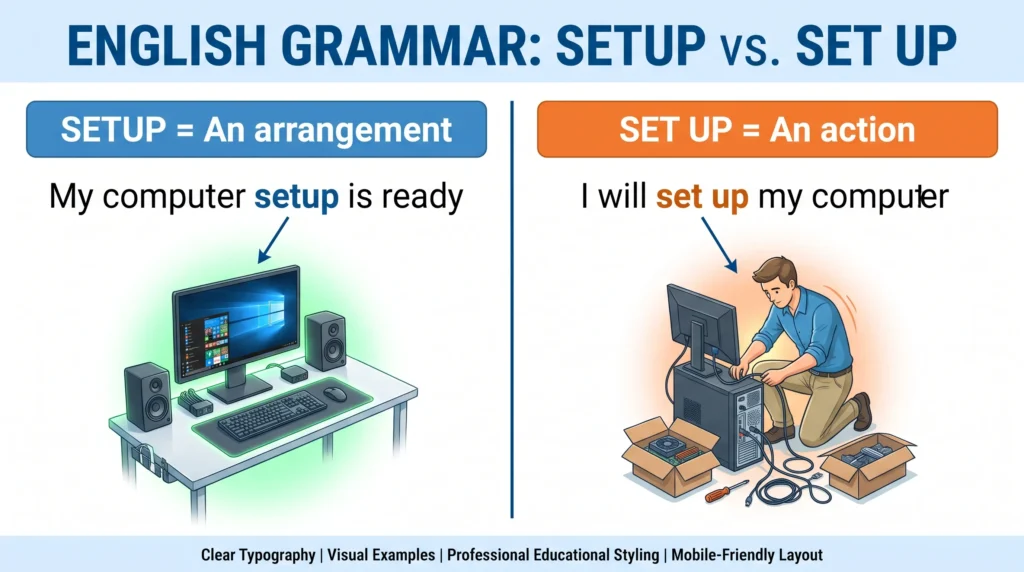
The difference between setup and set up is their grammatical function. Setup is a noun or adjective that describes an arrangement, system, or preparation. Set up is a verb phrase that means to arrange, prepare, install, or establish something.
For example:
- Correct: My computer setup is simple.
- Correct: I need to set up my computer.
The easiest way to remember the difference is that setup names an arrangement, while set up describes the action of creating one.
What Is the Difference Between Setup and Set Up?
Although setup and set up look almost identical, they perform different grammatical jobs.
Setup is a one-word noun or adjective. It refers to an arrangement, configuration, or the way something is organized. It can also describe something related to preparing or configuring a system.
Set up is a two-word verb phrase. It describes an action, such as preparing equipment, arranging a meeting, creating an account, or establishing a business.
Consider this example:
- I will set up a new workspace.
- My new workspace setup is comfortable.
In the first sentence, someone is performing an action. In the second, the word describes the resulting arrangement.
The distinction is not about pronunciation or meaning alone. It is about how the word functions in a sentence.
Read also: Will vs Would: What’s the Difference?
Why Does the Difference Between Setup and Set Up Matter?
Using the wrong form can make otherwise professional writing look careless. This is particularly noticeable in emails, business documents, technical instructions, academic assignments, and website content.
Imagine receiving these two instructions:
- Please setup your account before Monday.
- Please set up your account before Monday.
The second sentence is correct because the writer is asking someone to perform an action.
Now consider:
– Your account setup is complete.
Here, setup is correct because it names the configuration process or arrangement.
Understanding this distinction helps you:
- Write clearer workplace emails and instructions.
- Avoid common spelling and grammar mistakes.
- Produce more professional technical documentation.
- Recognize the difference between actions and things.
- Edit sentences without relying entirely on spellcheck.
ALSO CHECKOUT: Adapt vs Adopt: What’s the Difference?
The Core Rule: Setup vs Set Up
SETUP
One word = Noun or adjective
Use it when naming an arrangement, configuration, or preparation.
Example: The office setup is excellent.
SET UP
Two words = Verb phrase
Use it when describing the action of arranging, preparing, installing, or establishing something.
Example: We need to set up the office.
Memory trick: If you can replace the word with arrangement or configuration, use setup. If you can replace it with arrange, prepare, or configure, use set up.
How to Use Setup and Set Up Correctly
The best way to choose between these forms is to identify what the sentence is doing. Is it naming an arrangement, or describing an action?
1. Use Setup as a Noun
A noun is a word that names a person, place, thing, or idea. In this case, setup names an arrangement, configuration, system, or situation.
It can refer to computers, workplaces, meetings, businesses, equipment, and many other things.
Examples:
- The new office setup gives everyone more working space.
- My gaming setup includes two monitors.
- The entire setup took less than an hour.
- We need a better security setup for the building.
- Her home studio setup is impressive.
A useful test is to place a, the, this, or my before the word. If the sentence makes sense, setup may be functioning as a noun.
For example:
- The setup is ready.
- My setup needs improvement.
- We tested three different setups.
Notice that the plural form is setups, not set ups.
2. Use Setup as an Adjective
An adjective describes a noun. Setup can describe something related to the process of preparing, configuring, or arranging a system.
It commonly appears before another noun.
Examples:
- Please read the setup instructions before installing the software.
- The setup process is straightforward.
- We need a new setup guide for employees.
- The technician checked the setup requirements.
- There is no additional setup fee.
In these examples, setup describes the type or purpose of the instructions, process, guide, requirements, or fee.
You can remember this by asking: Does the word describe another noun? If so, setup is usually the appropriate form.
3. Use Set Up as a Verb
A verb expresses an action or state. Set up is a phrasal verb, meaning that two words work together to create a particular meaning.
It can mean:
- To prepare something for use.
- To arrange something in a particular way.
- To establish a business or organization.
- To create an account or system.
- To organize a meeting or event.
- To install or configure equipment.
Examples:
- I need to set up my new laptop.
- Can you set up a meeting with the manager?
- They plan to set up a new business.
- We must set up the equipment before the presentation.
- She wants to set up an online account.
If the sentence describes something someone needs to do, set up is generally the correct choice.
4. Understand the Different Verb Forms
The verb set is irregular. Its base form, past tense, and past participle are all spelled set.
However, the second word changes when the verb is used in different grammatical forms.
| Verb form | Example |
|---|---|
| Present | I set up my account. |
| Third-person present | She sets up meetings. |
| Past | They set up the equipment yesterday. |
| Present continuous | We are setting up the office. |
| Present perfect | He has set up his business. |
| Past perfect | They had set up the system before we arrived. |
| Future | I will set up the new computer. |
| Infinitive | We need to set up a meeting. |
Remember that setting up is correct when the verb takes the -ing form. You do not write setupping.
5. Know Where to Place Pronouns
There is another useful detail about set up that many English learners overlook.
When a pronoun such as it, them, him, or her acts as the object of this phrasal verb, it normally goes between set and up.
Correct:
- Please set it up before the meeting.
- I will set them up tomorrow.
- Can you set it up for me?
Incorrect:
- Please set up it before the meeting.
- I will set up them tomorrow.
However, when the object is a noun, both positions are possible:
- Please set up the equipment.
- Please set the equipment up.
This is called a separable phrasal verb. It means the object can appear between the two parts or after them, depending on the type of object. EFLsongs – English Finder+1
Correct Examples of Setup vs Set Up
The following examples show how both forms work in everyday situations.
Examples Using Setup
- Conversation: Your home office setup looks much better now.
- Email: Please review the account setup before approving the request.
- School: Our classroom setup encourages group discussions.
- Workplace: The new office setup provides more privacy for employees.
- Social media: I finally upgraded my gaming setup.
- Academic writing: The experimental setup remained unchanged throughout the study.
- Technology: The phone setup was easier than I expected.
- Business: The company’s current business setup allows remote working.
- Events: The wedding setup looked beautiful in the evening.
- Photography: This camera setup produces sharper images.
Examples Using Set Up
- Conversation: Can you set up the television for me?
- Email: I will set up a meeting with the marketing team.
- School: The teacher asked us to set up our science equipment.
- Workplace: We need to set up a new employee account.
- Social media: I want to set up a separate account for my business.
- Academic writing: Researchers set up an experiment to examine the hypothesis.
- Technology: She helped me set up my new smartphone.
- Business: They plan to set up a branch in another city.
- Events: Volunteers will set up the chairs before the guests arrive.
- Photography: We need to set up the lighting before the photo shoot.
Incorrect vs Correct: Setup or Set Up?
These examples highlight common mistakes and explain why one form works better than the other.
| ❌ Incorrect | ✅ Correct | Why |
|---|---|---|
| I need to setup my computer. | I need to set up my computer. | The sentence describes an action, so use the verb phrase. |
| The set up is complete. | The setup is complete. | The word names an arrangement or completed configuration. |
| Please setup your account. | Please set up your account. | The reader is being asked to perform an action. |
| My office set up is comfortable. | My office setup is comfortable. | The sentence describes an arrangement. |
| We will setup a meeting. | We will set up a meeting. | Organizing a meeting is an action. |
| The computer set up was easy. | The computer setup was easy. | Here, the word functions as a noun. |
| She has a professional set up. | She has a professional setup. | The word identifies the arrangement she has. |
| They are setup the equipment. | They are setting up the equipment. | The continuous tense requires setting up. |
| Can you set up it? | Can you set it up? | A pronoun object normally goes between the two parts of this phrasal verb. |
| The setup instructions are confusing, so I cannot setup the device. | The setup instructions are confusing, so I cannot set up the device. | The first form modifies instructions; the second describes an action. |
| We tested three set ups. | We tested three setups. | The plural noun is written as one word. |
| He is responsible for set up the system. | He is responsible for setting up the system. | The preposition for is followed by a gerund (an -ing verb form) here. |
Why People Make This Mistake
The confusion between setup and set up is understandable. Both forms contain the same letters, have closely related meanings, and sound almost identical in ordinary speech.
Several factors contribute to the mistake.
1. Similar Pronunciation
Both forms are generally pronounced the same way in ordinary English. When speaking, you cannot hear whether someone intends to write one word or two.
For example, these sentences sound nearly identical:
- I will set up the computer.
- The computer setup is ready.
The difference becomes clear only when you examine the grammatical role of the words.
2. Similar Spelling
The only visible difference is the space between set and up. Because the words are identical in spelling otherwise, writers sometimes overlook the distinction.
This is especially common when typing quickly or writing informal messages.
3. Overgeneralization
Some learners assume that because setup and set up have similar meanings, they can be used interchangeably.
However, English spelling often depends on grammatical function.
Compare these related pairs:
- Backup / back up
- Makeup / make up
- Follow-up / follow up
- Login / log in
- Startup / start up
The spelling patterns are not identical in every case, so each expression should be checked individually.
4. Spellcheck and Autocorrect Limitations
Spellcheck tools can identify many spelling errors, but they do not always recognize grammatical mistakes.
For example, I need to setup my account contains a recognizable English word. A basic spelling checker may not flag it because the problem is the word’s grammatical function, not its spelling.
Always check whether the selected form fits the sentence.
5. Translation Interference
Some languages do not use spaces in the same way English does when distinguishing compound nouns from verb phrases.
As a result, learners may translate the meaning correctly but choose the wrong English spelling.
The best solution is to learn the grammatical function of each form rather than translating both expressions as one equivalent word.
Common Setup vs Set Up Mistakes Checklist
Use this checklist when editing your writing.
- Writing setup after a modal verb: After can, should, must, or will, use set up. Example: You should set up your account.
- Using set up as a noun: When naming an arrangement, use setup. Example: The setup is ready.
- Writing set ups as a plural noun: The correct plural is setups. Example: We compared two setups.
- Using setup before an action verb: Do not write I am setup the computer. Use I am setting up the computer.
- Placing a pronoun after up: Write set it up, not set up it.
- Confusing a setup guide with the act of setting up: A setup guide is a document; setting up is an action.
- Assuming every similar compound follows the same spelling rule: Check individual expressions instead of applying one spelling pattern to every phrasal verb.
Setup vs Set Up in Real English
Understanding the grammar rule is important, but it is equally useful to recognize how these expressions appear in natural everyday English.
1. Grammatically Correct: My Computer Setup Is Ready
This sentence is grammatically correct because setup functions as a noun. It identifies the arrangement or configuration of the computer and its related equipment. The possessive adjective my introduces the noun phrase naturally. You could also say, “My computer setup needs improvement.” Both sentences use the one-word form to describe an existing arrangement rather than an action.
2. Grammatically Correct: I Need to Set Up My Computer
This sentence is grammatically correct because set up functions as a verb phrase. The infinitive marker to is followed by the base form of the verb, set. The word up completes the phrasal verb. It naturally describes the action of preparing a computer for use, whether that involves connecting equipment, installing software, or configuring settings.
3. Grammatically Possible but Context-Dependent: The Set-Up Is Complete
The hyphenated form set-up is accepted as a noun in some English dictionaries and publishing conventions. Therefore, this sentence is not automatically incorrect. However, many modern American English style guides prefer setup as one word. If you are writing for a general audience and have no house style to follow, The setup is complete is a straightforward choice.
4. Natural Everyday English: Can You Set It Up?
This is a natural way to ask someone to prepare or configure something. English speakers commonly place the pronoun it between set and up. You might use this expression when asking someone to prepare a television, install a device, arrange a meeting, or configure an account. The alternative Can you set up it? is not the standard construction.
5. Natural Everyday English: The Setup Looks Great
This sentence is natural when commenting on an arrangement, such as a home office, gaming station, photography studio, or event space. The word setup names the entire arrangement rather than the individual objects. It is also common in informal conversation to use setup when discussing how equipment, furniture, or technology has been organized.
American vs British English: Is There a Difference?
The basic distinction between setup and set up is the same in American and British English.
Both varieties use:
- Setup as a noun: The office setup is convenient.
- Setup as an adjective: Read the setup instructions.
- Set up as a verb: We need to set up the office.
There is, however, a variation worth knowing: set-up is also used as a hyphenated noun or adjective in some British English writing and dictionaries.
For example:
- The set-up of the new office took several days.
- We are still in the set-up phase.
The unhyphenated setup is also used in British English. Therefore, it would be misleading to say that setup is exclusively American or that British writers must always use set-up.
For consistent writing, choose one accepted form according to your preferred dictionary or publication style. definition in the Cambridge English Dictionary+2
Formal vs Informal Usage
There is no special formality distinction between setup and set up. Both are appropriate in professional, academic, and everyday English.
The choice depends on grammar, not tone.
| Situation | Correct usage | Example |
|---|---|---|
| Formal email | Set up | We will set up a meeting next week. |
| Business report | Setup | The current setup requires improvement. |
| Academic paper | Setup | The experimental setup remained unchanged. |
| Technical instructions | Set up | Set up the device before installation. |
| Casual conversation | Setup | I like your gaming setup. |
| Workplace instructions | Set up | Please set up the conference room. |
You do not need to avoid either expression in formal writing. Simply use the form that matches its grammatical function.
Setup vs Set Up: Comparison Table
| Feature | Setup | Set up |
|---|---|---|
| Number of words | One | Two |
| Part of speech | Noun or adjective | Verb phrase |
| Main meaning | Arrangement or configuration | Arrange, prepare, or establish |
| Describes an action? | No, not by itself | Yes |
| Describes a thing? | Yes | No, not in this construction |
| Can be plural? | Yes: setups | No plural noun form |
| Used after modal verbs? | Not as the verb | Yes |
| Example | The setup is complete. | Set up the equipment. |
| Example with technology | My phone setup is simple. | I need to set up my phone. |
| Example with business | The business setup is efficient. | They will set up a business. |
The simplest distinction: Setup is the arrangement or configuration; set up is the action of creating that arrangement.
Real-Life Situations: When to Use Setup or Set Up
Sometimes it is easier to understand a grammar rule through realistic situations rather than isolated sentences.
1. During a Job Interview
Interviewer: How comfortable are you with setting up office equipment?
Candidate: I can set up computers, printers, and other office devices.
The candidate uses set up because the sentence describes an ability to perform an action.
2. In a Workplace Meeting
Manager: Is the conference room ready?
Employee: Yes, the setup is complete.
Here, setup refers to the completed arrangement of the room.
3. In a Professional Email
Subject: New Employee Account
Please set up the new employee’s account before their first working day. The account setup should include email access and the required software.
The first use describes an action. The second names the configuration process.
4. In a Text Message
Friend 1: Can you help me with my new television?
Friend 2: Sure. I’ll come over and help you set it up.
The pronoun it appears between set and up, which is the standard construction.
5. In an Academic Assignment
The researchers set up the experimental equipment before collecting the data. The experimental setup remained consistent throughout the study.
Both forms are correct because the first describes an action and the second identifies the arrangement of the equipment.
6. When Starting a Business
Person A: What do I need to start an online store?
Person B: First, you need to set up your business account. Then you can improve your website setup.
The first expression describes an action, while the second refers to an existing configuration.
Quick Test: Setup or Set Up?

Test your understanding with these 10 questions. Choose the correct form for each sentence.
Grammar practice
0/10 answered
1. I need to _____ my new laptop.setupset up
2. The office _____ looks modern.setupset up
3. Please _____ a meeting with the director.setupset up
4. The computer _____ instructions are missing.setupset up
5. We tested three different _____ .setupsset ups
6. Can you set _____ before noon?up itit up
7. They are _____ the equipment now.setupsetting up
8. The experimental _____ was carefully designed.setupset up
9. She wants to _____ her own company.setupset up
10. The new account _____ took five minutes.setupset up
Check my answers
Frequently Asked Questions
1. Is setup one word or two words?
Setup is one word when used as a noun or adjective. Set up is two words when used as a verb. For example, “The setup is ready” uses the noun, while “I will set up the equipment” describes an action.
2. Is setup a real word?
Yes. Setup is a standard English word used as both a noun and an adjective. It can describe an arrangement, configuration, system, or preparation. It is commonly used in technology, business, education, and everyday conversation.
3. Is set up a phrasal verb?
Yes. Set up is a phrasal verb formed by combining the verb set with the particle up. Together, they can mean to arrange, prepare, establish, install, or configure something.
4. Is it set up or setup an account?
The correct expression is set up an account because the sentence describes an action. For example: “I need to set up an account before accessing the website.” When referring to the resulting configuration, use account setup.
5. Is it setup process or set up process?
Setup process is the standard form. Here, setup acts as an adjective describing the type of process. For example: “The setup process takes approximately ten minutes.”
6. What is the past tense of set up?
The past tense is set up. The verb set is irregular, so it does not change to setted. For example: “We set up the equipment yesterday.” The past participle is also set up, as in “We have set up the equipment.”
7. Is it setting up or setup?
Both forms are correct in different grammatical situations. Use setting up when describing an ongoing action, such as “She is setting up the office.” Use setup when naming an arrangement, such as “The office setup is complete.”
8. Can setup be used as an adjective?
Yes. Setup can describe another noun, particularly in technical and business contexts. Examples include setup instructions, setup process, setup requirements, and setup fee. In these expressions, it identifies something related to preparation or configuration.
9. Is set-up with a hyphen grammatically correct?
Yes. Set-up is an accepted hyphenated noun or adjective in some dictionaries and writing conventions. However, setup is also widely accepted, including in British English. The best choice depends on your preferred style guide and the publication’s consistency requirements.
10. Is setup the same as configuration?
Not always, although the meanings overlap. Setup can refer to an entire arrangement, including equipment, software, furniture, or organizational structure. Configuration more specifically refers to how the parts or settings of a system are arranged. In many technology contexts, the terms can be used similarly.
11. Is set up formal or informal English?
Set up is suitable for both formal and informal English. You can use it in professional emails, academic writing, technical instructions, and everyday conversations. Its suitability depends on the sentence, not the level of formality.
12. How can I remember the difference between setup and set up?
Remember this simple distinction: Setup is a thing; set up is an action. If you are naming an arrangement or configuration, use setup. If someone is arranging, preparing, installing, or establishing something, use set up.
Quick Summary: Setup vs Set Up
The difference between setup and set up depends on their grammatical function. Use setup as a noun when referring to an arrangement, configuration, or system. It can also function as an adjective before another noun, as in setup instructions or setup process. Use set up as a verb when describing an action, such as preparing equipment, arranging meetings, creating accounts, or establishing a business. Remember that the correct plural noun is setups, not set ups. When using a pronoun as the object, write set it up, not set up it. Both American and British English follow the same basic distinction. The easiest rule is simple: setup is the arrangement; set up is the action.


