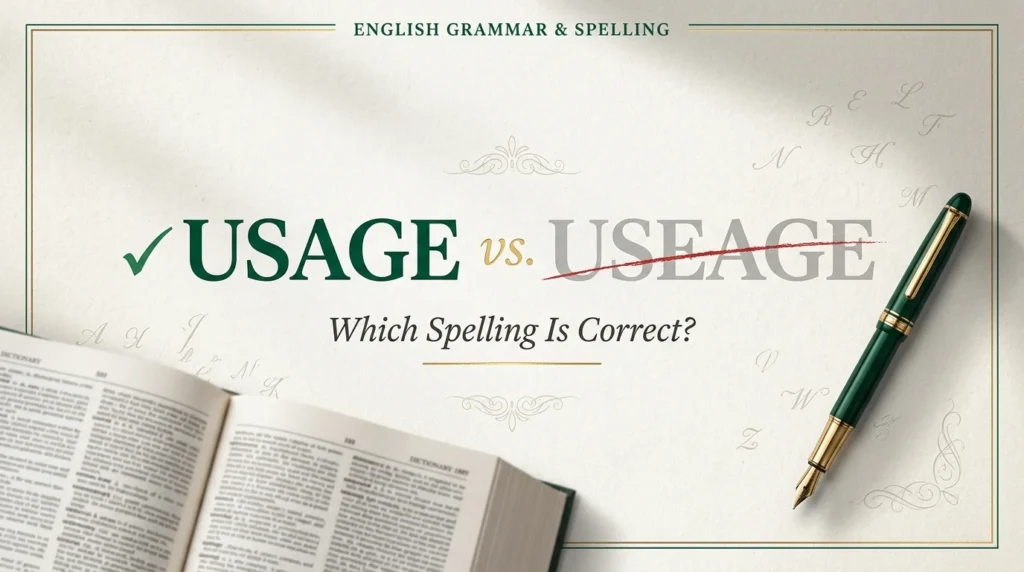

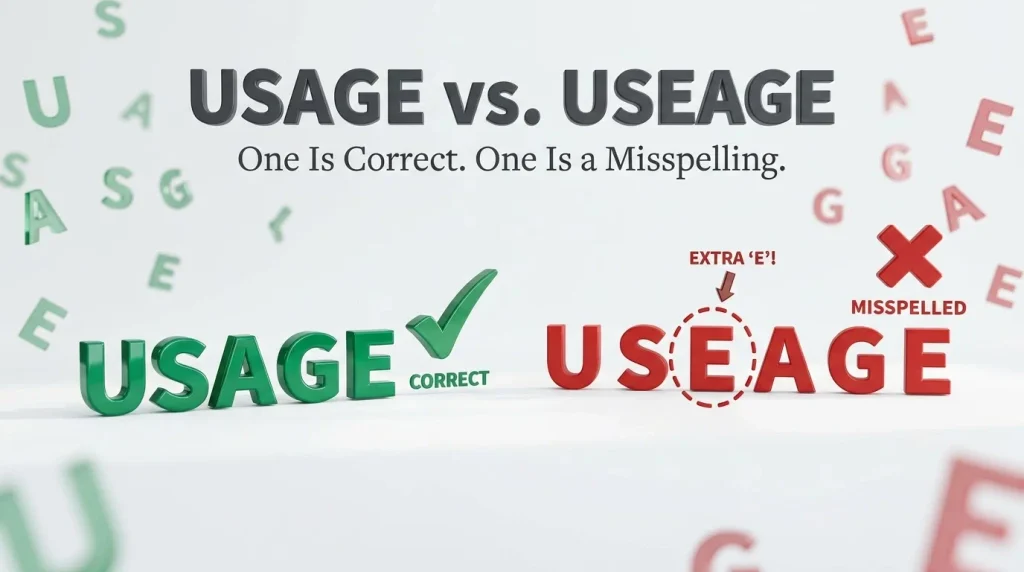
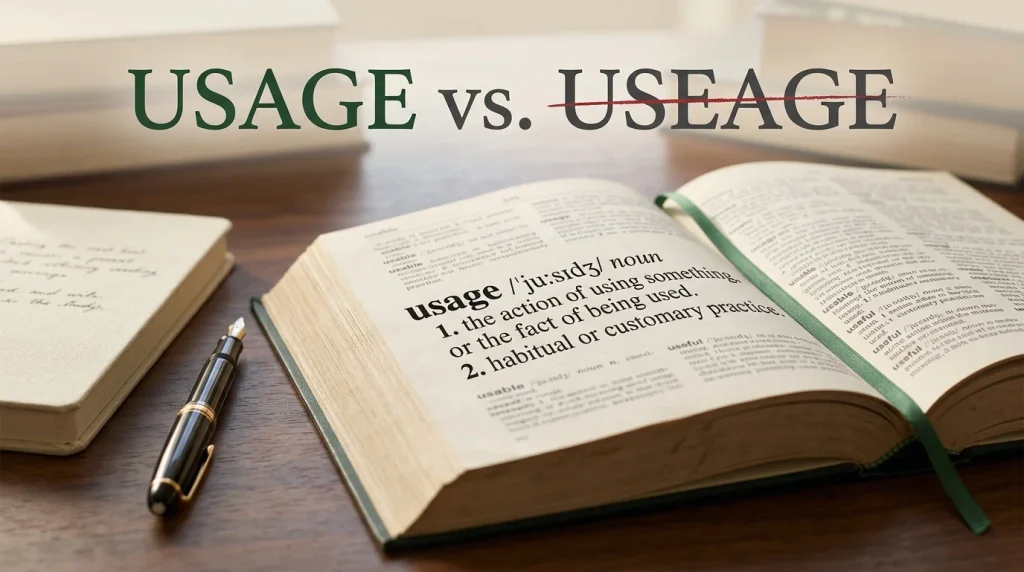
Usage is the correct spelling in standard English. Useage is a misspelling, not an accepted alternative. The word usage is a noun that describes how something is used, how much it is used, or the customary way words and expressions are used. For example, “The report measures monthly data usage” is correct. Whether you write an email, an academic essay, or a business report, choose usage, never useage.
What Is the Difference Between Usage and Useage?
The difference is simple: usage is the standard English word, while useage is an incorrect spelling of that word.
Usage — Correct
The noun refers to the way something is used, a pattern of use, or an established language practice.
Example: The app tracks my daily internet usage.
Useage — Incorrect
This spelling is not a standard alternative and should be corrected in ordinary English writing.
Incorrect: The app tracks my daily internet useage.
There is no difference in meaning to learn between these two spellings because useage is not the accepted form of the noun. The important distinction is between the correct spelling, usage, and the common spelling error, useage.
What Does Usage Mean?
Usage is a noun with several related meanings. The exact meaning depends on the sentence.
1. The Way Something Is Used
Usage can describe the manner in which a tool, product, service, or resource is used.
Examples:
- The manual explains the safe usage of the equipment.
- The company monitors employee software usage.
- Proper usage of the machine can extend its working life.
2. The Amount or Frequency of Use
The word can also refer to how much or how often something is used.
Examples:
- My mobile data usage increased this month.
- The electricity usage in our office fell during the holidays.
- The website tracks customer usage over time.
3. The Way Words and Expressions Are Used
In language learning and grammar, usage refers to the ways people use words, phrases, and grammatical constructions.
Examples:
- The teacher explained the usage of the phrase in context.
- English usage changes as the language develops.
- The dictionary provides examples of modern word usage.
These meanings share one central idea: usage describes a way, pattern, amount, or practice of using something.
Why Does the Difference Matter?
A single extra letter may seem unimportant, but spelling errors can affect how readers judge your writing. The mistake is especially noticeable when it appears repeatedly in a document or in content that has been carefully edited.
Correct spelling matters in several situations:
- Academic writing: An incorrect spelling can distract readers from your argument.
- Professional emails: Accurate spelling helps your message look polished and reliable.
- Business reports: Terms such as data usage, resource usage, and energy usage should be written consistently.
- Website content: Repeated spelling mistakes can reduce reader confidence in your content.
- English exams: Using the standard spelling helps you avoid unnecessary errors.
The goal is not to make every sentence sound formal. It is to communicate clearly and choose the established spelling, whatever the situation.
The Core Rule: Always Write Usage
Rule: Use usage when you mean the way, amount, pattern, or customary practice of using something. Do not write useage as an alternative spelling.
Remember the correct spelling:
U-S-A-G-E
The incorrect spelling contains an extra e:
U-S-E-A-G-E
A useful way to remember the difference is to learn usage as a complete word rather than trying to build it by attaching -age to the full spelling of use.
For example:
- Correct: The report examines energy usage.
- Incorrect: The report examines energy useage.
This is a spelling rule for this particular word. English word formation is not always predictable enough for a single rule to explain every noun.
How to Use Usage Correctly
Use usage when the sentence refers to a pattern, manner, amount, or convention of use.
Use Usage for Language and Grammar
When discussing vocabulary, grammar, or communication, usage often describes how a word or expression is used.
Examples:
- The lesson covers the usage of common prepositions.
- This expression is acceptable in everyday English usage.
- The dictionary explains the modern usage of the term.
- The student improved her understanding of English word usage.
In these examples, usage focuses on language practices rather than the act of using a physical object.
Use Usage for Technology and Resources
The word is also common in technology, business, and resource management.
Examples:
- The phone displays daily data usage.
- High electricity usage increased the monthly bill.
- The software records application usage.
- The report compares water usage across several buildings.
In these contexts, usage may refer to a measurable amount or a pattern over time.
Know When Use Is the Better Choice
Although usage is correct, it is not always the most natural word for every sentence. The noun use is often shorter and more direct.
Compare these examples:
- Natural: The use of plastic bags has declined.
- Also correct: Plastic bag usage has declined.
- Natural: Use this password to sign in.
- Incorrect: Usage this password to sign in.
The last example is wrong because use is a verb giving an instruction. Usage is a noun and cannot replace that verb in this sentence.
A helpful distinction is to ask whether the sentence needs an action or a noun describing a practice. Use use for the action; use usage when the noun meaning fits.
Correct Examples of Usage in Everyday English
The following original examples show how to spell and use usage in different situations.
Conversation
- “Your phone’s data usage seems higher this week.”
- “The teacher explained the usage of that expression.”
- “Please review the monthly internet usage before renewing the plan.”
- “I’ve attached a report showing our department’s software usage.”
School and Exams
- “The assignment examines the usage of descriptive language in short stories.”
- “Our English teacher gave us examples of correct word usage.”
Workplace and Business
- “We need to reduce unnecessary energy usage in the building.”
- “The new dashboard provides a summary of customer usage.”
Social Media
- “I’m checking my screen usage to spend less time on my phone.”
- “This post explains the usage of a phrase that many learners misunderstand.”
Academic Writing
- “The study investigates changes in language usage among younger speakers.”
- “The researchers measured water usage across three agricultural regions.”
Each sentence uses the same correct spelling. The meaning changes with the context, but the spelling does not.
Incorrect vs. Correct: 10 Common Mistakes
| ❌ Incorrect | ✅ Correct | Why |
|---|---|---|
| The app tracks data useage. | The app tracks data usage. | Usage is the established spelling of the noun. |
| Our water useage has increased. | Our water usage has increased. | The extra e does not belong in the word. |
| Please check your internet useage. | Please check your internet usage. | The standard expression is internet usage. |
| The report examines energy useage. | The report examines energy usage. | The correct spelling has five letters. |
| Proper word useage is important. | Proper word usage is important. | Language practices are described as word usage. |
| The software monitors customer useage. | The software monitors customer usage. | Useage is not the standard noun. |
| Her English useage has improved. | Her English usage has improved. | The noun must retain its established spelling. |
| We reviewed monthly phone useage. | We reviewed monthly phone usage. | The same spelling applies to technology-related use. |
| The article explains grammar useage. | The article explains grammar usage. | The extra letter is a spelling error, not a grammatical variant. |
| High electricity useage raised costs. | High electricity usage raised costs. | Electricity usage is the correct noun phrase. |
Notice that the incorrect sentences are not necessarily confusing in meaning. Readers can often work out what the writer intended. However, understanding a sentence does not make its spelling correct.
Why People Make This Mistake
The spelling useage looks plausible for several reasons. Understanding these causes makes the correct form easier to remember.
1. The Word Use Ends in E
The verb use ends with the letter e. Writers may assume that adding the ending -age produces useage.
That is a reasonable guess, but English spelling does not always follow a simple process of joining visible word parts. The established noun is usage, and its spelling must be learned as it is.
2. English Spelling Is Not Entirely Predictable
English has many words whose spelling cannot be reliably predicted from their meaning or pronunciation alone. A familiar word ending may encourage a writer to apply the same pattern elsewhere, even when the result is incorrect.
For this reason, it is safer to remember usage as a standard spelling than to invent a spelling rule that supposedly works for every word ending in -age.
3. Pronunciation Does Not Show Every Letter
Usage is commonly pronounced “YOO-sij.” The ending sounds like a soft ij sound, so hearing the word does not tell you whether an extra letter should appear in its written form.
Writers who rely on how a word sounds may therefore guess the spelling incorrectly.
4. Spellcheck Does Not Replace Knowledge
Spellcheckers and autocorrect tools can catch many mistakes, but their behavior depends on the software, dictionary, and context. A misspelling may not always be flagged, particularly in unusual circumstances.
Do not assume a word is correct simply because an automated tool has left it unchanged. When uncertain, check the spelling or use a word you already know is correct.
5. Translation Can Reinforce the Error
Learners who translate directly from another language may expect English words to follow a more consistent pattern of word formation. They may also remember a spelling encountered in online material, even when that spelling is incorrect.
The practical solution is to learn usage as a complete vocabulary item, together with common phrases such as data usage, word usage, and water usage.
Common Mistakes Checklist
Use this checklist when proofreading your writing.
- Adding an extra e: Replace useage with usage. Read the word letter by letter if necessary.
- Confusing a noun with a verb: Use usage to describe a pattern or amount of use, but use use when someone performs an action.
- Assuming the word has two accepted spellings: Treat usage as the standard form, not one choice among two equivalent alternatives.
- Relying only on spellcheck: Proofread the final text even if your software does not underline the word.
- Using usage when use is simpler: Prefer direct wording when the shorter noun expresses the same idea naturally.
- Repeating the same error throughout a document: Search for useage before publishing or submitting your work.
These checks address both spelling and word choice. Correct spelling matters, but selecting the most natural word also helps make your writing clear.
Usage in Real English
Knowing the correct spelling is only part of good writing. You also need to understand when usage sounds natural and when another word would be a better choice.
Grammatically Correct and Natural
“Your mobile data usage has doubled this month” is both grammatically correct and natural in everyday English. The word usage fits because the sentence describes a measurable amount of data consumed. Similarly, word usage is a natural expression when discussing language. These combinations are common because usage communicates a pattern, quantity, or established way of doing something.
Grammatically Possible but Less Natural
“The usage of my phone was very high yesterday” is understandable and grammatically possible, but it may sound less direct in casual conversation. “I used my phone a lot yesterday” is usually simpler and more natural when describing your own behavior. The noun usage works better when discussing statistics, reports, patterns, or measured activity rather than an ordinary personal action.
Incorrect, Even If the Meaning Is Clear
“The useage of mobile data increased” communicates an understandable idea, but useage is still a spelling error. Correcting it to usage fixes the spelling: “The usage of mobile data increased.” You could also write “Mobile data usage increased,” which is more concise. The key distinction is that a reader’s ability to understand a sentence does not make a nonstandard spelling acceptable.
American vs. British English
There is no spelling difference between American and British English for this word. Usage is the standard spelling in both varieties, and useage is not an accepted regional alternative.
| Context | American English | British English |
|---|---|---|
| Correct spelling | usage | usage |
| Incorrect spelling | useage | useage |
| Data example | Mobile data usage increased. | Mobile data usage increased. |
| Language example | English usage changes over time. | English usage changes over time. |
You do not need to remember separate American and British spellings. The same form works in school assignments, professional writing, and everyday communication in both varieties.
Formal vs. Informal Usage
The spelling usage remains the same in formal and informal writing. What changes is whether the noun is the most suitable choice for the situation.
Formal writing: In reports, academic papers, and technical documents, usage is useful when discussing measured activity or language conventions. For example, “The study evaluates changes in online language usage” suits an academic context.
Informal writing: In conversation or text messages, people often choose the shorter verb use or a simpler expression. “I used too much data this month” may sound more conversational than “My data usage was excessive.”
Neither register permits useage as a standard spelling.
Usage vs. Useage: Comparison Table
| Feature | Usage | Useage |
|---|---|---|
| Standard spelling | Correct | Incorrect |
| Accepted standard noun | Yes | No |
| Meaning | Way, amount, pattern, or practice of using something | No separate standard meaning |
| Part of speech | Noun | Not a standard English word |
| Suitable for academic writing | Yes | No |
| Suitable for business writing | Yes | No |
| American English | Correct | Incorrect |
| British English | Correct | Incorrect |
| Example | Monthly data usage | Monthly data useage |
| Recommendation | Use this spelling | Avoid this spelling |
The table captures the main distinction: these are not two words with different meanings. One is the correct spelling, and the other is a misspelling.
Real-Life Situations: Usage or Useage?
Situation 1: A Job Interview
A candidate is explaining how a company can reduce operating costs.
Incorrect: “I would analyze the electricity useage in each department.”
Correct: “I would analyze the electricity usage in each department.”
Why it works: Usage is the correct noun for the amount of electricity consumed. Accurate spelling also helps the candidate present a professional impression.
Situation 2: A Workplace Email
A manager requests a report about employee software activity.
Incorrect: “Please send me the software useage figures by Friday.”
Correct: “Please send me the software usage figures by Friday.”
Why it works: Software usage is a natural phrase for activity measured by a system or organization.
Situation 3: A Text Message
A friend asks why a mobile data allowance ran out early.
Incorrect: “My data useage was too high this month.”
Correct: “My data usage was too high this month.”
More conversational: “I used too much data this month.”
Why it works: Both corrected sentences are natural, but the verb-based version is more direct in casual conversation.
Situation 4: An English Exam
A student writes about the importance of vocabulary.
Incorrect: “Correct word useage improves communication.”
Correct: “Correct word usage improves communication.”
Why it works: Word usage is the appropriate expression for discussing how words are used in a language.
Situation 5: An Academic Report
A researcher describes a study of household water consumption.
Incorrect: “The study compares water useage in urban and rural homes.”
Correct: “The study compares water usage in urban and rural homes.”
Why it works: Water usage is an established expression for the amount or pattern of water consumption.
Quick Quiz: Test Your Understanding
Choose the correct answer for each sentence.
- The app tracks monthly data (usage / useage).
- The teacher explained the (usage / useage) of the expression.
- Please (use / usage) the side entrance.
- Our electricity (usage / useage) fell last month.
- The report examines changes in English (usage / useage).
- I need to (use / usage) my phone less often.
Practice questions
0 of 6 answered
- The app tracks monthly data ___.
usage
useage
- The teacher explained the ___ of the expression.
usage
useage
- Please ___ the side entrance.
use
usage
- Our electricity ___ fell last month.
usage
useage
- The report examines changes in English ___.
usage
useage
- I need to ___ my phone less often.
use
usage
Check answers
Quick Summary
Usage is the correct spelling in standard English, while useage is a misspelling. The word usage is a noun that can describe how something is used, how much it is used, or the customary way words and expressions are used. It appears in phrases such as data usage, water usage, and English usage. The spelling is identical in American and British English, and the correct form works in both formal and informal writing. Remember that use is a verb, while usage is a noun. When proofreading, look for the extra e in useage and replace it with usage. When a simpler expression sounds more natural, choose use instead.
Frequently Asked Questions
Is usage or useage correct?
Usage is correct. Useage is a misspelling and should not be used in standard English writing. Choose usage in emails, essays, reports, and everyday communication.
Is useage ever an acceptable alternative spelling?
No. In standard modern English, useage is not an accepted alternative spelling of usage. If you encounter it in a document or online post, treat it as a spelling error unless the text is discussing the misspelling itself.
Why is usage spelled without an extra e?
The established spelling is usage, not useage. Writers often add the extra letter because the related verb use ends in e. However, English spelling does not always follow a simple pattern of attaching an ending to the complete spelling of a related word.
What does usage mean in simple English?
Usage means the way something is used, the amount or frequency of its use, or the customary way a word or expression is used. For example, phone usage can describe how much someone uses a phone, while English usage refers to how people use the language.
Is usage a noun or a verb?
Usage is a noun. It names a practice, pattern, amount, or manner of use. Use can be a verb, as in “I use this application every day,” or a noun, as in “The use of this application is increasing.”
Is usage correct in academic writing?
Yes. Usage is appropriate in academic writing when it accurately expresses the intended meaning. For example, “The research examines changes in language usage among students” is correct. Avoid useage, and consider whether the simpler word use would communicate the point more clearly.
Is usage spelled the same way in American and British English?
Yes. Both American and British English use usage. There is no regional spelling difference for this word, so you do not need to change it when writing for readers in either variety.
What is the difference between usage and use?
Use can function as a verb or noun, while usage is a noun that often emphasizes a manner, pattern, amount, or convention of use. For example, “Use your phone carefully” contains a verb, whereas “Phone usage has increased” uses a noun to describe a pattern.
What is the easiest way to remember the correct spelling?
Memorize the five-letter spelling U-S-A-G-E. Remember that the standard noun does not contain an extra e after the s. You can also practise with familiar phrases such as data usage, water usage, and word usage.
Will spellcheck always catch useage?
Not necessarily. Many spellcheckers identify useage as an error, but software behavior varies. Proofreading and learning the standard spelling are more reliable than depending entirely on automated corrections.
Final Takeaway
When deciding between usage and useage, choose usage every time in standard English. The spelling is the same in American and British English, and the word is suitable for academic, professional, and everyday contexts. Remember, however, that usage is not always interchangeable with use: the best choice depends on the sentence and the meaning you want to express.
When deciding between usage and useage, choose usage every time in standard English. The spelling is the same in American and British English, and the word is suitable for academic, professional, and everyday contexts. Remember, however, that usage is not always interchangeable with use: the best choice depends on the sentence and the meaning you want to express.