
What Batton or Baton Means?
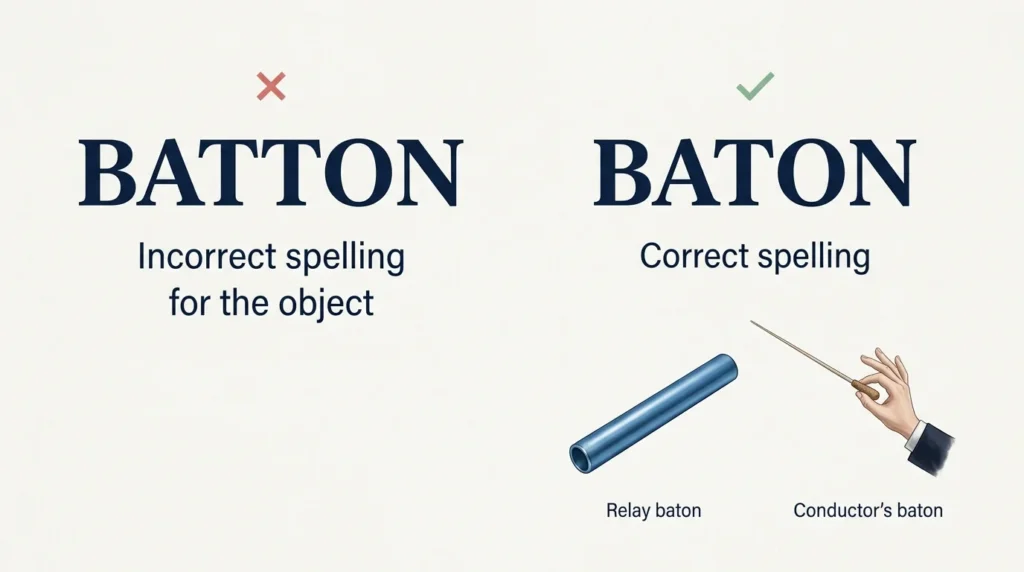
The difference between batton and baton is primarily a matter of standard spelling and context. In modern English, baton is the established word for a particular type of stick or rod.
Baton is a countable noun. Its precise meaning depends on the situation.
- Music: A lightweight wand a conductor uses to guide an orchestra or choir.
- Sports: A short stick passed from one runner to another in a relay race.
- Law enforcement: A sturdy stick carried by a police officer, also called a truncheon in British English or a nightstick in American English.
- Ceremonies and marching: A staff or a twirling implement used by a drum major or performer.
- Leadership and responsibility: In the expression pass the baton, the word represents the transfer of responsibility from one person to another.
Examples:
- The conductor raised her baton to signal the beginning of the performance.
- Our team lost valuable time when the baton slipped during the relay.
- The retiring director passed the baton to her successor.
What Does Batton Mean?
In contemporary standard English, batton is generally a misspelling of baton when referring to these objects.
There are two important qualifications:
- Proper names: Batton may be a person’s surname or part of a business name. Names should retain their established spelling.
- Historical usage: Older English texts sometimes use batton as a spelling variant of baton or batten. This does not make it the appropriate spelling in ordinary modern writing.
For a school assignment, business email, article, or everyday message, use baton for the object.
The Main Difference
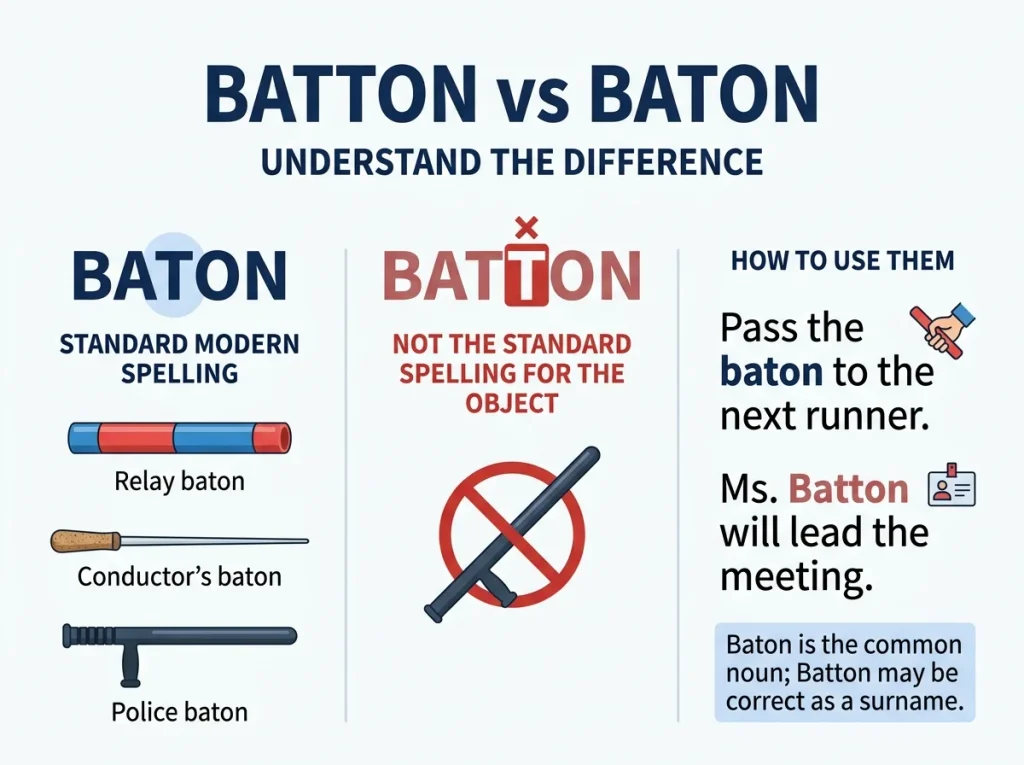
The distinction is straightforward: baton is the standard modern spelling, while batton is normally an error when used to describe the same object.
| Feature | Batton | Baton |
|---|---|---|
| Standard modern spelling for the object | No | Yes |
| Part of speech in the intended use | Usually a misspelling | Countable noun |
| Meaning | No standard modern meaning for the object under this spelling | A stick or rod used in music, sport, policing, or ceremonies |
| Correct example | Mr. Batton joined the meeting. | The runner passed the baton. |
| Appropriate in formal writing | Only when intentionally used as a name or in a historical quotation | Yes |
| Plural of the object | Not standard | Batons |
The forms are not interchangeable in ordinary contemporary English. If the sentence describes a relay race, an orchestra, or a police officer’s equipment, baton is the spelling to use.
The Core Rule
The Rule in Simple English
Write baton with one “t” and one “n.”
Use baton whether you are talking about music, athletics, police equipment, a ceremonial object, or a transfer of responsibility.
- Correct: The orchestra’s conductor picked up the baton.
- Incorrect: The orchestra’s conductor picked up the batton.
- Correct: The new manager will take the baton next month.
- Incorrect: The new manager will take the batton next month.
Why the Rule Works
English spelling is not always predictable from pronunciation. Some words contain doubled consonants, such as button, mutton, and written. That pattern may make batton look plausible, but the spelling of one word cannot reliably be inferred from the spelling of another.
Baton entered English through French, where the corresponding word is bâton. Modern English retains the single-t spelling.
The reliable approach is to learn the word as a complete spelling rather than trying to derive it from its sound.
How to Use It
Common Usage
The word baton appears in several distinct contexts.
In music
A conductor may raise, lower, or move a baton to guide the tempo and expression of a musical performance.
Example: The conductor used a small baton to cue the woodwind section.
In athletics
Relay runners pass a baton to their teammates during a race.
Example: The second runner accelerated immediately after receiving the baton.
In law enforcement
A baton is a piece of equipment carried by some police officers.
Example: The report described the equipment as a police baton.
In leadership and teamwork
The expression pass the baton is also used figuratively. It means transferring responsibility, leadership, or an ongoing task to someone else.
Example: After training her replacement, Nadia passed the baton to the new team leader.
Less Common or Special Usage
Baton also appears in ceremonial settings and baton-twirling performances. In addition, it has specialized uses in heraldry.
You may encounter batton in older writing, archival documents, surnames, or business names. Preserve that spelling when it is genuinely part of the original name or text, but do not adopt it as a modern alternative for the object.
Correct Examples
The following examples show how to spell and use baton in different contexts.
- The conductor tapped her baton against the music stand before the rehearsal began.
- The final runner received the baton just before entering the last bend.
- Our school ordered new batons for the marching band’s performance.
- The athlete dropped the baton during the exchange and had to retrieve it.
- The police officer carried a baton as part of the required equipment.
- The orchestra remained silent until the conductor lifted his baton.
- The retiring principal passed the baton to her successor at the ceremony.
- The young performer practiced spinning her baton in the garden.
- The coach reminded the runners to keep their hands ready for the baton exchange.
- The new department head will take the baton at the beginning of next week.
- The museum displayed a ceremonial baton beside the officer’s uniform.
- Mr. Batton sent the revised schedule to the entire department.
Notice the distinction in the final example: Batton is correct there because it is a surname, not the name of the object.
Incorrect vs Correct
| Incorrect | Correct | Why |
|---|---|---|
| The conductor raised his batton. | The conductor raised his baton. | Baton is the standard spelling for a conductor’s wand. |
| She dropped the batton during the relay. | She dropped the baton during the relay. | Relay races use a baton. |
| The officer carried a batton. | The officer carried a baton. | The modern spelling has one t. |
| The coach handed him the batton. | The coach handed him the baton. | The spelling does not change when someone hands over the object. |
| The orchestra waited for the batton. | The orchestra waited for the baton. | Musical usage takes baton. |
| The team practiced the batton exchange. | The team practiced the baton exchange. | The standard expression is baton exchange. |
| The performer spun her batton. | The performer spun her baton. | The object used in baton twirling is spelled baton. |
| The manager passed the batton to her successor. | The manager passed the baton to her successor. | The figurative expression is pass the baton. |
| Several battons were stored in the equipment room. | Several batons were stored in the equipment room. | The standard plural is batons. |
| The ceremonial batton was placed on the table. | The ceremonial baton was placed on the table. | The standard spelling applies to ceremonial objects too. |
Important exception: Do not automatically change Batton to Baton when the word is a person’s name, an organization’s official name, or part of a historical quotation. Correct spelling depends on what the word represents.
Why People Make This Mistake
1. The Extra Letter Looks Plausible
English contains many familiar words with double t, including button, mutton, and written. Because batton resembles these patterns, it can look like a reasonable spelling even though it is not standard for the object.
2. Pronunciation Does Not Reveal Every Letter
The pronunciation of baton varies between speakers and regions. In many American accents, it sounds approximately like “buh-TAHN”; in many British accents, it sounds closer to “BAT-uhn.”
Neither pronunciation provides a reliable reason to insert another t. Similar-sounding words can have different spellings.
3. The Word Appears in Several Unrelated Settings
Someone who knows baton only from a relay race may not immediately recognize it in a discussion of orchestral music or leadership. Seeing the word in different contexts can create uncertainty, even though the spelling remains the same.
4. Typing Habits Reinforce the Error
A writer may type the extra letter automatically or repeat a spelling previously seen online. Spell-checking tools do not always flag every error, particularly when the text resembles a proper name.
Common Mistakes
Mistake 1: Adding an Extra “T”
The most direct error is writing batton when referring to the object.
Incorrect: The conductor placed the batton on the desk.
Correct: The conductor placed the baton on the desk.
Remember the established spelling rather than guessing from the sound.
Mistake 2: Changing the Spelling in the Plural
Adding -s does not correct an incorrectly spelled base word.
Incorrect: The runners practiced with two battons.
Correct: The runners practiced with two batons.
The singular is baton and the plural is batons.
Mistake 3: Assuming Every Occurrence of “Batton” Is an Error
Context matters when the form is a proper name or appears in historical material.
Example: Ms. Batton will lead the meeting.
Here, Batton is correct if that is the person’s actual surname. It should not be changed merely because baton is the standard spelling of the object.
Mistake 4: Confusing the Object With the Figurative Expression
The phrase pass the baton can describe a transfer of duties rather than a physical handoff.
Incorrect: The founder passed the batton to the next director.
Correct: The founder passed the baton to the next director.
The spelling remains the same whether the transfer is literal or figurative.
Batton or Baton in Real English
In contemporary writing, baton is the natural, standard choice for the object. It is appropriate in academic work, news reports, workplace communication, sports commentary, and everyday conversation.
Batton requires more careful interpretation. As an ordinary noun for a conductor’s wand or a relay stick, it is incorrect in standard modern English. As a surname, registered name, or historical spelling, it may be entirely legitimate.
This distinction is important because not every unusual spelling is a spelling error. A name must be written according to its established form, while an ordinary English noun should follow conventional spelling.
Pronunciation also deserves separate treatment. A speaker may pronounce baton differently from another speaker without either using the wrong spelling. The regional variation in pronunciation does not create a corresponding modern spelling distinction.
Formal vs Informal Usage
Formal Usage
Use baton in reports, academic writing, professional correspondence, sports coverage, and formal descriptions.
Example: The relay team completed the exchange without dropping the baton.
Everyday Usage
The same spelling applies in casual conversation, text messages, and social media posts.
Example: “Don’t drop the baton this time!” the coach joked before the race.
There is no special informal spelling. Batton does not become correct simply because the communication is casual.
Comparison Table
| Question | Batton | Baton |
|---|---|---|
| Is it standard for the object? | No | Yes |
| What does it mean? | Usually a misspelling in this context | A stick or rod used in several activities |
| What is its grammatical role? | Not the standard noun spelling intended here | Countable noun |
| What is the plural? | Not standard for the object | Batons |
| Does pronunciation determine the spelling? | No | No |
| Can it appear as a name? | Yes | Yes, if it is the established name |
| What should I write in a relay-race report? | Avoid it | Use baton |
Memory Trick
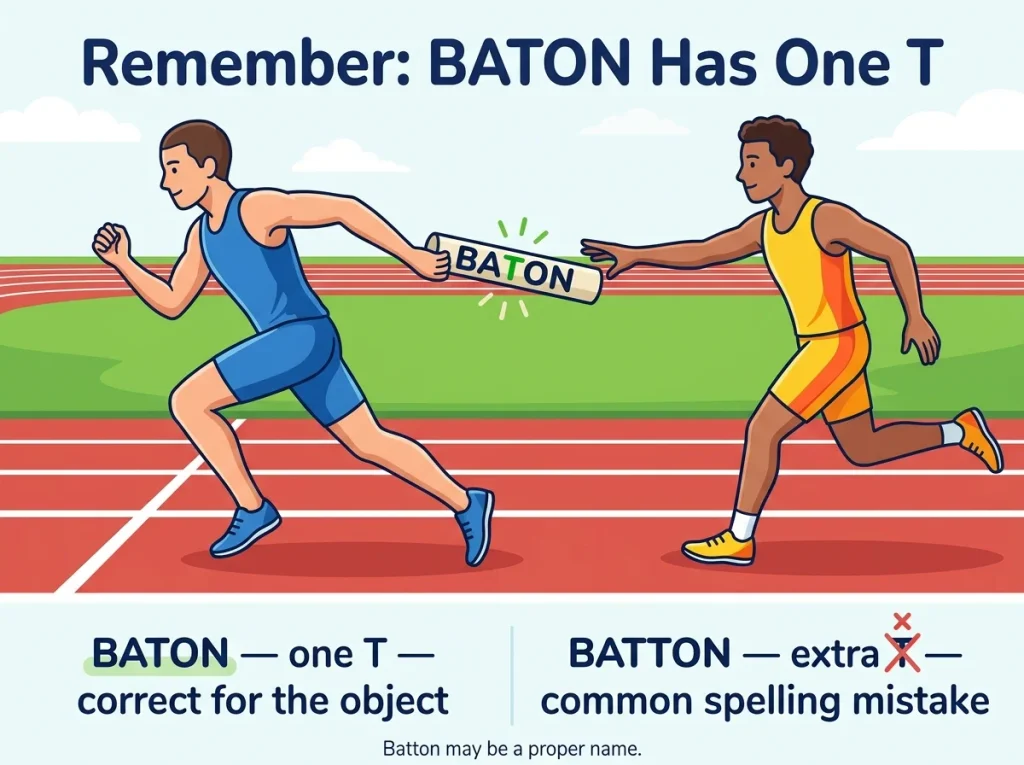
Think of a relay race: one baton, one “t.”
Picture the baton moving from one runner to the next. The spelling stays unchanged throughout the race: baton, baton, baton.
You can also remember the short rule:
A baton is passed; a batton is a spelling to bypass.
The rhyme is a memory aid, not a separate English spelling rule. For ordinary modern writing, remember baton with a single t.
Real-Life Examples
At Work
“The outgoing project manager passed the baton to her colleague before taking leave.”
Here, baton refers figuratively to responsibility. The sentence is natural in a workplace context because the phrase is an established metaphor for handing over a role or task.
In an Email
Subject: Relay Practice Schedule
“Please bring your baton to tomorrow’s practice. We will work on the handoff technique before the competition.”
The word refers to the physical object used in the race. The same spelling works in both the subject’s context and the message.
In Conversation
“Did the conductor use a baton for the entire performance?”
This is a natural question about musical conducting. The spelling does not change if the speaker is discussing a choir rather than an orchestra.
At School or University
“The student explained how a successful baton exchange can affect a relay team’s performance.”
In educational and academic contexts, baton is the correct spelling for the sports equipment.
Expert Tips
- Learn the whole word visually: Memorize baton rather than trying to reconstruct it from pronunciation.
- Check the meaning before correcting it: If the word refers to an object passed between runners or used by a conductor, choose baton. If it is a person’s surname, preserve the name.
- Remember the plural: The correct form is batons, not battons.
- Recognize the figurative phrase: Pass the baton and take the baton both use the same spelling when referring to a transfer of responsibility.
- Do not rely exclusively on autocorrect: A spelling tool may overlook a mistake or accept a string as a name. Read the sentence for meaning as well as spelling.
- Separate spelling from pronunciation: Accent differences can change how baton sounds without changing how it is written.
Quick Summary
Baton is the standard modern English spelling for a conductor’s wand, a relay-race stick, a police baton, and similar ceremonial or performance objects. It also appears in the figurative expression pass the baton, which means to transfer responsibility or leadership. The plural is batons.
Batton is normally a misspelling when used to refer to any of these objects. However, it may be correct as a surname, an official name, or an older spelling preserved in a historical text. The difference is therefore not simply that one string of letters can never exist: it is that only baton is the standard contemporary spelling for the intended common noun. For everyday, academic, and professional writing, remember the simple rule: one t in baton.
ALSO CHECKOUT: Usage vs. Useage: Which Spelling Is Correct?
Frequently Asked Questions
1. Is it batton or baton?
Baton is correct when referring to the stick used in a relay race, by a conductor, or by a police officer. Batton is generally a misspelling in these contexts.
2. Is batton a real word?
Batton occurs in historical spelling records and as a proper name. It is not the standard modern spelling of the common noun baton. The intended meaning and context determine whether an occurrence is legitimate.
3. What does baton mean?
A baton is a stick or rod used for a particular purpose, such as conducting music, competing in a relay race, or serving as police equipment. In pass the baton, it represents responsibility being transferred to another person.
4. How do you spell the plural of baton?
The plural is batons. For example: “The equipment manager checked that all four batons were ready for the relay.”
5. Why do people spell baton as batton?
The extra t may be influenced by familiar English words such as button and mutton. Pronunciation and typing habits can also contribute to the mistake, but the standard spelling remains baton.
6. Is batton ever correct?
Yes, in specific contexts. It may be a surname, an official name, or an older spelling found in historical writing. It is not the standard contemporary spelling for the object.
7. Is baton spelled the same in American and British English?
Yes. Both American and British English use baton for the object. Pronunciation can differ, but the standard spelling does not.
8. Is a baton only used in relay races?
No. A baton can be used by a musical conductor, a police officer, a drum major, or a baton-twirling performer. The word also has a figurative use when responsibility passes from one person to another.
9. What does “pass the baton” mean?
Literally, it means handing the baton to the next runner in a relay race. Figuratively, it means transferring responsibility, leadership, or an ongoing task to someone else.
10. How do you pronounce baton?
Pronunciation varies by accent. Many American speakers say something like “buh-TAHN,” while many British speakers use a form closer to “BAT-uhn.” These are approximate guides; the spelling remains baton in both varieties.
Mini Quiz
Choose the correct answer for each question. The answer and explanation appear in the final two columns so you can check your understanding.
| # | Question | Answer | Explanation |
|---|---|---|---|
| 1 | The conductor raised her (batton / baton). | baton | Baton is the standard spelling for a conductor’s wand. |
| 2 | The final runner received the ______ from her teammate. | baton | Relay runners pass a baton. |
| 3 | True or false: Batton is the standard modern spelling for a police baton. | False | The standard spelling of the object is baton. |
| 4 | Choose the correct plural: (battons / batons). | batons | Add -s to baton to form the plural. |
| 5 | The director will pass the ______ to her successor. | baton | Pass the baton is an established figurative expression. |
| 6 | Which sentence uses a standard spelling for the object? A. The athlete dropped the batton. B. The athlete dropped the baton. | B | Baton is the correct spelling for the relay object. |
| 7 | Complete the sentence: Mr. ______ will lead the meeting. The person’s established surname is Batton. | Batton | A person’s actual surname should retain its established spelling. |
| 8 | Does British English normally spell the object batton instead of baton? | No | The standard spelling is baton in both varieties. |
| 9 | Identify and correct the spelling mistake: “The runners practiced the batton exchange.” | batton → baton | The standard sports expression is baton exchange. |
| 10 | A manager transfers responsibility to a colleague. Which expression fits? A. Pass the baton. B. Pass the batton. | A. Pass the baton. | The figurative expression uses the standard spelling baton. |
Final takeaway: When you mean the object or the transfer of responsibility, write baton. Reserve Batton for a genuine proper name or a context in which the historical spelling must be preserved.