
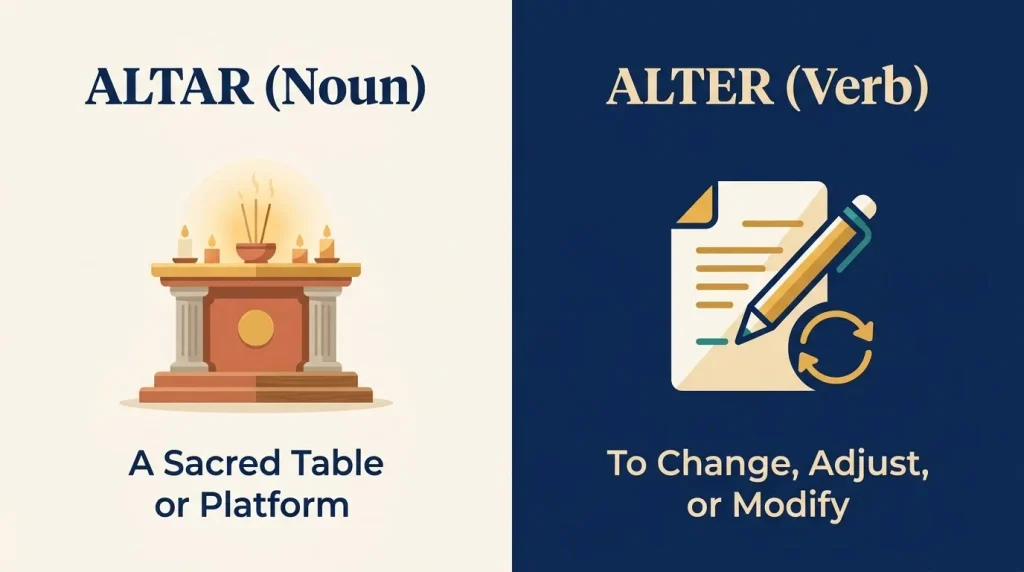
Altar (with an A) is a noun referring to a raised platform, table, or structure used for religious ceremonies, worship, or sacrifices. Alter (with an E) is a verb that means to change, modify, adjust, or make different.
To remember the difference, think of the spelling: an altar is used for a worship service, while to alter means to make changes.
What Is Altar vs. Alter?
Understanding the difference between altar and alter comes down to identifying whether you need a physical object (a noun) or an action (a verb).
- Altar is a noun (a person, place, thing, or idea). Historically and traditionally, it describes a sacred table or elevated platform where religious rites, prayers, offerings, or weddings occur.
- Alter is a verb (an action word). It describes the act of modifying something—such as revising a plan, adjusting an opinion, or tailoring a piece of clothing to fit better.
Why It Matters
Using the wrong word can completely change the meaning of your sentence, create confusion, or make professional writing look careless:
- Loss of Credibility: Writing “We need to altar our strategy” in a corporate email or project proposal signals a lack of attention to detail.
- Unintended Humor: Stating “She stood at the alter” is a minor typo, but saying “The tailor will altar my suit” accidentally implies a sacred ceremony is happening to your clothes.
- Legal and Technical Errors: In contracts, technical manuals, or editorial work, writing “alter” when referring to physical architectural structures or “altar” when referring to modification clauses can alter the legal meaning of a document.
The Core Rule
The Core Rule:
Use Altar (noun) when referring to a structure or table.
Use Alter (verb) when referring to an action that changes something.
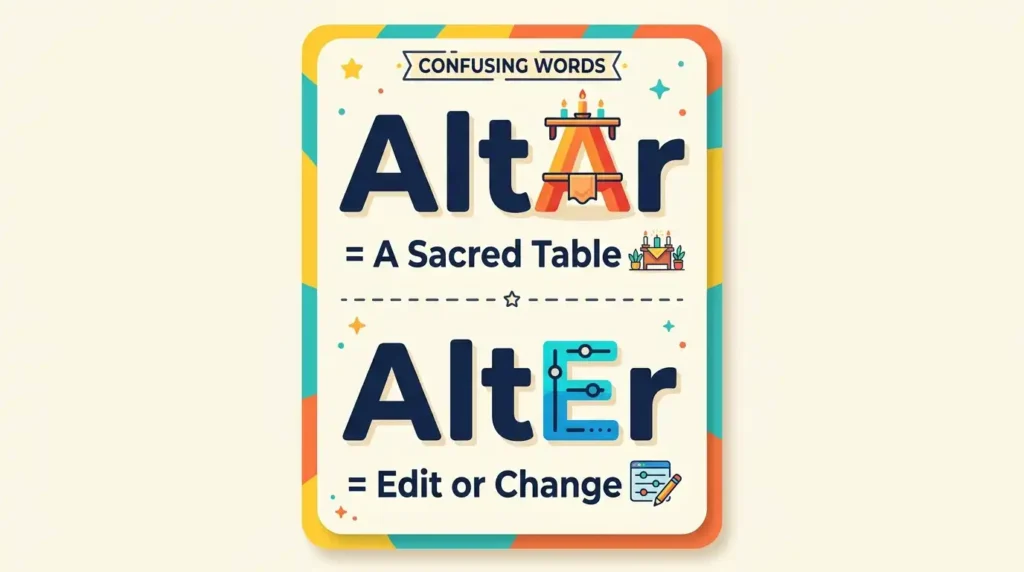
- Altar = A sacred place / A table.
- Alter = Edit / Modifey / Make different.
How to Use It
Using “Altar” (Noun)
Use altar exclusively when referring to a physical or figurative elevated structure associated with worship, ritual, or deep devotion.
- Literal use: Tables in churches, temples, or shrines.
- Figurative use: Expressing extreme devotion or sacrifice (e.g., “sacrificing personal time on the altar of success”).
Using “Alter” (Verb)
Use alter whenever an action involves modification, transformation, or adjustment.
- Standard action: Changing plans, routes, weather patterns, or settings.
- Grammatical forms: Because it is a regular verb, it easily takes standard verb endings:
- Base form: alter
- Third-person singular: alters
- Past tense: altered
- Present participle: altering
- Noun form: alteration
Correct Examples Across Contexts
- Conversation: “I had to alter my route home because of heavy traffic on the highway.”
- Email: “Please let me know if we need to alter the meeting time to accommodate team members in different time zones.”
- School: “The priest placed the ceremonial bread directly on the altar before beginning the service.”
- Workplace: “Our team decided to alter the software code to resolve the recurring performance bug.”
- Social Media: “Standing at the altar surrounded by our family was the happiest moment of my life!”
- Academic Writing: “Climate change continues to alter global weather patterns and marine ecosystems.”
- Tailoring/Fashion: “The dressmaker offered to alter the waistline of the gown for a custom fit.”
- Literature: “The ancient tribe constructed a stone altar at the peak of the mountain.”
- Business Strategy: “Market dynamics forced the board to alter its quarterly revenue expectations.”
- Legal Context: “Neither party may alter the terms of this contract without written consent from both signatories.”
Incorrect vs. Correct Usage
| ❌ Incorrect | ✅ Correct | Why It Is Incorrect |
| The tailor offered to altar my jacket. | The tailor offered to alter my jacket. | “Altar” is a noun (a sacred table). Tailors perform the action of modifying clothes, which requires the verb “alter.” |
| They exchanged vows at the alter. | They exchanged vows at the altar. | A wedding ceremony takes place at a physical platform or table (“altar”), not an action verb (“alter”). |
| We cannot altar the laws of physics. | We cannot alter the laws of physics. | Changing or modifying physical laws requires the verb “alter.” |
| The priest carefully cleaned the church alter. | The priest carefully cleaned the church altar. | The physical object inside the church is an “altar.” |
| Software updates will altar user settings. | Software updates will alter user settings. | Software modifying settings is an action, so the verb “alter” is required. |
| He sacrificed his health on the alter of work. | He sacrificed his health on the altar of work. | This figurative expression refers to sacrificing something on a sacred platform (“altar”). |
| Please don’t altar the original document. | Please don’t alter the original document. | Modifying a document requires the verb “alter.” |
| Flowers were arranged neatly around the alter. | Flowers were arranged neatly around the altar. | The object being decorated is a physical platform, requiring “altar.” |
| Heavy rain forced us to altar our weekend plans. | Heavy rain forced us to alter our weekend plans. | Changing or adjusting plans is an action, requiring “alter.” |
| The architect decided to altar the building layout. | The architect decided to alter the building layout. | Modifying a design or floor plan requires the verb “alter.” |
Why People Make This Mistake
Understanding why homophones cause confusion helps prevent errors in the future:
- Homophones (Identical Pronunciation): Both words are pronounced identically as /ˈɔːl.tər/ (or /ˈɑːl.tər/). Because they sound identical, the brain defaults to whichever spelling is retrieved first during rapid typing.
- Typographical Proximity: On standard QWERTY keyboards, A and E are both typed with the left hand on the home/top row, making accidental key swaps common.
- Spellcheck Limitations: Automated spellcheck tools rarely flag altar or alter as errors because both are real words. Unless your editor evaluates full sentence context, incorrect usage passes without a warning.
Common Mistakes Checklist
- Conflating Tailoring with Sacred Objects:
- The Mistake: Writing “clothing altars.”
- Why it happens: Confusing the noun suffix -ar with the action word.
- How to avoid: Remember that clothing adjustments always require an E (alter / alteration).
- Using “Alter” as a Noun for a Physical Table:
- The Mistake: Writing “the church alter.”
- Why it happens: Assuming all words ending in -er function as standard nouns (like teacher or runner).
- How to avoid: Associate the A in altar with Architecture or Archaeology (a physical structure).
- Confusing Derivatives:
- The Mistake: Writing “alterations” when referring to religious items, or “altarations” for clothing changes.
- How to avoid: Note that alteration, unaltered, and altering all stem strictly from the verb alter. Altar rarely forms derivative words in standard modern English.
Altar vs. Alter in Real English
1. Tailoring and Clothing
In daily conversation, “alter” is most commonly used in the context of clothing. When people say they need to get something “altered,” they mean taking a garment to a tailor or seamstress to adjust the hem, waist, or sleeves.
Example: “This suit fits well around the shoulders, but I need to get the trousers altered before the wedding.”
2. Idiomatic and Figurative Usage
“Altar” frequently appears in modern English idioms, particularly in discussions about sacrifice or romance. Phrases like “lead to the altar” (getting married) or “sacrificing [something] on the altar of [something else]” (giving up a personal priority for a goal) are widely used in journalism and literature.
Example: “He worked 80 hours a week, sacrificing his family time on the altar of career advancement.”
American vs. British English
There is no structural, grammatical, or spelling distinction between American English and British English for these two words:
- Both standard American English (AmE) and British English (BrE) use altar as the noun for a sacred structure.
- Both standard American English (AmE) and British English (BrE) use alter as the verb meaning to change or modify.
Formal vs. Informal Usage
- Altar: Used in both formal contexts (religious studies, literature, legal records) and informal settings (describing weddings or using figurative idioms).
- Alter: Fits comfortably across all registers of written and spoken English. However, in extremely informal speech, native speakers often swap “alter” for simpler phrasal verbs or words like change, tweak, or fix up.
| Register | Example Usage |
| Formal / Academic | “The administration reserves the right to alter course offerings without prior notice.” |
| Informal / Conversational | “Let’s tweak the schedule a bit so we aren’t rushing.” (or) “I had to alter my plans.” |
Comparison Table
| Feature | Altar | Alter |
| Part of Speech | Noun | Verb |
| Primary Meaning | A sacred structure, platform, or table used for religious rituals or ceremonies. | To change, modify, adjust, or make different. |
| Memory Trick | Altar = A sacred place / A table | Alter = Edit / Exchange / Modifey |
| Common Suffixes / Forms | Altars (plural noun) | Alters, Altered, Altering, Alteration |
| Example Sentence | “The bride walked slowly toward the altar.” | “We had to alter our travel itinerary due to severe weather.” |
| Antonyms / Opposites | (N/A – concrete object) | Preserve, maintain, keep, retain |
Real-Life Situations
- Job Interview: “If market trends shift, I am quick to alter my approach to ensure project objectives are still met on schedule.”
- Business Email: “Hi Sarah, please alter section 3 of the draft proposal to reflect our revised budget allocations.”
- Wedding Planning: “We hired a decorator to arrange floral displays around the altar before the guests arrive.”
- Text Message: “Running running late! Can we alter dinner reservations to 8:00 PM instead?”
- Academic Exam: “The industrial revolution significantly altered social hierarchies and urban migration patterns across 19th-century Europe.”
ALSO CHECK: Lier vs Liar: Correct Spelling, Meaning & Easy Memory Trick.
Practice Quiz
Test your understanding of altar vs. alter. Select the correct word for each sentence below:
- The ancient stone (altar / alter) stood in the center of the temple ruins.
- We need to (altar / alter) the strategy before submitting the final report.
- The seamstress promised to (altar / alter) the length of the dress by tomorrow.
- They exchanged rings while standing before the (altar / alter).
- Nothing you say will (altar / alter) my decision.
- The company decided to (altar / alter) its terms of service.
- Fresh lilies decorated the church (altar / alter) for the Sunday service.
- Do not (altar / alter) the original file; make a copy first.
ALSO CHECKOUT: Invest On or Invest In? The Correct Usage Explained.
Quiz Answer Key
- altar (Noun referring to a sacred stone structure)
- alter (Verb meaning to modify or change)
- alter (Verb meaning to tailor or adjust clothing)
- altar (Noun referring to the platform in a ceremony)
- alter (Verb meaning to change or influence)
- alter (Verb meaning to modify guidelines)
- altar (Noun referring to the physical table in a church)
- alter (Verb meaning to edit or change)
Frequently Asked Questions
What is the main difference between altar and alter?
The main difference is their part of speech and meaning. Altar is a noun that refers to a sacred table or platform used in religious ceremonies. Alter is a verb that means to change, adjust, or modify something.
How can I easily remember the difference between altar and alter?
Use a spelling association trick: Altar with an A is A table used for worship. Alter with an E means to Edit or make changes.
Is it “alter the plan” or “altar the plan”?
The correct phrase is “alter the plan.” Because changing a plan is an action, it requires the verb alter.
Is it “walk down the altar” or “walk down the aisle”?
While people often say someone was led to the altar, the physical walkway in a church or venue is called the aisle. The altar is the elevated table or structure at the front where the ceremony takes place.
Does alter mean to cut or shorten clothes?
Yes, in fashion and tailoring, to alter clothing means to modify its fit—which can involve shortening hems, taking in waists, or adjusting shoulder seams.
What is an example of altar used figuratively?
An example is: “He sacrificed his personal life on the altar of career success.” Here, altar figuratively represents something to which valuable things are given up or sacrificed.
Are altar and alter pronounced differently?
No. In standard English, altar and alter are homophones, meaning they are pronounced identically as /ˈɔːl.tər/. The correct choice depends entirely on context and grammar.
What is the noun form of alter?
The noun form of the verb alter is alteration, which refers to the act of modifying something or the result of a change.
Quick Summary
Understanding altar vs. alter comes down to recognizing the word’s grammatical function in your sentence. Altar (spelled with an A) functions strictly as a noun referring to a sacred platform, raised structure, or ceremonial table used in religious rites and weddings. In contrast, alter (spelled with an E) functions as a verb meaning to change, modify, adjust, or tailor something.
Because both terms are homophones—sounding identical when spoken—automated spellcheckers often fail to detect when one is swapped for the other. Remembering that an altar is a table, while to alter is to edit, ensures your writing remains clear, accurate, and professional across all formats.