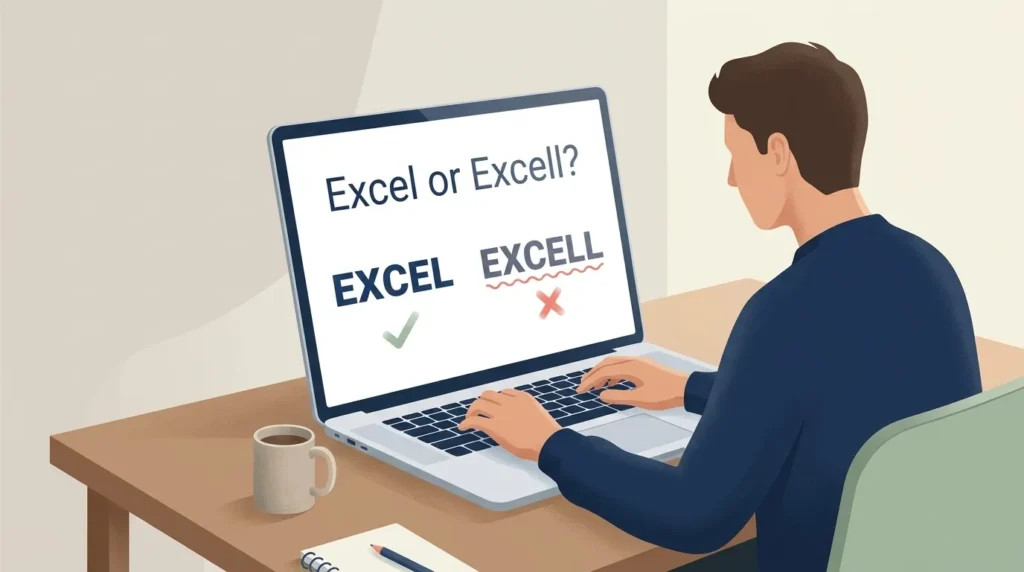

The correct spelling is excel, with one l at the end. Excell is a common misspelling of the verb excel, which means to do something exceptionally well or to be very good at a particular activity. For example, “She excels at mathematics” is correct. Use Excel with a capital E when referring to Microsoft Excel, the spreadsheet program. In ordinary writing, never add a second l to the verb.
What Is the Difference Between Excel and Excell?
The difference is simple: excel is the correct English word, while excell is generally an incorrect spelling when you mean “to do very well.”
The verb excel describes performing exceptionally well, showing a high level of skill, or achieving outstanding results. It can apply to schoolwork, sports, professional tasks, creative activities, and many other areas.
For example:
- Correct: “He wants to excel in his career.”
- Incorrect: “He wants to excell in his career.”
There is also a second common use of Excel: it is the name of Microsoft’s spreadsheet application. That proper name is capitalized, but the spelling remains the same.
Why Does the Correct Spelling Matter?
Spelling errors can affect how clearly and professionally your writing comes across. If you write excell in a job application, academic assignment, business email, or professional profile, readers may interpret it as a basic spelling mistake.
The issue is especially important because excel often appears in contexts where you want to communicate competence or achievement.
Compare these statements:
- “I aim to excel in a leadership role.”
- “I aim to excell in a leadership role.”
The first sentence communicates your goal clearly. The second contains a spelling error that may distract from your message.
Correct spelling also helps search engines, readers, and digital tools interpret your content more accurately.
The Core Rule: Use “Excel” With One Final L
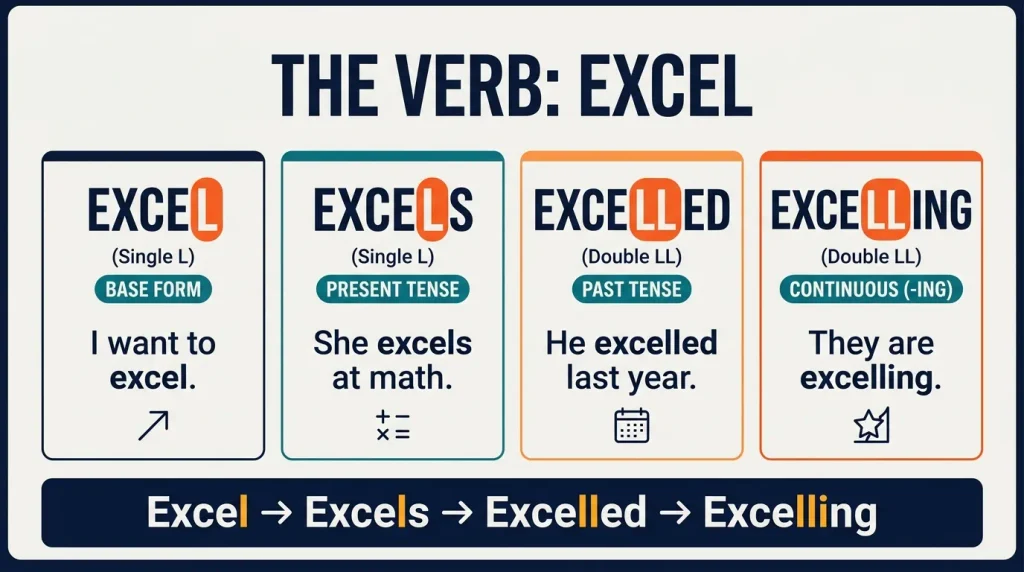
The base verb is always spelled “excel.” However, when you add certain endings, the final l doubles: excel → excelled and excel → excelling. The third-person form is excels, with one final l followed by s.
Remember these forms:
| Verb form | Correct spelling | Example |
|---|---|---|
| Base form | excel | I want to excel. |
| Third-person singular | excels | She excels at writing. |
| Past tense | excelled | He excelled in science. |
| Past participle | excelled | They have excelled this year. |
| Present participle | excelling | We are excelling at our work. |
The important point is that “excell” is not the base form, even though excelled and excelling contain two l letters.
How to Use “Excel” Correctly
Use excel when describing someone who performs very well, demonstrates a strong skill, or achieves outstanding results. The verb commonly appears with at or in, depending on what follows.
Use “excel at” for skills and activities
Use excel at when talking about something a person does particularly well.
- Maya excels at solving difficult puzzles.
- Our team excels at customer service.
- He wants to excel at public speaking.
- My sister excels at playing the piano.
Use “excel in” for subjects, fields, and areas of achievement
Use excel in when referring to a subject, profession, field, or broader area of performance. There is some overlap with excel at, so the choice is not an absolute rule.
- She excels in mathematics.
- The company excels in renewable energy research.
- He excelled in his final examinations.
- They hope to excel in their chosen careers.
Use “Excel” for Microsoft’s software
Capitalize Excel when referring to the spreadsheet program.
- Please enter the figures in Microsoft Excel.
- I created an Excel spreadsheet for the monthly budget.
- The finance team uses Excel to analyze sales data.
The capital letter identifies the product name. It does not change the spelling.
Correct Examples of “Excel” in Sentences
Here are examples from everyday life, education, professional communication, and technology.
- Conversation: “You really excel at explaining difficult ideas.”
- Email: “I hope to excel in my new position.”
- School: “Aisha continues to excel in mathematics.”
- Workplace: “Our department excels at solving customer problems.”
- Job application: “I am motivated to excel in a challenging role.”
- Academic writing: “Students often excel when they receive clear feedback.”
- Sports: “The young athlete excelled throughout the tournament.”
- Social media: “Keep practicing, and you will have more opportunities to excel.”
- Business report: “The company excels in product development and customer support.”
- Personal development: “You do not need to be perfect to excel at something.”
- Technology: “I used Excel to organize the survey results.”
- Past achievement: “The team excelled under pressure.”
- Ongoing progress: “Several students are excelling in the advanced course.”
- Future goal: “She hopes to excel as a software engineer.”
Notice how the word changes according to the sentence. The base form excel can follow to, will, can, and other modal verbs, while excels, excelled, and excelling fit different grammatical structures.
Incorrect vs. Correct: 12 Common Examples
| ❌ Incorrect | ✅ Correct | Why |
|---|---|---|
| I want to excell at my job. | I want to excel at my job. | The base verb has one final l. |
| She excells in science. | She excels in science. | Add s to the base form; do not double the l. |
| He hopes to excell in business. | He hopes to excel in business. | The verb after to uses the base form. |
| They are exceling at school. | They are excelling at school. | The final l doubles before -ing. |
| She has excell in every subject. | She has excelled in every subject. | The present perfect requires the past participle excelled. |
| Our team excell at teamwork. | Our team excels at teamwork. | A singular subject takes excels in the present tense. |
| I excelleds in the competition. | I excelled in the competition. | The past-tense form does not take an additional s. |
| He is excel at mathematics. | He excels at mathematics. | Use excels for a general ability, or is excelling for current progress. |
| We will excell next year. | We will excel next year. | After will, use the base form. |
| The student is excelled this term. | The student excelled this term. | Use the simple past for a completed achievement. |
| Save the file in Excell format. | Save the file in Excel format. | The software name is Microsoft Excel. |
| I work with Microsoft Excell. | I work with Microsoft Excel. | The product name has one final l. |
Why Do People Confuse “Excel” and “Excell”?
Several spelling habits make this mistake understandable, even though the correction is straightforward.
1. The double L in “excelled” and “excelling”
This is probably the most useful clue to understand. Because excelled and excelling contain two l letters, writers may assume the base word must also have two. However, the correct base form is excel. The doubled consonant appears when certain endings are added.
2. Similar-looking words
English contains words such as excellent, spell, and compel. Seeing the double l in excellent can make excell look plausible. Nevertheless, similar-looking words do not always follow the same spelling pattern.
3. Pronunciation does not reveal the spelling
Excel and the mistaken form excell are generally pronounced the same when someone intends the English verb. Since the extra letter does not create a different sound, listening alone will not help you identify the spelling error.
4. Autocomplete and spellcheck can miss mistakes
Digital writing tools are useful, but they are not perfect. A tool may overlook an error, especially in a name, brand, or unusual context. Therefore, do not assume that a word is correct simply because your device did not underline it.
5. Translation and second-language learning
English learners may apply spelling patterns from their first language or rely on how a word sounds. They may also remember excellent before learning the spelling of excel. The solution is to learn the base verb and its forms together rather than memorizing only one isolated spelling.
Common Mistakes Checklist
Before submitting an essay, email, report, or website article, check these points:
- Writing “excell” as the base verb: Replace it with excel.
- Writing “excells”: Use excels for he, she, or it in the present tense.
- Writing “exceling”: Use excelling when describing ongoing progress.
- Writing “excelleds”: Use excelled for the simple past and past participle.
- Using the wrong verb form after a helping verb: Write “will excel,” “has excelled,” and “is excelling.”
- Misspelling the software name: Write Microsoft Excel, not Microsoft Excell.
- Confusing the verb with the adjective: Write “She excels at writing” or “She is an excellent writer,” depending on the intended meaning.
A quick proofreading trick is to search your document for “excell”. Then inspect each result. In ordinary writing about achievement or spreadsheet software, it will usually need correction.
ALSO READ: Loosing or Losing: Meaning, Difference and Examples.
Excel in Real English
Grammatically correct
Excel is a standard verb used in both formal and everyday English. You can say that someone excels at a skill, excels in a subject, or excelled during an event. For example, “The candidate excels at communicating with clients” is grammatically correct and suitable for a professional setting. The forms excels, excelled, and excelling are also correct when the sentence structure calls for them.
Grammatically possible but potentially unnatural
A sentence can be grammatically sound yet feel unnecessarily formal or vague for its situation. For example, “I intend to excel in the activity of preparing dinner” is understandable, but most everyday speakers would simply say, “I want to become a better cook.” The verb excel often emphasizes strong performance or achievement, so it may sound overly grand when the subject is a routine task.
Natural, everyday English
In everyday conversation, excel is natural when discussing a real strength, an achievement, or an area where someone performs particularly well. People commonly say, “She excels at math,” “He excels in his field,” or “Our team excelled under pressure.” In more casual situations, phrases such as “She’s really good at math” may sound friendlier and less formal. Choose the expression that fits your audience and purpose.
ALSO READ: Altar vs. Alter: Differences, Examples, and Easy Rules.
American vs. British English
There is no spelling difference between American and British English for this word. Both varieties use excel, excels, excelled, and excelling.
The British expression excel yourself is also used to mean doing something better than you usually do, sometimes with a sense of praise or surprise. For example, “You’ve really excelled yourself with this meal” is a familiar British-style usage. This is a difference in expression, not a different spelling of excel.
Formal vs. Informal Usage
The verb excel works in both formal and informal contexts, although it can sound more polished or achievement-focused than everyday alternatives.
| Context | Natural example |
|---|---|
| Formal report | “The department excels in risk management.” |
| Job application | “I aim to excel in a collaborative environment.” |
| Academic writing | “The students excelled in the final assessment.” |
| Everyday conversation | “You really excel at making people feel welcome.” |
| Casual conversation | “You’re really good at this.” |
| Software instructions | “Open the data file in Microsoft Excel.” |
Use excel when you want to emphasize a high level of performance. Use simpler alternatives such as do well, be good at, or perform strongly when a more conversational tone suits the situation.
Excel vs. Excell: Comparison Table
| Feature | Excel | Excell |
|---|---|---|
| Standard spelling of the verb | Correct | Incorrect |
| Meaning | To perform exceptionally well | No standard meaning as this verb |
| Base form | excel | Not standard |
| Present-tense form | excels | Not standard |
| Past-tense form | excelled | Not standard |
| Present participle | excelling | Not standard |
| Spreadsheet software | Microsoft Excel | Incorrect spelling of the product name |
| Suitable for formal writing | Yes | No, when intended to mean excel |
One detail is worth remembering: the fact that excell is generally a misspelling does not mean that every word beginning with those letters is incorrect. For example, excellent is a correctly spelled adjective. Always judge the full word and its intended meaning.
Real-Life Situations: Which Form Should You Use?
In a job interview
Interviewer: “What is one of your professional strengths?”
Candidate: “I excel at organizing complex projects and keeping the team informed.”
This is a good use of excel because the candidate is describing a skill.
In a work email
Incorrect: “I hope to excell in my new position.”
Correct: “I hope to excel in my new position.”
The base form follows hope to.
In a school assignment
Incorrect: “Ali excells in English.”
Correct: “Ali excels in English.”
The subject Ali is singular, so the present-tense form is excels.
In a progress report
Correct: “The student is excelling in mathematics this term.”
The present continuous form is excelling describes ongoing progress.
When sharing a spreadsheet
Incorrect: “I have attached the report in Microsoft Excell.”
Correct: “I have attached the report in Microsoft Excel.”
The software name is a proper noun and should be spelled Excel.
How to Remember the Correct Spelling
Use this three-step memory method:
- Start with the base form: The word is excel, with one final l.
- Learn the common forms together: excel, excels, excelled, excelling.
- Check the meaning: If you mean doing very well or using Microsoft’s spreadsheet program, write excel or Excel, as appropriate.
A short reminder is: “I excel; I excelled; I am excelling.” The base word has one final l, while the past-tense and -ing forms double it.
Quick Quiz: Excel or Excell?
Choose the correct form for each sentence before checking the answers.
- She wants to (excel / excell) in science.
- Our manager (excels / excells) at solving problems.
- The team is (exceling / excelling) this season.
- He (excelled / excell) in his final exams.
- Please open the file in Microsoft (Excel / Excell).
- With practice, you can (excel / excell) at public speaking.
Answers
- excel — the base form follows wants to.
- excels — the present-tense form for a singular subject.
- excelling — the correct -ing form.
- excelled — the correct past-tense form.
- Excel — the software’s proper name.
- excel — the base form follows can.
FAQ: Excel or Excell
Is “excell” ever correct?
Not when you mean the standard English verb excel or Microsoft’s spreadsheet software. In those contexts, excell is a misspelling. A proper name or business name may independently use that spelling, but that does not make it the correct form of the ordinary English verb.
Why does “excelled” have two Ls if “excel” has one?
When the verb takes the endings -ed or -ing, its final consonant doubles: excelled and excelling. The base form remains excel. Learning these forms together helps prevent the common mistake of writing excell.
Is “excels” spelled with one L or two?
It is spelled excels, with one l followed by s. For example, “My brother excels at chess” is correct.
Is “excellent” related to “excel”?
Yes. The words are related in meaning and origin, but they have different spellings and grammatical roles. Excel is a verb, while excellent is an adjective: “She excels at writing” and “She is an excellent writer.”
Should I write “excel at” or “excel in”?
Both are correct. Excel at often introduces a skill or activity, as in “He excels at coding.” Excel in often introduces a subject or broader field, as in “She excels in engineering.” There is overlap, so use the phrasing that best fits your sentence.
Is Excel a noun or a verb?
It can be both, depending on capitalization and context. Lowercase excel is usually a verb meaning to perform exceptionally well. Capitalized Excel is the name of Microsoft’s spreadsheet software and is used as a proper noun.
Does “excel” mean the same as “succeed”?
The meanings overlap, but they are not identical. Succeed means achieving an intended result or goal. Excel emphasizes performing exceptionally well or demonstrating a high level of ability. Someone can succeed at a task without necessarily excelling at it.
How do I pronounce “excel”?
It is commonly pronounced ik-SEL, with the stress on the second syllable. The misspelling excell is generally pronounced the same way, which is why pronunciation alone cannot help you distinguish the spellings.
Is “excel” formal or informal?
It is appropriate in both formal and informal English. It works well in professional reports, applications, academic writing, and everyday conversation. In relaxed conversation, do well or be good at may sometimes sound more casual.
What is the easiest way to remember “excel or excell”?
Remember the base verb with one final l: excel. Then memorize its common forms: excels, excelled, and excelling. The extra l appears in excelled and excelling, not in the base form.
Quick Summary
The correct spelling is excel, not excell, when you mean to perform exceptionally well or demonstrate a high level of skill. Use excel after words such as to, can, and will. For the present tense, write excels; for the past tense and past participle, use excelled; and for the -ing form, use excelling. The double l in excelled and excelling is a common reason people misspell the base verb. When referring to Microsoft’s spreadsheet application, capitalize the name as Excel. The spelling is the same in American and British English. To remember the rule, learn all four verb forms together: excel, excels, excelled, excelling.