
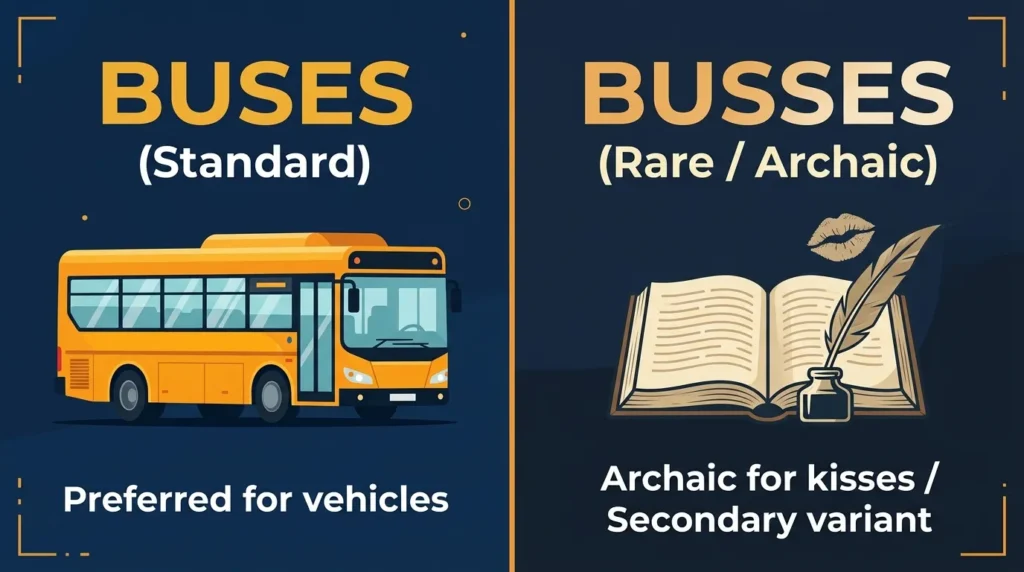

Buses is the overwhelming standard plural spelling for large passenger vehicles. Busses is an acceptable but rare secondary variant for the plural noun, and it historically refers to the verb buss, which means to kiss or to clear restaurant tables. To avoid errors in modern writing, always use buses for vehicles.
What Is Busses or Buses?
The debate between buses and busses comes down to primary standard spelling versus rare historical variants.
- Buses is the dominant plural form of the noun bus (a large motor vehicle carrying passengers). It is also the most common third-person singular present tense verb form (e.g., “He buses tables at night”).
- Busses is a valid historical alternative plural for vehicles, but it is rarely used today. More uniquely, busses is the plural noun or present-tense verb derived from buss, an archaic word meaning “to kiss.”
Why It Matters
Using the wrong spelling can make your writing appear outdated or unintentionally ambiguous:
- Editorial & Professional Standards: Major style guides and global publishing houses mandate buses for public transport. Using busses in reports, news articles, or academic papers can look like a typo.
- Accidental Double Entendre: Because buss means a kiss, writing “She receives many busses every morning” could be interpreted as receiving many kisses rather than catching multiple commuter vehicles.
- Consistency across Global English: Standardizing on buses ensures seamless readability across American, British, Canadian, and Australian dialects.
The Core Rule
The Core Rule:
Always write Buses when referring to vehicles.
Reserve Busses only if you intentionally mean kisses or rare culinary table-clearing contexts where double s is specifically preferred.
- Buses = Standard plural for vehicles (1 s in the middle).
- Busses = Rare variant for vehicles / kisses / clearing dishes (2 s‘s in the middle).
How to Use It
Plural Noun (Vehicles)
When counting or referring to multiple transit vehicles, use buses:
- “Three school buses idling outside.”
- “City buses run every fifteen minutes.”
Verb Forms (Transporting & Table Clearing)
When using the verb meaning to transport by bus or to clear dishes from restaurant tables:
- Standard Verb: Buses / Bused / Busing
- “The company buses employees to the campus.”
- “She bused tables during college.”
- Alternative Verb (Less Common): Busses / Bussed / Bussing
- While accepted in some dictionaries, the single-S form (bused, busing) remains the preferred modern standard in news and business.
Correct Examples Across Contexts
- Conversation: “We missed two buses this morning because of the heavy rain.”
- Email: “Please note that shuttle buses will pick up conference attendees at 8:00 AM.”
- School: “Students must line up in an orderly fashion before boarding the school buses.”
- Workplace: “The municipality is investing in electric buses to reduce urban emissions.”
- Social Media: “Why do three buses always arrive at the exact same time after waiting for an hour?”
- Academic Writing: “Public transit infrastructure relies on municipal buses to connect low-income neighborhoods.”
- Literature: “An old poem recounted sweet busses shared under the moonlight.” (Meaning kisses)
- Restaurant Industry: “The busser buses tables efficiently during the dinner rush.”
- News Media: “Transit authorities confirmed that city buses will run on holiday schedules tomorrow.”
- Legal/Policy: “Regulations mandate seatbelt installation across all newly manufactured intercity buses.”
Incorrect vs. Correct Usage
| ❌ Incorrect | ✅ Correct | Why It Is Incorrect |
| The city bought twenty new electric busses. | The city bought twenty new electric buses. | While busses appears in dictionaries as an alternative, buses is the standard spelling for vehicles. |
| All school busses must stop at railroad crossings. | All school buses must stop at railroad crossings. | Standard educational and official guidelines specify buses. |
| He busses to work every single morning. | He buses to work every single morning. | Standard modern usage favors single s (buses) for transport action. |
| Double-decker busses are famous in London. | Double-decker buses are famous in London. | British English strongly prefers single-S buses for transport vehicles. |
| We waited for the tour busses outside the museum. | We waited for the tour buses outside the museum. | Single s is preferred to maintain standard publication quality. |
| The charter busses were delayed by roadwork. | The charter buses were delayed by roadwork. | Vehicles should consistently use buses. |
| Transit busses help cut down inner-city traffic. | Transit buses help cut down inner-city traffic. | Buses is the recognized, modern noun form. |
| Passengers loaded onto the regional busses. | Passengers loaded onto the regional buses. | Using double s introduces unnecessary variance. |
| Night busses operate on modified schedules. | Night buses operate on modified schedules. | Prefer single s for all vehicle plurals. |
| Fleet owners are upgrading their diesel busses. | Fleet owners are upgrading their diesel buses. | Commercial standards require buses. |
Why People Make This Mistake
Understanding why the double-S spelling occurs helps clarify why the rule developed:
- Short Vowel Doubling Rule: In English phonics, a short vowel followed by a single consonant often doubles that consonant when adding a suffix (e.g., gas $\rightarrow$ gasses, quiz $\rightarrow$ quizzes, buss $\rightarrow$ bussed). Writers naturally expect bus to become busses.
- Historical Overlap: In the early to mid-20th century, busses was significantly more common in printed English than it is today.
- Spellcheck Tolerance: Most modern software dictionaries accept busses as a valid word because it exists as an archaic noun for a kiss and a secondary variant for vehicles.
Common Mistakes Checklist
- Doubling the S when making the noun plural:
- The Mistake: Writing “busses” when talking about transit.
- Why it happens: Overapplying short-vowel spelling rules.
- How to avoid: Remember that bus is an shortened clipping of omnibus, following simple plural addition (+s).
- Confusing Verb Conjugations (Bused vs. Bussed):
- The Mistake: Mixing up single-S and double-S forms across a document.
- Why it happens: Lack of consistent house style rules.
- How to avoid: Stick to single s across all forms: bus, buses, bused, busing.
- Assuming Busses is purely an error:
- The Mistake: Correcting historical poetry or older texts where busses means kisses.
- How to avoid: Recognize that buss (kiss) is a distinct headword in English dictionaries.
Busses or Buses in Real English
1. Daily Transportation and News
In everyday conversation, news broadcasts, and digital media, buses is used almost exclusively. Native speakers in North America, Europe, and Australia write buses without hesitation when describing local transit.
Example: “I prefer taking buses over the subway during rush hour.”
2. Culinary and Hospitality Industry
In restaurant management, the verb to bus refers to clearing dirty dishes. While some culinary manuals historically wrote busses or bussed, modern job postings and training guides now standardly adopt buses, bused, and busing.
Example: “The server buses the table as soon as the guests leave.”
American vs. British English
Unlike many spelling differences (such as color/colour or organize/organise), there is no regional split between American and British English regarding this keyword:
- American English (AmE): Strongly prefers buses. Busses appears occasionally in older technical manuals, but major style guides (such as AP and Chicago) specify buses.
- British English (BrE): Strictly prefers buses. Busses is viewed as non-standard or obsolete across the UK and Commonwealth countries.
Formal vs. Informal Usage
- Buses: Required in formal, academic, legal, business, and journalistic contexts. It is equally natural in casual text messages and personal posts.
- Busses: Restricted to literary contexts referencing archaic terms for kissing (buss), or as an optional secondary variant in informal writing.
| Register | Example Usage |
| Formal / Academic | “Municipal policy dictates that all city buses transition to zero-emission engines by 2030.” |
| Informal / Conversational | “We can catch one of the night buses after the concert ends.” |
Comparison Table
| Feature | Buses | Busses |
| Primary Part of Speech | Noun (plural) / Verb (3rd person) | Noun (plural) / Verb (3rd person) |
| Primary Meaning | Multiple motor vehicles for public transport. | Rare variant for vehicles; plural of buss (kisses). |
| Standard Status | Universal modern standard. | Secondary variant / Archaic usage. |
| Past Tense Verb | Bused | Bussed |
| Present Participle | Busing | Bussing |
| Example Sentence | “The city operates 500 buses.” | “Old ballads speak of warm busses and fond farewells.” |
Real-Life Situations
- Job Interview: “In my previous role, I optimized transit schedules for over two hundred municipal buses.”
- Business Email: “Due to road construction, express buses will be rerouted starting Monday morning.”
- School Assignment: “Write an essay explaining how public buses help reduce carbon footprints in major urban centers.”
- Text Message: “Are you taking the subway or riding the buses?”
- Hospitality Training: “Every staff member buses dirty dishes to maintain clean dining areas.”
ALSO READ: Altar vs. Alter: Differences, Examples, and Easy Rules.
Practice Quiz
Test your knowledge of busses vs. buses. Choose the best option for each sentence below:
- How many (busses / buses) pass by this station every hour?
- Modern electric (busses / buses) produce zero tailpipe emissions.
- The server efficiently (buses / busses) the dirty glassware from the bar.
- She read a Victorian poem about tender (busses / buses) shared in secret.
- Tour (busses / buses) were parked along the main avenue.
- The school district purchased ten new (busses / buses) for the athletic team.
- He (bused / bussed) tables all summer to pay for college tuition.
- Automated transit apps track all city (busses / buses) in real time.
Quiz Answer Key
- buses (Standard plural noun for transit vehicles)
- buses (Standard plural noun for vehicles)
- buses (Standard present-tense verb for clearing dishes)
- busses (Archaic noun meaning kisses)
- buses (Standard plural noun for vehicles)
- buses (Standard plural noun for school vehicles)
- bused (Standard single-S past tense verb form)
- buses (Standard plural noun for transit vehicles)
ALSO READ: Lier vs Liar: Correct Spelling, Meaning & Easy Memory Trick.
Frequently Asked Questions
Is busses ever correct for public transit vehicles?
Yes, busses is listed in major dictionaries as an acceptable secondary spelling for multiple vehicles. However, buses is the overwhelming standard used by publishers, news media, and style guides worldwide.
Why does buses only have one S in the middle?
Bus entered English as a shortened form (clipping) of the Latin word omnibus. When forming the regular plural, standard English simply adds -es, resulting in buses.
Is bussed or bused preferred for the past tense?
Bused with a single s is preferred in modern publication and formal writing, though bussed is recognized as a variant.
What does the word buss mean?
Buss is an archaic or literary noun and verb meaning a kiss or to kiss playfully.
Do British and American English treat buses differently?
No. Both American and British English mandate buses as the primary, standard plural form for public transport vehicles.
How do major style guides rule on buses vs. busses?
Major style guides—including the Associated Press (AP) Stylebook and The Chicago Manual of Style—specify buses for vehicles and bused/busing for verb forms.
What is the correct present participle: busing or bussing?
Busing is the preferred modern standard spelling, though bussing is accepted as a alternative.
Why doesn’t spellcheck flag busses as a typo?
Spellcheck tools usually do not flag busses because it is a valid dictionary entry (both as a secondary plural for vehicles and as the plural of buss).
Quick Summary
Choosing between busses and buses is straightforward when following modern editorial standards. Buses is the primary, globally accepted plural noun for public transit vehicles, as well as the standard third-person singular verb form. While busses appears in dictionaries as a secondary variant, it is rarely used in contemporary publishing and historically refers to the word buss, meaning a kiss or to kiss.
By consistently using buses, bused, and busing, you ensure your writing remains professional, clear, and aligned with all major English style guides across both American and British dialects.