


Use losing when you mean failing to win, misplacing something, or no longer having something. Use loosing when you mean releasing or setting something free. Although the words look almost identical, their meanings are different. For example, you are losing your keys if you cannot find them, but an archer may be loosing arrows by releasing them from a bow. In everyday English, losing is the word you will need far more often.
Loosing or Losing?
Choose losing when something is being lost, reduced, misplaced, or not won. For example, you might be losing money, losing weight, losing patience, or losing a match. In contrast, loosing comes from the verb loose and means releasing or setting something free. An archer can be loosing arrows, for instance. Therefore, the easiest way to choose correctly is to identify the intended meaning first: lose → losing; loose → loosing.
What Do Losing and Loosing Mean?
Although losing and loosing share a similar appearance, each word comes from a different base verb. Understanding those base verbs makes the distinction much easier to remember.
What Does Losing Mean?
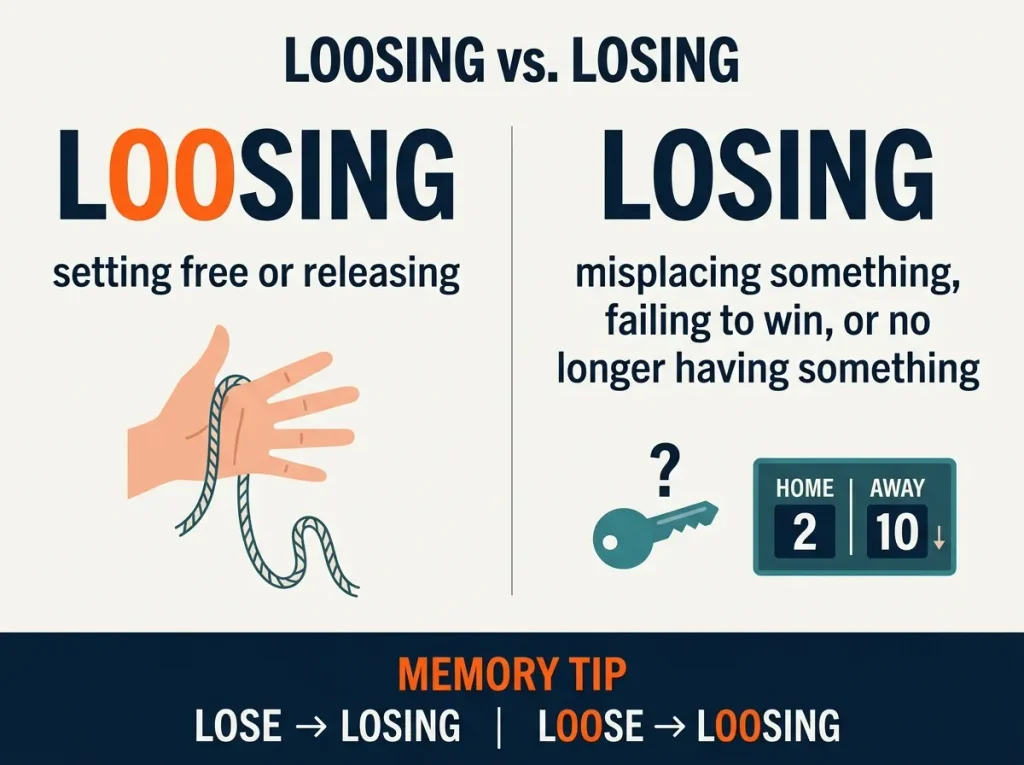
Losing is the -ing form of the verb lose. It describes failing to keep, win, or maintain something, or experiencing a reduction or disadvantage.
For example, you might be losing a competition, losing your phone, or losing confidence. Similarly, a business can be losing customers, and a student can be losing concentration during an exam.
Common expressions include:
- Losing a game or competition
- Losing your keys or phone
- Losing money or business
- Losing weight
- Losing patience or confidence
- Losing interest in a subject
- Losing control or hope
- Losing time or an opportunity
Notice that the word applies to both physical and abstract things. You can lose an object, but you can also lose an advantage, a feeling, or the ability to control a situation.
Example: Our team is losing the match, but we still have time to recover.
Here, losing means that the team is currently behind or failing to win.
What Does Loosing Mean?
Loosing is the -ing form of the verb loose, which can mean to release, free, or let something go. Although this use is grammatically correct, it is considerably less common in everyday English than losing.
For example, an archer may loose an arrow, or someone may loose an animal from its restraint. The word also appears in historical, literary, and specialised descriptions.
Examples include:
- Loosing an arrow from a bow
- Loosing hounds to follow a trail
- Loosing a bird from a cage
- Loosing a captive from restraint
However, loosing is not the usual choice when you simply mean making something less tight. In that situation, loosening is generally the more natural verb.
Example: The archer was loosing arrows towards the distant target.
In this sentence, loosing means releasing arrows, not misplacing them.
The Core Rule: Lose vs. Loose
The simplest way to remember the difference is to connect each ing form to its base verb.
LOSE → LOSING
Use when something is lost, not won, reduced, or no longer maintained.
Examples: losing money, losing a game, losing patience.
LOOSE → LOOSING
Use when something is released, freed, or let go.
Examples: loosing an arrow, loosing an animal.
Keep in mind that loose is also commonly an adjective meaning not tight. For instance, My shoelace is loose describes its condition. If you mean that the shoelace is becoming less tight, however, The knot is loosening is usually the natural choice.
A Simple Memory Trick
Remember these two connections:
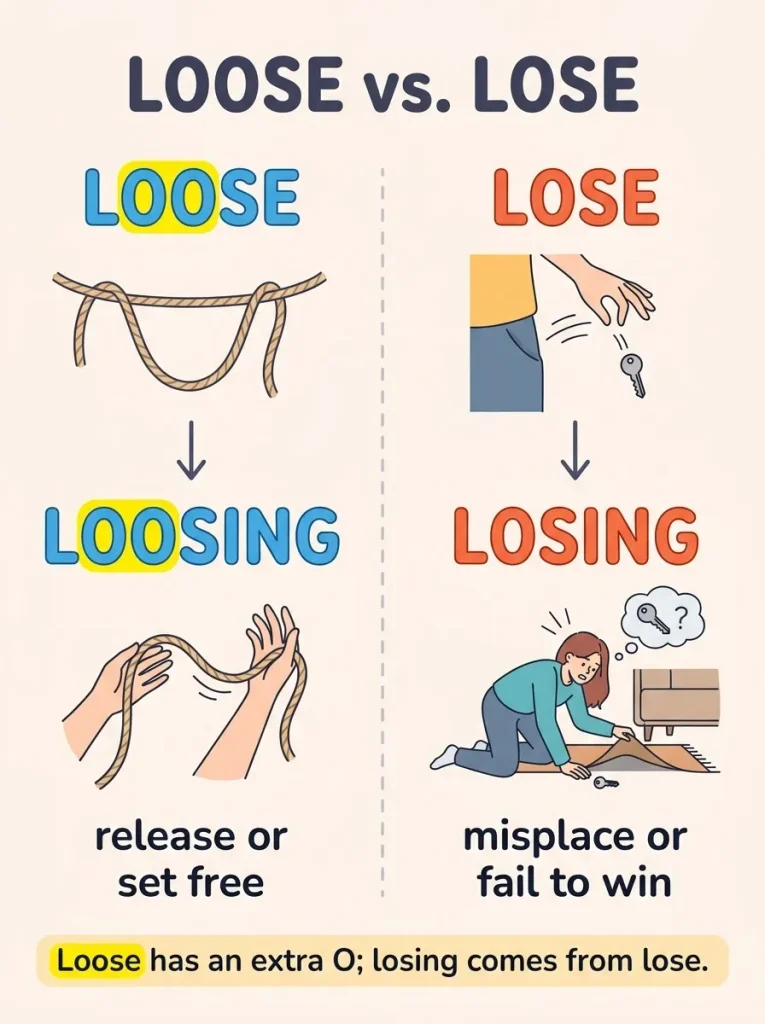
- Lose has one “o,” so losing has one “o.” Use it for loss, defeat, or reduction.
- Loose has two “o” letters, so loosing keeps two “o” letters. Use it when something is being released.
You can also test the sentence by replacing the word with a simpler expression. If failing to keep makes sense, choose losing. If releasing makes sense, loosing may be correct.
How to Use Losing and Loosing Correctly
Once you know the base verbs, the choice becomes much more straightforward. First, identify what is happening in the sentence. Then select the word that expresses that action.
Use Losing for Loss, Defeat, or Reduction
Choose losing whenever the intended meaning involves no longer having something, failing to win, or experiencing a decline.
For example:
- Everyday life: I keep losing my house keys.
- Health: She is losing weight gradually.
- Sports: Our team is losing by two points.
- Business: The company is losing customers to its competitors.
- Education: I am losing focus because the room is noisy.
- Emotions: He is losing patience with the repeated delays.
- Technology: My phone is losing battery power quickly.
- Relationships: They are losing trust in the organisation.
In each case, the sentence describes loss or reduction rather than release. Therefore, loosing would communicate the wrong meaning.
Use Loosing for Releasing or Setting Free
Choose loosing only when the verb loose accurately describes the action.
For example:
- The archer was loosing arrows at the target.
- The keeper began loosing the hounds.
- The story described soldiers loosing arrows from the castle walls.
- The handler was loosing the birds from their enclosure.
These examples are grammatically possible, but some sound specialised or literary in modern English. In everyday conversation, releasing the arrows or letting the birds go may sound more natural.
Moreover, if you mean removing tension from a rope or making a screw less tight, use loosening in most ordinary situations.
Example: The mechanic is loosening the bolt before removing the wheel.
Here, loosening means making the bolt less tight. It does not mean releasing something into the open.
Correct Examples of Losing and Loosing
The following examples show how the words work across everyday conversations, education, work, emails, social media, and formal writing.
Examples of Losing
- Conversation: “I think I am losing my wallet again.”
- Email: “We are losing valuable time because the files have not arrived.”
- School: “I keep losing concentration during long lectures.”
- Workplace: “The department is losing experienced employees.”
- Social media: “I am losing followers, but I am still enjoying creating content.”
- Academic writing: “The study examines why some participants are losing interest in the programme.”
- Sports: “Our team is losing the final by one point.”
- Finance: “The business has been losing money for three consecutive months.”
- Relationships: “She worries about losing contact with her childhood friends.”
- Technology: “The wireless connection keeps losing its signal.”
In every example, losing refers to a loss, decline, or failure to maintain something.
Examples of Loosing
- Archery: “The archer was loosing arrows towards the target.”
- Historical fiction: “The defenders began loosing arrows from the city walls.”
- Hunting narrative: “At dawn, the hunters were loosing the hounds.”
- Animal release: “The keeper was loosing the birds from their enclosure.”
These examples are valid uses of loosing, but they describe relatively specific actions. Consequently, most everyday writers will use the word losing much more frequently.
Incorrect vs. Correct: 12 Common Examples
The extra “o” can change the meaning of a sentence. Therefore, always check the intended action rather than relying on the appearance of the word.
| ❌ Incorrect | ✅ Correct | Why |
|---|---|---|
| I am loosing my keys. | I am losing my keys. | You are misplacing your keys, not releasing them. |
| She is loosing weight. | She is losing weight. | Weight is decreasing, so the verb is lose. |
| We are loosing the game. | We are losing the game. | The team is failing to win. |
| He is loosing patience. | He is losing patience. | He is running out of patience. |
| The company is loosing money. | The company is losing money. | The company is experiencing a financial loss. |
| I do not want to loose this opportunity. | I do not want to lose this opportunity. | An opportunity can be lost, not ordinarily loosed. |
| They are loosing customers. | They are losing customers. | Customers are leaving or no longer buying from the business. |
| She is loosing confidence. | She is losing confidence. | Her confidence is declining. |
| I am afraid of loosing control. | I am afraid of losing control. | The meaning is failing to maintain control. |
| He keeps loosing his phone. | He keeps losing his phone. | He repeatedly misplaces his phone. |
| The students are loosing focus. | The students are losing focus. | Their attention is fading. |
| The team is loosing its advantage. | The team is losing its advantage. | The team is no longer maintaining its lead or benefit. |
Important: Loosing is not always incorrect. For example, “The archer is loosing an arrow” can be correct because it describes releasing an arrow. The mistake occurs when loosing is used to express loss, defeat, or reduction.
Why People Confuse Loosing and Losing
Several factors make these words easy to mix up. Fortunately, understanding the cause helps you prevent the error.
1. The Spellings Look Almost Identical
The words differ by only one letter. Since both begin with loo- in their written form, a writer may add an extra “o” without noticing that the base verb has changed.
However, the correct spelling depends on whether the intended verb is lose or loose. Remembering the base verb is more reliable than guessing from the finished word.
2. Their Pronunciation Is Similar
The two words share a similar vowel sound, but their final consonant sounds differ in standard pronunciation:
- Losing: the middle consonant has a /z/ sound, like the sound in easy.
- Loosing: the middle consonant has an /s/ sound, like the sound in missing.
Consequently, the words are not exact homophones. Nevertheless, quick speech, unfamiliarity with the rarer word, or difficulty distinguishing the consonants can contribute to confusion.
3. Writers Overgeneralise Spelling Patterns
English spelling has many familiar patterns, but they do not always work consistently. Because loose has two “o” letters, some writers assume that its appearance should carry over whenever they need a similar-sounding word.
However, lose is a separate verb with its own spelling. Its -ing form is losing, not loosing.
4. Spellcheck Does Not Always Catch the Error
Spellcheckers often identify misspelled words. However, both losing and loosing are legitimate English forms, so a spelling checker may accept either one without recognising that the meaning is wrong in a particular sentence.
For example, “I am loosing weight” contains a real word, but it does not express the intended meaning. Therefore, proofreading must include a context check, not just a spelling check.
5. Translation Can Reinforce the Confusion
Some learners translate a word directly from another language and then choose an English spelling that looks familiar. However, a single word in another language may cover several meanings that English expresses through different verbs.
As a result, it is safer to learn the English expressions in context. Memorise lose weight, lose a game, and lose patience as complete phrases, rather than learning only the isolated word lose.
Common Mistakes Checklist
Before submitting an email, assignment, report, or social media post, check for these frequent problems.
- Using loosing for misplacing something. This happens when the extra “o” slips into the word. Instead, use losing because the object is no longer where you expect it to be.
- Writing loosing weight. Weight reduction involves loss, not release. Therefore, the standard phrase is losing weight.
- Confusing loose with lose. Loose is often an adjective meaning not tight, while lose is a verb meaning to no longer have something or fail to win. Check the role the word plays in the sentence.
- Using loosing when you mean making something less tight. In most everyday contexts, loosening is the natural verb for reducing tightness.
- Assuming loosing is never a real word. It is valid when it means releasing or setting free. The problem is not the spelling itself but whether it matches the intended meaning.
- Trusting autocorrect without reading the sentence. Because both forms exist, a spellchecker may not flag the error. Read the whole sentence and check its meaning.
Ultimately, the most reliable habit is to ask: “Am I losing something, or am I releasing something?”
Loosing or Losing in Real English
The difference between these words is not simply a matter of correct and incorrect spelling. It also involves choosing the expression that fits the situation naturally.
Grammatically Correct
“I am losing my keys” is grammatically correct because losing is the present participle of lose and works with am to form the present continuous tense. Similarly, “The archer is loosing an arrow” is grammatically possible because loosing comes from the verb loose. In both cases, the word form is correct, provided the sentence expresses the intended meaning.
Grammatically Possible but Unnatural
“The mechanic is loosing the bolt” may be understood as an attempt to describe releasing something, but it is not the usual expression if the mechanic is making the bolt less tight. In that situation, “The mechanic is loosening the bolt” is clearer and more natural. Although the words are related, loosing and loosening do not serve as interchangeable choices in every context.
Natural, Everyday English
In everyday communication, losing appears in familiar expressions such as losing my keys, losing weight, losing money, and losing patience. By contrast, loosing is much less common and usually appears when a writer specifically means releasing something, particularly in descriptions of archery, hunting, or historical scenes. Therefore, if you are unsure, losing is likely correct when the sentence is about loss rather than release.
ALSO READ: Busses or Buses? Correct Plural & Verb Usage Explained.
American vs. British English
There is no standard American-versus-British spelling distinction between losing and loosing. Both varieties use the same spellings and the same basic distinction in meaning.
For example, an American writer would write “She is losing interest in the project,” and a British writer would use the same spelling. Likewise, loosing can be used in either variety when the intended meaning is releasing or setting free.
Therefore, do not choose between these words based on the country or variety of English. Choose according to the meaning of the sentence.
Formal vs. Informal Usage
The spelling distinction remains the same in formal and informal English. However, the rarity of loosing means that it is most likely to appear in specific descriptive or literary contexts rather than ordinary conversation.
In a business email, you might write, “We are losing valuable time because the approval has been delayed.” In a historical novel, by contrast, you might write, “The archers were loosing arrows from the battlements.”
For everyday writing, use the common expression that communicates the action clearly. In particular, do not use loosing merely because it looks more familiar or seems to match the sound you have in mind.
ALSO READ: Suing vs Sueing: Which Spelling Is Correct?
Losing vs. Loosing vs. Loose vs. Loosening
These four forms are related in appearance, but each has a different role or meaning. Comparing them side by side makes the distinction easier to remember.
| Word | Part of speech or form | Meaning | Example |
|---|---|---|---|
| Lose | Verb | Fail to keep or win something | I do not want to lose the match. |
| Losing | -ing form of lose | Experiencing loss or failing to maintain something | We are losing the match. |
| Loose | Usually an adjective; also a verb | Not tight; as a verb, release or set free | The screw is loose. |
| Loosing | -ing form of loose | Releasing or setting something free | The archer is loosing an arrow. |
| Loosen | Verb | Make or become less tight | Please loosen the strap. |
| Loosening | -ing form of loosen | Making or becoming less tight | The strap is loosening. |
Notice the distinction between loosing and loosening. If you are untying a tight knot or reducing tension, loosening is usually the best word. If you are releasing something, loosing may be correct, although releasing is often clearer in contemporary everyday English.
ALSO READ: Appreciate It or Appreciated It: Which Is Correct?
Real-Life Situations: Which Word Should You Use?
The easiest way to apply the rule is to imagine the situation and identify the action.
In a Job Interview
You want to explain a challenge at work.
Correct: “Our team was losing time because the approval process was too slow.”
Why? The team was wasting or falling behind on time. It was not releasing anything.
In a Workplace Email
You need to update a manager about customer numbers.
Correct: “We are losing customers because deliveries have been delayed.”
Why? Customers are leaving or taking their business elsewhere. Therefore, losing is the correct form.
In a Text Message
You cannot find your phone.
Correct: “I think I am losing my phone again!”
Why? You mean that you have misplaced it, not that you are setting it free.
In an Exam
You are describing a team that is behind in a competition.
Correct: “The team is losing the match by one point.”
Why? The team is currently failing to win. The sentence requires losing.
In a Historical Story
You are writing about archers defending a castle.
Correct: “The archers began loosing arrows from the walls.”
Why? In this context, loosing means releasing arrows. Nevertheless, “The archers began firing arrows” may sound more familiar to many modern readers.
Practice Quiz: Loosing or Losing?
Choose the correct word for each sentence. Pay attention to the meaning, not just the spelling.
- I keep ___ my glasses whenever I leave the house.
- The company is ___ money because costs have increased.
- The archer was ___ arrows at the target.
- She is ___ patience with the repeated interruptions.
- The keeper began ___ the dogs from their enclosure.
- Our team is ___ the final by three points.
- The mechanic is ___ the bolt to remove the wheel.
- He is worried about ___ his job.
1. I keep ___ my glasses whenever I leave the house.loosinglosing
2. The company is ___ money because costs have increased.loosinglosing
3. The archer was ___ arrows at the target.loosinglosing
4. She is ___ patience with the repeated interruptions.loosinglosing
5. The keeper began ___ the dogs from their enclosure.loosinglosing
6. Our team is ___ the final by three points.loosinglosing
7. The mechanic is ___ the bolt to remove the wheel.loosingloosening
8. He is worried about ___ his job.loosinglosing
Check answers
Answer all eight questions to check your score.
Frequently Asked Questions
Is loosing a real word?
Yes. Loosing is a valid form of the verb loose, meaning to release or set something free. However, it is much less common than losing in everyday English. Use it only when the intended meaning is release rather than loss.
Is losing always the correct choice?
No. Losing is correct when something is being lost, reduced, or not won. However, loosing can be correct when someone releases something, such as an arrow. The meaning of the sentence determines the spelling.
Is it losing weight or loosing weight?
The correct expression is losing weight. It describes a reduction in weight, so it comes from the verb lose. By contrast, loosing weight would suggest releasing weight, which is not the intended meaning.
Is it losing control or loosing control?
The standard expression is losing control. It means failing to maintain control of a situation, vehicle, emotion, or action. Loosing control is not the normal expression for this meaning.
Is it losing sleep or loosing sleep?
The correct phrase is losing sleep. It usually means not getting enough sleep, often because of worry or stress. For example, “I have been losing sleep over the upcoming exam.”
Why does spellcheck accept loosing?
Spellcheck may accept loosing because it is a real English word. However, a standard spellchecker may not determine whether the word matches the sentence’s meaning. Therefore, you still need to proofread the context.
Do losing and loosing sound the same?
No. In standard pronunciation, losing has a /z/ sound in the middle, while loosing has an /s/ sound. Although the vowel sounds are similar, the consonant sound differs. However, some speakers may find the distinction difficult to hear in fast speech.
What is the difference between losing and loosening?
Losing refers to loss, defeat, or reduction. Loosening means making something less tight or allowing it to become less tight. For example, “I am losing my keys” describes misplacing them, while “I am loosening the knot” describes reducing its tightness.
Is loosing used in American and British English?
Yes. The spelling and basic meaning are the same in American and British English. In both varieties, losing is the usual word for loss, while loosing is a less common form meaning releasing or setting free.
How can I remember the difference between losing and loosing?
Connect each word to its base verb: lose → losing and loose → loosing. If you mean failing to keep or win something, use losing. If you mean releasing something, loosing may be correct. Additionally, remember that loosening is usually the natural choice for making something less tight.
Quick Summary
Use losing when you mean misplacing something, failing to win, experiencing a reduction, or no longer maintaining something. For example, you can be losing money, losing weight, losing patience, or losing a match. In contrast, loosing comes from loose and means releasing or setting something free, as when an archer looses an arrow. Although both forms are valid English words, losing is much more common in everyday writing. Remember the base verbs to avoid confusion: lose → losing and loose → loosing. Finally, use loosening when you mean making something less tight, such as loosening a knot or a bolt. The intended meaning—not the extra “o”—determines the correct word.