

The correct spelling is training, with one n before the ending -ing. Trainning is a misspelling in standard English. The word training refers to learning or teaching skills, preparing for a task, or practicing to improve performance. For example, “The company provides training for new employees” is correct. Remember the simple rule: train + ing = training. You do not need to double the final n.
What Is the Difference Between Training and Trainning?
Training is the correct English spelling. It can refer to the process of learning a skill, teaching someone how to do something, or preparing for an activity. In contrast, trainning is an incorrect spelling when you mean the word training.
For example:
- Correct: “The staff will receive safety training.”
- Incorrect: “The staff will receive safety trainning.”
The difference is not in meaning or pronunciation. Instead, the second version contains an unnecessary extra n.
The word training is used in many settings, including education, sports, business, healthcare, technology, and personal development. Whether you are talking about a fitness routine or a workplace course, the standard spelling remains the same.
Why Correct Spelling Matters
Spelling mistakes can distract readers from your message. This is especially important when you are writing a résumé, applying for a job, submitting an assignment, or sending a professional email.
For example, an employer reading “Completed customer service trainning” may understand what you mean, but the spelling error can make the résumé appear less carefully prepared.
Similarly, businesses need correct spelling in course descriptions, staff manuals, training schedules, and website content. A small error can reduce the polish of otherwise useful information.
Correct spelling also makes proofreading easier. Once you know that training has one n before -ing, you can recognize the mistake quickly and avoid repeating it.
The Core Rule: Train + ing = Training
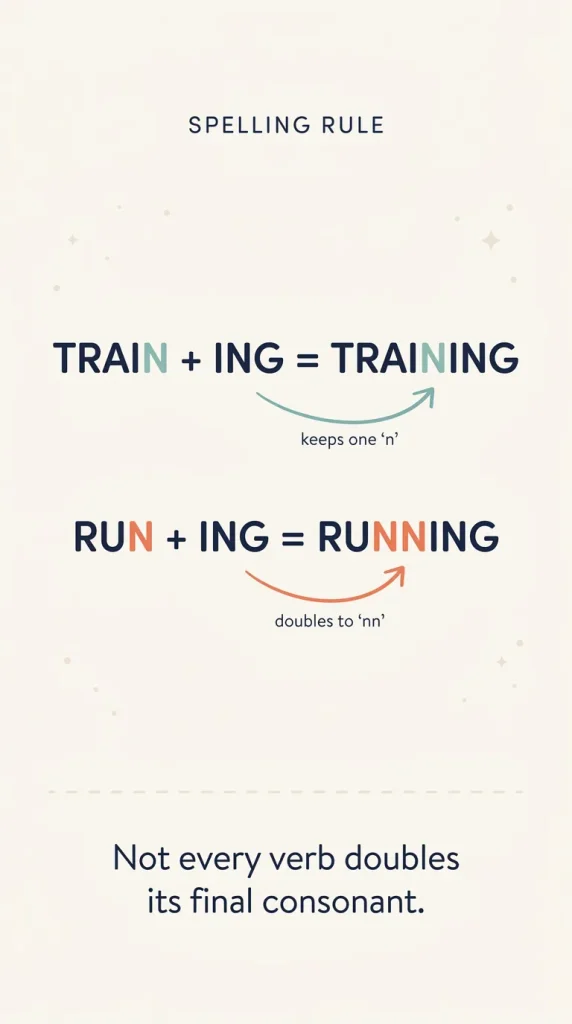
Add -ing directly to the verb “train.” Do not double the final n.
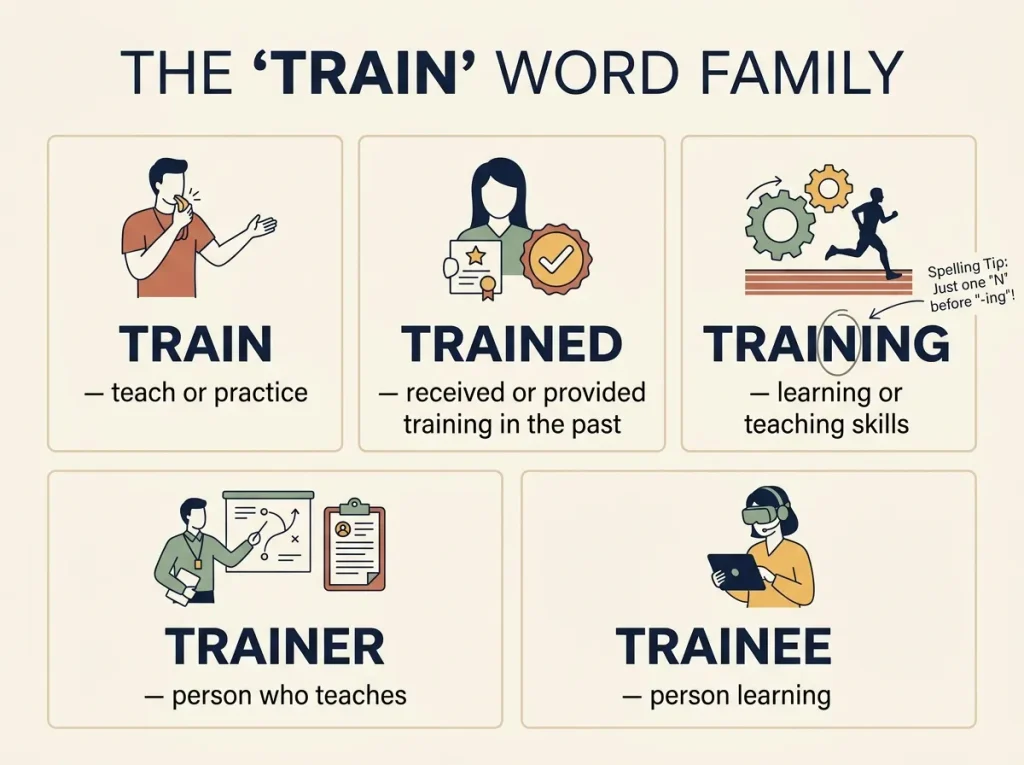
The correct spelling pattern is:
- train + ing = training
- train + ed = trained
- train + er = trainer
- train + ee = trainee
The reason is that English does not double the final consonant in every verb before adding an ending. Words such as run and sit double their final consonants in running and sitting. However, train contains the vowel combination ai, so its final n does not double when -ing is added.
Compare these examples:
| Base verb | Correct form | Why |
|---|---|---|
| train | training | Add -ing without doubling n |
| run | running | Double n after a short vowel |
| sit | sitting | Double t after a short vowel |
| explain | explaining | Add -ing without doubling n |
| swim | swimming | Double m after a short vowel |
This is why trainning may look plausible, but it is not the correct spelling.
How to Use “Training” Correctly
The word training has several common uses. It can function as a noun, as part of a verb phrase, or as a describing word before another noun.
Training as a noun
A noun names a person, place, thing, or idea. As a noun, training refers to the process or activity of learning and developing skills.
Examples:
- Employee training begins next Monday.
- The athlete needs more training before the competition.
- Her medical training prepared her for the role.
- Online training gives employees more flexibility.
In these sentences, training names an activity or process.
Training as part of a verb phrase
The word training is also the present participle of the verb train. A present participle is the form ending in -ing that can be used with a helping verb to describe an ongoing action.
For example:
- The coach is training the new players.
- I am training for a half-marathon.
- The company is training its staff to use the new system.
Here, the word describes an action that is happening or continuing.
Training as a describing word
The word can also appear before another noun to identify the type of thing being discussed.
Examples include:
- training session
- training course
- training manual
- training program
- training materials
For instance, “Please read the training manual before Monday” uses training to describe the kind of manual.
When should you use “train,” “trained,” or “training”?
Choose the form that fits the sentence.
| Word | Typical use | Example |
|---|---|---|
| Train | Base verb | We train every morning. |
| Trains | Present tense with he, she, or it | She trains new employees. |
| Trained | Past tense or past participle | He trained the team last year. |
| Training | Noun or -ing verb form | They are training today. |
| Trainer | A person who trains others | The trainer explained the exercise. |
| Trainee | A person receiving training | Each trainee received a handbook. |
These forms are related, but they are not interchangeable. Therefore, check both the spelling and the grammar of the whole sentence.
Correct Examples of “Training” in Sentences
The following examples show how to use training in everyday, academic, and professional situations.
- Conversation: “I have football training after school.”
- Workplace: “All new employees must complete safety training.”
- Email: “Please confirm your availability for the training session.”
- Education: “The teacher received additional training in classroom management.”
- Fitness: “I am training for my first marathon.”
- Healthcare: “Nurses undergo extensive training before working independently.”
- Business: “The company introduced training to improve customer service.”
- Social media: “Three weeks of training helped me prepare for the race.”
- Academic writing: “Professional training can help graduates develop practical skills.”
- Technology: “The team is training the software to recognize patterns in the data.”
- Job application: “I completed customer service training in 2025.”
- Sports: “The players continued their training despite the rain.”
- Online learning: “The course offers training in digital marketing.”
- Personal development: “Consistent training can help you build confidence.”
Notice that training can describe physical practice, professional instruction, or the development of a skill. The context determines its meaning, but the spelling never changes to trainning.
Incorrect vs. Correct: 12 Common Examples
| ❌ Incorrect | ✅ Correct | Why |
|---|---|---|
| I am trainning for a race. | I am training for a race. | The verb train takes -ing without doubling n. |
| The company offers trainning. | The company offers training. | The noun has one n before -ing. |
| She completed her trainning yesterday. | She completed her training yesterday. | The standard spelling is training. |
| We have trainning tomorrow. | We have training tomorrow. | The extra n is unnecessary. |
| He is trainning new staff. | He is training new staff. | The present participle is formed as train + ing. |
| Please attend the trainning session. | Please attend the training session. | Compound phrases use the same correct spelling. |
| My trainning starts at nine. | My training starts at nine. | The noun is spelled with one n before -ing. |
| The coach is trainning the players. | The coach is training the players. | The verb form does not double the final consonant. |
| I need more trainning in Excel. | I need more training in Excel. | The correct spelling applies in professional contexts, too. |
| Our online trainning is free. | Our online training is free. | The adjective-like use before another word does not change the spelling. |
| Employee trainning begins Monday. | Employee training begins Monday. | Use the standard spelling in workplace notices. |
| The training helped me improve. | The training helped me improve. | This sentence is already correct; no change is needed. |
The final row is included as a reminder that not every sentence needs correcting. Good proofreading means identifying actual errors rather than changing correct writing unnecessarily.
Why People Make This Spelling Mistake
The error usually comes from applying a familiar spelling pattern to a word that does not follow it.
1. Confusion with words that double their final consonants
English has many verbs that double a final consonant before adding -ing. For example, run becomes running, and swim becomes swimming. Consequently, some writers assume that train should become trainning.
However, the doubling pattern does not apply to every verb. Because train contains the vowel combination ai, the correct form is training.
2. Spelling patterns learned from other words
Writers often remember spelling patterns as general rules. Although this can be helpful, applying a rule too broadly can create errors. In linguistics, this is called overgeneralization: using a rule in a situation where it does not apply.
For example, a learner may correctly remember run → running but incorrectly extend the same pattern to train → trainning.
3. Typing too quickly
Sometimes the extra letter is simply a typo. While typing quickly, a writer may press n twice without noticing. This is especially easy to miss in a long email or document.
A quick proofreading pass can help. Search for trainning in your document, then check every occurrence.
4. Spellcheck and autocomplete limitations
Spellcheckers catch many spelling errors, but they are not perfect. Depending on the application and its dictionary, an error may be missed or an incorrect suggestion may appear.
Therefore, use spelling tools as a second check rather than your only source of confidence. Learning the correct form helps you identify mistakes that software overlooks.
5. Translation and second-language interference
English learners may apply spelling habits from another language. Some languages use different rules for adding endings or doubling consonants, so a spelling that feels logical in one language may be incorrect in English.
To avoid this problem, learn the word family together: train, trains, trained, training, trainer, and trainee. This approach makes the pattern easier to remember.
ALSO CHECK: Excel or Excell: Which Spelling Is Correct?
Common Mistakes Checklist
Before sending an email, submitting an assignment, or publishing a page, check these frequent errors.
- Adding an extra n: Write training, not trainning. The base verb is train, and you simply add -ing.
- Confusing training with trained: Use training for the activity or ongoing action, but trained for a completed action or a person who has received instruction. For example, “She is training” differs from “She is trained.”
- Using the wrong form after a helping verb: Write “They are training,” not “They are train.” The helping verb are requires the appropriate -ing form in this sentence.
- Mixing up trainer and trainee: A trainer teaches or coaches; a trainee receives the instruction.
- Assuming all verbs double their final consonants: Compare run → running with train → training instead of applying one spelling pattern to every word.
- Trusting spellcheck without reviewing: If the word appears in a résumé or important document, inspect it yourself.
- Repeating the typo in headings and image text: Check page titles, captions, filenames, and graphics, not just body paragraphs.
The easiest final check is to remember TRAIN + ING = TRAINING. If you see trainning, remove the extra n.
Training in Real English
Grammatically correct
Training is a standard English noun and verb form. It can describe a learning process, physical preparation, workplace instruction, or an ongoing action. For example, “The staff are receiving safety training” and “She is training for a marathon” are both correct. In the first sentence, training names an activity; in the second, it forms part of a verb phrase describing an ongoing action.
Grammatically possible but potentially unnatural
Some sentences use training correctly but express the idea in a way that feels unnecessarily wordy. For example, “I am undertaking training in the activity of cooking dinner” is understandable, but it sounds formal for an ordinary conversation. In that context, “I am learning to cook” is more direct. The best choice depends on whether you mean structured instruction or simply gaining experience.
Natural, everyday English
In everyday English, people commonly say “I have training tomorrow,” “I’m training for a race,” or “The company provides staff training.” These expressions are natural in the right context. However, training does not always mean a formal class: it can also refer to repeated practice, such as sports training. Choose a more specific phrase—such as a training session or a training course—when the exact activity matters.
ALSO READ: Loosing or Losing: Meaning, Difference and Examples.
American vs. British English
There is no spelling difference between American and British English in this case. Both use training, not trainning.
The word also has the same broad meanings in both varieties: learning or teaching skills, preparing for a task, and practicing to improve performance. Some vocabulary around training may vary by workplace, school, or sport, but that does not affect the spelling of the word itself.
Formal vs. Informal Usage
The word training works in both formal and informal English. What changes is usually the phrase around it.
| Context | Example | Why it fits |
|---|---|---|
| Formal business writing | “Staff training will commence on Monday.” | Suitable for a formal notice |
| Workplace email | “The training session starts at 10 a.m.” | Clear and professional |
| Academic writing | “The study examined the effects of teacher training.” | Appropriate for research |
| Everyday conversation | “I have football training tonight.” | Natural and concise |
| Casual fitness discussion | “I’m training for a 10K.” | Common way to describe preparation |
| Online learning | “This training course covers basic coding.” | Clear description of instruction |
In casual conversation, practice may be more suitable for a specific repeated activity, while training often suggests preparation or skill development. For example, a musician might say “I need more practice,” while a new employee might say “I need more training.”
Training vs. Trainning: Comparison Table
| Feature | Training | Trainning |
|---|---|---|
| Spelling status | Correct | Incorrect in standard English |
| Meaning | Learning, instruction, or preparation | No standard meaning as this word |
| Base verb | Train | Intended base verb is usually train |
| Formation | Train + ing | Incorrectly doubles n |
| Used as a noun | Yes | No, not as a standard spelling |
| Used in a verb phrase | Yes: “is training” | No |
| Suitable for résumés | Yes | No |
| Suitable for academic writing | Yes | No |
| American English | Correct | Incorrect |
| British English | Correct | Incorrect |
The distinction is straightforward: training is the correct spelling, while trainning is a spelling mistake. There is no difference in meaning between the two forms because trainning is not a standard alternative spelling.
Real-Life Situations: How to Use “Training”
In a job interview
Interviewer: “How have you prepared for this position?”
Candidate: “I completed customer service training and practiced handling difficult conversations.”
The word training correctly refers to the instruction and preparation the candidate received.
In a workplace email
Incorrect: “The new staff trainning will begin on Tuesday.”
Correct: “The new staff training will begin on Tuesday.”
The corrected version is suitable for a professional announcement. Before sending the email, also check the date, time, and any instructions employees need.
In a school assignment
Incorrect: “Regular trainning can improve an athlete’s performance.”
Correct: “Regular training can improve an athlete’s performance.”
The spelling is the same in academic and everyday writing. In addition, the sentence uses training naturally to describe repeated preparation.
In a text message
Incorrect: “I have football trainning tonight.”
Correct: “I have football training tonight.”
Even in an informal message, the standard spelling is training. A casual tone does not require a different spelling.
In a résumé
Incorrect: “Completed advanced computer trainning.”
Correct: “Completed advanced computer training.”
For a résumé, use the correct spelling and name the relevant course or skill when possible. Specific details make the qualification clearer to employers.
How to Remember the Correct Spelling
Use this simple three-step method:
- Start with the base word: Write train.
- Add the ending: Attach -ing directly to get training.
- Check the number of n’s: Keep the single n at the end of train; do not add another one.
A useful memory phrase is:
“I take a train, then I train. My training has one n before -ing.”
You can also compare the word with similar forms:
- train → training
- explain → explaining
- contain → containing
- remain → remaining
These examples reinforce the pattern: the final n stays single when -ing is added to these verbs.
Quick Quiz: Training or Trainning?
Choose the correct spelling in each sentence. Check the answers after you finish.
- The company offers free (training / trainning) to new employees.
- I am (training / trainning) for a cycling event.
- Her professional (training / trainning) lasted two years.
- The manager is (training / trainning) the new team.
- Please attend the safety (training / trainning) tomorrow.
- He completed his (training / trainning) before starting work.
- The coach scheduled an extra (training / trainning) session.
- We are (training / trainning) staff to use the new software.
Answer key
- Training — the correct noun spelling.
- Training — the -ing form of train.
- Training — the standard spelling for professional instruction.
- Training — the correct present participle.
- Training — the spelling remains the same in a compound phrase.
- Training — the noun describes the instruction he completed.
- Training — the word correctly describes a practice or instruction session.
- Training — the verb form describes an ongoing action.
Score guide: If you answered all eight correctly, you have mastered this spelling distinction. If you missed any, review the core rule: train + ing = training.
Quick Summary
Training is the correct spelling; trainning is incorrect in standard English. The word can refer to learning a skill, teaching someone, preparing for a task, or practicing to improve performance. To form it, simply add -ing to train: train + ing = training. Unlike run → running and sit → sitting, the verb train does not double its final n. Use training in workplace emails, résumés, school assignments, sports discussions, and everyday conversations. The spelling is the same in American and British English. To avoid the mistake, learn related forms together, including train, trained, training, trainer, and trainee. Above all, remember that the extra n in trainning is unnecessary.
FAQ: Training or Trainning
Which spelling is correct, training or trainning?
Training is correct. Trainning is a misspelling in standard English. Write “employee training,” “sports training,” and “online training” with one n before -ing.
Why is training not spelled with two n’s?
The verb train takes -ing without doubling its final consonant. The usual doubling pattern applies to some short-vowel verbs, such as run → running, but not to train → training.
Is trainning ever an accepted spelling in English?
Not as the standard word meaning instruction, practice, or preparation. If you encounter trainning in an ordinary sentence, it should generally be corrected to training. A name or brand could independently use unusual spelling, but that would be a separate case.
What does training mean?
Training means the process of learning, teaching, or developing skills through instruction and practice. It can refer to workplace courses, sports preparation, physical exercise, or professional education.
Is training a noun or a verb?
It can be both, depending on the sentence. In “The training was helpful,” it is a noun. In “She is training for a race,” it is the -ing form of the verb train, used with a helping verb.
What is the difference between training and trained?
Training refers to the activity or an ongoing action, while trained is the past-tense or past-participle form of train. For example, “He is training new employees” describes an ongoing action, while “He trained new employees last year” describes a past action.
What is the difference between a trainer and a trainee?
A trainer is a person who provides instruction or coaching. A trainee is a person who receives that instruction. For example, a workplace trainer may teach a group of new trainees how to use a computer system.
Is training spelled differently in American and British English?
No. Both American and British English use training. The spelling does not change according to the English variety.
Can I write training on a résumé?
Yes. Training is the correct spelling for a résumé, CV, or job application. For a stronger entry, specify the relevant subject, such as “Customer service training” or “Advanced Excel training.”
How do you pronounce training?
Training is commonly pronounced TRAY-ning, with the stress on the first syllable. The incorrect spelling trainning does not represent a separate standard pronunciation.
Is “training session” correct?
Yes. Training session is a common phrase for a scheduled period of instruction or practice. For example, “The training session begins at 2 p.m.” is correct.
What is the easiest way to remember the spelling?
Break the word into two parts: TRAIN + ING = TRAINING. Since train already has its final n, do not add another one before -ing.