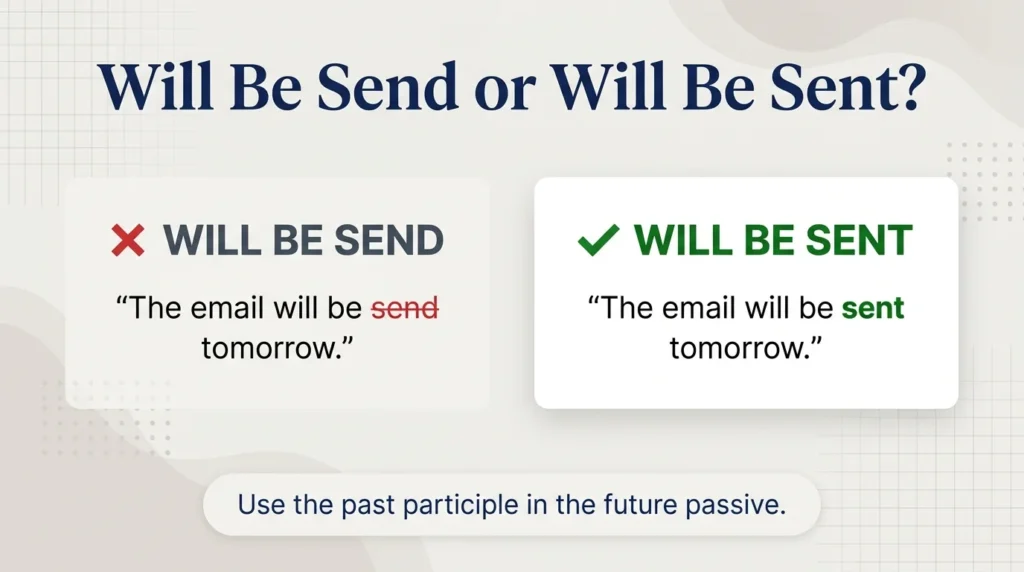

The correct phrase is “will be sent,” not “will be send,” when you want to describe something that will be sent in the future. The reason is grammatical: sent is the past participle of the verb send, and English uses a past participle to form the passive voice. For example, write “The email will be sent tomorrow.” If you are describing the person who performs the action, use “I will send the email.”
What Will Be Send or Will Be Sent Means
The difference between will be send and will be sent is the form of the verb used in a future passive sentence. Although both phrases may look possible to English learners, only will be sent follows standard English grammar for this construction.
What Does “Will Be Sent” Mean?
“Will be sent” describes an action that is expected, planned, or predicted to happen in the future, with the focus on the person or thing receiving the action.
Examples:
- Your order will be sent tomorrow.
- The documents will be sent by email.
- A confirmation message will be sent after registration.
In these sentences, the order, documents, and message receive the action. The person or organization sending them does not need to be mentioned.
What Does “Will Be Send” Mean?
“Will be send” is an incorrect verb construction in standard English when intended as the future passive.
For example:
- Incorrect: The report will be send tomorrow.
- Correct: The report will be sent tomorrow.
The mistake occurs because send is the base form of the verb, while the passive construction requires its past participle, sent.
What Is the Difference Between “Will Send” and “Will Be Sent”?
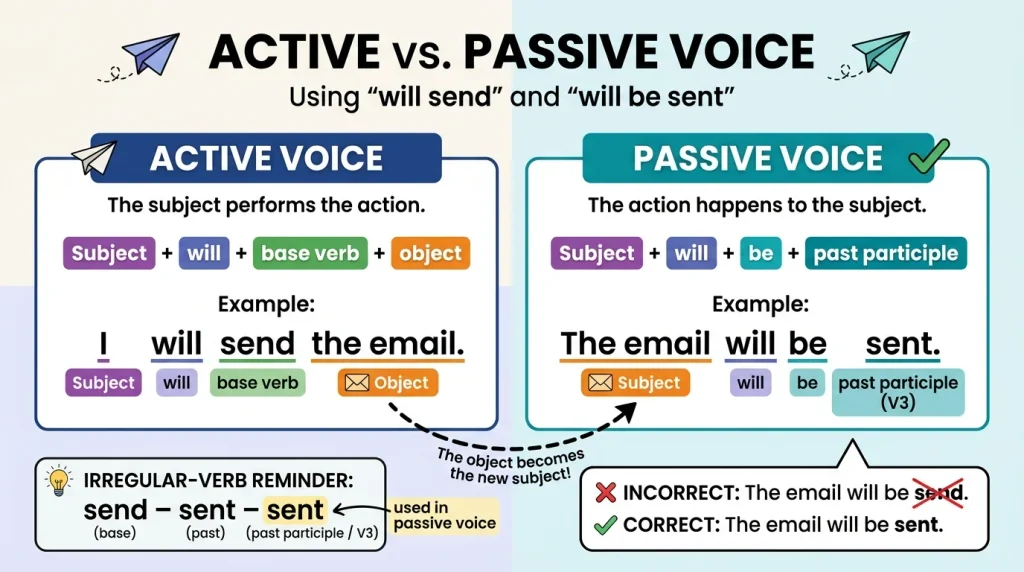
This is an important distinction because both forms are correct, but they serve different grammatical purposes.
- Will send: Active voice. The subject performs the action.
- Will be sent: Passive voice. The subject receives the action.
For example:
- Active: The manager will send the report.
- Passive: The report will be sent by the manager.
The meaning is similar, but the focus changes. The active sentence emphasizes the manager; the passive sentence emphasizes the report.
The Main Difference
| Feature | Will Be Send | Will Be Sent |
|---|---|---|
| Grammatical status | Incorrect in standard future passive sentences | Correct |
| Verb form | Base form, send | Past participle, sent |
| Construction | Does not follow the required passive pattern | Future passive |
| Suitable for formal writing | No | Yes |
| Example | The file will be send. | The file will be sent. |
The central rule is simple: when using will be to form the future passive, follow it with the past participle of the main verb.
The Core Rule
The Rule in Simple English
Use this structure to form the future passive:
Subject + will + be + past participle
Examples:
- The email will be sent.
- The package will be delivered.
- The application will be approved.
- The results will be announced.
Because send is an irregular verb, its past participle is sent, not send or sended.
Therefore:
- Incorrect: The invitation will be send.
- Correct: The invitation will be sent.
Why the Rule Works
The modal verb will is followed by a base-form verb. In a future passive construction, that verb is be. The next verb must then be a past participle to complete the passive structure.
Break down the sentence:
“The email will be sent tomorrow.”
- The email: The subject receiving the action.
- Will: Marks the future.
- Be: Helps form the passive construction.
- Sent: The past participle of send.
- Tomorrow: Identifies the future time.
The important point is that will governs be, while sent completes the passive construction. This is why the rule “use the base verb after will” does not make “will be send” correct.
How to Use It
Common Usage
Use “will be sent” when the item or information receiving the action is the main focus.
1. Emails and messages
Your confirmation email will be sent shortly.
2. Packages and deliveries
The parcel will be sent to your address tomorrow.
3. Documents and reports
The final report will be sent to the director before Friday.
4. School and university communication
The examination results will be sent to students by email.
5. Business communication
The revised contract will be sent after the meeting.
6. Applications and notifications
A notification will be sent when your application has been processed.
When to Use “Will Send” Instead
Use “will send” when the subject performs the action.
Examples:
- I will send you the details tonight.
- Our team will send the invoice tomorrow.
- The school will send the certificates next week.
These sentences are active, so the base form send is correct after will.
Compare the structures:
| Active voice | Passive voice |
|---|---|
| I will send the email. | The email will be sent. |
| They will send the documents. | The documents will be sent. |
| The company will send your order. | Your order will be sent. |
Less Common or Special Usage
The phrase “will be sent” can also describe future instructions, official notices, scheduled communications, or actions whose sender is unknown.
For example:
“Successful applicants will be sent an invitation.”
This is correct passive English. The sentence focuses on the applicants receiving invitations rather than identifying who sends them.
You can also use “will be sent out” when talking about distributing messages, notices, invitations, or products.
Example: “The invitations will be sent out next Monday.”
The phrasal form sent out is also correct because sent remains the past participle.
Correct Examples
Here are 12 examples showing how to use “will be sent” naturally.
- The email will be sent to you after your payment is confirmed.
- Your package will be sent tomorrow morning.
- The meeting details will be sent to all participants.
- The final report will be sent to the client by Friday.
- Your examination results will be sent by email.
- A password reset link will be sent to your registered address.
- The invitations will be sent out next week.
- The application will be sent to the relevant department for review.
- The documents will be sent once they have been approved.
- A receipt will be sent automatically after the transaction.
- The revised schedule will be sent to every member of the team.
- Further instructions will be sent before the training session begins.
In every example, the subject receives the action, and sent is the past participle required by the passive construction.
Incorrect vs Correct
| ❌ Incorrect | ✅ Correct | Why |
|---|---|---|
| The email will be send tomorrow. | The email will be sent tomorrow. | The passive requires sent. |
| Your order will be send today. | Your order will be sent today. | Send is the base form. |
| The documents will be send by email. | The documents will be sent by email. | Use the past participle. |
| The results will be send next week. | The results will be sent next week. | Sent is the correct verb form. |
| A message will be send shortly. | A message will be sent shortly. | The future passive needs sent. |
| The invitation will be send to everyone. | The invitation will be sent to everyone. | Correct the verb form. |
| The invoice will be send after payment. | The invoice will be sent after payment. | The invoice receives the action. |
| The report will be send by the manager. | The report will be sent by the manager. | The passive participle is sent. |
| The files will be send securely. | The files will be sent securely. | Use sent after will be. |
| The certificates will be send to students. | The certificates will be sent to students. | The plural subject does not change the participle. |
Not every sentence involving send should use sent. For example, “I will send the certificates” is correct because it uses active voice.
Why People Make This Mistake
1. Confusing “Will Send” With “Will Be Sent”
Learners often know that will is followed by a base-form verb. They then incorrectly apply that rule to the entire sequence “will be send.”
Compare:
- Correct: I will send the file.
- Correct: The file will be sent.
The first sentence is active. The second is passive. Each has a different grammatical structure.
2. Forgetting That “Send” Is Irregular
Regular verbs often form their past participles with -ed, such as finish → finished. The verb send does not follow that pattern.
Its three main forms are:
- Base form: send
- Simple past: sent
- Past participle: sent
Remembering these forms makes it easier to use the verb correctly.
3. Applying the Wrong Rule After “Be”
The word be appears in several constructions, and the following verb form depends on the structure.
Compare:
- I will be sending the report. — Future progressive.
- The report will be sent. — Future passive.
The first uses the -ing form because it describes an ongoing future action. The second uses a past participle because it is passive.
4. Typing Quickly
People may type “will be send” in an email, chat, or document without reviewing the verb form. Spelling and grammar tools can help identify the problem, but understanding the rule is more reliable than relying entirely on corrections.
Common Mistakes
Mistake 1: Using the Base Verb in a Passive Sentence
Incorrect: Your account details will be send to you.
Correct: Your account details will be sent to you.
Fix: When the subject receives the action, check whether the sentence needs a passive construction and a past participle.
Mistake 2: Using “Sent” in an Active Future Sentence
Incorrect: I will sent the documents tomorrow.
Correct: I will send the documents tomorrow.
Fix: In an active future sentence, use the base form directly after will.
Mistake 3: Using “Sended” Instead of “Sent”
Incorrect: The package will be sended tomorrow.
Correct: The package will be sent tomorrow.
Fix: Learn the irregular forms of send. Its past tense and past participle are both sent.
Mistake 4: Confusing Passive and Progressive Structures
Incorrect: The report will be sending tomorrow. (when you mean that someone will send the report)
Correct: The report will be sent tomorrow.
Fix: Use will be sending for an ongoing action with an appropriate subject, such as “I will be sending the report tomorrow.” Use will be sent when the report receives the action.
Will Be Send or Will Be Sent in Real English
In standard written and spoken English, “will be sent” is the correct form for the future passive. “Will be send” is a grammatical error in that construction, even when the intended meaning is clear.
Consider these real-life situations:
- Correct and natural: “Your password reset link will be sent shortly.”
- Incorrect: “Your password reset link will be send shortly.”
- Correct active alternative: “We will send your password reset link shortly.”
The active alternative is often more direct because it identifies the person or organization responsible for the action. The passive form is useful when the item, process, or result is more important than the sender.
The choice between active and passive voice depends on what you want to emphasize. The choice between send and sent depends on the grammatical structure.
American vs British English
There is no difference between American and British English in this construction. Both varieties use “will be sent.”
| English variety | Correct example |
|---|---|
| American English | The package will be sent tomorrow. |
| British English | The package will be sent tomorrow. |
| Canadian English | The package will be sent tomorrow. |
| Australian English | The package will be sent tomorrow. |
The spelling and grammatical rule remain the same across these varieties.
Formal vs Informal Usage
Formal Usage
In business emails, official notices, academic writing, and professional correspondence, use “will be sent” when the subject receives the action.
Examples:
- The requested documentation will be sent upon approval.
- The final decision will be sent to all applicants by email.
- The revised agreement will be sent for your review.
Everyday Usage
The same rule applies to text messages and casual conversations.
Examples:
- Your photos will be sent tonight.
- The link will be sent in a minute.
- The food will be sent to your house.
You can also use a more direct active sentence in everyday English:
“I’ll send you the link in a minute.”
The tone may vary, but the grammatical distinction does not.
Comparison Table
| Feature | Will Send | Will Be Sent | Will Be Send |
|---|---|---|---|
| Correctness | Correct | Correct | Incorrect in standard future passive |
| Voice | Active | Passive | Incorrect construction |
| Verb form | Base form | Past participle | Wrong verb form |
| Main emphasis | Person doing the action | Thing receiving the action | Not applicable |
| Example | I will send the email. | The email will be sent. | The email will be send. |
This comparison is important because will send is not incorrect. The error occurs when send is used in place of sent in the future passive construction.
Memory Trick
Remember this simple rule:
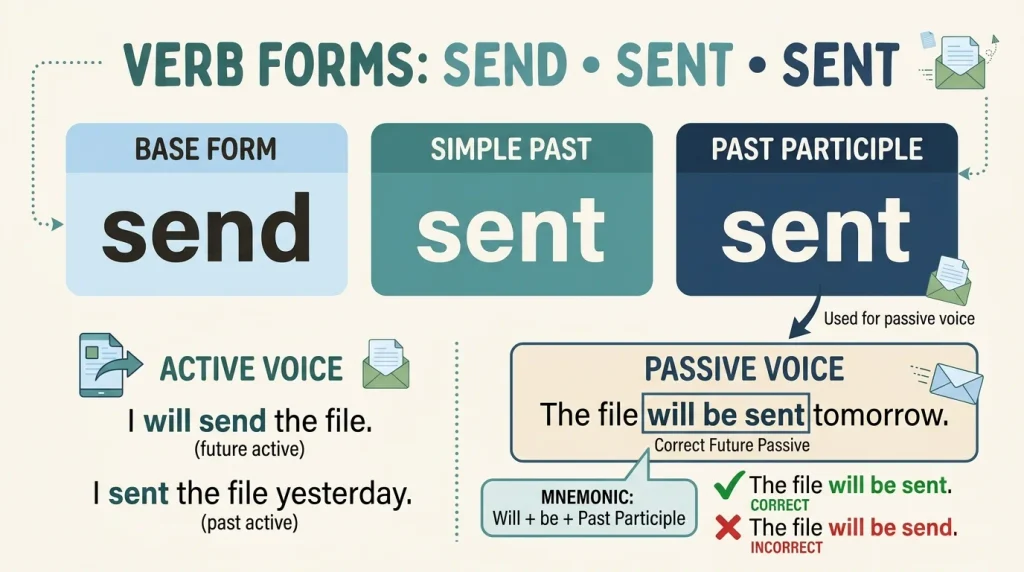
“Will be” needs “sent” when you are using the passive voice.
You can also remember the three verb forms:
SEND
Base form
I will send it.
SENT
Past tense
I sent it yesterday.
SENT
Past participle
It will be sent.
Memory shortcut: send → sent → sent. After “will be” in a passive sentence, choose the third form: sent.
Real-Life Examples
At Work
Correct: The updated spreadsheet will be sent to the finance department this afternoon.
Active alternative: I will send the updated spreadsheet to the finance department this afternoon.
The first emphasizes the spreadsheet; the second emphasizes the person sending it.
In an Email
Correct: Your appointment confirmation will be sent to your registered email address.
Incorrect: Your appointment confirmation will be send to your registered email address.
In Conversation
Correct: Don’t worry; the details will be sent to you later.
Active alternative: Don’t worry; I’ll send you the details later.
The active version is shorter and often sounds more conversational.
At School or University
Correct: The examination timetable will be sent to all students before the end of the week.
Incorrect: The examination timetable will be send to all students before the end of the week.
In Online Shopping
Correct: Your order will be sent once the payment has been confirmed.
Active alternative: We will send your order once your payment has been confirmed.
Both correct sentences describe a future action, but they focus on different parts of the process.
Expert Tips
- Identify the subject. Ask whether the subject performs the action or receives it. This helps you decide between active and passive voice.
- Memorize irregular verb forms. Learn send, sent, sent instead of trying to form the past participle by adding -ed.
- Recognize the passive pattern. Look for will + be + past participle.
- Compare two versions. If you can write “The company will send the report,” the passive version is “The report will be sent by the company.”
- Do not overapply the rule. “I will send” is correct; it does not need to become “I will sent.”
- Proofread professional messages. Incorrect verb forms are easy to overlook in short emails, order updates, and automated notifications.
- Use the simplest natural sentence. If you know who is performing the action and want to emphasize that person, the active form is often clearer.
Quick Summary
“Will be sent” is correct; “will be send” is incorrect in standard English when forming the future passive. The verb send is irregular: its base form is send, and both its simple past and past participle are sent. The future passive follows the pattern subject + will + be + past participle, as in “The report will be sent tomorrow.” By contrast, “I will send the report tomorrow” is correct active voice because will is followed directly by the base verb send. The key is to identify the sentence structure, not simply memorize one phrase. Use will be sent when the subject receives the action, and will send when the subject performs it.
Frequently Asked Questions
1. Which is correct: will be send or will be sent?
Will be sent is correct. It uses the past participle sent required for the future passive construction.
2. Why is “will be send” incorrect?
In a future passive sentence, will is followed by be, and the main verb must be a past participle. Because the past participle of send is sent, “will be send” does not follow the required grammatical pattern.
3. Is “I will send” correct English?
Yes. “I will send the email tomorrow” is correct active voice. The subject, I, performs the action, so the base form send follows will.
4. What is the past participle of send?
The past participle is sent. The three main forms are send – sent – sent.
5. Can I say “The email will be sent to you”?
Yes. This is a correct future passive sentence. It means that someone will send the email to you in the future.
6. Is “will be sent” future tense?
It is commonly described as the future passive. More precisely, it combines the modal will, the verb be, and the past participle sent to describe a future action in the passive voice.
7. What is the difference between “will send” and “will be sent”?
“Will send” is active: “The company will send the invoice.” “Will be sent” is passive: “The invoice will be sent by the company.” Both are correct, but the focus differs.
8. Is “will be sended” correct?
No. Send is irregular, so its past participle is sent, not sended. Write “The package will be sent tomorrow.”
9. Is “will be sent to you” correct?
Yes. For example, “The confirmation will be sent to you shortly.” The preposition to identifies the recipient.
10. Can I use “will be sent” in formal emails?
Yes. It is grammatically correct and suitable for formal and professional communication. For example, “The requested documents will be sent upon approval.”
11. Is “will be sending” also correct?
Yes, but it serves a different purpose. “I will be sending the documents tomorrow” describes an ongoing or planned future activity from the sender’s perspective. “The documents will be sent tomorrow” is passive and focuses on the documents.
12. What is the easiest way to remember the rule?
Remember send – sent – sent and the pattern will + be + past participle. When the subject receives the action, write “will be sent.” When the subject performs the action, write “will send.”
Mini Quiz
Choose the grammatically correct answer in each question.
| # | Question | Answer | Explanation |
|---|---|---|---|
| 1 | The email will be (send/sent) tomorrow. | Sent | Future passive requires the past participle. |
| 2 | I will (send/sent) you the report. | Send | The base form follows will in active voice. |
| 3 | The documents will be send to the client. Correct or incorrect? | Incorrect | Write “The documents will be sent to the client.” |
| 4 | What is the past participle of send? | Sent | The verb forms are send, sent, sent. |
| 5 | The package will be (send/sent) next week. | Sent | The package receives the action. |
| 6 | Choose the correct active sentence: “We will send it” or “We will sent it.” | We will send it. | Use the base verb after will. |
| 7 | The invitations will be sent by the school. Is this active or passive? | Passive | The invitations receive the action. |
| 8 | Correct this sentence: “Your receipt will be sended shortly.” | Your receipt will be sent shortly. | Send is irregular. |
| 9 | Fill in the blank: The results ___ be sent tomorrow. | Will | The complete future passive is “will be sent.” |
| 10 | Which is correct: “I will send the file” or “The file will be sent”? | Both | The first is active; the second is passive. |
Final takeaway: Use “will be sent” for the future passive and “will send” for the active future. Never use “will be send” for the standard future passive construction.
STEP 4 — RESEARCH & CONTENT INTELLIGENCE REPORT
1. Search Intent Analysis
Primary intent: Grammar correction and word-form comparison.
The searcher wants to know which phrase is correct and why the verb changes from send to sent.
| Intent | Reader expectation |
|---|---|
| Primary | Is it “will be send” or “will be sent”? |
| Grammar | Why does the verb change after “will be”? |
| Verb forms | What are the forms of send? |
| Usage | When should I use “will send” instead? |
| Error correction | How do I correct common sentence mistakes? |
| Learning | What is an easy way to remember the rule? |
The most important editorial decision is to explain both the future passive construction and its contrast with active voice.
2. SERP Analysis
The sampled search results consistently identify “will be sent” as correct and explain the past participle rule. Other recurring elements include examples involving emails and packages, comparisons with “will send,” and explanations of active versus passive voice.
- Dominant intent: Resolve a grammar question.
- Recurring explanations: The irregular forms send – sent – sent and the structure will + be + past participle.
- Common questions: Why is “will be send” wrong? Is “will send” correct? What is the difference between active and passive voice?
- Featured Snippet opportunity: A short answer with one correct example and one incorrect example.
- Related search themes: Will send or will be sent, will be sent to, send versus sent, and future passive grammar.
- Content opportunity: Explain why “will send” is correct in active voice while “will be send” is incorrect in the intended passive construction.
Research limitation: The report is based on a sample of search results, not a complete audit of every ranking page or a verified extraction of live People Also Ask and AI Overview content.
3. Competitive Content Analysis
The sampled pages generally answer the central question correctly. Common content patterns include quick-answer paragraphs, comparison tables, example sentences, and simple grammar rules.
The main editorial risks are:
- Incorrectly describing will be sent as merely a future tense rather than explaining its passive structure.
- Claiming that will send is incorrect, when it is correct active voice.
- Repeating the same rule in multiple sections without additional teaching value.
- Failing to explain why the base verb follows will in one construction but the past participle appears after will be in the passive.
- Using unnatural examples that do not reflect real communication.
The article addresses these issues by comparing active and passive sentences directly and providing distinct examples of both.
4. Content Gap Analysis
| Reader need | How the article addresses it |
|---|---|
| Quick correction | Gives the answer immediately beneath the H1. |
| Grammar explanation | Breaks down will + be + past participle. |
| Irregular verb forms | Explains send – sent – sent. |
| Active/passive distinction | Compares “I will send the email” with “The email will be sent.” |
| Related structures | Explains “will be sending” and “will be sent out.” |
| Practical use | Covers business emails, deliveries, education, and notifications. |
| Knowledge retention | Includes a memory trick and a 10-question quiz. |
These are content-design priorities based on the observed search intent, rather than claims that every competing page omits these points.
5. Question Map
Primary questions
- Which phrase is correct?
- What does “will be sent” mean?
Answered in the quick answer and opening sections.
Grammar questions
- What is the past participle of send?
- What is the future passive structure?
Answered in the core rule and verb-form examples.
Confusion questions
- Why do learners write “will be send”?
- Why is “will send” correct?
Answered in the mistake analysis and comparison tables.
Usage questions
- When should passive voice be used?
- Is “will be sending” also correct?
- How does the phrase work in formal emails?
Answered in the practical usage and FAQ sections.
Learning questions
- How can I remember the verb forms?
- How can I check my own sentences?
Answered in the memory trick, expert tips, and quiz.
6. Topical Coverage Map
| Semantic dimension | Coverage |
|---|---|
| Grammar | Future passive construction |
| Verb forms | Send, sent, sent |
| Voice | Active versus passive |
| Meaning | Future action and recipient focus |
| Syntax | Modal verb, auxiliary be, past participle |
| Context | Emails, business, delivery, education |
| Common mistakes | Send, sent, and sended |
| Related structures | Will send, will be sent, will be sending |
| Learning support | Examples, mnemonic, quiz |
7. Keyword & Query Coverage
The main keyword will be send or will be sent is addressed directly in the H1, opening answer, comparison tables, and FAQs.
Related queries are covered naturally through:
- Will be sent grammar
- Will send or will be sent
- Send or sent
- Will be sent to you
- Past participle of send
- Future passive voice
- Will be sending vs. will be sent
The article uses semantic coverage instead of forcing repeated exact-match keywords into every heading.
8. Featured Snippet Opportunities
Opportunity 1 — Direct answer
“Will be sent” is correct. “Will be send” is incorrect in standard future passive sentences because the past participle of send is sent.
Opportunity 2 — Grammar formula
Subject + will + be + past participle
Example: The email will be sent tomorrow.
Opportunity 3 — Active/passive comparison
“I will send the email” is active, while “The email will be sent” is passive.
Opportunity 4 — Verb forms
A short table displaying send – sent – sent can answer a common grammar question.
These formats are suitable candidates for concise search answers, but inclusion in a featured result cannot be guaranteed.
9. AI Overview & Entity Coverage
The important grammatical concepts are:
- Send: Base form of the verb.
- Sent: Both the simple past form and the past participle.
- Will: Modal auxiliary expressing future reference.
- Be: Auxiliary used in the passive construction.
- Future passive: Will + be + past participle.
- Active voice: The subject performs the action.
- Passive voice: The subject receives the action.
The relationship between these concepts is the core of the answer. The British Council’s grammar guidance confirms that passive constructions use the verb be with a past participle, including future passive examples such as “will be sent.”
10. Final Content Advantage
The article’s primary advantage is that it explains the rule rather than only correcting the phrase.
It helps readers:
- Choose “will be sent” confidently.
- Understand why the past participle is required.
- Avoid confusing passive voice with active voice.
- Recognize the irregular forms of send.
- Apply the same grammar pattern to practical communication.
The strongest SEO and educational approach is to answer the question immediately, explain the underlying construction clearly, and use realistic examples without padding the page with repetitive explanations.