
The correct spelling for the familiar inflatable object is balloon, not ballon. A balloon is an object filled with air or gas, often used for parties, decorations, and scientific purposes. The word can also be a verb meaning to expand or increase rapidly, as in “Costs ballooned unexpectedly.” Although ballon can appear in specialized contexts, such as ballet terminology, it is not the standard spelling for the everyday object.
Ballon or Balloon?
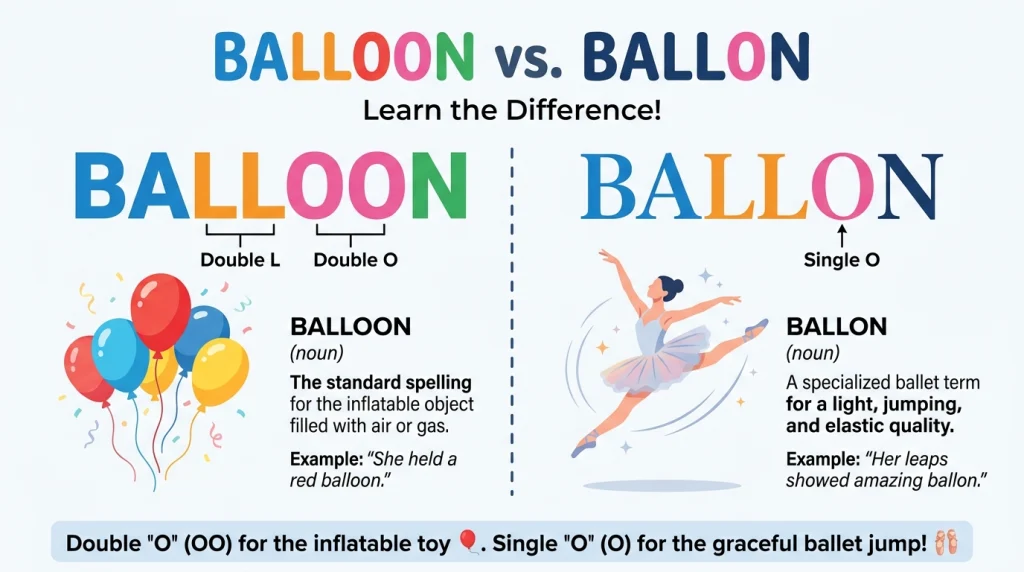
Balloon is the correct spelling when you mean an inflatable object, a hot-air balloon, or something that expands rapidly. It contains two Ls and two Os: B-A-L-L-O-O-N. The spelling ballon is incorrect when used with these meanings. However, ballon is also a specialized ballet term describing a dancer’s light, springy quality during a jump. In ordinary English writing, use balloon unless you specifically mean that technical dance term.
What Is the Difference Between Ballon and Balloon?
The difference is primarily about spelling and meaning. Balloon is the everyday English word for an inflatable object and also functions as a verb. Ballon is not the standard spelling of that object, but it has a recognized specialized meaning in ballet.
Understanding the context helps you choose the correct form instead of assuming that every occurrence of ballon is necessarily a typo.
What Does Balloon Mean?
Balloon is a noun and a verb.
As a noun, it commonly refers to a flexible object filled with air or gas. Balloons are used for birthday parties, celebrations, advertising, scientific observations, and other purposes.
Examples:
- We decorated the room with colorful balloons.
- A hot-air balloon drifted above the hills.
- The children received a balloon at the fair.
As a verb, balloon means to expand, swell, or increase rapidly. It is often used figuratively, meaning that something grows significantly rather than literally turning into an inflatable object.
Examples:
- The project’s expenses ballooned after several delays.
- Her workload ballooned when two colleagues left.
- The company’s debt ballooned over the following year.
The spelling stays the same in both uses, although the verb changes form: balloons, ballooned, and ballooning.
Also check it: Smoothe vs. Smooth: Meaning, Correct Spelling, and Examples.
What Does Ballon Mean?
Ballon is a specialized ballet term referring to the lightness, buoyancy, or springy quality a dancer displays when jumping. It describes the impression that a dancer rises and lands with exceptional lightness.
For example:
- The instructor praised the dancer’s ballon during the jump sequence.
- The review highlighted the performer’s excellent ballon.
This specialized use is different from the everyday English word balloon. The French word ballon also has meanings such as “ball,” depending on context, but a French spelling does not replace the standard English spelling of the inflatable object.
If you are writing about a birthday decoration, a hot-air aircraft, or rapidly increasing costs, use balloon.
Why the Correct Spelling Matters
Spelling errors can change how polished and professional your writing appears. Although readers can often understand what you mean when you write ballon, the error may distract them from your message.
Consider these situations:
- Schoolwork: A spelling mistake may cost you marks or make an otherwise strong assignment look careless.
- Professional emails: Incorrect spelling can weaken the impression your message makes on colleagues or clients.
- Event invitations: A misspelled word can make promotional material look less carefully edited.
- Online content: Product descriptions, advertisements, and social media posts benefit from accurate spelling.
- Academic writing: Dance-related writing may require the specialized term ballon, while general descriptions of inflatable objects require balloon.
The important lesson is to choose the spelling according to the meaning you intend. Correct spelling helps readers understand your message without unnecessary distraction.
The Core Rule: When Should You Use Balloon?
Use balloon for an inflatable object or for the verb meaning to expand rapidly. Use ballon only when you specifically mean the specialized ballet term or another context in which that spelling is appropriate.
Remember these two patterns:
- B-A-L-L-O-O-N: The everyday English word.
- B-A-L-L-O-N: A specialized ballet term, or a misspelling when the intended word is balloon.
For most everyday writing, the decision is straightforward: choose balloon.
How to Use Balloon Correctly
1. Use Balloon as a Noun
A noun names a person, place, thing, or idea. When balloon names an inflatable object, it is a countable noun, meaning you can use it with numbers and words such as a, one, or several.
Examples:
- I bought a balloon for my nephew.
- Three balloons were tied to the gate.
- The red balloon floated toward the ceiling.
- We watched a hot-air balloon rise above the field.
The plural form is balloons, not ballons, when you mean inflatable objects.
2. Use Balloon as a Verb
The verb balloon means to expand or increase rapidly. It often describes costs, workloads, debts, populations, and other things that grow unexpectedly.
Examples:
- Our travel expenses ballooned after the flight was canceled.
- The company’s operating costs are ballooning.
- Her responsibilities ballooned after the promotion.
- The crowd ballooned as more people arrived.
The main verb forms are:
| Verb form | Example |
|---|---|
| Base form | Costs can balloon quickly. |
| Third-person singular | The budget balloons every year. |
| Past tense | The bill ballooned after extra fees were added. |
| Present participle | The team’s workload is ballooning. |
| Past participle | Expenses have ballooned since January. |
The double O remains in every form.
3. Use Balloon in Compound Expressions
A compound expression combines words to identify a particular thing or concept.
Common examples include:
- Hot-air balloon
- Weather balloon
- Balloon animal
- Balloon payment
- Balloon ride
- Balloon decoration
The spelling balloon remains unchanged in these expressions. In a balloon payment, for example, the term refers to a large final payment due at the end of certain loan arrangements. It does not refer to an actual inflatable object.
4. Use Ballon in Specialized Ballet Writing
Use ballon when discussing the technical quality of a ballet dancer’s jump, provided that this is the term intended by the specialist context.
Example:
“The choreographer emphasized ballon and controlled landings during rehearsal.”
In this sentence, ballon refers to a dancer’s apparent lightness and spring, not a party decoration.
If you are writing for a general audience, explain the term the first time you use it. Readers may otherwise assume it is a spelling error.
Correct Examples of Balloon in Everyday English
The following original examples show how balloon works in different settings.
- Conversation: “Could you buy a blue balloon for the birthday party?”
- Email: “Please confirm the number of balloons required for the event.”
- School assignment: “A balloon expands when the gas inside it pushes against its walls.”
- Workplace: “Our project costs ballooned because the delivery schedule changed.”
- Social media: “The kids were delighted to see the balloons covering the room.”
- Academic writing: “The researchers released a weather balloon to collect atmospheric measurements.”
- Travel: “We booked a sunrise hot-air balloon ride during our vacation.”
- News reporting: “The city’s repair expenses ballooned after the storm.”
- Business communication: “We need to investigate why our operating costs have ballooned this quarter.”
- Everyday description: “The fabric ballooned in the strong wind.”
- Creative writing: “A silver balloon drifted past the open window.”
- Shopping: “This package contains twelve reusable balloon clips.”
Notice that the word can describe both a physical object and an action or process involving expansion. Its spelling does not change to ballon simply because the meaning is figurative.
Incorrect vs. Correct: 10 Common Spelling Mistakes
The following table shows common errors involving balloon, including mistakes with its plural and verb forms.
| ❌ Incorrect | ✅ Correct | Why |
|---|---|---|
| I bought a ballon. | I bought a balloon. | The everyday English noun requires two Os. |
| She carried two ballons. | She carried two balloons. | The plural adds S to balloon. |
| The ballon floated away. | The balloon floated away. | An inflatable object is spelled balloon. |
| We ordered red ballons. | We ordered red balloons. | The double O remains in the plural. |
| The costs ballon every year. | The costs balloon every year. | The verb meaning “increase rapidly” also has two Os. |
| Expenses ballon-ed after the delay. | Expenses ballooned after the delay. | The past tense is formed by adding ED to balloon. |
| The workload is ballon-ing. | The workload is ballooning. | The present participle retains the double O. |
| They bought a hot-air ballon. | They bought a hot-air balloon. | The compound expression uses the standard noun. |
| The weather ballon was released. | The weather balloon was released. | A weather balloon uses the same standard spelling. |
| The final payment was a ballon payment. | The final payment was a balloon payment. | The financial term is spelled balloon payment. |
One distinction is worth remembering: ballon is not automatically wrong in every context. If you are discussing ballet technique, it may be the intended specialized term. The corrections above apply when the intended word is the everyday English balloon.
Why People Make This Spelling Mistake
Several factors make ballon a plausible-looking error.
1. Pronunciation Does Not Reveal Every Letter
When you hear someone say balloon, you hear the spoken word rather than the letters used to write it. The two Os are not pronounced as separate letter names, so pronunciation alone may not remind you to write both.
English spelling often contains details that cannot be recovered from sound alone. That is why seeing and remembering the written form matters.
2. Repeated Letters Are Easy to Omit
When typing quickly, people sometimes leave out a repeated letter. In balloon, the two Ls and two Os create two places where a letter can accidentally disappear.
The best solution is to remember the whole spelling rather than rely on how the word sounds.
3. English Spelling Patterns Can Be Misleading
English has many words with different vowel patterns, and there is no universal rule that tells you exactly when every vowel should be doubled.
A writer might assume that ballon follows a familiar spelling pattern. However, the established spelling of the everyday word is balloon, and memorizing its letter sequence is more reliable than guessing.
4. Autocorrect Does Not Always Understand Meaning
Spellcheckers are useful, but they do not always identify the word you intended. A multilingual keyboard or dictionary may recognize a spelling used in another language or specialized field.
For example, a ballet student writing about a dancer’s ballon may be using a legitimate technical term. A person describing a birthday decoration probably intends balloon. The surrounding sentence determines which form fits.
5. Translation Between Languages Can Cause Confusion
Learners who know French or another language may have encountered ballon before learning the standard English spelling balloon. This can influence how they write the English word.
When moving between languages, avoid assuming that a similar-looking word follows the same spelling conventions. Check the form used in the language you are writing.
Also read: Batton or baton with meanings.
Common Mistakes Checklist
Before submitting a piece of writing, check these potential errors.
- Dropping the second O: Write balloon, not ballon, when you mean the inflatable object.
- Dropping an L: The standard spelling has two Ls as well as two Os.
- Misspelling the plural: Use balloons, not ballons, for multiple inflatable objects.
- Misspelling the past tense: Write ballooned, not balloned, when describing a rapid increase.
- Misspelling the -ing form: Use ballooning, not balloning, for the verb’s present participle.
- Trusting autocorrect without checking meaning: A recognized word may still be the wrong word for your sentence.
- Assuming the shorter form is always meaningless: Ballon has a specialized use in ballet.
- Ignoring context: Identify whether you mean an object, rapid expansion, or a technical dance term.
A quick visual check of the repeated letters can prevent most everyday mistakes involving this word.
Ballon or Balloon in Real English
Grammatically Correct
“The children played with colorful balloons” is grammatically correct and natural. Here, balloons is the plural noun referring to inflatable objects. Likewise, “Our expenses ballooned” is correct because ballooned is a verb meaning that expenses increased rapidly. In dance writing, “The dancer demonstrated excellent ballon” can also be correct when the specialized ballet term is intended.
Grammatically Possible but Unnatural
“Please inflate the ballon for the party” communicates a clear idea, but it uses the wrong spelling for the everyday object in standard English. A reader will probably understand the sentence, yet the spelling remains incorrect for that meaning. By contrast, using the technical term ballon in a casual conversation about party decorations would be confusing because the specialized meaning does not fit the situation.
Natural, Everyday English
“Can you bring a few balloons to the party?” sounds natural in everyday conversation. “Our expenses have ballooned” is also a natural way to describe a rapid increase in costs. Both examples use the standard spelling, even though one describes a physical object and the other describes a change. In ordinary English, choose balloon whenever you mean the object or the act of expanding rapidly.
American vs. British English
There is no spelling difference between standard American and British English for the everyday word balloon.
| Feature | American English | British English |
|---|---|---|
| Standard spelling | balloon | balloon |
| Plural | balloons | balloons |
| Past-tense verb | ballooned | ballooned |
| Verb meaning | Expand or increase rapidly | Expand or increase rapidly |
| Common spelling ballon for an inflatable object | Incorrect | Incorrect |
Whether you are writing for an American, British, Australian, or other general English-speaking audience, use balloon for the familiar inflatable object.
Formal vs. Informal Usage
The spelling does not change between formal and informal English.
In an informal text, you might write, “I bought balloons for the party.” In a formal report, you might write, “The research team released a weather balloon to measure atmospheric conditions.”
Similarly, balloon is appropriate in business writing when describing a rapid increase: “Operating expenses ballooned during the second quarter.”
The specialized term ballon belongs in relevant dance discussions, whether formal or informal. It should not be used as a casual alternative spelling for the everyday object.
Ballon vs. Balloon: Comparison Table
| Feature | Balloon | Ballon |
|---|---|---|
| Standard spelling for an inflatable object | Yes | No |
| Refers to a hot-air aircraft | Yes | No |
| Verb meaning “increase rapidly” | Yes | No |
| Specialized ballet term | No | Yes |
| Used in everyday English | Very common | Uncommon |
| Plural for inflatable objects | balloons | Not the correct form |
| Past tense of the expansion verb | ballooned | Not the correct form |
| Best choice for ordinary writing | Yes | Only for the intended specialized meaning |
The simplest rule is to choose balloon unless you are specifically writing about the ballet term ballon.
Real-Life Situations: Which Word Should You Choose?
Situation 1: Writing a Birthday Invitation
You are preparing an invitation and want to mention decorations.
Incorrect: “Join us for cake, games, and colorful ballons.”
Correct: “Join us for cake, games, and colorful balloons.”
Why: The sentence refers to inflatable decorations, so the standard spelling is balloons.
Situation 2: Sending a Workplace Email
You are explaining why a project exceeded its budget.
Incorrect: “The project’s expenses ballon-ed after the deadline changed.”
Correct: “The project’s expenses ballooned after the deadline changed.”
Why: The verb ballooned describes a rapid increase in expenses.
Situation 3: Completing an English Exam
The question asks you to identify the correct spelling of the object used at birthday parties.
Incorrect: ballon
Correct: balloon
Why: The standard English noun has seven letters, including two Ls and two Os.
Situation 4: Writing a Science Report
You describe an instrument used to collect atmospheric information.
Incorrect: “The team launched a weather ballon.”
Correct: “The team launched a weather balloon.”
Why: The compound expression weather balloon retains the standard spelling.
Situation 5: Writing a Ballet Review
You are describing a dancer’s lightness during a jump.
Possible correct usage: “The dancer’s ballon gave the jump an impression of exceptional lightness.”
Why: In this specialized context, ballon refers to a ballet quality rather than an inflatable object.
An Easy Trick to Remember the Spelling
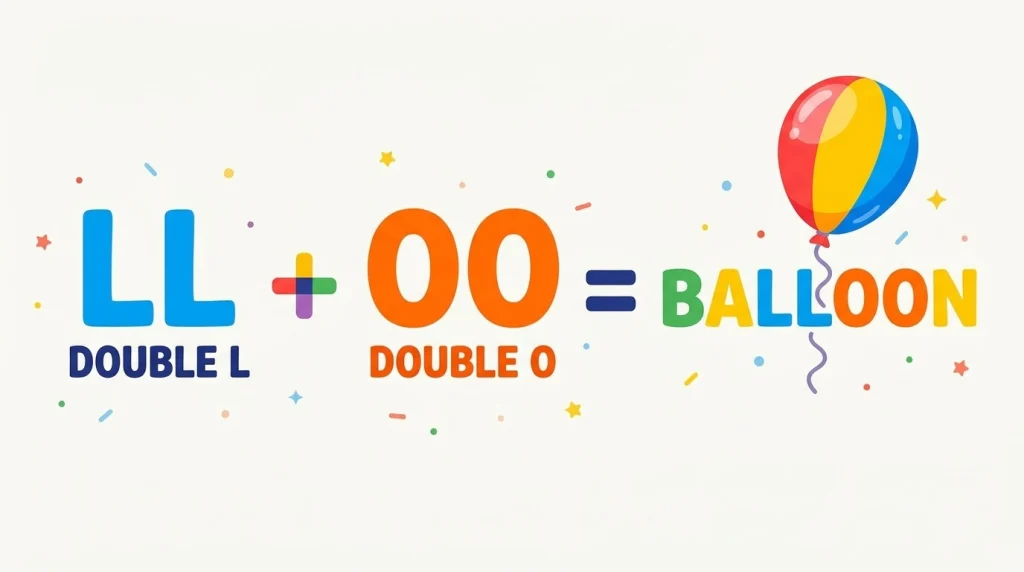
Use the phrase “Double L, double O: BALLOON!”
Break the word into its visible parts:
B A | L L | O O | N
Then check the two pairs:
- Two Ls: LL
- Two Os: OO
If you are writing about a birthday decoration, a weather balloon, or something that increases rapidly, check that both pairs are present before moving on.
This is a spelling memory aid rather than a general rule for English words. Not every word follows the same pattern, so learn balloon as a complete word.
Quick Quiz: Ballon or Balloon?
Choose the correct word or form for each sentence.
- We bought six ______ for the school celebration.
- The company’s costs began to ______ after the unexpected delay.
- The children watched a hot-air ______ rise into the sky.
- Her workload has ______ since she became team leader.
- The ballet teacher discussed the dancer’s ______.
Answers and Explanations
- Balloons — The plural of the everyday noun balloon is balloons.
- Balloon — The verb means to increase rapidly.
- Balloon — The standard spelling for the aircraft is hot-air balloon.
- Ballooned — The past participle describes a workload that increased significantly.
- Ballon — In this specialist ballet context, the term refers to lightness and buoyancy in a dancer’s movement.
If you answered all five correctly, you understand both the everyday spelling and the main specialized exception.
Quick Summary
Balloon is the correct standard English spelling for an inflatable object, a hot-air aircraft, and the verb meaning to expand or increase rapidly. It contains two Ls and two Os, and those letters remain in forms such as balloons, ballooned, and ballooning. The shorter spelling, ballon, is incorrect when you mean the everyday object, although it has a specialized use in ballet terminology. American and British English use the same standard spelling. To remember it, think “double L, double O: balloon.” Before submitting an email, assignment, report, or social media post, check the spelling and make sure it matches the meaning you intend.
Frequently Asked Questions
Is ballon ever correct in English?
Yes. Ballon is used as a specialized ballet term for a dancer’s lightness or springy quality when jumping. It is not the standard spelling of the everyday inflatable object. Context determines whether the specialized term is appropriate.
Is balloon spelled with one L or two?
Balloon has two Ls and two Os. Its complete spelling is B-A-L-L-O-O-N. Remembering both pairs helps you avoid common errors such as baloon and ballon.
What is the plural of balloon?
The plural is balloons. Add S to the end without changing the double L or double O.
Example: “We ordered twenty balloons for the event.”
Is it ballooned or balloned?
The correct past-tense form of the verb is ballooned. The verb means to expand or increase rapidly.
Example: “The cost of repairs ballooned after the storm.”
Is it ballooning or balloning?
The correct form is ballooning. The double O remains when you add ING.
Example: “The company’s expenses are ballooning.”
Why does balloon have two Os?
The spelling is an established feature of the English word. Its pronunciation does not clearly tell you to write two Os, so the most reliable approach is to learn the complete spelling rather than try to derive it from sound.
Do American and British English spell balloon differently?
No. Both American and British English use balloon for the inflatable object and ballooned for the past-tense verb.
Can balloon be used as a verb?
Yes. Balloon can mean to swell, expand, or increase rapidly.
Example: “The final bill ballooned after additional charges were added.”
What is a balloon payment?
A balloon payment is a large payment due at the end of certain loan arrangements. It is a financial term, and balloon keeps the same spelling as the everyday noun.
How can I remember the spelling of balloon?
Remember “double L, double O: balloon.” Check that the word contains both pairs of repeated letters whenever you write about an inflatable object or rapid expansion.
Is ballon a spelling mistake in a birthday invitation?
Yes, if you mean an inflatable decoration. Write balloon for one and balloons for more than one. The specialized ballet meaning does not apply to ordinary party decorations.
What is the easiest way to choose between ballon and balloon?
Ask yourself what you mean. If you are referring to an inflatable object, a hot-air aircraft, or rapid expansion, use balloon. If you are discussing the specialized ballet concept of lightness in a jump, ballon may be correct.