

Both invest and invest in are correct English, but they are used in different grammatical patterns. Use invest when the object or activity does not need to be specified, as in “I want to invest.” Use invest in when identifying the asset, business, project, skill, or other thing receiving money, time, or effort, as in “I want to invest in a business.” You can also use invest something in something, as in “She invested $5,000 in the company.”
Invest or Invest In?
Both “invest” and “invest in” are correct. Use invest on its own when talking generally about putting money, time, or effort to productive use. Use invest in when naming the thing receiving that investment. For example, “I plan to invest this year” is correct, as is “I plan to invest in real estate.” When you mention an amount or resource, you can also say, “I plan to invest $2,000 in real estate.”
What Is the Difference Between Invest and Invest In?
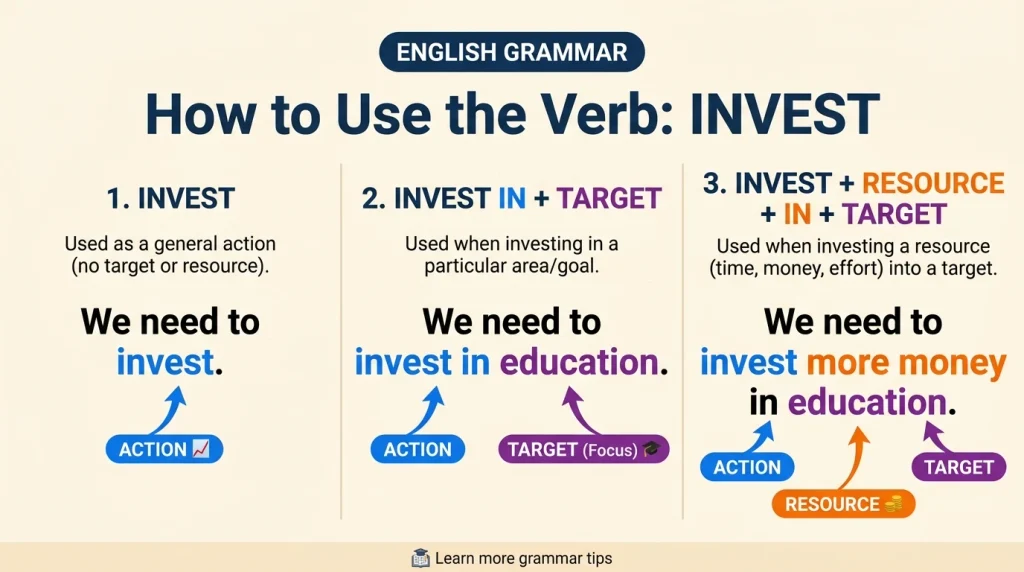
The difference is grammatical, not simply a difference in meaning. Invest is a verb meaning to put money, time, energy, or resources into something with the expectation of a return, benefit, or improvement. Invest in is a common pattern that identifies what receives those resources.
Consider these examples:
- “We need to invest.” The speaker does not specify the investment target.
- “We need to invest in technology.” The speaker identifies the target.
- “We need to invest more money in technology.” The speaker identifies both the amount and the target.
All three sentences are correct. The best choice depends on how much information you want to communicate.
What Does Invest Mean?
Invest is a verb. In financial contexts, it means to put money into assets or activities with the aim of earning a return or gaining value. More broadly, it can mean devoting time, effort, energy, or resources to something that may produce a worthwhile result.
Examples:
- “I started investing after I found a stable job.”
- “The company plans to invest next year.”
- “Good teachers invest time in helping their students.”
- “She invested considerable effort in improving her writing.”
The verb does not always require an explicit target. When the context makes the subject clear, invest can stand alone.
ALSO READ: Will Be Send or Will Be Sent?
What Does Invest In Mean?
Invest in is the verb invest followed by the preposition in. The phrase commonly identifies the person, thing, activity, or area receiving money or effort.
Examples:
- “They invested in renewable energy.”
- “I want to invest in my education.”
- “The business is investing in new equipment.”
- “We should invest in employee training.”
The phrase also has a broader everyday meaning. Someone might say, “It’s time to invest in a better office chair,” meaning that buying a more expensive but useful item is worthwhile.
Why the Difference Matters
Choosing the right grammatical pattern helps you express your idea clearly and naturally. This is especially important in business communication, academic writing, financial discussions, and professional emails.
Compare these sentences:
- “Our company needs to invest.” This is correct but leaves the investment target unspecified.
- “Our company needs to invest in cybersecurity.” This identifies the area requiring resources.
- “Our company needs to invest more funding in cybersecurity.” This identifies both the resource and the target.
The distinction also matters when you describe time and effort. “She invested two hours” can be grammatical when the context supplies the activity. “She invested two hours in preparing the presentation” makes the activity explicit.
The goal is not to add in to every sentence. It is to choose the pattern that communicates the intended meaning.
ALSO CHECKOUT: Usage vs. Useage: Which Spelling Is Correct?
The Core Rule: How to Use Invest and Invest In
Use “invest” when no investment target needs to be named. Use “invest in” to identify the target. Use “invest something in something” when you want to name both the resource and the target.
Remember these three patterns:
- Invest: “We should invest.”
- Invest in + target: “We should invest in education.”
- Invest + resource + in + target: “We should invest more money in education.”
The third pattern is particularly useful in business and academic writing because it specifies what is being invested and where it is going.
How to Use Invest Correctly
1. Use Invest Without In When Speaking Generally
You can use invest without naming the target when it is unknown, unimportant, or already understood from the conversation.
Examples:
- “I’m thinking about investing.”
- “It’s never too late to invest.”
- “The company has enough cash to invest.”
- “Before you invest, understand the risks.”
- “We need to invest more wisely.”
These sentences are complete and natural. You do not need to add in unless you want to identify an investment target.
2. Use Invest In to Name the Investment Target
Use invest in when you want to tell the reader what receives money, time, effort, or resources.
Examples:
- “She invests in index funds.”
- “The school invested in new laboratory equipment.”
- “Our department is investing in staff development.”
- “They decided to invest in a local startup.”
- “He invests in learning new skills.”
The target can be a physical asset, an organization, a project, a person, or an abstract goal.
3. Use Invest Something In Something
This pattern includes two parts after the verb: the resource being invested and the target receiving it.
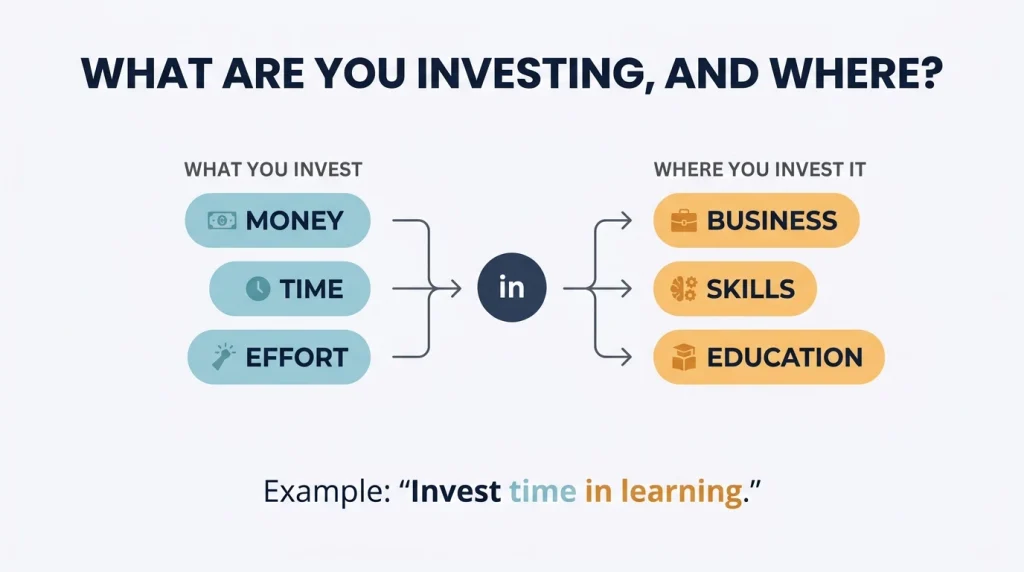
Structure: invest + money/time/effort/resources + in + target
Examples:
- “She invested $10,000 in the business.”
- “The university invested millions of dollars in research.”
- “I invested several weekends in completing the course.”
- “The company invested considerable effort in improving customer service.”
- “They invested their savings in a retirement fund.”
In these examples, the first noun phrase tells us what is being invested, and the phrase beginning with in tells us where the investment goes.
4. Use Invest In for Time and Effort
Investment does not always involve money. English speakers also use invest in to describe devoting resources to personal growth, relationships, learning, and work.
Examples:
- “Invest in your communication skills.”
- “Parents invest time in supporting their children.”
- “The manager invested considerable energy in mentoring new employees.”
- “She has invested years in building her career.”
- “We should invest more effort in understanding our customers.”
You can also use the pattern invest time in doing something.
For example: “He invested several hours in preparing for the interview.”
5. Use Invest With for a Different Meaning
Do not confuse invest in with invest someone with something. The latter is a more formal construction meaning to give someone a quality, power, or authority.
Examples:
- “The new role invested her with greater authority.”
- “The ceremony invested him with the responsibilities of office.”
This use is less common in everyday conversation. It does not mean putting money into a person or business.
6. Use Invest As a Noun in Related Expressions
The noun investment follows similar patterns:
- “An investment in education can produce long-term benefits.”
- “The company made a significant investment in research.”
- “Her investment of time helped the team meet its deadline.”
Remember that invest is the verb, while investment is the noun. The correct preposition depends on the full expression and its meaning.
Correct Examples of Invest and Invest In
The following examples show how both patterns work in different real-world settings.
- Conversation: “I’m ready to invest, but I need to learn more first.”
- Email: “We recommend investing in updated software before the next quarter.”
- School assignment: “Governments should invest in public education.”
- Workplace meeting: “We need to invest more resources in customer support.”
- Social media: “Invest in yourself by learning something new every day.”
- Academic writing: “The researchers invested considerable time in collecting reliable data.”
- Financial discussion: “She decided to invest a portion of her savings in government bonds.”
- Business report: “The organization invested $2 million in expanding its production facility.”
- Job interview: “I invest time in developing my technical and communication skills.”
- Personal conversation: “It’s worth investing in a comfortable pair of walking shoes.”
- Project planning: “Before we invest, we should compare the expected costs and benefits.”
- Professional development: “The company continues to invest in training its employees.”
These examples illustrate a central point: invest can stand alone, while invest in identifies the target when that information is needed.
Incorrect vs. Correct: 10 Common Mistakes
Some errors involve missing prepositions. Others involve choosing the wrong preposition or using a pattern that is grammatically possible but unclear in context.
| ❌ Incorrect or less suitable | ✅ Correct or clearer | Why |
|---|---|---|
| I want to invest in. | I want to invest. | The sentence has no investment target. If the target is needed, name it after in. |
| We invested on new equipment. | We invested in new equipment. | Invest in is the usual pattern for identifying the target. |
| She invested money on the company. | She invested money in the company. | The standard construction is invest money in something. |
| They want to invest their savings. | They want to invest their savings in property. | The first sentence is grammatical, but the second identifies the target more clearly. |
| He invested in improving his writing skills. | He invested time in improving his writing skills. | The first sentence is grammatical; the second is more specific when the resource matters. |
| We invested to the project. | We invested in the project. | Use in, not to, to identify the investment target. |
| The school invested for technology. | The school invested in technology. | For can express purpose elsewhere, but in is the standard choice for the target here. |
| I invested $500 for the fund. | I invested $500 in the fund. | Use in to identify the fund receiving the money. |
| The company invested heavily the staff. | The company invested heavily in its staff. | The preposition is needed to connect the investment to its target. |
| She invested her time to learn English. | She invested her time in learning English. | After invest time in, use a noun or an -ing form to name the activity. |
Important: Not every sentence in the first column is equally ungrammatical. For example, “They want to invest their savings” is correct when the target is understood or irrelevant. Editing should improve accuracy and clarity, not add words mechanically.
Why People Make This Mistake
1. Translating Directly From Another Language
Some languages use a preposition that does not match English in. Learners may translate the expression word for word and produce phrases such as invest on or invest to.
The most reliable approach is to learn the whole pattern: invest in a business, invest money in a business, and invest time in learning.
2. Confusing the Object With the Target
In “She invested $5,000 in the company,” the amount is the resource and the company is the target.
Learners sometimes assume that because invest already has an object—such as $5,000—no preposition is needed before the target. English allows both elements, but they have different roles.
3. Overgeneralizing From Other Verbs
English verbs do not all take the same prepositions. We spend money on something, put money into something, and commonly invest money in something.
The preposition that follows one verb cannot automatically be transferred to another.
4. Relying on Autocomplete or Spellcheck
A spelling checker may accept a sentence even when its preposition is unnatural for the intended meaning. All the words in “We invested on technology” are spelled correctly, but the usual English construction is “invested in technology.”
Check grammar and word combinations, not just spelling.
5. Assuming In Is Always Required
The opposite mistake is adding in even when no target follows it.
“I plan to invest” is complete. “I plan to invest in” normally leaves the reader waiting for the target, unless the sentence continues in a way that supplies it.
The goal is to use in when the sentence requires or benefits from a target, not to attach it automatically.
Common Mistakes Checklist
Use this checklist when editing sentences with invest.
- Missing the target after in: “We invested in” usually feels incomplete when no target follows. Name the target or remove in.
- Using on instead of in: For the usual investment-target meaning, write “invest in a company,” not “invest on a company.”
- Using to instead of in: Write “invest in research,” not “invest to research” when naming the target.
- Confusing resource and target: In “invest money in equipment,” money is the resource and equipment is the target.
- Adding in unnecessarily: “I plan to invest” is correct when you are speaking generally.
- Using an awkward activity phrase: “Invest time in learning” is the standard pattern for describing the time spent on an activity.
- Assuming investment must involve money: Time, energy, and effort can also be invested.
- Confusing invest in with invest with: Invest in usually identifies a target; invest someone with authority means to give that person authority.
A useful final check is to ask two questions: What is being invested? What is it being invested in? If the second answer is not important or is already understood, you may not need to state it.
Invest or Invest In in Real English
Grammatically Correct
“I want to invest” is grammatically correct because invest can be used without an expressed target. “I want to invest in renewable energy” is also correct because the prepositional phrase identifies the target. “I want to invest $5,000 in renewable energy” adds the resource as well. Each sentence follows a valid pattern; the difference is how much detail the speaker chooses to provide.
Grammatically Possible but Unnatural
“I want to invest in” may occur as an unfinished sentence, but in ordinary writing it usually sounds incomplete because the reader expects a target after in. Similarly, “She invested her time to learn English” is understandable, but “She invested her time in learning English” is the more natural standard construction. The best correction depends on the intended meaning, not simply on sentence length.
Natural, Everyday English
In everyday English, people often say “invest in yourself,” “invest in a good computer,” or “invest in your future.” In a financial conversation, “I haven’t invested yet” is also natural when the specific asset is not relevant. At work, “We need to invest more in training” is concise and clear. English speakers choose the pattern that fits the context and the information they want to emphasize.
American vs. British English
The basic patterns invest and invest in are used in both American and British English. There is no general regional rule requiring Americans to use one pattern and British speakers to use the other.
| Feature | American English | British English |
|---|---|---|
| General statement | I want to invest. | I want to invest. |
| Naming a target | Invest in stocks. | Invest in shares. |
| Naming the resource and target | Invest money in a business. | Invest money in a business. |
| Investing time | Invest time in learning. | Invest time in learning. |
| Usual preposition for a target | In | In |
The words used to describe particular financial products may differ. For example, stocks is common in American English, while shares is common in British financial contexts. That vocabulary difference does not change the underlying grammar.
Formal vs. Informal Usage
Both invest and invest in are suitable for formal and informal communication.
In informal conversation, someone might say, “I want to invest in a better laptop.” In a formal business report, a writer might say, “The organization plans to invest additional funds in cybersecurity infrastructure.”
Formal writing often benefits from specifying the resource and target, particularly when the amount, purpose, or outcome matters. However, there is no need to make every sentence longer than necessary.
The expression invest in yourself is common in motivational and everyday writing. In academic or business contexts, more precise wording may be preferable, such as “invest time in professional development.”
Invest vs. Invest In: Comparison Table
| Feature | Invest | Invest In |
|---|---|---|
| Grammatical form | Verb | Verb + preposition |
| Basic meaning | Put money, time, effort, or resources to productive use | Identify what receives the investment |
| Can stand alone? | Yes, when the target is unnecessary or understood | Usually needs a target after in |
| Example | We need to invest. | We need to invest in training. |
| With an amount | Invest $2,000. | Invest $2,000 in a fund. |
| With time | Invest time. | Invest time in learning. |
| Typical context | General statements about investing | Naming a particular asset, person, activity, or goal |
| Correctness | Correct | Correct |
Real-Life Situations: Choosing the Right Pattern
Situation 1: A Job Interview
Question: “How do you improve your professional skills?”
Less informative: “I invest.”
Clearer: “I invest time in learning new software and improving my communication skills.”
Why: The longer answer identifies the resource and the activities receiving it.
Situation 2: A Business Meeting
Question: “What should we do with the additional budget?”
General answer: “We should invest carefully.”
Specific answer: “We should invest additional funds in staff training and equipment.”
Why: Both are correct. The specific answer identifies the intended uses of the money.
Situation 3: A Professional Email
Less natural: “We plan to invest on new security systems.”
Correct: “We plan to invest in new security systems.”
Why: Invest in is the standard construction for identifying the target of the investment.
Situation 4: A Text Message
Natural: “I’m thinking about investing, but I haven’t decided yet.”
Why: The target does not need to be named when the speaker is discussing investing generally.
Situation 5: An Academic Essay
Less suitable: “Schools should invest to better teaching.”
Clearer: “Schools should invest in better teaching resources and teacher development.”
Why: The corrected version uses the usual preposition and identifies the areas that need resources.
An Easy Way to Remember Invest vs. Invest In
Use this simple memory aid:
Invest = the action. Invest in = the action plus its target.
- Start with the action: “We need to invest.”
- Ask what receives the investment: “We need to invest in education.”
- Add the resource if needed: “We need to invest more money in education.”
This is a practical guide rather than an absolute rule about every possible use of the verb. Invest has other grammatical patterns, including invest someone with authority. For ordinary financial and resource-related writing, however, the three patterns above will cover many common situations.
Quick Quiz: Invest or Invest In?
Complete each sentence with the most appropriate form or preposition.
- The company plans to invest ___ renewable energy.
- Before you ___, make sure you understand the risks.
- The university invested millions of dollars ___ research.
- She invests a lot of time ___ improving her English.
- We need to invest more carefully, but we have not decided what to invest ___ yet.
- The organization wants to invest its resources ___ employee training.
Answers and Explanations
- In — Invest in renewable energy identifies the target.
- Invest — The sentence is complete without a target because the statement is general.
- In — The construction is invest an amount in a target.
- In — The standard expression is invest time in doing something.
- In — The final clause identifies the target that has not yet been selected.
- In — The sentence identifies employee training as the target receiving resources.
If you got these right, you understand the most common patterns. The key is to learn the full construction rather than memorize invest in as a phrase that must appear in every sentence.
Quick Summary
Both invest and invest in are grammatically correct, but they serve different purposes. Use invest when speaking generally or when the investment target is already understood. Use invest in when identifying the asset, business, project, person, skill, or activity receiving money, time, or effort. When you want to name both the resource and the target, use the pattern invest something in something, as in “She invested $5,000 in the business.” For everyday financial and professional English, invest in is the standard choice when naming a target. Remember: invest is the action; invest in identifies where the resources go. Always choose the construction that communicates your intended meaning clearly.
Frequently Asked Questions
Is invest in grammatically correct?
Yes. Invest in is a standard English construction used to identify what receives money, time, effort, or other resources. For example, “They invested in employee training” is correct.
Can I use invest without in?
Yes. “I want to invest” is grammatically correct when you are speaking generally or when the investment target does not need to be stated. You can add in when you want to identify that target.
Should I say invest in a company or invest a company?
For the usual meaning of putting money into a business, say “invest in a company.” You can also say “invest money in a company.” The company is the target of the investment, not the resource being invested.
Is invest on ever correct?
Invest on occurs in some English contexts, but it is not the usual construction for identifying an investment target. In standard everyday and professional writing, prefer “invest in a business,” “invest in technology,” and “invest money in a project.” Do not confuse the phrase “invest on behalf of someone,” where on behalf of means acting for another person, with the preposition used to name the investment target.
Is it invest time in or invest time on?
“Invest time in” is the standard and widely accepted construction, particularly before a noun or an -ing form. For example, “She invested time in improving her presentation.” Spend time on is also common, but that does not mean the same preposition should automatically follow invest.
Can I say invest in myself?
Yes. “Invest in myself” is a natural expression meaning to devote money, time, or effort to your own development and well-being. It can refer to education, health, professional skills, or personal growth.
What is the difference between invest in and invest into?
Invest in is the standard choice in most financial, business, and everyday contexts. Invest into appears in some varieties of English, but it is less conventional in many standard written contexts. Unless a particular style or regional usage calls for it, choose invest in.
Is invest in followed by a noun or a verb?
It can be followed by a noun phrase or an -ing form that names an activity. Examples include “invest in education” and “invest in learning new skills.” Avoid using an ordinary infinitive directly after in in this construction.
Can I invest money in doing something?
Yes. The pattern invest money in doing something is grammatical when the activity is the target of the investment. For example, “The organization invested money in developing a safer product.” You can also use invest time in doing something or invest effort in improving a process.
What is the difference between invest in and invest with?
Invest in something usually means putting money or resources into a target. Invest someone with something is a more formal construction meaning to give someone authority, power, or a particular quality. For example, “The new position invested her with considerable authority.”
Which is better in business writing: invest or invest in?
Neither is universally better. Use invest for general statements, such as “The company plans to invest.” Use invest in when identifying the target, such as “The company plans to invest in cybersecurity.” When amounts and destinations matter, “The company plans to invest $2 million in cybersecurity” is more informative.
Is invest in formal or informal English?
It is appropriate in both formal and informal English. It appears in financial reports, academic writing, business proposals, workplace emails, and everyday conversations. The level of formality depends on the surrounding wording and context, not on the phrase itself.