
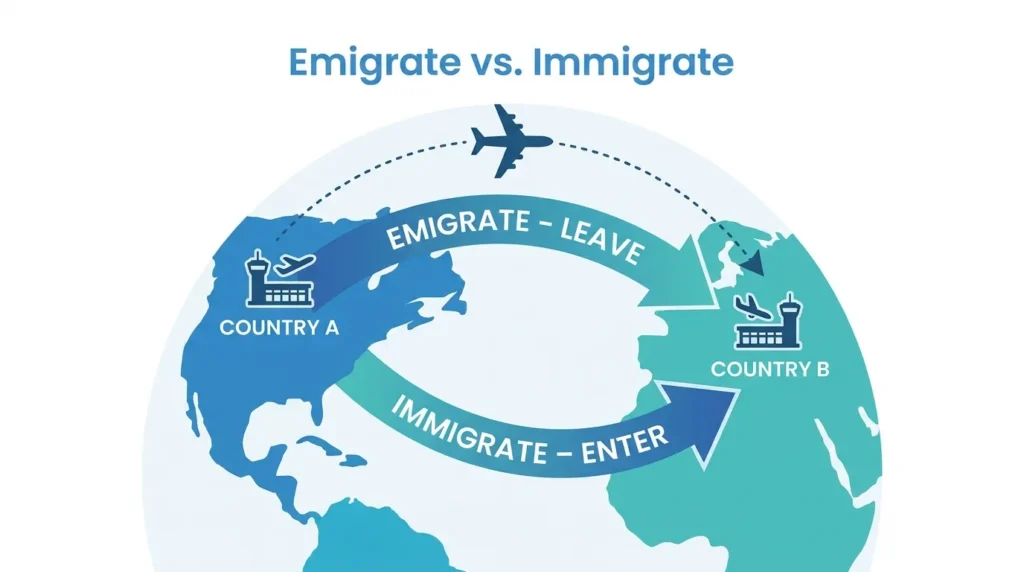

The easiest way to remember the difference is direction:
- Emigrate means to leave your home country to live in another country.
- Immigrate means to enter another country to live there permanently or for an extended period.
For example, if someone moves from Pakistan to Canada, they emigrate from Pakistan and immigrate to Canada.
Both words describe the same international move, but they focus on different sides of it. The key is knowing whether you are talking about leaving a country or arriving in one.
The difference between emigrate and immigrate is the direction from which you describe an international move. Emigrate focuses on leaving a country, while immigrate focuses on entering another country to live there.
Consider this example:
A family moves from Pakistan to Canada.
- From Pakistan’s perspective, the family emigrates.
- From Canada’s perspective, the family immigrates.
Both words describe the same journey. Neither is more correct than the other; the appropriate choice depends on which side of the move you want to emphasize.
Why Does the Difference Matter?
These words are closely related, but using the wrong one can change the meaning of your sentence.
This matters particularly when writing about:
- Immigration applications: Explaining whether someone is leaving a country or entering a new one.
- Academic writing: Discussing population movement, international migration, and demographic changes.
- News reports: Reporting how many people leave a country compared with how many arrive.
- Professional communication: Describing someone’s international relocation accurately.
- English examinations: Choosing the correct vocabulary in grammar exercises and writing tasks.
For example, saying that thousands of people immigrated from Pakistan may confuse readers about whether Pakistan is their destination or their country of departure. Choosing the appropriate verb makes the intended direction clearer.
ALSO CHECKOUT: Setup vs Set Up: What’s the Difference and Which One Should You Use?
The Core Rule: When to Use Emigrate and Immigrate
The simplest rule is:
E
Emigrate = Exit
Use it when focusing on leaving a country to live somewhere else.
Example: She emigrated from Pakistan.
I
Immigrate = Into
Use it when focusing on entering another country to live there.
Example: She immigrated to Canada.
Remember: The difference is about perspective, not two different types of journeys.
How to Use Emigrate and Immigrate
Both words are verbs. They describe international relocation, but they emphasize different parts of the movement.
1. How to Use Emigrate
Use emigrate when discussing someone leaving their country to establish a life elsewhere.
The most common sentence pattern is:
Emigrate from + country of origin
Examples:
- He emigrated from Bangladesh.
- My grandparents emigrated from Italy.
- Several families emigrated from the region after the conflict.
- She hopes to emigrate from her home country next year.
You can also use emigrate without naming the country:
- Many young professionals want to emigrate.
- Her family decided to emigrate after years of economic difficulties.
An important exception: You can also say emigrate to when naming the destination. This construction is grammatically correct because the verb still emphasizes leaving.
For example:
- My uncle emigrated to Australia in 2015.
- Thousands of people emigrated to the United States during that period.
You can include both the starting point and destination:
– My uncle emigrated from Pakistan to Australia.
2. How to Use Immigrate
Use immigrate when discussing someone entering another country to establish a life there.
The common sentence pattern is:
Immigrate to + destination country
Examples:
- She immigrated to Germany.
- My parents immigrated to Canada.
- They plan to immigrate to the United States.
- His family immigrated to Australia several years ago.
You can also use immigrate without naming the destination when the context makes it clear:
- Her parents immigrated when she was young.
- Many people immigrated during the nineteenth century.
The origin can also be included:
- My grandparents immigrated to Canada from India.
- Thousands of people immigrated from Europe to the United States.
The important point is that immigrate focuses on arrival, even when the sentence also identifies where someone came from.
3. How to Use Both Words in One Sentence
Sometimes, the clearest way to describe an international move is to use both verbs.
For example:
Maria emigrated from Mexico and immigrated to Canada.
The first verb describes her departure. The second describes her arrival.
Here are three more examples:
- My parents emigrated from Pakistan and immigrated to the United Kingdom.
- The family emigrated from Italy before immigrating to Argentina.
- Many workers emigrated from their home countries and immigrated to the Gulf states.
This construction is particularly useful in academic writing, historical discussions, and explanations of international relocation.
Correct Examples of Emigrate and Immigrate
Understanding definitions is useful, but seeing these words in different situations makes them easier to remember.
Here are 12 original examples from everyday and professional English.
Everyday Conversations
- “My cousin emigrated from Pakistan last year and now lives in Germany.”
- “Did your grandparents immigrate to Canada when they were young?”
- “Several of our neighbors are planning to emigrate next summer.”
Emails and Professional Communication
- “Our company recently hired an engineer who immigrated to Australia from India.”
- “I am writing to explain why my family decided to emigrate from our home country.”
- “The employee immigrated to the United States in 2022 and has worked here since then.”
School and Academic Writing
- “Historical records show that many families emigrated from Ireland during the nineteenth century.”
- “The research examines the experiences of people who immigrated to New Zealand.”
- “Economic instability contributed to increased emigration from the region.”
Social Media and Personal Writing
- “We emigrated from our hometown several years ago, but we still miss our old neighborhood.”
- “My parents immigrated to the UK before I was born.”
- “Moving abroad was difficult, but immigrating to a new country gave our family more opportunities.”
Notice that these examples do not all require the same preposition. The correct construction depends on the information you want to emphasize.
Incorrect vs. Correct: 10 Common Sentence Problems
The following examples show mistakes that can change the intended direction or make a sentence grammatically incomplete.
| ❌ Incorrect | ✅ Correct | Why |
|---|---|---|
| She immigrated Canada. | She immigrated to Canada. | The destination needs an appropriate preposition. |
| They emigrated Pakistan. | They emigrated from Pakistan. | Use from to identify the country being left. |
| My parents immigrated to India when they left it. | My parents emigrated from India when they left it. | The sentence describes departure, not arrival. |
| He emigrated from Australia when he arrived there. | He immigrated to Australia when he arrived there. | The intended focus is entering Australia. |
| My grandparents immigrate to Canada in 1990. | My grandparents immigrated to Canada in 1990. | A completed event in 1990 needs the past tense. |
| She is immigrate to Germany next year. | She is immigrating to Germany next year. | After is, use the present participle in this construction. |
| They decided immigrating from Italy. | They decided to emigrate from Italy. | Decide is normally followed by a to-infinitive here. |
| His family has immigrate to France. | His family has immigrated to France. | The present perfect requires the past participle. |
| We are planning to immigrated to Canada. | We are planning to immigrate to Canada. | After to in an infinitive, use the base verb. |
| My parents emigrated from Pakistan and immigrated from Canada. | My parents emigrated from Pakistan and immigrated to Canada. | The second clause should identify the destination, not repeat the departure perspective. |
Important: Not every sentence containing emigrate to or immigrate from is automatically incorrect. Both constructions can occur in correct English when the context supports them. The key is whether the intended meaning is clear.
Why People Confuse Emigrate and Immigrate
There are several reasons these words cause difficulty, even for people who speak English fluently.
1. Their Spellings Are Almost Identical
Both words contain the same basic letter sequence:
- Emigrate
- Immigrate
The difference is mainly at the beginning, where one starts with e and the other with i.
Because their spellings look so similar, readers sometimes recognize the general meaning but select the wrong word.
2. They Describe the Same Event
This is probably the biggest reason for confusion.
Imagine someone moving from Pakistan to Australia.
The person has left Pakistan and entered Australia. Both actions belong to the same international move.
Consequently, either word may be appropriate depending on the perspective:
- Emigrated from Pakistan.
- Immigrated to Australia.
People sometimes assume that because the event is the same, the words must also be interchangeable. They are not.
3. People Overgeneralize the Preposition Rule
English learners are often taught:
- Emigrate = from.
- Immigrate = to.
This is a helpful starting point, but it is not an absolute rule.
For example:
“She emigrated to Canada in 2018.”
This sentence is correct. The verb emphasizes her departure from her previous country, while to Canada identifies her destination.
Likewise, a sentence can use immigrated from to identify someone’s origin when the destination or broader context makes the direction clear.
4. Spellcheck Does Not Always Recognize Meaning
Modern spelling tools can identify many spelling mistakes, but they do not always understand the meaning a writer intends.
Both emigrate and immigrate are correctly spelled English words.
Therefore, a spellchecker may accept a sentence containing the wrong word because the selected word is spelled correctly.
5. Translation Can Create Confusion
In some languages, a single verb may describe moving to another country without making the distinction between leaving and arriving.
When speakers translate directly into English, they may choose emigrate and immigrate interchangeably.
The solution is to identify the perspective before translating the sentence.
Common Mistakes Checklist
Use this checklist whenever you are unsure which word belongs in your sentence.
- Using immigrate when describing departure: If you are emphasizing the country someone leaves, choose emigrate. This avoids reversing the intended perspective.
- Using emigrate when emphasizing arrival: If you want to highlight the country someone enters, choose immigrate.
- Forgetting the preposition: Use emigrate from for the origin and immigrate to for the destination as your default patterns.
- Treating the two verbs as alternative spellings: They have different meanings, so replacing one with the other can change the sentence.
- Ignoring verb tense: Use emigrated or immigrated for completed past events.
- Confusing verbs with nouns: Emigrant and immigrant refer to people, while emigration and immigration refer to processes.
- Assuming every move is permanent: These words generally describe relocation to live in another country, not ordinary tourism or a short holiday.
- Trusting spellcheck alone: Both words are correctly spelled, so check the meaning as well.
Emigrate vs. Immigrate in Real English
Knowing a dictionary definition is only part of learning vocabulary. You also need to understand how these words work in actual sentences.
1. Grammatically Correct English
Both words are standard English verbs and can be used in formal and everyday writing. For example, “She emigrated from Spain” and “She immigrated to Canada” are both correct. You can also combine them: “She emigrated from Spain to Canada.” The choice depends on whether you are emphasizing the country someone leaves or the country someone enters.
2. Grammatically Possible but Potentially Unnatural English
A sentence can be grammatically possible but still sound confusing if its direction is unclear. For example, “He immigrated from Canada” can be understood in a context where the speaker identifies his origin, but without additional information, readers may wonder where he immigrated to. Adding the destination makes the intended movement easier to follow.
3. Natural, Everyday English
In everyday conversation, people often avoid these two verbs altogether and simply say “move abroad,” “move to Canada,” or “leave the country.” These expressions are straightforward and work well when the exact immigration perspective is unimportant. When discussing someone’s country of departure or arrival more precisely, emigrate and immigrate remain natural and useful choices.
Formal vs. Informal Usage
There is no special formal-versus-informal meaning difference between emigrate and immigrate. Both are neutral vocabulary.
However, the choice of expression may depend on the situation.
| Situation | Natural expression |
|---|---|
| Casual conversation | My family moved to Canada. |
| Formal email | My family immigrated to Canada. |
| Academic writing | Emigration from the region increased. |
| News reporting | Immigration to the country increased. |
| Personal statement | I emigrated from Pakistan in 2020. |
In casual conversation, move abroad may sound simpler. In official documents, research, and formal reports, the more precise terms are often preferable.
Emigrate vs. Immigrate vs. Migrate
A third word, migrate, is closely related to the other two. Understanding it completes the comparison.
| Feature | Emigrate | Immigrate | Migrate |
|---|---|---|---|
| Main meaning | Leave a country to live elsewhere | Enter another country to live there | Move from one place to another |
| Main focus | Departure | Arrival | Movement |
| Typical preposition | From | To | To / From |
| Permanent relocation | Usually | Usually | Not necessarily |
| Used for animals | Generally no | Generally no | Yes |
| Example | She emigrated from Spain. | She immigrated to Canada. | Birds migrate south. |
What Does Migrate Mean?
Migrate is a broader word that describes movement from one place to another.
Unlike emigrate and immigrate, it does not necessarily involve crossing an international border or settling permanently.
Examples:
- Birds migrate to warmer regions during winter.
- Workers migrate from rural areas to major cities.
- Some families migrate between regions for employment.
- The population migrated toward the coastal areas.
When Should You Use Migrate Instead?
Use migrate when you want to describe movement generally without emphasizing the departure or arrival perspective.
For example:
- Emigrate: Thousands of people emigrated from the country.
- Immigrate: Thousands of people immigrated to the country.
- Migrate: Thousands of people migrated across the region.
This distinction is particularly useful in geography, environmental science, population studies, and discussions about animal movement.
Related Words: Emigrant, Immigrant, Emigration, and Immigration
The difference between emigrate and immigrate also applies to their related nouns.
Emigrant vs. Immigrant
An emigrant is a person who leaves their country to live somewhere else.
An immigrant is a person who enters another country to establish a life there.
For example:
- My grandfather was an emigrant from Italy.
- My grandfather became an immigrant in Canada.
Both sentences can describe the same person.
Emigration vs. Immigration
Emigration refers to the process of leaving a country to live elsewhere.
Immigration refers to the process of entering another country to live there.
Examples:
- Emigration from the region increased after the economic crisis.
- Immigration to the country increased during the same period.
Quick Word-Family Comparison
| Verb | Person | Process |
|---|---|---|
| Emigrate | Emigrant | Emigration |
| Immigrate | Immigrant | Immigration |
| Migrate | Migrant | Migration |
A useful distinction is that immigrant and emigrant describe the same person from different geographical perspectives.
Emigrate vs. Immigrate in Real-Life Situations
The following situations show how to choose the right word when communicating in everyday and professional settings.
1. During a Job Interview
Interviewer: “Why did your family leave Pakistan?”
Candidate: “My parents emigrated from Pakistan when I was a child because they wanted better employment opportunities.”
The speaker emphasizes the country the family left.
2. During an Office Meeting
Manager: “Can you tell us about your international background?”
Employee: “I immigrated to the United Kingdom in 2019 and have worked here ever since.”
The employee emphasizes arriving in the UK.
3. In a Formal Email
Subject: Confirmation of Relocation History
“I would like to confirm that my family emigrated from Bangladesh and immigrated to Australia in 2017.”
Both verbs are appropriate because the sentence identifies the departure and destination.
4. In an English Examination
Question: Choose the correct word.
“Many families decided to ______ from their home country during the economic crisis.”
Correct answer: Emigrate
The sentence emphasizes leaving the home country.
5. In a Personal Text Message
“I heard your brother immigrated to Germany. How is he settling in?”
The sentence focuses on the country your brother entered.
Frequently Asked Questions
1. What is the simplest way to remember emigrate vs. immigrate?
Remember E = Exit and I = Into. Emigrate means leaving a country to live somewhere else, while immigrate means entering another country to live there. This simple association helps you choose the correct word without memorizing complicated grammar rules.
2. Can someone emigrate from one country and immigrate to another?
Yes. Both words describe different perspectives of the same international move. Someone moving from India to Canada emigrates from India and immigrates to Canada. There is no contradiction because each verb emphasizes a different part of the journey.
3. Is it correct to say emigrate to Canada?
Yes. Emigrate to Canada is grammatically correct. Although emigrate from is the usual construction when naming the country someone leaves, emigrate to can identify the destination while the verb emphasizes departure. For example: “Her family emigrated to Canada in 2018.”
4. Is immigrate from grammatically correct?
Yes, it can be correct when the sentence identifies someone’s origin and the destination is understood or stated elsewhere. For example: “They immigrated from Pakistan to Canada.” However, if you only want to emphasize leaving Pakistan, emigrated from Pakistan is the clearer choice.
5. What is the difference between an emigrant and an immigrant?
An emigrant is someone viewed from the country they leave. An immigrant is someone viewed from the country they enter. The same individual can be both an emigrant and an immigrant. For example, someone who moves from China to France is an emigrant from China and an immigrant to France.
6. Are emigrate and immigrate synonyms?
No. They are related words, but they are not interchangeable synonyms. Both describe international relocation, but emigrate emphasizes departure and immigrate emphasizes arrival. Using one instead of the other can change the intended perspective of a sentence.
7. What is the difference between immigration and migration?
Immigration refers specifically to entering another country to live there. Migration is a broader term for movement from one place to another. Migration can involve movement between countries, regions, or even seasonal movement by animals. Immigration always concerns movement into a country or territory.
8. Do emigrate and immigrate have different meanings in American and British English?
No significant difference exists in their basic meanings between American and British English. Both varieties use emigrate for departure and immigrate for arrival. Their spelling and fundamental usage remain the same.
9. Can I use emigrate and immigrate in academic writing?
Absolutely. Both words are appropriate in academic writing, particularly in history, geography, sociology, economics, and population studies. Use emigration when discussing people leaving a country and immigration when discussing people entering one.
10. Is moving abroad the same as emigrating?
Not necessarily. Moving abroad is a general expression for relocating to another country. Emigrating specifically describes leaving a country to establish a life elsewhere. A short-term move for travel or a temporary assignment does not automatically qualify as emigration.
Test Your Understanding: Emigrate vs. Immigrate Quiz
Choose the correct word for each sentence. Check your answers after completing all five questions.
Grammar practice
5 questions
1. My grandparents ______ from Italy in 1985.emigratedimmigrated
2. She ______ to Canada when she was twelve.emigratedimmigrated
3. Many birds ______ south during winter.immigratemigrate
4. My parents emigrated from India and ______ to Australia.immigratedemigrated
5. Thousands of people decided to ______ after the economic crisis.immigrateemigrate
Check my answers
Answer all five questions to see your results.
Quick Summary: Emigrate vs. Immigrate
Emigrate and immigrate describe the same type of international relocation from two different perspectives. Emigrate means leaving a country to live somewhere else, while immigrate means entering another country to establish a life there. Remember E for Exit and I for Into to distinguish the words easily. Use emigrate from when identifying the country someone leaves and immigrate to when identifying the destination. You can also use both verbs in one sentence: “She emigrated from Pakistan and immigrated to Canada.” The broader word migrate describes movement between places and does not necessarily involve international relocation or permanent settlement. Understanding this distinction helps you write more clearly and accurately.


