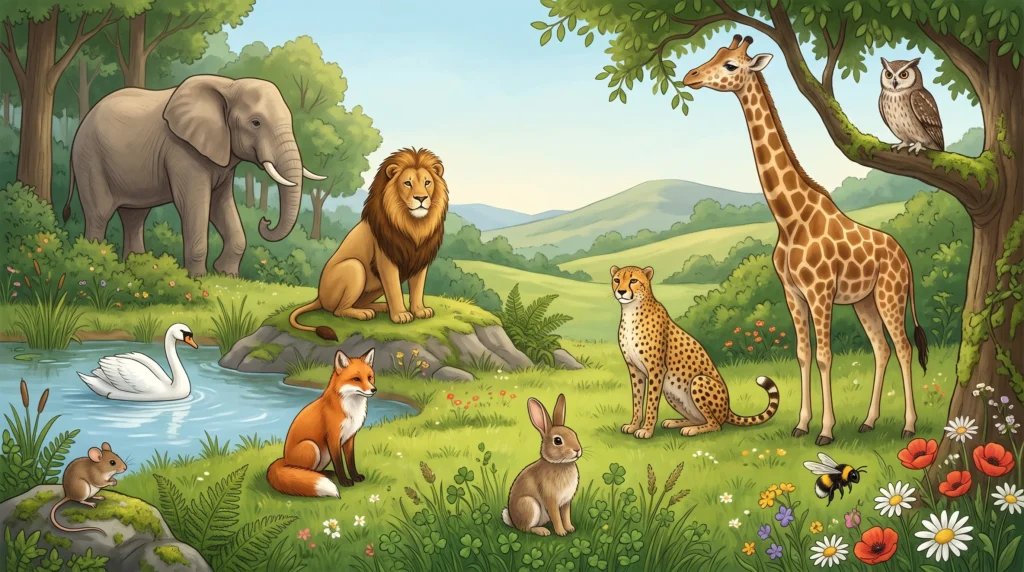

Animal similes compare people, animals, actions, or situations to familiar animal characteristics using words such as like and as. Expressions such as “as brave as a lion,” “as busy as a bee,” and “as quiet as a mouse” make descriptions more vivid and easier to understand.
Whether you are writing a school assignment, creating a story, improving your English vocabulary, or looking for creative ways to describe someone, animal similes can help you express ideas more clearly.
This guide includes more than 100 animal similes, their meanings, original example sentences, common mistakes, and practical exercises to help you use them naturally.
Read also: Emigrate vs. Immigrate: Meaning, Difference, Rules, and Examples
What Are Animal Similes?
Animal similes are figures of speech that compare a person, animal, object, action, or situation to an animal to highlight a shared quality.
They usually contain the words like or as. The comparison is not meant to be taken literally. Instead, it helps readers imagine a particular characteristic, such as speed, strength, bravery, cleverness, or gentleness.
For example:
- As brave as a lion: Describes someone who shows great courage.
- As busy as a bee: Describes someone who is constantly working.
- As sly as a fox: Describes someone who is clever and sometimes deceptive.
- As slow as a snail: Describes someone or something that moves very slowly.
- As gentle as a lamb: Describes someone who is kind and mild.
Consider this sentence:
“Despite being nervous about the competition, Sarah walked onto the stage as brave as a lion.”
Sarah is not literally a lion. The comparison emphasizes her courage despite feeling afraid.
Animal similes work because people already recognize many characteristics traditionally associated with particular animals. A writer can use that shared understanding to communicate an idea in just a few words.
Why Do Animal Similes Matter?
Animal similes make ordinary descriptions more expressive. Instead of simply telling readers that someone is fast, quiet, stubborn, or hardworking, you can create a picture that makes the quality easier to imagine.
They are particularly useful in:
- Creative writing: Make characters, actions, and scenes more interesting.
- School assignments: Improve descriptive paragraphs, essays, and storytelling.
- Everyday conversations: Express personality and behavior in memorable ways.
- Poetry: Create imagery and emotional connections.
- English learning: Build vocabulary and understand figurative language.
- Professional communication: Add personality to informal presentations and storytelling when appropriate.
Compare these two sentences:
- Plain: “The little boy ran very quickly.”
- More descriptive: “The little boy ran as fast as a cheetah.”
The second sentence gives readers a stronger impression of speed.
However, more similes do not automatically make writing better. One well-chosen comparison is often more effective than several comparisons competing for attention.
ALSO CHECKOUT: Up to Date vs Up-to-Date: What’s the Difference?
The Core Rule of Animal Similes
The rule
An animal simile compares two different things by highlighting a shared quality. It commonly uses like or as to make the comparison clear.
Common patterns:
- As + adjective + as + animal
- Verb + like + animal
- Like + animal + descriptive phrase
Examples:
- As strong as an ox.
- She swims like a fish.
- He moved like a frightened deer.
Remember that the animal and the subject do not need to be similar in every way. They only need to share the particular quality being described.
For example, someone described as “as stubborn as a mule” is being compared to a mule because of stubbornness, not because the person looks or behaves exactly like one.
Read as well: 50+ Nature Similes: Examples, Meanings & Writing Tips
100+ Animal Similes With Meanings and Examples
The following animal similes are organized by the qualities they describe. This makes it easier to find the right comparison for a particular sentence, character, or situation.
1. Animal Similes for Bravery and Courage
Lion escaped circus near Rome: Video of lion wandering Italian streets – Deseret News
These similes describe people who face danger, difficulty, or uncertainty with courage.
| Animal simile | Meaning |
|---|---|
| As brave as a lion | Extremely courageous |
| As fearless as a tiger | Showing little fear |
| As bold as a lion | Confident and daring |
| As courageous as an eagle | Showing strength in difficult situations |
| As fierce as a wolf | Strong, determined, and intense |
| As daring as a hawk | Willing to take risks |
| As fearless as a wild horse | Independent and difficult to intimidate |
| As bold as a rooster | Confident and assertive |
| As protective as a mother bear | Strongly protective of others |
| As determined as a hunting falcon | Focused on achieving a goal |
Example sentences:
- The young firefighter was as brave as a lion when he entered the burning building.
- She approached the difficult interview as fearless as a tiger.
- The captain remained as determined as a hunting falcon throughout the competition.
2. Animal Similes for Speed and Quickness
Speed Freaks of Nature: The Fastest-Accelerating Animals
These comparisons describe fast movement, quick reactions, or energetic behavior.
| Animal simile | Meaning |
|---|---|
| As fast as a cheetah | Extremely fast |
| As quick as a rabbit | Moving or reacting quickly |
| As swift as a gazelle | Moving with great speed |
| As speedy as a hare | Running very quickly |
| As quick as a squirrel | Reacting rapidly |
| As fast as a racehorse | Moving at high speed |
| As swift as a falcon | Moving rapidly and precisely |
| As quick as a darting fish | Changing direction rapidly |
| As fast as a running deer | Moving quickly |
| As nimble as a monkey | Moving quickly and easily |
Example sentences:
- The athlete ran as fast as a cheetah during the final race.
- My younger brother is as quick as a squirrel when he plays video games.
- The goalkeeper moved as swiftly as a falcon to block the ball.
3. Animal Similes for Strength and Power
Stunning Belgian Blue Ox in a Lush Green Field
These similes describe physical power, endurance, and impressive strength.
| Animal simile | Meaning |
|---|---|
| As strong as an ox | Extremely physically strong |
| As powerful as a bull | Possessing great physical power |
| As mighty as an elephant | Exceptionally powerful |
| As tough as a rhinoceros | Able to withstand difficulty |
| As muscular as a gorilla | Having great muscular strength |
| As strong as a bear | Physically powerful |
| As sturdy as a buffalo | Strong and resilient |
| As powerful as a charging bull | Showing forceful energy |
| As resilient as a camel | Able to endure difficult conditions |
| As strong as a workhorse | Capable of sustained hard work |
Example sentences:
- My grandfather is as strong as an ox despite his age.
- The weightlifter looked as powerful as a bull during the competition.
- Their team remained as resilient as a camel during the difficult season.
4. Animal Similes for Intelligence and Cleverness
Wildlife in Greenwich Park | The Royal Parks
These comparisons describe intelligence, observation, problem-solving, or cunning behavior.
| Animal simile | Meaning |
|---|---|
| As wise as an owl | Showing good judgment |
| As sly as a fox | Clever, often in a deceptive way |
| As sharp as a hawk | Highly observant |
| As clever as a dolphin | Intelligent and quick to learn |
| As curious as a cat | Always eager to investigate |
| As resourceful as a squirrel | Good at finding solutions |
| As alert as a meerkat | Constantly watching surroundings |
| As observant as an eagle | Noticing small details |
| As quick-witted as a fox | Able to think quickly |
| As intelligent as a chimpanzee | Showing considerable intelligence |
Example sentences:
- Our teacher is as wise as an owl when giving advice.
- The detective was as observant as an eagle while examining the evidence.
- My little sister is as curious as a cat and always asks questions.
5. Animal Similes for Quietness and Silence
Mouse Control | C-shine Pakistan
These similes describe people or animals that make very little noise or move quietly.
| Animal simile | Meaning |
|---|---|
| As quiet as a mouse | Extremely silent |
| As silent as an owl | Making almost no noise |
| As quiet as a sleeping cat | Completely peaceful and still |
| As silent as a fish | Not making a sound |
| As quiet as a rabbit in hiding | Moving or behaving cautiously |
| As silent as a hunting fox | Moving without attracting attention |
| As still as a resting deer | Remaining motionless |
| As quiet as a dove | Gentle and peaceful |
| As silent as a snake in grass | Moving quietly and cautiously |
| As soft-footed as a cat | Walking without making noise |
Example sentences:
- The students became as quiet as mice when the principal entered.
- She moved through the hallway as softly as a cat.
- The children sat as still as resting deer while listening to the story.
6. Animal Similes for Hard Work and Energy
Why honeybees may be key to understanding alcohol addiction – ABC News
These comparisons describe people who work continuously, stay active, or show great enthusiasm.
| Animal simile | Meaning |
|---|---|
| As busy as a bee | Constantly occupied |
| As hardworking as an ant | Working steadily and diligently |
| As industrious as a beaver | Working with great effort |
| As energetic as a puppy | Full of energy |
| As active as a squirrel | Always moving |
| As tireless as a workhorse | Working for long periods |
| As eager as a puppy | Extremely enthusiastic |
| As restless as a caged bird | Unable to remain still |
| As persistent as an ant | Continuing despite difficulties |
| As lively as a cricket | Full of activity and energy |
Example sentences:
- My mother was as busy as a bee preparing for the family celebration.
- The volunteers worked as hard as ants to clean the neighborhood.
- The children were as energetic as puppies during the school trip.
7. Animal Similes for Personality and Behavior
Can Peacocks Fly? | IFLScience
Animal comparisons can describe personality traits, including kindness, pride, stubbornness, and independence.
| Animal simile | Meaning |
|---|---|
| As proud as a peacock | Extremely proud or showy |
| As stubborn as a mule | Unwilling to change one’s mind |
| As gentle as a lamb | Kind and mild |
| As loyal as a dog | Faithful and dependable |
| As playful as a kitten | Full of fun and energy |
| As independent as a cat | Preferring to act alone |
| As graceful as a swan | Moving elegantly |
| As friendly as a puppy | Warm and welcoming |
| As mischievous as a monkey | Playfully troublesome |
| As patient as a tortoise | Able to wait calmly |
Example sentences:
- He was as stubborn as a mule and refused to change his decision.
- My grandmother is as gentle as a lamb with every child.
- The dancer moved as gracefully as a swan across the stage.
8. Animal Similes for Hunger and Appetite
These expressions describe different eating habits and levels of hunger.
| Animal simile | Meaning |
|---|---|
| As hungry as a bear | Extremely hungry |
| As hungry as a wolf | Having a very strong appetite |
| Eats like a horse | Eats a large amount |
| Eats like a bird | Eats very little |
| As greedy as a pig | Eating excessively or wanting too much |
| As eager as a puppy at mealtime | Very excited about food |
| As hungry as a lion | Extremely hungry |
| As ravenous as a shark | Having an intense appetite |
| As slow as a grazing cow | Eating slowly |
| As picky as a cat | Very selective about food |
Example sentences:
- I skipped breakfast, so by lunchtime I was as hungry as a bear.
- My brother eats like a horse after football practice.
- My grandmother eats like a bird but always enjoys dessert.
9. Animal Similes for Happiness and Emotions
Understanding When Dogs Reach Their Full Weight: A Comprehensive Guide for Pet Owners | Houndsy
These comparisons express happiness, excitement, fear, anger, and other feelings.
| Animal simile | Meaning |
|---|---|
| As happy as a lark | Extremely cheerful |
| As happy as a pig in mud | Completely content |
| As excited as a puppy | Very enthusiastic |
| As nervous as a rabbit | Easily frightened or anxious |
| As frightened as a deer | Extremely scared |
| As angry as a hornet | Very angry |
| As grumpy as a bear | Irritable or bad-tempered |
| As lonely as a stray dog | Feeling isolated |
| As cheerful as a songbird | Full of happiness |
| As miserable as a wet cat | Extremely unhappy or uncomfortable |
Example sentences:
- The children were as happy as larks during their summer vacation.
- I felt as nervous as a rabbit before my first public speech.
- Dad was as grumpy as a bear after waking up too early.
10. Animal Similes for Appearance and Physical Features
These comparisons describe physical appearance, size, shape, or distinctive features.
| Animal simile | Meaning |
|---|---|
| As tall as a giraffe | Extremely tall |
| As thin as a greyhound | Very slim |
| As big as an elephant | Extremely large |
| As round as a hedgehog curled into a ball | Rounded in shape |
| As hairy as a gorilla | Covered with thick hair |
| As graceful as a gazelle | Elegant in movement |
| As spotted as a leopard | Having many spots |
| As long-necked as a giraffe | Having a very long neck |
| As fluffy as a rabbit | Soft and covered in fur |
| As elegant as a swan | Beautiful and graceful |
Example sentences:
- My cousin is as tall as a giraffe compared with his classmates.
- The kitten was as fluffy as a rabbit.
- The ballet dancer looked as graceful as a gazelle on stage.
Note: Some expressions above are established comparisons, while others are creative similes. Their purpose is to demonstrate how animal imagery can be used to describe different qualities. Creative comparisons may be less familiar to readers.
How to Use Animal Similes Correctly
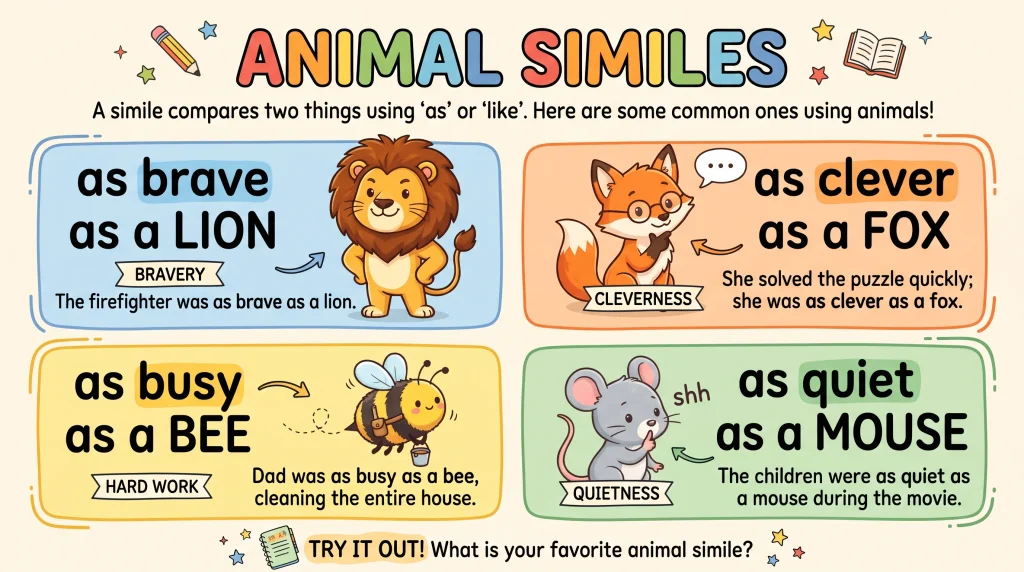
Knowing a list of animal similes is useful, but understanding how to place them in sentences makes your writing much stronger.
There are three common ways to construct animal similes.
1. Use “As … As” for Direct Comparisons
This is the most familiar structure for describing a particular quality.
Pattern: As + adjective + as + animal.
Examples:
- As brave as a lion.
- As quiet as a mouse.
- As strong as an ox.
- As gentle as a lamb.
- As stubborn as a mule.
In complete sentences:
- The young soldier was as brave as a lion.
- My baby sister is as quiet as a mouse when she sleeps.
- The farmer was as strong as an ox after years of physical work.
2. Use “Like” to Compare Actions
The word like is particularly useful when describing how someone moves, behaves, or performs an action.
Examples:
- She swims like a fish.
- He runs like a cheetah.
- The cat moves like a shadow.
- The children played like excited puppies.
- The goalkeeper jumped like a startled deer.
Here, the comparison focuses on an action rather than simply describing a personality trait.
3. Use Longer Comparisons for Creative Writing
You can expand a short animal simile to create a more detailed mental picture.
Examples:
- The little boy followed his mother like a duckling following its mother across a pond.
- The frightened rabbit disappeared into the bushes like a shadow at sunset.
- The children rushed toward the playground like puppies escaping through an open gate.
- The old man walked as slowly as a tortoise crossing a garden path.
Longer comparisons work especially well in stories, descriptive essays, and poetry. However, keep them relevant to the scene.
15 Correct Animal Similes in Complete Sentences
Here are additional original examples showing how animal similes fit into different types of everyday and written communication.
| Situation | Example sentence |
|---|---|
| Conversation | “You are as busy as a bee today!” |
| “Our support team has been working as tirelessly as ants to resolve the issue.” | |
| School assignment | “The frightened child hid behind his mother like a little mouse.” |
| Workplace | “During the emergency, our manager remained as calm as a resting swan.” |
| Social media | “Weekend mood: as happy as a puppy in a sunny garden.” |
| Academic writing | “The organism moved through the water like a fish navigating a stream.” |
| Storytelling | “The fox slipped through the forest as quietly as falling snow.” |
| Poetry | “Her laughter danced like birds across a morning sky.” |
| Interview | “I approach challenging tasks as patiently as a hunting heron.” |
| Presentation | “Our sales team has been as hardworking as a colony of ants.” |
| Friendly message | “You look as excited as a puppy waiting for a walk!” |
| Descriptive writing | “The enormous elephant moved as steadily as a mountain on legs.” |
| Classroom discussion | “The curious student was always asking questions like a little owl observing the world.” |
| Personal statement | “I remained as determined as a hunting falcon while pursuing my goals.” |
| Creative story | “The children scattered like startled birds when the bell rang.” |
The comparisons in professional and academic examples are illustrative rather than fixed expressions. In formal writing, use them only when figurative language suits the purpose.
Incorrect vs. Correct Animal Similes
Most animal similes are easy to construct, but writers sometimes confuse similes with metaphors, misuse comparison structures, or create sentences that do not express the intended meaning.
The following examples explain common problems and how to fix them.
| ❌ Incorrect | ✅ Correct | Why |
|---|---|---|
| She is brave like a lion as. | She is as brave as a lion. | The standard comparison pattern places the adjective between the two instances of “as.” |
| He runs as a cheetah. | He runs like a cheetah. | Use “like” to compare how someone performs an action. |
| My brother is as strong like an ox. | My brother is as strong as an ox. | Do not combine “as” and “like” in this comparison pattern. |
| She is as quiet than a mouse. | She is as quiet as a mouse. | The “as … as” construction requires the second “as,” not “than.” |
| He is like as a fox. | He is like a fox. | “Like” already introduces the comparison, so the extra “as” is unnecessary. |
| The girl swims as a fish. | The girl swims like a fish. | “Like a fish” makes the intended comparison clear. |
| He is as stubborn than a mule. | He is as stubborn as a mule. | “Than” is used in comparative constructions, not the standard equal-comparison pattern. |
| She works like busy bee. | She works like a busy bee. | The singular countable noun “bee” needs an article in this sentence. |
| The boy was brave as lion. | The boy was as brave as a lion. | The conventional structure requires both instances of “as,” and the singular countable noun needs an article. |
| My sister is a brave as a lion. | My sister is as brave as a lion. | The article “a” does not belong before the adjective in this construction. |
| He moves like an ox. (intended meaning: very fast) | He moves like a cheetah. | The chosen animal should support the quality being described. |
| She is as clever as an animal. | She is as clever as a fox. | A specific comparison creates a clearer mental picture than a vague reference. |
Important: Not every unusual animal comparison is grammatically incorrect. A writer can invent a new simile if its meaning is clear. The corrections above focus on genuine grammatical problems and comparisons that fail to communicate the intended idea.
Why Do People Make Mistakes With Animal Similes?
Animal similes seem simple, but several language habits can lead to incorrect or unnatural sentences.
1. Confusing “Like” and “As”
Both words can introduce comparisons, but they do not always work in the same grammatical structure.
Compare:
- She swims like a fish.
- She is as graceful as a swan.
The first sentence compares an action. The second compares a quality.
Learners sometimes combine both structures, producing sentences such as “She is as graceful like a swan.”
How to avoid it: Remember the two common patterns:
- Like + noun: “He runs like a cheetah.”
- As + adjective + as: “He is as fast as a cheetah.”
2. Memorizing Animals Without Understanding Their Associations
A simile works when the reader understands the quality being highlighted.
For example:
- A lion commonly represents courage.
- A bee commonly represents busyness.
- A fox commonly represents cleverness or cunning.
- A snail commonly represents slowness.
If you choose an animal that does not support your intended meaning, the comparison may confuse readers.
How to avoid it: Think about the characteristic before choosing the animal.
3. Overgeneralizing Grammar Rules
Some learners assume every animal simile must follow the “as … as” structure.
That is not true.
Both sentences are correct:
- She is as graceful as a swan.
- She moves like a swan.
The difference is structural, not a difference in correctness.
How to avoid it: Learn more than one comparison pattern.
4. Trusting Spellcheck Too Much
Spellcheckers can identify many spelling mistakes, but they cannot always determine whether an animal comparison makes sense.
For example:
“She is as fast as an elephant.”
The sentence is grammatically possible, but if you mean that she runs extremely fast, a cheetah would be a more recognizable comparison.
How to avoid it: Read the complete sentence and check whether the animal supports your intended meaning.
5. Translating Directly From Another Language
Some animal comparisons are specific to particular cultures and languages. An expression that sounds natural in one language may sound unfamiliar or confusing when translated literally into English.
How to avoid it: Learn commonly used English expressions as complete phrases rather than translating each word separately.
Common Animal Simile Mistakes Checklist
Use this checklist when writing sentences with animal comparisons.
- Mixing “like” and “as”: Avoid combining two different comparison patterns unnecessarily. Write “as quiet as a mouse,” not “as quiet like a mouse.”
- Missing articles: Use articles where required, as in “like a busy bee” and “as strong as an ox.”
- Choosing the wrong animal: Match the animal to the characteristic you want to communicate.
- Taking comparisons literally: Remember that “as brave as a lion” describes courage, not physical resemblance.
- Using too many similes: Several comparisons in one sentence can make writing confusing.
- Ignoring context: A playful comparison may not suit a serious academic report.
- Confusing metaphors with similes: “He is a lion” is a metaphor, while “He is as brave as a lion” is a simile.
- Using unfamiliar comparisons without explanation: A highly creative comparison may need context so readers understand it.
- Assuming every animal has one fixed meaning: Animal associations are cultural conventions, not universal facts.
- Using insulting comparisons carelessly: Some expressions can sound rude when applied to another person.
Animal Similes in Real English
Not every sentence containing an animal comparison sounds equally natural. A comparison may be grammatically correct but unfamiliar, overly elaborate, or unsuitable for a particular situation.
Understanding these differences helps you choose expressions that communicate naturally.
1. Grammatically Correct and Natural
“As busy as a bee” is a familiar English expression. It is commonly used to describe someone who has many tasks or is working continuously.
For example: “I’ve been as busy as a bee preparing for the wedding.” The sentence is grammatically correct and natural in everyday conversation. It also works in informal writing, particularly when the writer wants a friendly and expressive tone.
2. Grammatically Possible but Less Natural
“As hardworking as a penguin” is grammatically possible. However, it is not a widely established English expression with a conventional meaning.
A reader may understand the intended comparison from context, but the phrase does not have the same immediate recognition as “as hardworking as an ant.”
For everyday communication, established comparisons are generally clearer. Save unusual animal comparisons for creative writing where originality is important.
3. Natural in Everyday English
“He eats like a horse” is a familiar expression used to describe someone who eats a large amount of food.
For example: “My brother eats like a horse after football practice.” The sentence sounds natural in casual conversation.
However, the expression is informal and may not be appropriate in a formal nutritional report. In that situation, “He has a large appetite” would be clearer and more neutral.
4. Natural but Potentially Insulting
“As stubborn as a mule” is a familiar expression, but it can sound critical when used to describe another person.
For example: “You are as stubborn as a mule, and you never listen to anyone.”
The sentence is grammatically correct, but its tone is negative. It may be acceptable in playful conversation between close friends, but it could sound disrespectful in a workplace discussion.
5. Natural in Creative Writing
“Like a startled deer” is a recognizable comparison for someone who appears frightened or suddenly confused.
For example: “When the teacher called his name, he stared at her like a startled deer.”
This construction is natural in storytelling because it helps readers imagine the character’s reaction. It is less suitable for a formal report, where a direct description such as “He appeared suddenly frightened” would be more precise.
American vs. British English: Are Animal Similes Different?
Most common animal similes are understood in both American and British English.
Expressions such as these are widely recognizable in both varieties:
- As brave as a lion.
- As busy as a bee.
- As quiet as a mouse.
- As stubborn as a mule.
- As wise as an owl.
- As slow as a snail.
There is no major grammatical difference in how these expressions are constructed.
However, some animal-related expressions have different levels of familiarity depending on regional usage and cultural context. This does not mean that the basic grammar of animal similes changes between the two varieties.
Formal vs. Informal Usage of Animal Similes
Animal similes can appear in both formal and informal writing, but their suitability depends on the situation.
| Context | Suitability | Example |
|---|---|---|
| Casual conversation | Very suitable | “You are as busy as a bee!” |
| Creative writing | Very suitable | “The fox moved like a shadow through the forest.” |
| School assignments | Suitable | “The athlete ran as fast as a cheetah.” |
| Poetry | Very suitable | “Her voice floated like a songbird’s melody.” |
| Professional presentations | Sometimes suitable | “Our team has worked like a colony of ants.” |
| Formal academic reports | Use selectively | “The organism moved through the water like a fish.” |
| Legal or technical documents | Generally avoid | Use precise, literal descriptions instead. |
The main principle is simple: use animal similes when they make an explanation more memorable, but avoid them when precision and neutrality are more important.
Animal Similes vs. Metaphors vs. Idioms
Animal similes are sometimes confused with metaphors and idioms because all three can use animals to communicate meanings beyond their literal definitions.
However, they are different types of figurative language.
| Feature | Animal Simile | Animal Metaphor | Animal Idiom |
|---|---|---|---|
| Meaning | Direct comparison involving an animal | Describes something as an animal | Established expression with a figurative meaning |
| Common structure | Like or as | Direct identification | Fixed or familiar phrase |
| Example | He is as brave as a lion. | He is a lion in battle. | Let the cat out of the bag. |
| Purpose | Highlights a shared quality | Creates a stronger symbolic comparison | Communicates a conventional meaning |
| Literal meaning | Not intended literally | Not intended literally | Usually different from the literal meaning |
Animal Simile
An animal simile directly compares two things using like or as.
Example: “She is as graceful as a swan.”
The sentence compares her graceful movement to that of a swan.
Animal Metaphor
An animal metaphor describes someone or something as an animal without using an explicit comparison word.
Example: “My brother is a lion when he faces challenges.”
The sentence presents the brother as a lion to emphasize his courage.
Animal Idiom
An animal idiom is an established expression whose meaning cannot always be understood from its individual words.
Example: “Don’t let the cat out of the bag.”
It means not to reveal a secret.
Remember: An expression does not become a simile simply because it mentions an animal. Look at how the comparison works and what the expression means.
Real-Life Situations: Animal Similes in Context
The best way to understand animal similes is to see how they work in realistic situations.
Situation 1: During a Job Interview
A candidate is explaining how they handle difficult tasks.
Candidate: “I remain as determined as a hunting falcon when working toward an important goal.”
The comparison communicates determination and focus. However, a simpler expression such as “I stay focused and determined” may be more suitable in a highly formal interview.
Situation 2: During a Team Meeting
A manager appreciates the team’s hard work.
Manager: “Everyone has been as busy as a bee preparing for this product launch.”
The expression creates a friendly atmosphere and recognizes the team’s effort.
Situation 3: Writing a School Essay
A student is describing a character in a story.
Example: “Although the little girl was frightened, she stood as brave as a lion and protected her younger brother.”
The simile emphasizes the character’s courage and makes the description more interesting.
Situation 4: Sending a Text Message
A friend asks why you have not replied all morning.
Reply: “Sorry! I’ve been as busy as a bee with my assignments.”
The expression communicates that you have been occupied without needing a lengthy explanation.
Situation 5: Writing a Short Story
A writer wants to describe a character entering a mysterious room.
Example: “He crept through the dark hallway like a fox moving silently through the forest.”
The comparison creates a picture of cautious, quiet movement and adds atmosphere to the scene.
Situation 6: Describing a Sports Competition
A commentator describes a runner approaching the finish line.
Example: “She sprinted toward the finish line as fast as a cheetah.”
The comparison emphasizes the runner’s speed and excitement.
How to Create Your Own Animal Similes
You do not need to memorize hundreds of expressions to become good at using animal similes. You can create original comparisons by connecting an animal’s recognizable characteristics to the quality you want to describe.
Follow these five steps:
- Choose a quality. Decide whether you want to describe speed, strength, fear, happiness, intelligence, or another characteristic.
- Select an animal. Think of an animal commonly associated with that quality.
- Identify the shared characteristic. Determine exactly what the person, action, or situation has in common with the animal.
- Choose a comparison structure. Use either “as … as” or “like.”
- Write a complete sentence. Make sure the comparison fits naturally into its context.
Example:
- Quality: Patience.
- Animal: Heron.
- Shared characteristic: Waiting quietly and watching for an opportunity.
- Simile: As patient as a waiting heron.
- Complete sentence: “The fisherman remained as patient as a waiting heron beside the river.”
Here are five additional creative examples:
- As watchful as a meerkat guarding its surroundings.
- As playful as otters splashing through a river.
- As graceful as a butterfly drifting through a garden.
- As persistent as an ant carrying a heavy leaf.
- As curious as a raccoon exploring a new place.
These are original descriptive comparisons rather than established English idioms. Their effectiveness depends on how clearly the context communicates the intended quality.
Practice Quiz: Test Your Knowledge of Animal Similes
Try these questions to check whether you understand animal similes, their meanings, and how to use them correctly.
Animal Similes Knowledge Test
0 / 8 answered
1. What does ‘as brave as a lion’ mean?Extremely courageousVery hungryExtremely quietVery lazy
2. Which sentence uses an animal simile correctly?She is as graceful like a swan.She is graceful as swan.She is as graceful as a swan.She is a graceful as swan.
3. What does ‘as stubborn as a mule’ describe?Someone who is generousSomeone who refuses to change their mindSomeone who moves quicklySomeone who is very shy
4. Which animal is commonly associated with cleverness?SnailFoxSheepTortoise
5. Which sentence compares an action using ‘like’?He is as strong as an ox.She is as quiet as a mouse.He swims like a fish.She is as wise as an owl.
6. What does ‘as busy as a bee’ mean?Very tiredVery occupiedVery frightenedVery confused
7. Which expression is a metaphor rather than a simile?As brave as a lionHe fights like a tiger.She is a lion in battle.As quiet as a mouse
8. Which animal simile describes someone who moves slowly?As fast as a cheetahAs slow as a snailAs quick as a rabbitAs swift as a falcon
Check my answers
Frequently Asked Questions About Animal Similes
1. What are the 10 most common animal similes?
Ten familiar animal similes include:
- As brave as a lion.
- As busy as a bee.
- As quiet as a mouse.
- As strong as an ox.
- As sly as a fox.
- As wise as an owl.
- As slow as a snail.
- As stubborn as a mule.
- As gentle as a lamb.
- As proud as a peacock.
These expressions are commonly used to describe personality traits, behavior, and physical characteristics.
2. What is the best animal simile for a brave person?
“As brave as a lion” is one of the most recognizable animal similes for courage. It describes someone who faces danger or difficulty without giving up. For example: “The young girl was as brave as a lion when she stood up for her friend.”
3. Which animal simile describes someone who is very intelligent?
“As wise as an owl” describes someone who demonstrates wisdom, knowledge, or good judgment. If you want to emphasize cleverness rather than wisdom, “as sly as a fox” may be more appropriate.
4. What animal simile describes someone who is very fast?
“As fast as a cheetah” is a familiar comparison for someone who runs or moves extremely quickly. Another option is “as quick as a rabbit,” which can also describe someone who reacts rapidly.
5. What is a funny animal simile?
Funny animal similes use playful comparisons to create humor. Examples include “as grumpy as a bear after waking up,” “as clumsy as a newborn giraffe,” and “as excited as a puppy seeing its favorite person.” These creative expressions are especially useful in humorous stories and informal conversations.
6. What is the difference between an animal simile and an animal metaphor?
An animal simile uses like or as to compare two things, such as “She is as brave as a lion.” An animal metaphor directly describes someone as an animal, such as “She is a lion.” Both communicate figurative meaning, but their grammatical structures are different.
7. Can animal similes be used in academic writing?
Yes, but they should be used selectively. Animal similes can make descriptive or literary analysis more engaging. However, scientific, technical, and research writing generally benefits from precise and literal language rather than unnecessary figurative comparisons.
8. Can I create my own animal similes?
Yes. You can create original animal similes by identifying a recognizable animal characteristic and comparing it with a person, action, or situation. For example, “as patient as a heron waiting by the water” is a creative comparison that communicates patience through imagery.
9. What is an animal simile for someone who is very quiet?
“As quiet as a mouse” is a familiar expression describing someone who makes very little noise. For example: “The children were as quiet as mice while the baby slept.”
10. Are animal similes and animal idioms the same?
No. An animal simile makes a direct comparison, usually using like or as. An animal idiom is an established expression with a figurative meaning. For example, “as busy as a bee” is a simile, while “let the cat out of the bag” is an idiom meaning to reveal a secret.
11. Which animal simile describes someone who eats a lot?
“He eats like a horse” is a familiar informal expression describing someone with a large appetite. “As hungry as a bear” is another common comparison used to describe someone who feels extremely hungry.
12. Why do writers use animal similes?
Writers use animal similes to make descriptions more vivid, memorable, and expressive. They help readers understand characteristics such as courage, speed, intelligence, and gentleness by connecting unfamiliar situations with recognizable animal qualities.
Summary: Animal Similes
Animal similes are figurative comparisons that use animals to describe people, actions, objects, or situations. They commonly use like or as to highlight a shared characteristic. Familiar examples include “as brave as a lion,” “as busy as a bee,” “as quiet as a mouse,” and “as strong as an ox.” Writers use them to make descriptions more vivid and memorable in conversations, stories, poetry, and school assignments. To use animal similes correctly, choose an animal that represents the intended quality, follow the appropriate comparison structure, and consider the context. Remember that a simile makes a comparison, a metaphor makes a direct identification, and an idiom communicates an established figurative meaning.