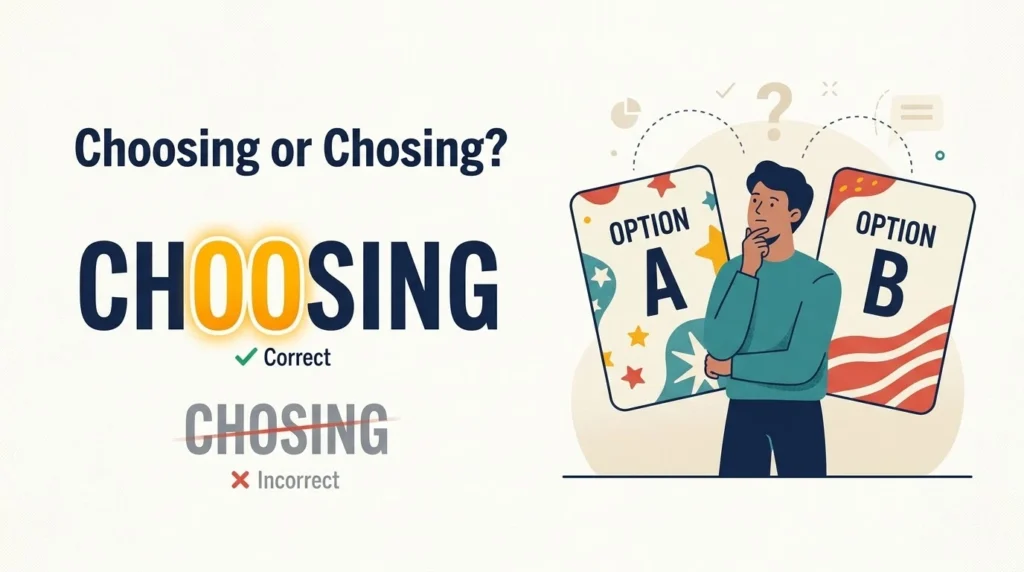

Choosing is the correct spelling in standard English. Chosing is a misspelling when you mean the act of selecting something. The word comes from the verb choose: remove the final silent E and add -ing, keeping both Os. For example, “She is choosing a new course” is correct, while “She is chosing a new course” is incorrect.
Choosing or Chosing?
The correct spelling is choosing, with two Os. Chosing is incorrect in standard English when you mean selecting or deciding between options. The word is formed from choose by dropping the final silent E before adding -ing. Remember the spelling pattern: choose → choosing. Both American and British English use the same spelling.
What Is the Difference Between Choosing and Chosing?
The difference is simple: choosing is the standard English word, while chosing is a spelling error when the intended word is choosing.Choosing comes from the verb choose, which means to select someone or something from available options. It can describe an action happening now or the activity of making a selection.
Examples:
- “I am choosing a gift for my friend.”
- “Choosing the right university takes time.”
- “The committee is choosing a new team leader.”
The spelling remains choosing whether you are writing a text message, an academic essay, a business email, or a social media post.
ALSO READ: What Occasion or Ocassion Means
What Does Choosing Mean?
Choosing has two closely related grammatical uses.
As a present participle, it helps form continuous verb tenses, which describe an action in progress.
Example: “They are choosing a new supplier.”
As a gerund, it functions as a noun and names the activity itself.
Example: “Choosing a reliable supplier requires careful research.”
In both sentences, the spelling is identical. The difference lies in how the word functions in the sentence.
What Does Chosing Mean?
Chosing is not the standard spelling of the -ing form of choose. It usually appears when someone accidentally removes one of the two Os while adding the ending.
For example:
- Incorrect: “He is chosing a subject for his assignment.”
- Correct: “He is choosing a subject for his assignment.”
The correction is straightforward: restore the missing O.
ALSO READ: Invest or Invest In: Which Is Correct?
Why the Correct Spelling Matters
Spelling affects readability and can influence how carefully your writing is perceived. Although readers may understand chosing from context, the error can distract them from your message.
Using choosing correctly matters in several situations:
- Schoolwork: Correct spelling helps maintain the quality of essays, assignments, and examinations.
- Professional emails: Accurate writing makes instructions and requests look polished.
- Business documents: Reports and proposals should use standard spelling consistently.
- Online publishing: Correct spelling supports readability and editorial quality.
- Everyday messages: A quick spelling check prevents avoidable mistakes.
The goal is not to make every message formal. It is to use the standard spelling regardless of how casually or formally you write.
The Core Rule: How to Spell Choosing
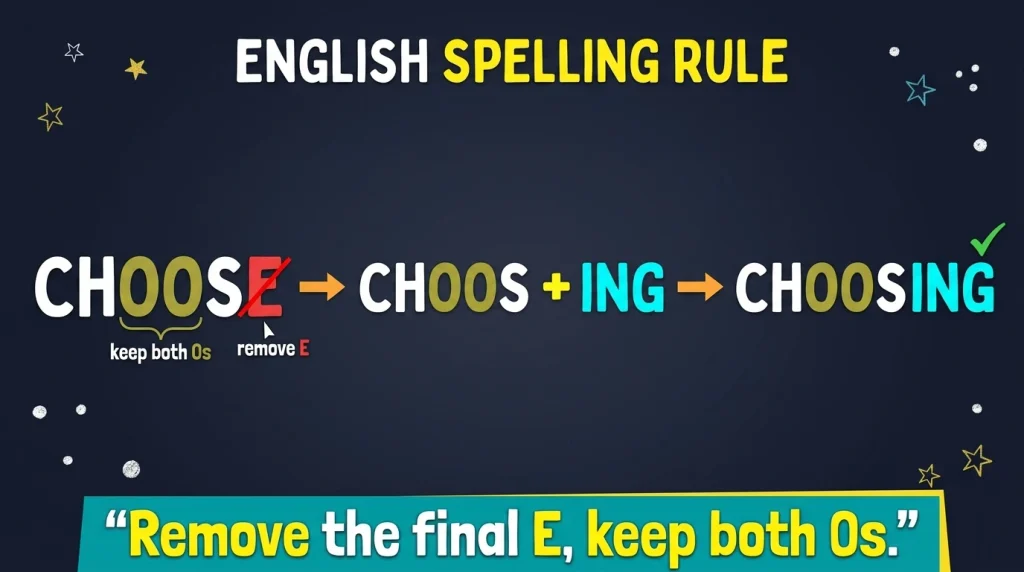
Start with “choose,” remove only the final silent E, and add “-ing.” Keep both Os.
The spelling changes like this:
- Base verb:
choose - Remove the final E:
choos - Add
ing:choosing
The correct result is choosing, not chosing.
This follows a common English spelling pattern: many verbs ending in a silent E drop that E before taking -ing.
Examples:
| Base verb | Correct -ing form |
|---|---|
| Choose | Choosing |
| Make | Making |
| Write | Writing |
| Hope | Hoping |
| Use | Using |
| Move | Moving |
| Lose | Losing |
Notice that the final E disappears, but the other letters remain. In choose, both Os belong to the stem of the word and stay in place.
How to Use Choosing Correctly
1. Use Choosing for an Action in Progress
When someone is making a selection at the moment of speaking, choosing commonly appears with a form of be: am, is, or are.
Examples:
- “I am choosing a new phone.”
- “She is choosing which subjects to study.”
- “They are choosing between two apartments.”
- “We are choosing a date for the meeting.”
The structure is:
Subject + am/is/are + choosing + object or additional information
The same form can describe a temporary process rather than an action occurring at this exact second.
Example: “The panel is choosing a candidate this week.”
2. Use Choosing to Name the Activity
When choosing functions as a gerund, it names the activity of selecting something.
Examples:
- “Choosing a career can be challenging.”
- “Choosing carefully may save you money.”
- “She enjoys choosing books for her children.”
- “We discussed choosing a different supplier.”
In these examples, choosing does not need to describe an action happening right now. It refers to the activity or process.
3. Use Choosing After Certain Verbs
Some verbs are commonly followed by an -ing form. Choosing can appear after verbs such as enjoy, consider, avoid, and practice.
Examples:
- “I enjoy choosing gifts for my family.”
- “They are considering choosing a different location.”
- “She avoided choosing sides during the disagreement.”
- “He practiced choosing the best answer under time pressure.”
The exact meaning depends on the first verb. For example, consider choosing means thinking about the possibility of making a selection.
4. Use Choosing After Prepositions
When a verb follows a preposition and acts as the name of an activity, it generally takes the -ing form.
Examples:
- “She spent an hour choosing a dress.”
- “They succeeded in choosing a suitable candidate.”
- “He had difficulty choosing between the two offers.”
- “After choosing a topic, begin your research.”
The word choosing keeps the same spelling regardless of the preposition or expression that comes before it.
5. Know When to Use Choose, Chose, and Chosen Instead
Not every sentence about a decision requires choosing. Select the verb form that fits the tense and grammatical structure.
| Word | Grammatical form | Example |
|---|---|---|
| Choose | Base form or present tense | I choose the blue one. |
| Chooses | Present tense with he, she, or it | She chooses carefully. |
| Chose | Simple past tense | He chose the earlier flight. |
| Chosen | Past participle | They have chosen a winner. |
| Choosing | -ing form | We are choosing a winner. |
| Chosing | Misspelling of choosing | Incorrect: We are chosing a winner. |
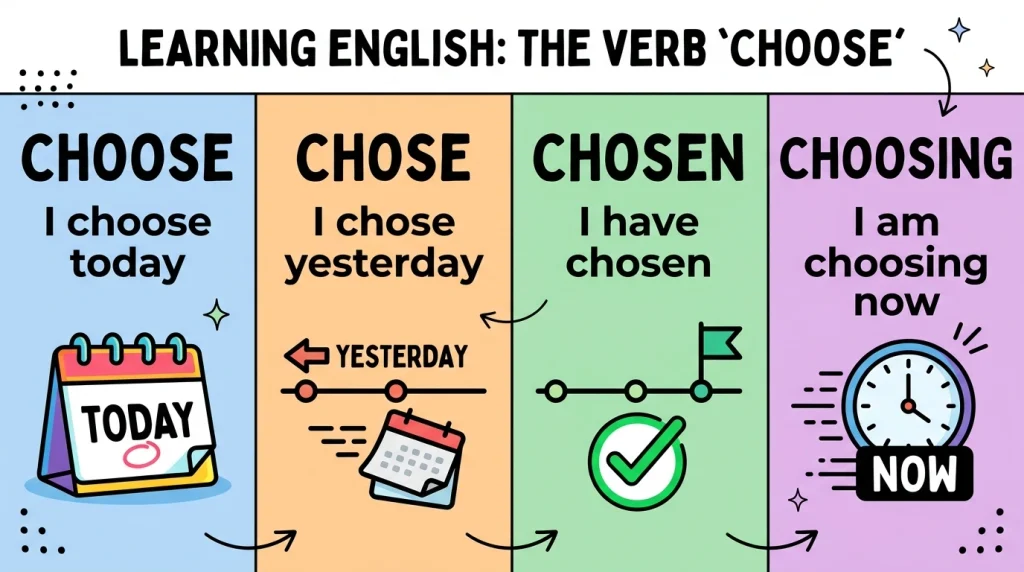
A useful sequence to remember is:
- Today: “I choose.”
- Yesterday: “I chose.”
- Right now: “I am choosing.”
- Decision completed: “I have chosen.”
The word chose is a real English word, but it is not the base form used to create choosing.
Correct Examples of Choosing in Everyday English.
These examples show the standard spelling in different settings.
- Conversation: “I’m still choosing what to wear for dinner.”
- Email: “Thank you for choosing our company for your project.”
- Schoolwork: “Choosing an appropriate research question is the first step.”
- Workplace: “Our team is choosing a supplier based on quality and reliability.”
- Social media: “Choosing my favorite picture from this trip is impossible.”
- Academic writing: “Choosing a suitable method depends on the research objectives.”
- Customer service: “Thank you for choosing the annual membership plan.”
- Job interview: “I was careful when choosing examples that demonstrated my leadership skills.”
- Text message: “Are you still choosing a movie, or should I pick one?”
- Business report: “Choosing an appropriate pricing strategy requires market research.”
- Personal development: “Choosing to learn a new skill can open up opportunities.”
- Everyday planning: “She spent the morning choosing furniture for her apartment.”
Each example uses choosing with both Os intact. The word may appear at the beginning, middle, or end of a sentence without changing its spelling.
Incorrect vs. Correct: 10 Common Spelling Mistakes
| ❌ Incorrect | ✅ Correct | Why |
|---|---|---|
| I am chosing a new laptop. | I am choosing a new laptop. | The -ing form of choose retains both Os. |
| She is chosing her university subjects. | She is choosing her university subjects. | Remove the final E from choose, not an O. |
| Chosing a career takes time. | Choosing a career takes time. | The gerund is spelled choosing. |
| They are chosing between two plans. | They are choosing between two plans. | The spelling stays the same when describing a decision in progress. |
| Thank you for chosing our service. | Thank you for choosing our service. | The standard spelling is required in professional communication. |
| We are chosing a new manager. | We are choosing a new manager. | The word comes from choose, not chose. |
| He enjoys chosing books. | He enjoys choosing books. | The verb enjoy is followed by an -ing form here. |
| After chosing a topic, start writing. | After choosing a topic, start writing. | The -ing form is used after after to describe the activity. |
| She had trouble chosing an answer. | She had trouble choosing an answer. | Choosing is the correct spelling regardless of the sentence structure. |
| Chosing carefully can prevent mistakes. | Choosing carefully can prevent mistakes. | When the activity acts as the subject of a sentence, it is still spelled choosing. |
The key correction in every row is the same: use choosing with two Os.
Why People Make This Spelling Mistake
1. Confusion With Chose
One common reason is the relationship between choose and chose.
- Present: choose
- Past: chose
- -ing form: choosing
Because chose has only one O, writers may mistakenly transfer that spelling to choosing. However, the -ing form is built from choose, not chose.
2. Misunderstanding the Silent-E Rule
Learners often remember that verbs ending in silent E lose that letter before -ing is added. The problem occurs when they remove too much.
In choose, only the final E disappears. The two Os remain.
Compare:
- Choose → choosing
- Write → writing
- Hope → hoping
The rule changes the ending; it does not give you permission to remove other letters.
3. Relying Too Much on Pronunciation
The standard pronunciation of choosing is approximately “CHOO-zing.” The two Os represent one vowel sound, so hearing the word does not tell you that two separate O letters are required.
Pronunciation helps you recognize the word, but remembering its written form is necessary for accurate spelling.
4. Typing Quickly
When writing quickly, it is easy to omit a repeated letter. This can happen in messages, social posts, assignments, and work emails.
A quick proofreading pass helps catch this error, particularly when the word appears several times in a long document.
5. Trusting Spellcheck Without Reviewing the Sentence
Spellcheck tools can catch many misspellings, but writers should still review suggested corrections. Different tools may handle unfamiliar names, quotations, or specialized text differently.
Do not rely entirely on automatic correction. Learn the spelling pattern so you can identify the correct form yourself.
6. Translating Directly From Another Language
Learners may apply spelling patterns from their first language when writing English. This can lead to errors when English changes a word’s form in a way that is not obvious from pronunciation.
Learning the word family—choose, chooses, chose, chosen, and choosing—is more reliable than translating each form separately.
Common Mistakes Checklist
Before submitting your writing, review these common errors.
- Dropping an O: Write choosing, not chosing. Remember that the base verb has two Os.
- Starting from chose: Use choose as the base form when creating choosing.
- Removing the wrong letter: Drop only the final E before adding -ing.
- Confusing verb forms: Use chose for the simple past and chosen after forms of have.
- Using the wrong tense: “I am choosing yesterday” mixes a present continuous form with a past-time expression. Write “I was choosing yesterday” if the action was in progress then.
- Forgetting the gerund: In “Choosing a course takes time,” choosing names the activity.
- Trusting autocorrect blindly: Review the corrected sentence to make sure it expresses your intended meaning.
- Assuming spelling changes by context: The spelling choosing remains the same in formal, informal, academic, and professional English.
A quick final check is to compare the word with its base form: if you can see CHOOSE inside CHOOSING after removing the final E and adding -ING, you have the right spelling.
Choosing or Chosing in Real English
Grammatically Correct
“Choosing the right course takes time” is grammatically correct because choosing functions as the subject of the sentence. “She is choosing a course” is also correct because choosing forms part of the present continuous tense. In both cases, the spelling contains two Os. The grammatical role changes, but the spelling does not.
Grammatically Possible but Unnatural
“I’m choosing that course yesterday” is not a natural standard sentence because the present continuous form conflicts with the completed past-time reference yesterday. Depending on the intended meaning, write “I chose that course yesterday” or “I was choosing a course yesterday.” The issue is tense and time reference, not the spelling of choosing.
Natural, Everyday English
“I’m choosing a restaurant for tonight” is natural when the speaker is still deciding. “Choosing the right words matters” is also natural when talking about communication in general. In everyday English, choosing is common in conversations about plans, purchases, education, and decisions. Whether the word describes an ongoing action or an activity in general, always keep both Os.
American vs. British English
There is no spelling difference between American and British English for choosing. Both varieties use the same form.
| Feature | American English | British English |
|---|---|---|
| Correct spelling | Choosing | Choosing |
| Incorrect standard spelling | Chosing | Chosing |
| Base verb | Choose | Choose |
| Simple past | Chose | Chose |
| Past participle | Chosen | Chosen |
| -ing form | Choosing | Choosing |
The same spelling is used in other major English varieties, including Australian and Canadian English.
Formal vs. Informal Usage
The spelling choosing is correct in both formal and informal writing.
In a casual message, you might write, “I’m choosing a movie now.” In a formal report, you might write, “Choosing an appropriate evaluation method is essential to the study.”
The context determines the level of formality, but the spelling remains the same. Chosing is not an acceptable casual alternative to choosing in standard written English.
Choosing vs. Chosing: Comparison Table
| Feature | Choosing | Chosing |
|---|---|---|
| Standard English spelling | Correct | Incorrect for the intended meaning |
| Base verb | Choose | Intended to represent choose |
| Meaning | Selecting or deciding | No standard meaning as a form of choose |
| Number of Os | Two | One |
| Grammatical role | Present participle or gerund | No standard grammatical role as this verb form |
| Example | She is choosing a course. | Incorrect: She is chosing a course. |
| Formal writing | Appropriate | Should be corrected |
| Informal writing | Appropriate | Still a spelling error |
| American and British usage | Same spelling | Not the standard form in either variety |
The answer is consistent across ordinary English writing: use choosing.
Real-Life Situations: Choosing or Chosing?
Situation 1: Writing a School Assignment
Incorrect: “Chosing the right topic is the first step.”
Correct: “Choosing the right topic is the first step.”
Why: Choosing names the activity of selecting a topic.
Situation 2: Sending a Professional Email
Incorrect: “We are chosing a supplier for the next project.”
Correct: “We are choosing a supplier for the next project.”
Why: The present continuous form describes a selection process that is underway.
Situation 3: Sending a Text Message
Incorrect: “I’m chosing what to eat.”
Correct: “I’m choosing what to eat.”
Why: Informal writing still uses the standard spelling.
Situation 4: Answering an Interview Question
Incorrect: “I am careful when chosing a solution to a problem.”
Correct: “I am careful when choosing a solution to a problem.”
Why: The word follows when and describes the activity of selecting a solution.
Situation 5: Writing an Academic Essay
Incorrect: “Chosing an appropriate research method improves the study.”
Correct: “Choosing an appropriate research method improves the study.”
Why: Here, choosing functions as the subject of the sentence.
An Easy Trick to Remember Choosing
Use this memory aid:
“Choose keeps both Os when choosing.”
Remember the spelling in three steps:
- Start with CHOOSE.
- Remove the final E.
- Add ING, keeping both Os.
The result is CHOOSING.
You can also remember the word family together:
Choose → Chose → Chosen → Choosing
The past-tense form chose has one O, but the -ing form comes from choose, which has two. This distinction prevents the most common spelling error.
Quick Quiz: Choosing or Chosing?
Complete each sentence with the correct word or verb form.
- She is ______ a new laptop for her studies.
- ______ the right university can take several months.
- We are carefully ______ a date for the event.
- Yesterday, he ______ the cheaper option.
- They have ______ a new team leader.
- Thank you for ______ our company.
- I enjoy ______ books for my weekend reading.
- The committee is ______ between three candidates.
Answers and Explanations
- Choosing — The present continuous form describes an action in progress.
- Choosing — The -ing form acts as the subject of the sentence.
- Choosing — The word retains both Os in the present continuous form.
- Chose — Use the simple past form for an action completed yesterday.
- Chosen — The past participle follows have.
- Choosing — The word follows the preposition for and names the action.
- Choosing — The verb enjoy is commonly followed by an -ing form.
- Choosing — The committee is in the process of selecting a candidate.
If you missed any questions, review the word family and the rule for dropping the final E. These two ideas cover most mistakes involving choosing.
Quick Summary
Choosing is the correct spelling, while chosing is a misspelling when you mean selecting or deciding between options. The word comes from choose: remove the final silent E and add -ing, keeping both Os. Use choosing to describe an action in progress, as in “She is choosing a course,” or to name an activity, as in “Choosing a course takes time.” Do not confuse it with chose, the simple past tense, or chosen, the past participle. American and British English use the same spelling. Remember: choose keeps both Os when choosing. A quick comparison with the base verb can help you catch the mistake before publishing or submitting your writing.
Frequently Asked Questions
Is choosing the correct spelling?
Yes. Choosing is the correct standard English spelling of the -ing form of choose. Chosing is a misspelling when it is intended to mean selecting something.
Why does choosing have two Os?
The base verb choose contains two Os. When you add -ing, you remove only the final silent E. The two Os remain, producing choosing.
Is chosing ever correct in English?
It is not the standard spelling of the verb form meaning selecting. If you intend to describe the act of making a choice, write choosing.
What is the difference between choose, chose, and choosing?
Choose is the base or present form, chose is the simple past, and choosing is the -ing form. For example: “I choose today,” “I chose yesterday,” and “I am choosing now.”
Is choosing a gerund or a verb?
It can be either, depending on its role in the sentence. In “She is choosing a dress,” it helps form a verb phrase. In “Choosing a dress takes time,” it functions as a noun-like gerund.
Is choosing spelled differently in American and British English?
No. Both American and British English use choosing. The spelling does not change by region.
Why do people write chosing instead of choosing?
The error often occurs because writers remove one O while adding -ing, or confuse choosing with chose. The correct form is created from choose, not from chose.
What is the past tense of choose?
The simple past tense is chose. For example, “She chose the blue dress yesterday.” The past participle is chosen, as in “She has chosen the blue dress.”
Can choosing begin a sentence?
Yes. For example, “Choosing the right words can improve your communication.” In this sentence, choosing acts as the subject.
Is choosing appropriate for formal writing?
Yes. Choosing is suitable for academic essays, professional reports, formal emails, and everyday writing. The context affects the style, not the spelling.
How do you pronounce choosing?
It is commonly pronounced approximately “CHOO-zing,” with the main stress on the first syllable. The pronunciation does not reveal that two Os are required, so remembering the written form is useful.
How can I remember choosing without making a spelling mistake?
Remember the phrase “Choose keeps both Os when choosing.” Start with choose, remove the final E, and add -ing. The result is choosing.