
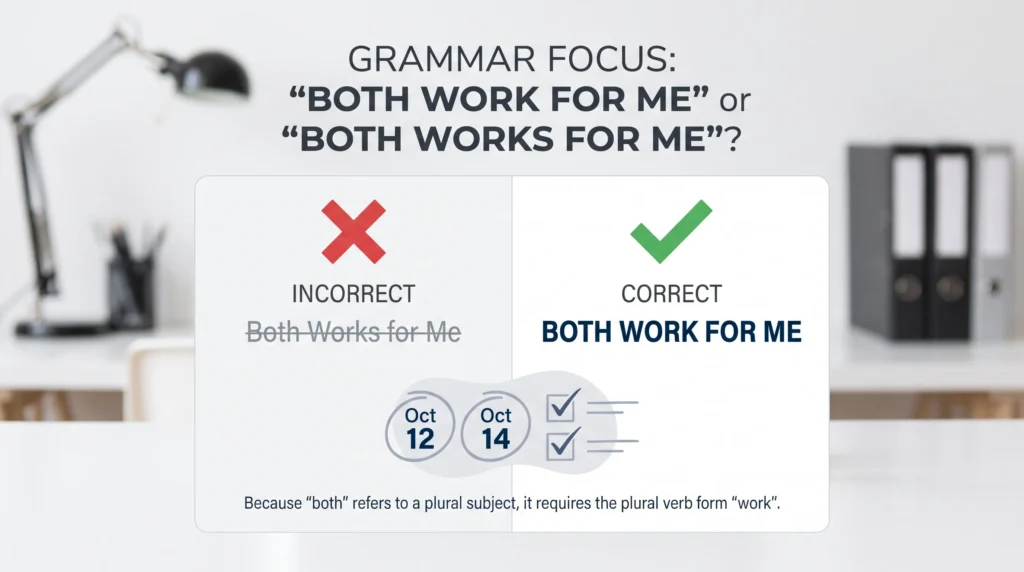

“Both work for me” is correct. “Both works for me” is grammatically incorrect when both is the subject referring to two options. The reason is subject-verb agreement: both refers to two people or things, so it takes the plural verb work, not the singular verb works. You can use “Both work for me” when accepting two meeting times, dates, plans, or suggestions.
Use “both work for me”, not “both works for me,” when saying that two options are suitable or acceptable to you. The word both refers to two things and takes a plural verb. For example, if someone suggests Monday and Wednesday for a meeting, you can reply, “Both work for me.” Remember: one option works for me, but two options both work for me.
What Is the Difference Between Both Work for Me and Both Works for Me?
The difference between these expressions is subject-verb agreement.
Both work for me is the grammatically correct expression. It means that two choices, arrangements, or possibilities are acceptable to you.
Both works for me is incorrect when both refers to two options and functions as the subject because works is the singular present-tense verb form.
Consider these examples:
- Correct: Both work for me. You can choose either date.
- Incorrect: Both works for me. You can choose either date.
- Correct: Both meeting times work for me.
- Incorrect: Both meeting times works for me.
The difference is the final -s in works. In the present simple tense, English normally adds -s or -es to the verb when the subject is third-person singular. Plural subjects take the base form.
Why It Matters
This is a small grammatical difference, but it can affect the quality of your written and spoken English.
You will often need this expression when discussing schedules, accepting invitations, choosing between two suggestions, or responding to workplace messages.
For example, imagine that a colleague asks:
“Would Monday or Thursday be better for our meeting?”
You want to tell them that either option is suitable.
The natural response is:
“Both work for me.”
Using the incorrect form, “Both works for me,” creates a subject-verb agreement error.
Understanding this distinction helps you communicate more accurately in:
- Professional emails and workplace messages.
- Conversations about appointments and schedules.
- Academic assignments and examinations.
- Text messages and social media.
- Everyday discussions involving two choices.
The Core Rule: Both Takes a Plural Verb
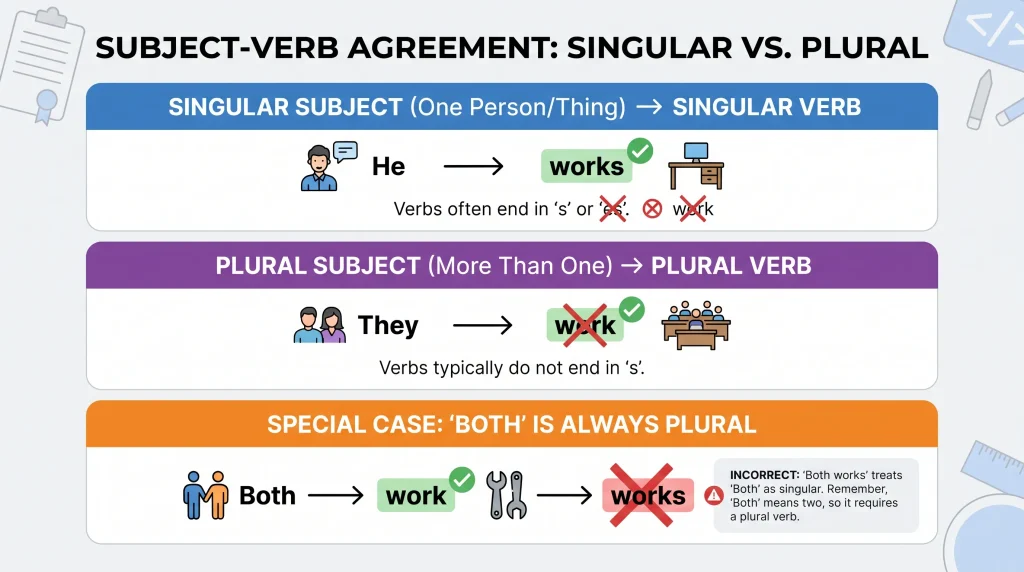
Both work for me.
Both refers to two options, so use the plural verb work.
Incorrect
Both works for me.
Works is the singular verb form and does not agree with the plural subject.
Easy rule: One works. Two work. Both work.
Understanding Subject-Verb Agreement
Subject-verb agreement means that the verb must match its subject in number.
In simple terms:
- A singular subject generally takes a singular verb.
- A plural subject takes a plural verb.
Look at these examples:
| Subject | Correct verb | Example |
|---|---|---|
| He | Works | He works for me. |
| She | Works | She works for me. |
| It | Works | It works for me. |
| They | Work | They work for me. |
| Both | Work | Both work for me. |
| We | Work | We work together. |
Notice that works is used with singular subjects such as he, she, and it. The word both refers to two things, so it follows the plural pattern.
How to Use “Both Work for Me” Correctly
The expression is useful in several everyday situations. Here are the most common ways to use it.
1. When Accepting Two Meeting Times
Use “both work for me” when someone suggests two possible times and you are available for either one.
Examples:
- Monday and Tuesday both work for me.
- Both meeting times work for me.
- I checked my calendar, and both work for me.
- Either time is fine with me; both work for me.
2. When Choosing Between Two Dates
You can use the expression when someone offers two possible dates for an appointment, event, or meeting.
Examples:
- Both dates work for me.
- Friday and Saturday both work for me.
- Both proposed dates work with my schedule.
- I am available on either day, so both work for me.
3. When Discussing Two Plans
The expression also works when discussing two possible arrangements or plans.
Examples:
- We could travel by train or bus. Both work for me.
- Both plans work for me, so you can decide.
- I have considered both options, and both work for me.
- We can meet online or in person. Both work for me.
4. When Responding to Suggestions
Use it when someone gives you two alternatives and you have no objection to either.
Examples:
- Both suggestions work for me.
- I like both ideas, and both work for me.
- Both arrangements work for me.
- I have no preference because both work for me.
5. When Discussing Work or Study Arrangements
You can also use the expression in professional and educational situations.
Examples:
- Both proposed schedules work for me.
- Both study methods work for me.
- I reviewed the two presentation formats, and both work for me.
- Both arrangements work for my current schedule.
Correct Examples of “Both Work for Me”
Here are 15 examples showing how the expression works in different situations.
Everyday Conversations
- Both work for me, so you can choose whichever you prefer.
- We can have lunch at home or outside. Both work for me.
- Both options work for me, and I am happy with either.
- Saturday and Sunday both work for me.
Workplace and Professional Emails
- I checked my calendar, and both proposed times work for me.
- Both arrangements work for our team.
- Thank you for suggesting two meeting dates. Both work for me.
- Both delivery options work for our schedule.
School and Academic Situations
- Both research topics work for me.
- I reviewed the two assignment formats, and both work for me.
- Both study schedules work for my examination preparation.
Text Messages and Social Media
- We can watch either movie tonight. Both work for me.
- Both work for me! Just tell me which one you prefer.
- The blue and black designs both work for me.
Business and Planning
15. Both proposed arrangements work for the project, so we can proceed with either.
These examples demonstrate that both work for me is suitable for conversations, professional communication, and written English.
Incorrect vs. Correct: 12 Common Examples
The following examples show common subject-verb agreement mistakes and their corrections.
| ❌ Incorrect | ✅ Correct | Why |
|---|---|---|
| Both works for me. | Both work for me. | Both refers to two options and takes a plural verb. |
| Both options works for me. | Both options work for me. | The plural subject options requires work. |
| Both times works for me. | Both times work for me. | Times is plural. |
| Both dates works for me. | Both dates work for me. | Dates is a plural noun. |
| Both ideas works for me. | Both ideas work for me. | Ideas is plural. |
| Both of them works for me. | Both of them work for me. | Both of them refers to two things. |
| Both suggestions works for me. | Both suggestions work for me. | Suggestions is plural. |
| Both plans works for me. | Both plans work for me. | Plans is plural. |
| Both arrangements works for me. | Both arrangements work for me. | Arrangements is plural. |
| Both alternatives works for me. | Both alternatives work for me. | Alternatives is plural. |
| Both methods works for me. | Both methods work for me. | Methods is plural. |
| Both choices works for me. | Both choices work for me. | Choices is plural. |
Important: The rule is not limited to the expression “both work for me.” It applies to other verbs as well. For example, say “Both are correct,” not “Both is correct,” and “Both have arrived,” not “Both has arrived.”
Why People Make This Mistake
There are several reasons people write “both works for me” even though “both work for me” is the standard grammatical form.
1. Confusion About the Word “Both”
The word both is a single word, so some learners mistakenly assume it needs a singular verb.
However, grammatical number does not depend on how many words appear in the subject. It depends on what the subject represents.
For example:
- Both work.
- They work.
- The two options work.
All three sentences use plural subjects.
2. Overgeneralizing the Singular Verb Rule
English learners often remember that present-tense verbs take -s with singular subjects.
For example:
- He works.
- She works.
- My brother works.
They may then apply this pattern incorrectly to both.
The important thing to remember is that both represents two people or things, not one.
3. Confusion Between “Both” and “Each”
This is an especially important distinction.
Although both and each can refer to the same two items, they follow different subject-verb agreement patterns.
- Both options work for me.
- Each option works for me.
Why?
Both considers the two options together, while each considers them individually.
Therefore, both takes a plural verb, while each takes a singular verb.
4. Autocomplete and Spellcheck Limitations
A spelling checker may recognize work and works as correctly spelled words.
However, correct spelling does not guarantee correct grammar.
For example, both words are spelled correctly, but only one fits the sentence:
“Both work for me.”
A grammar checker may catch the disagreement, but it is better to understand the rule yourself.
5. Translation Interference
Some learners translate sentences directly from their first language.
Their native language may use different subject-verb agreement patterns, which can lead them to add an unnecessary -s to work.
Instead of translating word by word, learn the English pattern:
Both + plural verb.
Common Mistakes Checklist
Use this checklist to avoid similar grammatical errors.
- Adding -s after both: Write “Both work for me,” not “Both works for me.” Remember that both is plural.
- Using a singular noun after both: Write “Both times,” not “Both time,” when referring to two separate appointment times.
- Confusing both with each: Write “Both options work” but “Each option works.”
- Using is instead of are: Write “Both are available,” not “Both is available.”
- Using has instead of have: Write “Both have arrived,” not “Both has arrived.”
- Using was instead of were: Write “Both were ready,” not “Both was ready.”
- Adding unnecessary words: If the two options are already clear, simply say “Both work for me.”
A quick proofreading habit can prevent most of these errors: identify the subject first, then check whether the verb agrees with it.
Both Work for Me in Real English
There is an important difference between a grammatically correct expression, a nonstandard expression that people may use, and a natural everyday expression.
Grammatically Correct
“Both work for me” is grammatically correct because both refers to two things and takes a plural verb. It is suitable for everyday conversations, workplace messages, and professional emails. For example, if someone suggests two meeting dates, replying “Both work for me” clearly communicates that you are available on either date.
Grammatically Nonstandard but Sometimes Heard
“Both works for me” is sometimes heard in informal speech, particularly when speakers make spontaneous subject-verb agreement mistakes. People will generally understand the intended meaning, but that does not make the construction standard English. It should be avoided in professional writing, academic work, and situations where grammatical accuracy matters.
Natural, Everyday English
“Both work for me” is a natural, concise response when someone offers two choices. For example, a colleague might ask whether Tuesday or Thursday suits you. You can simply reply, “Both work for me.” You can also say “Either day works for me.” Both expressions are natural, but their grammatical structures are different.
American vs. British English
There is no meaningful difference between standard American and British English in this grammatical rule.
Both varieties use both work for me, not both works for me, when both is the subject referring to two options.
| American English | British English |
|---|---|
| Both work for me. | Both work for me. |
| Both dates work for me. | Both dates work for me. |
| Both options are suitable. | Both options are suitable. |
| Both arrangements work. | Both arrangements work. |
The subject-verb agreement rule remains the same.
You do not need to learn separate American and British grammar rules for this expression.
Formal vs. Informal Usage
“Both work for me” is appropriate in both formal and informal English.
It is a neutral expression, meaning you can use it in professional communication without sounding too casual.
| Situation | Suitable expression |
|---|---|
| Casual conversation | Both work for me. |
| Text message | Both work for me! |
| Workplace chat | Both proposed times work for me. |
| Professional email | Both suggested dates work for my schedule. |
| Formal business communication | Both proposed arrangements are suitable. |
| Academic discussion | Both approaches work for this study. |
The important distinction is that formality does not change the subject-verb agreement rule.
Adding polite words does not make “both works for me” correct.
Comparison Table: Both, Each, Either, Neither, and All
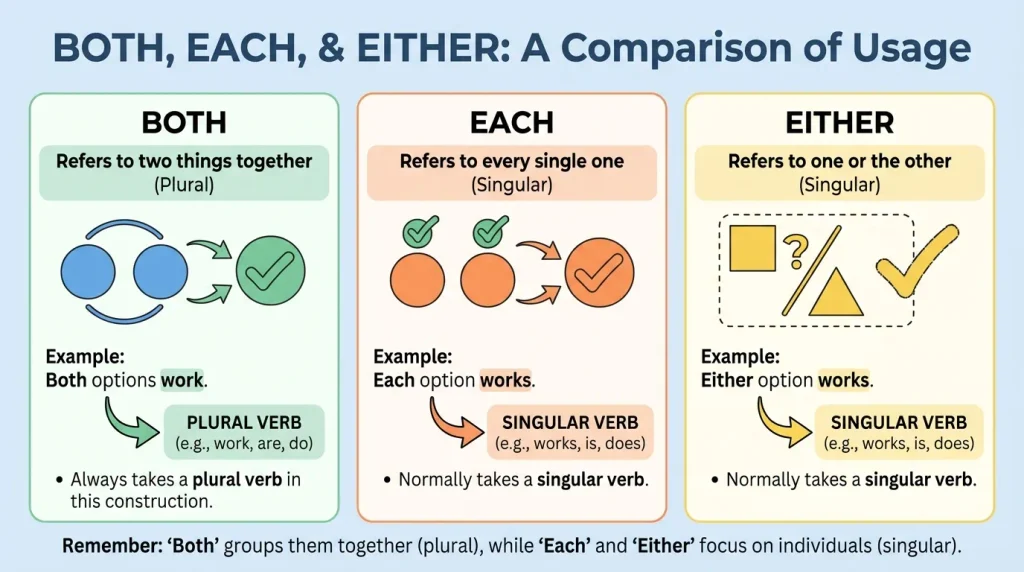
These words are often confused because they refer to people or things in different ways. However, they do not all follow the same verb agreement pattern.
| Word | Meaning | Verb agreement | Example |
|---|---|---|---|
| Both | Two together | Plural | Both work for me. |
| Each | Every one individually | Singular | Each works for me. |
| Either | One of two | Singular | Either works for me. |
| Neither | Not one or the other | Singular | Neither works for me. |
| All | Everyone or everything in a group | Depends on meaning | All are ready. |
Why “Either Works for Me” Is Also Correct
This is an important point.
Although both work for me and either works for me communicate similar ideas in many situations, their grammatical structures are different.
- Both work for me: Both options are acceptable.
- Either works for me: One option or the other is acceptable; you have no preference.
Compare:
“Monday and Wednesday are available. Both work for me.”
“Monday and Wednesday are available. Either works for me.”
Both sentences are correct.
The first emphasizes that the two options are suitable. The second emphasizes that you are happy with either individual choice.
ALSO CHECKOUT: What Happen or What Happened: Which One Is Correct?
Real-Life Situations: How to Use Both Work for Me
Situation 1: Scheduling a Meeting
Your manager asks:
“Can we meet on Monday or Wednesday?”
You reply:
“Both work for me. Please choose whichever is more convenient for you.”
This is correct because you are accepting two possible meeting dates.
Situation 2: Responding to a Professional Email
A colleague writes:
“Would you prefer the morning meeting or the afternoon meeting?”
You reply:
“Thank you for checking. Both times work for me.”
The plural noun times takes the plural verb work.
Situation 3: Making Weekend Plans
Your friend asks:
“Should we go out on Saturday or Sunday?”
You reply:
“Both work for me. I’m free on either day.”
This is natural conversational English.
Situation 4: Choosing Between Two Designs
Your manager presents two logo designs and asks for your opinion.
You reply:
“Both designs work for me. I’m happy with either option.”
Here, the plural subject designs takes the plural verb work.
Situation 5: Discussing Project Arrangements
A team member suggests two possible ways to complete a project.
You reply:
“I have reviewed both arrangements, and both work for me.”
The expression is suitable for professional communication.
ALSO READ: Soo vs So: Which Is Correct? Meaning, Difference, and Examples
An Easy Way to Remember: Both Work, One Works
You do not need to memorize complicated grammar explanations to remember this rule.
Use this simple comparison:
ONE OPTION
It works for me.
Singular subject → works
TWO OPTIONS
Both work for me.
Plural subject → work
You can also use the substitution trick:
- Both work for me → They work for me.
- Both works for me → They works for me.
Since “They work for me” is correct, “Both work for me” is correct too.
This is a quick way to check your sentence before sending an email or message.
Test Your Understanding: Both Work or Both Works?
Choose the correct answer in each sentence to check whether you understand the rule.
Grammar quiz
0/5 answered
1. Both _____ for me. You can choose either option.workworks
2. Both meeting dates _____ suitable.isare
3. Each option _____ for me.workworks
4. Neither of the two arrangements _____ for me.workworks
5. Both of these suggestions _____ reasonable.soundsounds
Check answers
Quick Summary
“Both work for me” is the grammatically correct expression when referring to two acceptable options. “Both works for me” is incorrect because both is plural and requires the plural verb work. Remember the simple rule: one option works, but two options work. You can use this expression when discussing meeting times, dates, plans, suggestions, and professional arrangements. Also, distinguish between both and each: say “Both options work for me” but “Each option works for me.” The same subject-verb agreement rule applies in American and British English. When someone offers you two choices, confidently reply, “Both work for me.”
Frequently Asked Questions (FAQ)
1. Is “both work for me” grammatically correct?
Yes. “Both work for me” is grammatically correct because both refers to two people or things and takes a plural verb. It is suitable for everyday conversations, professional emails, and workplace communication.
2. Can I say “both works for me” in casual conversation?
You may hear people use this expression in spontaneous conversation, but it is nonstandard when both is the subject. The correct expression is “both work for me.” It is best to use the standard form in both casual and professional communication.
3. Is “both of them work for me” also correct?
Yes. Both “Both work for me” and “Both of them work for me” are grammatically correct. The second version includes of them to identify the two things being discussed. You can use either expression when the context is clear.
4. Should I say “both work for me” or “either works for me”?
Both expressions are correct, but they have slightly different emphasis. “Both work for me” confirms that the two options are suitable. “Either works for me” means you are happy with one option or the other. Both are natural responses when someone offers two choices.
5. Is “both are fine with me” correct?
Yes. “Both are fine with me” is another correct way to express the same general idea. It uses the plural verb are because both refers to two things. For example, “Monday and Tuesday are available. Both are fine with me.”
6. Can I use “both work for me” in a business email?
Absolutely. It is a neutral, professional expression. For example: “Thank you for suggesting the two meeting times. Both work for me.” You do not need to use a longer or more complicated expression to sound professional.
7. Why do we say “each works” but “both work”?
Because each considers people or things individually, whereas both considers two people or things together. In standard English, each takes a singular verb, while both takes a plural verb. Therefore, “Each works” and “Both work” are correct.
8. Is “both of the options work for me” correct?
Yes. This is a completely correct sentence. The phrase both of the options refers to two options, so the verb must be plural. You can also shorten it to “Both options work for me” without changing the basic meaning.
9. Does the expression change in American and British English?
No. The subject-verb agreement rule is the same in standard American and British English. Both varieties use “Both work for me” rather than “Both works for me” when referring to two options.
10. Can “both works” ever be correct English?
Yes, but not as the intended subject-verb construction in “Both works for me.” For example, “Both works of art are impressive” uses works as a plural noun meaning pieces of art. Here, both determines the noun works, and the actual verb is are. This is a different sentence structure.


