

Both igniter and ignitor are correct English spellings. They refer to a device or component that starts a fire, flame, or combustion process. However, igniter is the more widely preferred spelling in American English, while ignitor is also an established variant, particularly in technical and product terminology. If you’re unsure which one to use, choose igniter for general writing.
What Is an Igniter?
An igniter is a person, device, or component that starts a fire or initiates combustion. Combustion is the process of burning fuel.
An igniter may produce a spark, supply heat, or provide another source of ignition, depending on the equipment.
You can find igniters in:
- Gas stoves
- Electric ovens
- Furnaces and heaters
- Gas grills
- Industrial burners
- Certain engines and other combustion systems
Examples:
- The oven igniter stopped working.
- The technician replaced the faulty igniter.
- The furnace needs a new igniter.
- The grill has an automatic igniter.
What Does Ignitor Mean?
Ignitor is an alternative spelling of igniter. It has essentially the same meaning: something that starts ignition.
It is a recognized English noun, not simply a spelling mistake.
For example:
- The technician inspected the furnace ignitor.
- The replacement ignitor arrived yesterday.
- The appliance uses an electronic ignitor.
- The manual lists the component as an ignitor.
The distinction is mainly spelling preference, not meaning. Both forms are recorded in dictionary usage. TMNG AL+2
The Core Rule: Igniter vs. Ignitor
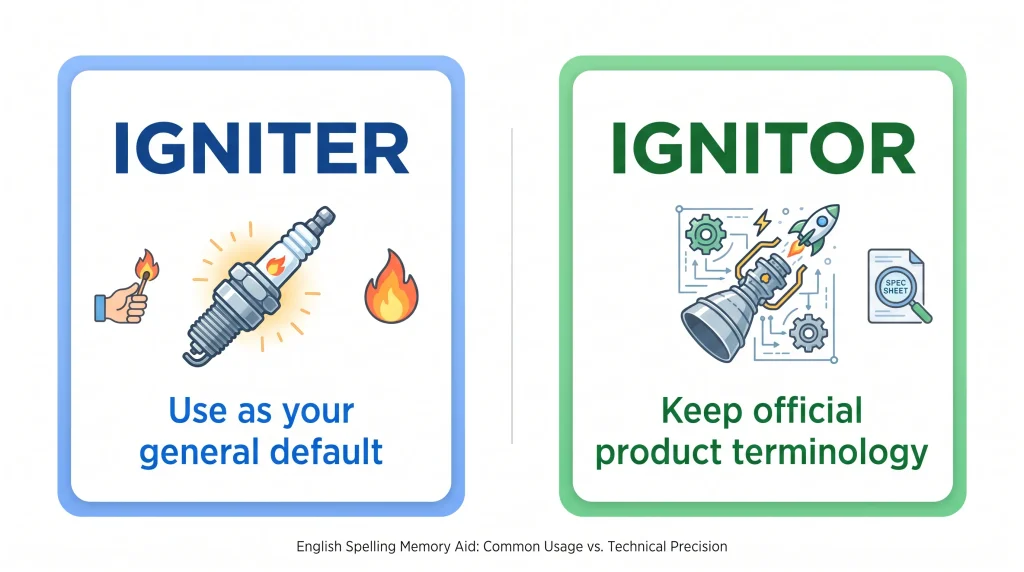
Recommended default
IGNITER
Use it in general writing, articles, explanations, and educational content.
Accepted alternative
IGNITOR
Use it when following an established product name, technical specification, or preferred terminology.
The easiest rule: Write igniter when choosing your own spelling. Keep ignitor when it is the official spelling used by a manufacturer or technical document.
ALSO CHECKOUT: Gases or Gasses: Which Spelling Is Correct?
How to Use Igniter and Ignitor
Use Igniter When:
- Writing an English article or blog post.
- Preparing a school or university assignment.
- Explaining how an appliance works.
- Writing general technical information.
- Describing a replacement component without a specific manufacturer designation.
Examples:
- The gas stove needs a new igniter.
- The mechanic checked the engine igniter.
- A faulty igniter can prevent the appliance from starting.
Use Ignitor When:
- Reproducing an official product name.
- Following a manufacturer’s terminology.
- Referring to a component identified as an ignitor in a technical manual.
- Maintaining the original spelling in a quotation or historical document.
Examples:
- The supplier lists the replacement part as an ignitor.
- The manual identifies the component as a hot-surface ignitor.
A Simple Numbered Guide
- Decide whether you are writing general English or referring to a specific product.
- Choose igniter for general writing.
- Check the manufacturer’s documentation if you are naming a replacement part.
- Keep the same spelling throughout your article or document.
Correct Examples of Igniter and Ignitor
Here are 12 examples showing both spellings in natural contexts.
Everyday Conversation
- The igniter on my gas stove is not working.
- I think the grill needs a replacement igniter.
School and Education
- An igniter helps initiate the combustion process.
- Our teacher explained how an ignition system works.
Workplace and Professional Writing
- The maintenance team inspected the furnace igniter.
- The engineer ordered a replacement igniter for the heating system.
Emails and Reports
- Please check whether the oven igniter needs replacement.
- The supplier confirmed that the required part is listed as an ignitor.
Social Media
- My new gas grill has an automatic igniter.
- The technician replaced the old ignitor yesterday.
Academic and Technical Writing
- The study examines the performance of an electronic igniter.
- The equipment specification identifies the component as an ignitor.
ALSO SEE: My and His vs. Mine and His: Which One Is Correct?
Less-Preferred vs. Recommended: 10 Spelling Examples
Because both spellings are accepted, it would be inaccurate to label every use of ignitor as incorrect. The following table shows the recommended choice for general writing.
| Less-preferred for general writing | Recommended | Why |
|---|---|---|
| The stove needs a new ignitor. | The stove needs a new igniter. | Igniter is the preferred general spelling. |
| The oven ignitor is faulty. | The oven igniter is faulty. | More familiar general spelling. |
| The technician replaced the ignitor. | The technician replaced the igniter. | Preferred in general descriptions. |
| The furnace ignitor failed. | The furnace igniter failed. | Better default for general writing. |
| The grill has an electric ignitor. | The grill has an electric igniter. | More familiar spelling for broad audiences. |
| The engine ignitor needs inspection. | The engine igniter needs inspection. | Preferred general spelling. |
| The replacement ignitor is expensive. | The replacement igniter is expensive. | Standard editorial preference. |
| The device contains an ignitor. | The device contains an igniter. | More familiar general usage. |
| The ignitor produces a spark. | The igniter produces a spark. | Recommended spelling for a general article. |
| The new ignitor works perfectly. | The new igniter works perfectly. | Preferred when no official product terminology applies. |
Important: The left-hand sentences are not necessarily grammatically wrong. If a manufacturer officially uses ignitor, retain that spelling rather than changing the product terminology.
Why Do People Confuse Igniter and Ignitor?
There are several reasons these two spellings cause confusion.
1. The -er and -or Endings
English uses both -er and -or to form nouns describing people or things that perform an action.
Examples include:
- Teacher
- Writer
- Creator
- Instructor
- Operator
Because both endings are common, writers may not know which one belongs in igniter.
2. Both Words Have the Same Pronunciation
Igniter and ignitor are generally pronounced the same way. Their pronunciation does not help you identify which spelling a writer has chosen.
3. Both Appear in Technical Documents
Appliance manuals, engineering documents, and product descriptions may use either spelling. Seeing both forms in professional material can make writers assume that one must be incorrect.
4. Spellcheck Accepts Both
Because both spellings are recognized, spellcheck may not flag either one. However, spellcheck cannot always tell you which form is more suitable for your intended audience.
5. Manufacturer Terminology Creates Confusion
A manufacturer may use ignitor in an official replacement-part name, while another company uses igniter. This creates variation in product listings and technical descriptions.
ALSO CHECKOUT: Anyone Has or Anyone Have? The Rule Made Simple
Igniter vs. Ignitor in Real English
1. Grammatically Correct
Both igniter and ignitor are accepted noun spellings. For example, “The oven igniter needs replacement” and “The oven ignitor needs replacement” are both grammatically correct. Neither spelling changes the basic meaning. Both refer to a component or device that initiates ignition. The choice is primarily about spelling preference and consistency.
2. Grammatically Possible but Less Preferred
Using ignitor in a general article is grammatically acceptable, but igniter is generally the safer editorial choice. Readers may encounter ignitor more often in particular product descriptions or established technical terminology. If you are writing for a broad audience, the familiar spelling igniter is a sensible default.
3. Natural, Everyday English
Both spellings can appear naturally in everyday English, especially when people discuss appliances, heating systems, or replacement parts. For example, “The gas stove needs a new igniter” sounds entirely natural. You may also see “ignitor” on a product label. The important thing is to use the spelling that matches the product or terminology you are discussing.
American vs. British English
Unlike clear spelling pairs such as color/colour and center/centre, igniter and ignitor are not a straightforward American-versus-British spelling pair.
Both spellings are recognized in English, and neither belongs exclusively to one variety.
A useful distinction:
| English variety | Spelling guidance |
|---|---|
| American English | Igniter is a good general default. |
| British English | Igniter is also acceptable; ignitor may appear. |
| International English | Either is recognized; use one consistently. |
| Technical English | Follow the terminology in the relevant documentation. |
Do not assume that ignitor is automatically British English or that igniter is exclusively American English.
Formal vs. Informal Usage
There is no special formal-versus-informal distinction between these spellings.
Both can appear in:
- Academic writing
- Professional reports
- Technical documentation
- Product descriptions
- Everyday conversations
For formal writing, choose igniter unless an official technical name or established terminology requires ignitor.
Consistency matters more than trying to create a difference in formality that does not exist.
Comparison Table: Igniter vs. Ignitor
| Feature | Igniter | Ignitor |
|---|---|---|
| Correct spelling | Yes | Yes |
| Part of speech | Noun | Noun |
| Meaning | Something that initiates ignition | Same meaning |
| Pronunciation | /ɪɡˈnaɪtər/ | Generally the same |
| General writing | Preferred default | Accepted alternative |
| Technical writing | Commonly suitable | Also used |
| American English | Accepted | Accepted |
| British English | Accepted | Accepted |
| Plural form | Igniters | Ignitors |
| Best general choice | Recommended | Use when terminology calls for it |
Real-Life Situations: Which Spelling Should You Choose?
Situation 1: Writing a School Assignment
A student explains how a gas oven works.
Recommended: The igniter creates the spark needed to start the burner.
Why? Igniter is a straightforward choice for general educational writing.
Situation 2: Preparing a Professional Email
An employee requests a replacement component.
Recommended: Please arrange a replacement igniter for the heating system.
Why? The familiar spelling is suitable for general professional communication.
Situation 3: Ordering a Replacement Part
A technician checks the manufacturer’s catalogue.
Correct approach: Use the exact spelling listed in the official product description, whether it says igniter or ignitor.
Why? Matching the manufacturer’s terminology helps avoid confusion when identifying a specific part.
Situation 4: Writing a Technical Report
An engineer describes an appliance component.
Recommended: The igniter was inspected during the maintenance procedure.
Why? Igniter is a suitable general spelling when no specific naming convention applies.
Situation 5: Editing an Older Manual
An editor encounters the word ignitor throughout an original document.
Correct approach: Keep ignitor if you are preserving the original terminology.
Why? Changing established terminology without a reason can create unnecessary inconsistencies.
Common Mistakes Checklist
- Assuming ignitor is always incorrect: Both spellings are accepted. Remember that igniter is the preferred general choice.
- Assuming the words have different meanings: They generally refer to the same thing.
- Treating ignitor as exclusively British: Both forms occur across English varieties.
- Changing official product names: Follow the manufacturer’s spelling when identifying a specific component.
- Mixing spellings unnecessarily: Choose one form and use it consistently throughout your writing.
- Confusing igniter with ignition: An igniter is a device or component; ignition is the process of starting combustion.
Easy Way to Remember Igniter vs. Ignitor
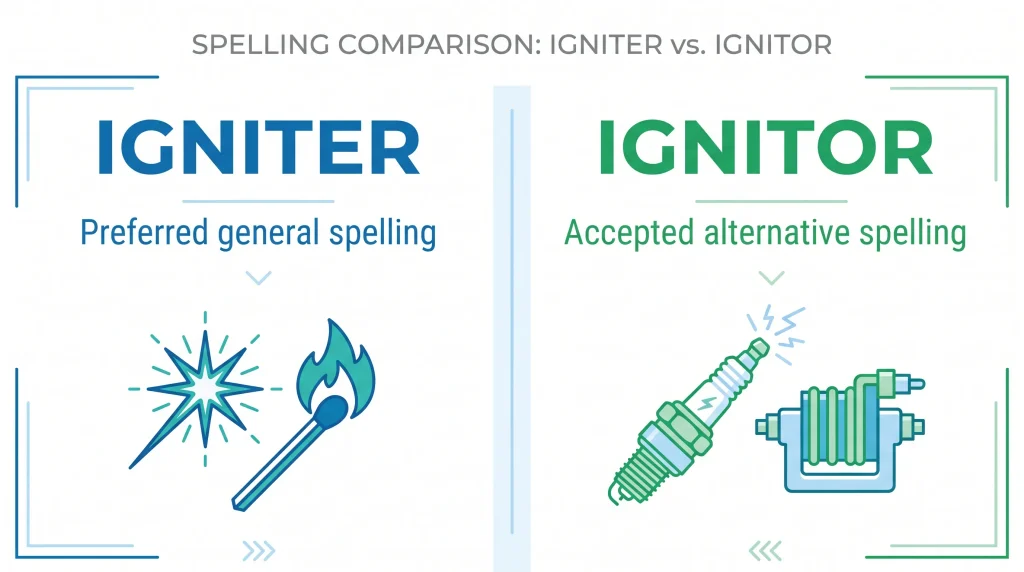
IGNITER = Your default choice
Use it in articles, essays, emails, and everyday writing.
IGNITOR = Alternative spelling
Keep it when a manufacturer or technical document uses it.
One simple memory trick:
Writing your own content? Use IGNITER. Following a product label? Copy its spelling.
You don’t need to memorize a complicated grammar rule.
Frequently Asked Questions (FAQ)
1. Is ignitor or igniter correct?
Both are correct English spellings. However, igniter is the preferred general spelling, while ignitor is an accepted alternative.
2. Is ignitor a real English word?
Yes. Ignitor is a recognized English noun. It refers to a person or device that initiates ignition.
3. What is the plural of igniter?
The plural is igniters. For example: “The technician inspected three faulty igniters.”
4. What is the plural of ignitor?
The plural is ignitors. For example: “The supplier ordered several replacement ignitors.”
5. Are igniter and ignitor pronounced the same?
Yes. They are generally pronounced identically. The difference is in their written endings, not their basic pronunciation.
6. Is igniter used in British English?
Yes. Igniter is an accepted spelling in British English. Ignitor also appears, so it is not an exclusive British spelling.
7. What is the difference between an igniter and an ignition system?
An igniter is a component or device that initiates ignition. An ignition system is the wider arrangement of components responsible for starting or controlling ignition.
8. Is igniter a noun or a verb?
Igniter is a noun. It names a person, device, or component that initiates ignition. The related verb is ignite.
9. Should I use igniter or ignitor in a technical report?
Use igniter as your general default. However, if the equipment manufacturer or an established technical specification uses ignitor, follow that terminology.
10. Why do some manufacturers write ignitor instead of igniter?
Manufacturers may follow established product naming conventions, historical terminology, or internal technical standards. Both spellings are recognized, so the choice does not necessarily indicate a mistake.
Quick Summary
Both igniter and ignitor are correct English spellings. They have essentially the same meaning and refer to a person, device, or component that initiates ignition. However, igniter is the better default for general writing, including articles, emails, educational content, and professional reports. Ignitor is an accepted alternative that may appear in technical documents, product descriptions, and manufacturer terminology. There is no strict American-versus-British distinction between the two spellings. If you are writing your own content, choose igniter. If you are referring to an officially named product or replacement component, follow the manufacturer’s spelling. The main rule is simple: use igniter by default and remain consistent.