


Nature similes are figures of speech that compare natural objects, events, or qualities with something else, usually using like or as. Examples include “The lake was as still as glass,” “The wind howled like a wolf,” and “The river wound through the valley like a silver ribbon.” These comparisons help readers imagine a scene by emphasizing qualities such as color, shape, sound, movement, and texture.
What Are Nature Similes?
A nature simile is a comparison that describes something in the natural world by connecting it to another thing with a recognizable shared quality.
For example:
- The sun glowed like a golden lantern.
- The leaves trembled like tiny green flags.
- The river was as smooth as glass.
- The stars sparkled like diamonds against the night sky.
The sun is not literally a lantern, and stars are not diamonds. The comparisons help readers visualize their brightness, appearance, or effect.
Nature similes can describe several features of the natural world:
- Appearance: The clouds looked like cotton.
- Sound: The wind howled like a wolf.
- Movement: The leaves danced like ribbons in the breeze.
- Texture: The moss felt as soft as velvet.
- Mood: The forest was as peaceful as a sleeping village.
- Intensity: The storm struck like a hammer.
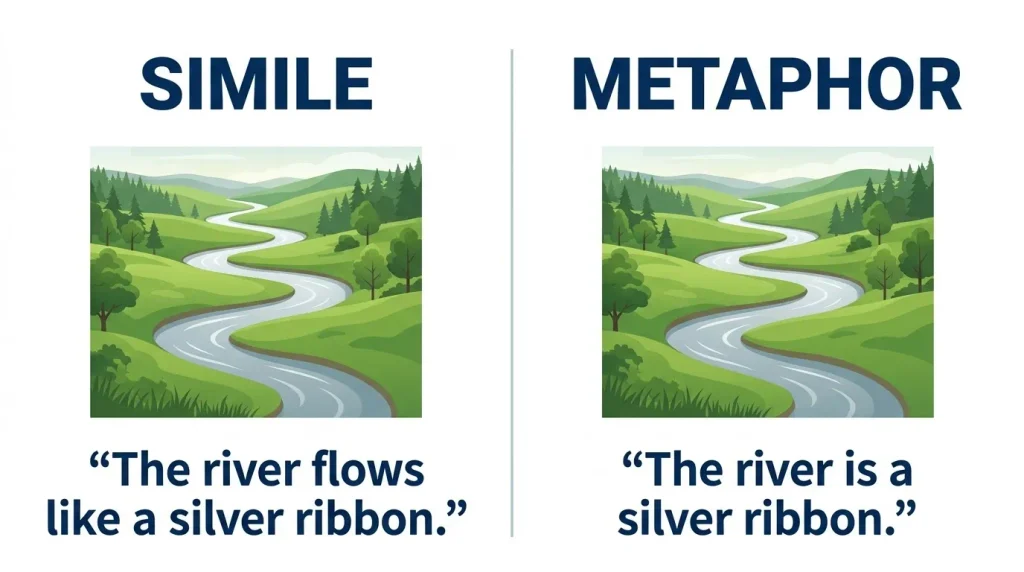
A nature simile does not have to compare two natural things. In “The river flowed like a ribbon,” a natural feature is compared with a human-made object. The important point is that the comparison highlights a quality the two things share.
Why Nature Similes Matter
Nature similes help readers picture a scene instead of merely receiving information about it. They can make writing more specific, memorable, and emotionally engaging.
Compare these sentences:
- Plain: The wind was strong.
- With a simile: The wind rushed through the valley like a speeding train.
The first sentence states a fact. The second suggests the wind’s speed, force, and sound.
Nature similes are useful when you want to:
- Make a story’s setting easier to imagine.
- Add imagery to poetry and descriptive writing.
- Explain an unfamiliar sight through a familiar comparison.
- Communicate feelings such as peace, fear, excitement, or sadness.
- Make school assignments more descriptive.
- Create engaging travel descriptions and social media captions.
However, figurative language is not always the best choice. A scientific report may need an exact measurement rather than a poetic description. The purpose of the writing determines whether a simile adds value.
The Core Rule
A nature simile compares two different things by highlighting a meaningful similarity, usually with like or as.
Two common patterns are:
- Like + noun phrase: The clouds looked like cotton.
- As + adjective or adverb + as: The lake was as calm as a sleeping child.
A noun phrase names a person, place, object, or idea. An adjective describes a quality, such as calm, bright, or soft.
| Sentence | Is it a simile? | Explanation |
|---|---|---|
| The river flowed like a silver ribbon. | Yes | It compares the river with a ribbon. |
| The grass was as soft as velvet. | Yes | It compares the grass’s texture with velvet. |
| The river flowed quickly. | No | It describes movement without making a comparison. |
| The forest was peaceful. | No | It describes a quality directly. |
| The forest was a green cathedral. | No, it is a metaphor. | It directly describes the forest as something else. |
Remember that like and as do not automatically create similes. Their grammatical function matters.
How to Use Nature Similes
A good nature simile helps readers understand a particular quality. Use the following steps to create one.
- Choose what you want to describe. Decide whether the subject is bright, quiet, rough, fast, delicate, or powerful.
- Identify a similar quality. For example, still water and a mirror share a smooth, reflective surface.
- Choose a suitable comparison. Think of an object, animal, or experience that makes the quality easier to imagine.
- Build the sentence. Use like or an as … as structure where appropriate.
- Check the result. Remove unnecessary words and make sure the comparison fits the scene.
For example:
- Observation: Sunlight flickers through the leaves.
- Shared quality: The light appears in small, shifting patches.
- Simile: Sunlight flickered through the leaves like coins at the bottom of a stream.
The final sentence is more specific than “The sunlight was beautiful.” It gives the reader a clearer visual image.
Choose a Simile That Matches the Mood
The same natural subject can communicate different feelings depending on the comparison.
| Intended mood | Nature simile | What it suggests |
|---|---|---|
| Peaceful | As still as a sheltered pond | Quiet and stability |
| Frightening | Like thunder rolling across a valley | Power and threat |
| Hopeful | Like the first green shoot after winter | Renewal and possibility |
| Sad | Like rain slipping down a cold window | Melancholy |
| Energetic | Like a stream breaking free of ice | Movement and release |
| Uncertain | Like mist hiding a mountain path | Confusion or mystery |
| Beautiful | Like starlight scattered over dark water | Delicate visual appeal |
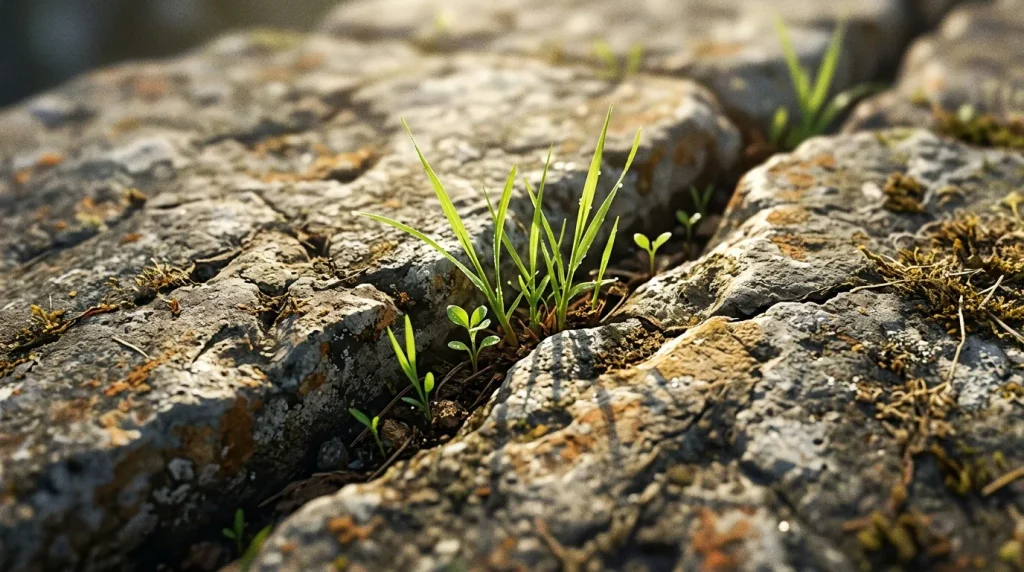
| Resilient | Like grass growing through a crack in stone | Persistence |
Avoid Overloading a Sentence
One strong comparison can be more effective than several unrelated images.
Overloaded: The river flowed like a snake, a racing horse, a silver ribbon, and a roaring lion.
Better: The river twisted through the rocks like a silver snake.
The improved version emphasizes the river’s winding movement. Multiple similes are not inherently wrong, but they can compete for attention when each creates a different image.
56 Nature Similes With Meanings and Examples
The examples below are grouped by subject. Some use familiar expressions, while others are original descriptive comparisons.
Similes About the Sun and Moon
1. As bright as the morning sun — Extremely bright or cheerful. Example: Her smile was as bright as the morning sun after a week of rain.
2. Like a golden coin in the sky — The sun’s round, golden appearance. Example: The setting sun hung over the hills like a golden coin.
3. As gentle as moonlight — Soft, quiet, or soothing. Example: Moonlight fell across the garden as gently as a whisper.
4. Like a silver lantern above the hills — The moon illuminating a dark landscape. Example: The full moon shone like a silver lantern above the hills.
5. As warm as afternoon sunshine — Comforting warmth or friendliness. Example: Her welcome was as warm as afternoon sunshine.
6. Like a fading ember in the evening sky — The reddish light of sunset gradually disappearing. Example: A final streak of red lingered like a fading ember in the evening sky.
Similes About the Sky and Clouds
7. As white as fresh snow — Very white. Example: The clouds were as white as fresh snow against the blue sky.
8. Like cotton scattered across the blue — Small, fluffy clouds spread across the sky. Example: Clouds drifted like cotton scattered across the blue.
9. As dark as a storm cloud — Dark or threatening in appearance. Example: His expression grew as dark as a storm cloud.
10. Like brushstrokes on a painted ceiling — Wispy clouds spreading across the sky. Example: Thin clouds stretched like brushstrokes across the evening sky.
11. As vast as an open ocean — Seemingly endless. Example: The cloudless sky looked as vast as an open ocean.
12. Like a curtain drawn across the mountains — Clouds or mist covering distant peaks. Example: A bank of clouds moved like a curtain across the mountains.
Similes About Trees, Flowers, and Plants
13. As strong as an oak — Strong and resilient. Example: She remained as strong as an oak through every challenge.
14. Like green umbrellas in the rain — Broad leaves spreading overhead. Example: The banana leaves opened like green umbrellas in the rain.
15. As delicate as a flower petal — Extremely fragile or soft. Example: She handled the tiny seedling as delicately as a flower petal.
16. Like dancers turning in the breeze — Flowers swaying gracefully. Example: The tulips moved like dancers turning in the breeze.
17. As fresh as morning dew — Fresh, clean, or renewed. Example: After a good night’s sleep, he felt as fresh as morning dew.
18. Like a green carpet across the earth — Grass or moss covering the ground. Example: Moss spread across the forest floor like a green carpet.
19. As stubborn as a tree gripping a cliff — Determined despite difficulty. Example: She remained as stubborn as a tree gripping a cliff through every challenge.
20. Like tiny stars scattered through the grass — Small flowers spread across a field. Example: Yellow buttercups appeared like tiny stars scattered through the grass.
Similes About Rivers, Lakes, and Oceans
21. As still as a mirror — Calm and motionless. Example: At dawn, the lake was as still as a mirror.
22. Like a ribbon winding through the valley — A river following a curved path. Example: The river shone like a ribbon winding through the valley.
23. As restless as the open sea — Constantly moving or unsettled. Example: His thoughts were as restless as the open sea before a storm.
24. Like glass broken into a thousand pieces — Light fragmented across moving water. Example: Sunlight scattered across the ripples like glass broken into a thousand pieces.
25. As deep as the ocean — Extremely deep, literally or figuratively. Example: Her curiosity was as deep as the ocean.
26. Like a drumbeat against the shore — Waves repeatedly striking the beach. Example: The waves rolled in like a drumbeat against the shore.
27. As clear as a mountain spring — Very clear. Example: The stream was as clear as a mountain spring.
28. Like a silver thread through the forest — A narrow stream reflecting light. Example: Water wound between the trees like a silver thread through the forest.
Similes About Rain, Wind, and Storms
29. Like fingers tapping on a window — Light, repeated raindrops. Example: Rain tapped on the window like impatient fingers.
30. As fierce as a winter gale — Extremely powerful or intense. Example: The wind was as fierce as a winter gale along the ridge.
31. Like a thousand tiny drums on the roof — Rapid or heavy rainfall. Example: The downpour sounded like a thousand tiny drums on the roof.
32. As unpredictable as mountain weather — Likely to change suddenly. Example: Conditions on the trail were as unpredictable as mountain weather.
33. Like a wolf calling across the valley — Wind making a long, howling sound. Example: The wind cried like a wolf calling across the valley.
34. As soft as a spring shower — Gentle and light. Example: The rain fell as softly as a spring shower.
35. Like a door slamming in the sky — A sudden, loud clap of thunder. Example: Thunder cracked like a door slamming in the sky.
36. As sudden as a flash of lightning — Happening almost instantly. Example: The change in weather was as sudden as a flash of lightning.
Similes About Mountains, Forests, and Landscapes
37. As tall as a mountain — Extremely tall. Example: The rock formation rose as tall as a mountain above the plain.
38. Like a sleeping giant beneath a blanket of trees — A large, quiet, forest-covered hill. Example: The hill rested like a sleeping giant beneath a blanket of trees.
39. As quiet as a forest before sunrise — Very quiet and still. Example: The campsite was as quiet as a forest before sunrise.
40. Like pillars holding up the sky — Tall trees or cliffs rising vertically. Example: The redwood trunks stood like pillars holding up the sky.
41. As dry as sun-baked earth — Extremely dry. Example: After months without rain, the garden was as dry as sun-baked earth.
42. Like waves frozen in gold — Sand dunes shaped into rippling forms. Example: The desert stretched before us like waves frozen in gold.
43. As rugged as a cliff face — Rough or uneven. Example: The mountain trail was as rugged as a cliff face.
Similes About Birds, Insects, and Other Animals
44. Like arrows released into the sky — Birds flying swiftly in one direction. Example: The swallows shot over the field like arrows released into the sky.
45. As busy as bees around a hive — Constantly active. Example: At dawn, the garden was as busy as bees around a hive.
46. Like a leaf carried by the wind — Moving without control over direction. Example: The feather drifted like a leaf carried by the wind.
47. As graceful as a heron in shallow water — Moving smoothly and elegantly. Example: The dancer crossed the stage as gracefully as a heron in shallow water.
48. Like silver sparks above the water — Fish flashing near the surface. Example: Small fish darted like silver sparks above the water.
49. As quiet as a fox in the grass — Moving silently and carefully. Example: The photographer crept through the meadow as quietly as a fox in the grass.
50. Like tiny acrobats among the branches — Squirrels moving quickly through trees. Example: The squirrels raced like tiny acrobats among the branches.
Similes About Seasons and Natural Changes
51. Like a quilt of autumn colors — A landscape displaying many fall colors. Example: The hillside looked like a quilt of autumn colors.
52. As crisp as a frosty morning — Fresh and cold. Example: The early air felt as crisp as a frosty morning.
53. Like a sleepy garden waking up — Plants beginning to grow in spring. Example: After the first warm week, the yard changed like a sleepy garden waking up.
54. As fleeting as a snowflake in sunlight — Lasting only a short time. Example: Their quiet moment together was as fleeting as a snowflake in sunlight.
55. Like a candle slowly burning out — Light or warmth gradually fading. Example: The last daylight disappeared like a candle slowly burning out.
56. As persistent as roots searching for water — Continuing despite obstacles. Example: Her determination was as persistent as roots searching for water.
The examples illustrate appearance, sound, movement, texture, and emotion. Choose a comparison for the quality you want to communicate rather than selecting a phrase simply because it sounds poetic.
Correct Nature Simile Examples in Everyday Contexts
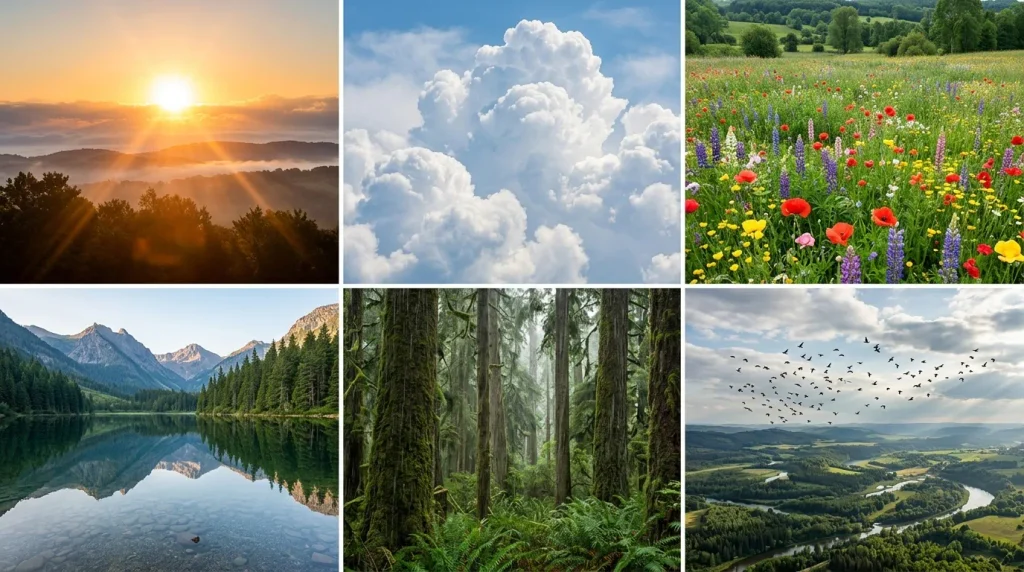
Nature similes are not limited to poetry or fiction. They can work in conversation, emails, schoolwork, workplace communication, social media, and academic writing when the tone suits the situation.
In Conversation
1. “The breeze felt as cool as water from a mountain stream.”
A conversational way to describe refreshing air.
2. “Those clouds look like mountains floating above us.”
A simple observation about cloud shapes.
In Emails
3. “The new garden is beginning to look like a green patchwork quilt.”
Suitable for a friendly gardening update.
4. “The weather changed as quickly as a summer storm.”
Useful when explaining an unexpected change of plans.
In School Assignments
5. “The snow covered the playground like a white blanket.”
A straightforward example of visual imagery.
6. “The leaves trembled like tiny birds on their branches.”
A comparison that emphasizes movement.
In Workplace Communication
7. “The project gained momentum like a river after heavy rain.”
A figurative description of rapid progress.
8. “The market shifted like sand beneath our feet.”
A vivid expression for changing conditions, suitable when a figurative tone is appropriate.
In Social Media
9. “The sunset spilled across the horizon like melted gold.”
Suitable for a sunset photograph.
10. “Morning mist wrapped the valley like a soft grey scarf.”
A descriptive caption for a misty landscape.
In Academic Writing
11. “The branching pattern resembled the veins of a leaf.”
A visual comparison that may help explain a pattern.
12. “The algae formed a thin layer resembling a green film across the water.”
A more precise description suited to scientific observation.
Academic writing can use comparisons, but figurative language should not replace evidence. In technical writing, state exact measurements and observations whenever they matter.
ALSO CHECK: Training or Trainning: Which Spelling Is Correct?
Incorrect vs. Correct Nature Similes
A sentence can contain a grammatical error, an unclear comparison, or a comparison that is technically correct but ineffective. The table explains the difference.
| ❌ Incorrect or weak | ✅ Correct or improved | Why |
|---|---|---|
| The clouds were as cotton. | The clouds were like cotton. | The original does not use a standard comparison structure. |
| The lake was like as a mirror. | The lake was like a mirror. | Like and as are incorrectly combined. |
| The wind was as fast like lightning. | The wind was as fast as lightning. | The equality pattern requires as … as. |
| The flowers were like beautiful. | The flowers were as beautiful as paintings. | Like normally introduces a noun phrase, not an adjective alone. |
| The sun was more brighter than gold. | The sun was brighter than gold. | Brighter already expresses comparison; more is unnecessary. |
| The river flowed as a ribbon. | The river flowed like a ribbon. | Like makes the intended comparison explicit. |
| The leaves danced like the wind. | The leaves danced like tiny flags in the wind. | The revised version gives a clearer image of movement. |
| The mountain was as tall like a tower. | The mountain was as tall as a tower. | Use the standard as … as construction. |
| The rain fell like very hard. | The rain fell as heavily as a waterfall. | The original uses like in an unsuitable construction. |
| The forest was silent like a completely silence. | The forest was as silent as an empty hall. | Silence is a noun; silent is the adjective needed here. |
A useful distinction: “The sky was like the ocean” is grammatically correct, but its meaning may be unclear without context. “The sky stretched endlessly like the ocean” provides a more specific shared quality.
Why People Make Mistakes With Nature Similes
Mistakes usually come from confusion about sentence patterns, the meaning of comparisons, or the difference between literal and figurative language.
Phonetic Similarity
Learners may remember the sound of a comparison pattern but not its exact structure. This can lead to forms such as “as bright like the sun.”
How to avoid it: Learn complete patterns: “bright like the sun” and “as bright as the sun.”
Spelling and Word-Form Overlap
English has related words that belong to different grammatical categories. For example, silence is a noun, while silent is an adjective.
How to avoid it: Check what the sentence needs. Write “The forest was silent” or “The forest was filled with silence.”
Overgeneralization
Learners sometimes assume that all comparisons follow the same pattern. However, “as white as snow” and “white like snow” use different structures.
How to avoid it: Practise the like + noun phrase and as … as patterns separately.
Autocomplete and Spellcheck Limitations
A spellchecker may accept a sentence in which every word is spelled correctly, even when the comparison is awkward or unclear.
How to avoid it: Read the entire sentence aloud and ask whether the comparison communicates the intended quality.
Translation Interference
A direct translation from another language may use an unfamiliar comparison or an unsuitable English structure.
How to avoid it: Learn common English patterns and check unfamiliar expressions in reliable dictionaries. Do not assume that a word-for-word translation will preserve the same meaning or effect.
Common Nature Simile Mistakes Checklist
- Mixing comparison structures: Write “as bright as the sun” or “bright like sunlight,” not “as bright like sunlight.”
- Choosing unrelated images: Make the shared quality clear so readers understand the comparison.
- Overloading sentences: Avoid stacking unrelated similes when one can communicate the idea.
- Using clichés without purpose: Familiar comparisons can work, but a specific image may be more memorable.
- Confusing similes and metaphors: “The river is a ribbon” is a metaphor; “The river is like a ribbon” is a simile.
- Ignoring the audience: A playful simile may suit a children’s story but distract from a technical report.
- Replacing measurements with imagery: State the actual measurement when accuracy matters.
- Relying only on spellcheck: Review grammar, meaning, and clarity separately.
- Translating expressions word-for-word: Check whether the comparison works in natural English.
- Forgetting the purpose: Every comparison should help readers understand a quality, image, or emotion.
Nature Similes in Real English
Grammatically Correct and Natural
“The lake was as smooth as glass.”
This sentence follows the standard as … as pattern and compares a lake’s surface with glass. The shared quality is smoothness, making the image immediately understandable. The sentence is suitable for a story, travel description, conversation, or school assignment. It works best when the lake is calm enough for the comparison to feel accurate.
Grammatically Possible but Unnatural
“The lake was as smooth as a singing mountain.”
The sentence follows a recognizable grammatical pattern, but the comparison is difficult to interpret because a singing mountain provides no obvious reference for smoothness. A writer could use this image deliberately in surreal poetry, where unexpected connections may be desirable. In ordinary descriptive writing, “smooth as glass” communicates the intended quality more clearly.
Natural Everyday English Without a Simile
“The wind was howling through the trees.”
This is natural English, but it is not an explicit simile. The verb howling evokes an animal-like sound without directly comparing the wind to an animal. “The wind howled like a wolf through the trees” makes the comparison explicit. Both sentences work, but they use different techniques to create imagery.
American vs. British English
There is no major grammatical difference between American and British English in how nature similes are formed. Both varieties use constructions such as “as quiet as a forest” and “like a silver ribbon.”
Spelling differences may occur in surrounding text. For example, American English commonly uses color, while British English commonly uses colour. These spelling differences do not change the structure or meaning of a simile.
Choose the spelling convention that matches your audience and apply it consistently.
Formal vs. Informal Usage
Nature similes can appear in both formal and informal writing, but their suitability depends on the purpose of the text.
| Context | Recommended approach | Example |
|---|---|---|
| Casual conversation | Use familiar, easy-to-understand comparisons. | The sky looks like a painting. |
| Creative writing | Choose vivid comparisons that support the scene. | The mist curled around the trees like smoke. |
| School assignments | Use clear examples and explain their effects. | The snow covered the field like a blanket. |
| Business communication | Use sparingly when a figurative tone is suitable. | The project gathered momentum like a rising tide. |
| Academic writing | Prefer precision; use comparisons when they clarify a concept. | The branching pattern resembles a leaf’s veins. |
| Scientific reporting | State measurable facts directly. | The water temperature was 12°C. |
Formal writing does not prohibit similes. It places greater emphasis on clarity, precision, and relevance.
Nature Similes vs. Metaphors and Personification
Similes, metaphors, and personification are related literary devices, but they work differently.
| Feature | Simile | Metaphor | Personification |
|---|---|---|---|
| Main technique | Explicit comparison | Direct or implied identification | Giving human qualities to nonhuman things |
| Common signal | Like or as | No required signal word | Human actions or emotions |
| Nature example | The clouds looked like sheep. | The clouds were sheep. | The clouds marched across the sky. |
| Main effect | Highlights a similarity | Presents one thing through another | Makes a scene seem active or human |
| Useful for | Clear comparisons | Compact, expressive imagery | Bringing nature to life |
Is Every Sentence With “Like” a Simile?
No. Like can express different meanings.
- Simile: The river shone like silver.
- Preference: I like walking in the forest.
- Similarity: The two leaves look alike.
- Approximation: It was like five kilometres to the lake.
Only the first sentence uses like to create the intended figurative comparison.
Is Every Sentence With “As” a Simile?
No. The word as has several grammatical functions.
- Simile: The grass was as soft as velvet.
- Role: She works as a park ranger.
- Time: As the sun rose, the birds began to sing.
The first sentence makes an explicit comparison. The others use as in different ways.
ALSO CHECKOUT: Occasion or Ocassion: Which Spelling Is Correct?
Real-Life Situations
During a Job Interview
A candidate might say, “The workload felt like a river after heavy rain, but we learned to manage it together.”
This comparison is understandable, but a direct description may sound more professional in a formal interview: “The workload increased quickly, and our team developed a system to manage it.”
During a Team Meeting
A project manager might say, “The project is gathering momentum like a river flowing downhill.”
This can work in a conversational presentation. A more direct alternative is “The project is progressing increasingly quickly.”
In an Email
“The garden is beginning to look like a patchwork quilt of spring flowers.”
The simile adds warmth and detail to a friendly message. A formal report might instead identify the plants and describe their coverage.
In a Text Message
“The sunset looks like melted gold tonight!”
This short comparison works well because the image is familiar and the meaning is immediately clear.
In an Exam
“The wind howled like a hungry wolf through the dark forest.”
This sentence compares the wind’s sound with a wolf’s howl. If asked to explain the simile, identify the two things being compared and the shared quality.
Nature Simile Practice Quiz
Test your understanding with these five questions.
1. Which sentence contains a nature simile?
- A. The wind blew through the trees.
- B. The wind howled like a wolf.
- C. The wind was cold.
2. What does “The lake was as still as glass” suggest?
- A. The lake was frozen solid.
- B. The lake’s surface was calm.
- C. The lake was very deep.
3. Which sentence uses a metaphor rather than a simile?
- A. The clouds were like sheep.
- B. The clouds drifted as softly as feathers.
- C. The clouds were sheep grazing across the sky.
4. Which simile best describes sudden speed?
- A. Like moss on a stone.
- B. As quick as lightning.
- C. As still as a pond.
5. Which is the clearest simile for gentle rain?
- A. The rain was as gentle as a whisper.
- B. The rain was gentle and it was rain.
- C. The rain was like gentle.
Quiz Answers
- B: “Like a wolf” explicitly compares the wind’s sound with a wolf’s howl.
- B: Glass suggests a smooth, motionless surface.
- C: The sentence identifies the clouds directly as sheep, making it a metaphor.
- B: Lightning provides a familiar image of speed.
- A: The sentence uses the standard as … as construction and makes a clear comparison.
Quick Summary
Nature similes compare natural objects, events, or qualities with other things, usually using like or as. Examples include “The lake was as still as glass,” “The wind howled like a wolf,” and “The river wound through the valley like a silver ribbon.” These comparisons help readers imagine appearance, sound, movement, texture, and emotion. To create an effective simile, identify the quality you want to describe, choose a related image, and make the comparison clear. Avoid mixing grammatical patterns or combining unrelated images. Nature similes work well in poetry, stories, school assignments, and everyday descriptions. In scientific and technical writing, prefer precise, literal language when accuracy matters more than imagery.
Frequently Asked Questions About Nature Similes
What is a simple nature simile for students?
“The clouds were like cotton” is a simple nature simile. It compares clouds with cotton to describe their soft, fluffy appearance. Students can create similar examples by identifying a quality of a natural object and comparing it with something familiar.
What are five examples of nature similes?
Five examples are “The lake was as still as glass,” “The wind howled like a wolf,” “The clouds floated like cotton,” “The river wound like a ribbon,” and “The stars sparkled like diamonds.” Each comparison highlights a recognizable quality, such as stillness, sound, shape, or brightness.
Can a nature simile describe human emotions?
Yes. Nature similes can communicate emotions by comparing them with natural sights or experiences. For example, “Her happiness spread like sunlight across the room” suggests warmth and joy. The comparison helps readers imagine the feeling rather than simply being told that someone is happy.
What makes a nature simile original?
An original simile uses a relevant comparison that adds something specific to the description. Instead of “The sky was as blue as the ocean,” a writer might say, “The evening sky faded like ink spreading through water.” Originality is most effective when the image remains clear and suits the scene.
Can a sentence contain more than one nature simile?
Yes. For example, “The clouds looked like sheep, while the sunset glowed like a bed of embers” contains two similes. Each describes a different visual feature. Multiple comparisons can enrich a passage, but too many competing images may make the writing difficult to follow.
Are nature similes appropriate for formal essays?
They can be appropriate in descriptive, narrative, and reflective essays. In analytical or scientific writing, use them only when they clarify an idea. A figurative comparison should not replace evidence, precise terminology, or a measurement when factual accuracy matters.
Do all nature similes have to describe something beautiful?
No. Nature similes can describe danger, discomfort, sadness, uncertainty, and destruction. For example, “The branches clawed at the roof like skeletal fingers” creates an unsettling atmosphere. The comparison serves the writer’s purpose rather than simply making nature appear attractive.
How can English learners improve their use of nature similes?
Practise common patterns, read descriptive English, and create original sentences. Learn structures such as “bright like sunlight” and “as bright as the sun.” Then check whether the comparison communicates the intended quality. Reading the sentence aloud can also help identify awkward wording.
Are nature similes and nature metaphors interchangeable?
No. A simile makes an explicit comparison, as in “The forest was like a cathedral.” A metaphor identifies one thing with another, as in “The forest was a cathedral.” Both can create vivid imagery, but they express the comparison differently.
How do I know when to avoid a nature simile?
Avoid one when it obscures meaning, distracts from the main point, or makes factual writing less precise. A poem may benefit from an unusual comparison, but a weather report should provide accurate conditions and measurements rather than rely on figurative descriptions.


