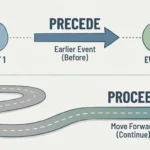
Use pick up (two words) when it’s a verb, meaning an action you do, like lifting something or collecting someone. Use pickup (one word) when it’s a noun or adjective, meaning a thing, an event, or a describing word, like a pickup truck or the pickup time. Here’s a quick test: if you can change it to picked up, write two words.
What Is the Difference Between Pick Up and Pickup?
Pick up is a phrasal verb, which means a verb joined to a small word (here, “up”) that together create one meaning. Because it’s a verb, it changes form: picks up, picked up, and picking up. In short, it describes something someone does.
Pickup, on the other hand, is a compound noun: two words fused into one name for a thing or event. It can also work as an adjective when it sits in front of another noun, as in pickup window or pickup location.
So the letters are the same, but the jobs are different. The spelling tells the reader which job the word is doing.
Why Getting It Wrong Matters
Most readers won’t stop to diagnose your grammar. Instead, they’ll simply feel that something is off, and that’s enough to cost you credibility in a few common situations:
- Customer-facing text. For instance, “Order now for free pick up” looks careless next to a competitor’s polished “free pickup.”
- Work emails. A line like “Please pickup the files” is the kind of slip a manager notices in a quick scan.
- Job applications. Likewise, a spelling slip on a basic word can overshadow strong experience in a cover letter.
- School and exams. Teachers mark part-of-speech errors, so this one is worth avoiding.
The Core Rule

Do it → two words. Have it → one word.
If you can do it (it’s an action), write pick up.
If you can have it (it’s a thing or an event), or it describes another noun, write pickup.
How to Use Pick Up and Pickup
Pick Up (verb): the common meanings
Pick up has many meanings, but they’re all actions:
- Lift something: Pick up your bag from the floor.
- Collect someone or something: I’ll pick up the parcel tomorrow.
- Learn casually: She picked up Spanish while living in Madrid.
- Resume: Let’s pick up the conversation after lunch.
- Improve or increase: Traffic usually picks up around 8 a.m.
- Catch an illness: He picked up a cold on the train.
- Pay for something: The company picked up the bill.
- Detect a signal or sound: The microphone picks up every whisper.
Pick Up is a separable phrasal verb
When the object is a noun, you can put it after “up” or in the middle. However, when the object is a pronoun (it, them, him, her, me), it must go in the middle.
- ✅ Pick up the book.
- ✅ Pick the book up.
- ✅ Pick it up.
- ❌ Pick up it.
By contrast, “pickup” never splits like this, because it’s one solid word.
Pickup (noun): a thing or an event
As a noun, pickup names something you can count, schedule, or cancel:
- The pickup is scheduled for noon. (an event)
- We offer free pickups on Fridays. (events, plural)
- He drives a pickup. (short for pickup truck)
- The guitar has two pickups. (the parts that capture string vibrations and turn them into an electrical signal)
Pickup (adjective): a describing word
When the word comes before another noun, it describes that noun. Nouns used this way are called noun adjuncts, and they stay singular.
- pickup time
- pickup location
- pickup window
- pickup truck
- pickup game (an informal, unorganized sports match)
Exceptions and related forms
Pick-up (hyphenated). Some British publishers and dictionaries keep the hyphen in the noun form, writing pick-up. It’s a spelling variant, not a different word, so choose one form and stay consistent. Meanwhile, the verb is never hyphenated.
Pick-me-up. A pick-me-up is a drink, snack, or small treat that boosts your mood or energy. It’s always hyphenated, and it’s a noun.
12 Correct Examples in Context
Conversation
- Can you pick up the kids at three?
- My pickup is at three, so I’ll be outside by 2:45.
Email
3. Once you arrive, please pick up your visitor badge at the front desk.
4. The courier confirmed the pickup for Tuesday morning.
School
5. After class, don’t forget to pick up your graded essays.
6. Because traffic is heavy at 3 p.m., parents can use the pickup lane on the east side of the building.
Workplace
7. Our team picked up two new clients last month.
8. Curbside pickup is available for all online orders.
Social media
9. Just picked up my new glasses, and I can finally read street signs.
10. Sunday pickup game at the park, so all skill levels are welcome!
Academic writing
11. Researchers found that infants pick up new speech sounds faster than adults.
12. After calibration, the sensor’s pickup of faint signals improved.
Incorrect vs. Correct
| ❌ Incorrect | ✅ Correct | Why |
|---|---|---|
| I’ll pickup the pizza on my way home. | I’ll pick up the pizza on my way home. | Because “pick up” is an action here, it’s a verb and takes two words. |
| Please note the pick up time is 4 p.m. | Please note the pickup time is 4 p.m. | Since “pickup” describes “time,” it works as an adjective and takes one word. |
| Where is the pick up location? | Where is the pickup location? | The word sits before a noun and describes it, so it must be one word. |
| She drives a pick up truck. | She drives a pickup truck. | “Pickup truck” names a vehicle type, so the first word is a closed compound. |
| Sales should pickup after the holidays. | Sales should pick up after the holidays. | Here “pick up” means “improve,” which is a verb meaning. |
| Order online for free pick up. | Order online for free pickup. | Because “free” describes a noun, the word must be a noun, and a noun is one word. |
| He picks-up his sister every day. | He picks up his sister every day. | A verb is never hyphenated, and the “s” attaches to “pick.” |
| He pickups his son from soccer. | He picks up his son from soccer. | Only the verb takes verb endings, so the “s” goes on “pick,” not on the end. |
| I’m waiting for my pick up. | I’m waiting for my pickup. | “My” signals a noun, so the word closes up. |
| The schedule includes a pick up for each hotel. | The schedule includes a pickup for each hotel. | Since “a pickup” is a noun phrase, it’s written as one word. |
| Let me pickup where I left off. | Let me pick up where I left off. | In this sentence “pick up” means “resume,” so it’s a verb phrase. |
Why People Make This Mistake
The words look and sound identical. In speech, the verb and the noun sound almost the same, so your ear gives you no clue about the spelling. Many speakers do stress the “up” in the verb (pick UP) and the “pick” in the noun (PICK-up), but that difference is subtle and easy to miss.
Closed compounds are everywhere. English often fuses verb phrases into nouns: set up → setup, back up → backup, check out → checkout, work out → workout. Writers learn that pattern and then sometimes apply it to the verb too. As a result, you get “I’ll pickup the keys.”
Spellcheck can’t help. Because both pick up and pickup are real, correctly spelled terms, a basic spellchecker accepts either. Telling them apart requires understanding the sentence, which is why this mistake slips through.
Some learners don’t expect phrasal verbs. In some languages, “collect” or “fetch” is a single verb. Therefore, learners may glue pick up together, or they may treat the “up” as optional.
Common Mistakes Checklist
- Gluing the verb. I pickup my coffee happens when the writer treats “pick up” as one unit. To avoid it, ask: Is someone doing this? If yes, split it.
- Splitting the noun. Free pick up often appears after a writer learns the verb form and over-corrects. Check for an article, adjective, or possessive in front. If one is there, it’s a noun, so close it.
- Splitting the adjective. Pick up location looks natural because “location” follows. Still, the word describes the next noun, so use one word.
- Hyphenating the verb. Picks-up is never right. Only the noun or adjective may take a hyphen, and even then only as a spelling variant.
- Putting a pronoun after “up.” Pick up it is wrong because pronouns must go in the middle. Write pick it up instead.
- Putting verb endings in the wrong place. Pickups him is wrong. Instead, write picks him up, since the “s” belongs on “pick.”
- Mixing styles inside one document. If you write pickup in the title and pick-up in the body, readers notice. Therefore, pick one noun spelling and stick to it.
ALSO CHECKOUT: Double Check or Double Confirm? Which One Is Correct
Pick Up vs Pickup in Real English
Grammatically correct
Both forms are correct when the spelling matches the part of speech. For example, in Please pick up the package at the pickup counter, the first is a verb and the second is an adjective. Every word sits in its proper slot, so the sentence is accurate even if it sounds slightly formal.
Grammatically possible but unnatural
Some sentences pass the rules yet sound clunky. Please perform the pickup of your package is grammatical because “pickup” is a noun. However, most people would simply say Please pick up your package. Turning a verb into a noun plus a helper verb (perform, make, conduct) sounds like a form letter. It suits scheduling paperwork, but it feels stiff in conversation.
Natural, everyday English
In everyday speech, people reach for pick up as a verb for almost everything: Can you pick me up? I’ll pick up some milk. Things usually pick up in March. Meanwhile, the noun appears mainly in set phrases, such as curbside pickup, pickup time, pickup truck, and pickup game. If you’re unsure, ask whether you’re doing something or naming something. Doing gets two words, and naming gets one.
ALSO CHECKOUT: Concave vs. Convex: Simple Rules to Never Mix Them Up
American vs. British English
The verb is identical everywhere: pick up. The noun, however, differs a little in spelling and vocabulary.
| American English | British English | |
|---|---|---|
| Noun spelling | Usually pickup | Often pick-up (hyphenated), though pickup also appears |
| Vehicle | pickup truck (very common) | pick-up or pick-up truck |
| Everyday term | “pickup truck” | “pick-up,” or “ute” in Australian English |
Because dictionaries list both noun spellings, follow your publication’s style guide. For American audiences, though, pickup is the safe choice.
Formal vs. Informal Usage
Pick up (verb) is neutral when it means “lift” or “collect.” However, some meanings lean casual. Pick up a language, pick up the tab, and pick someone up (to flirt) belong in relaxed speech.
In formal writing, consider these alternatives:
- collect or retrieve instead of pick up (an item)
- acquire instead of pick up (a skill)
- improve or recover instead of pick up (business)
- contract or catch instead of pick up (an illness)
Pickup (noun) is fine in logistics and customer-service writing. In contrast, pickup line and pickup game are informal. For the event itself, a more formal word is collection.
Pick Up vs Pickup Comparison Table
| Feature | Pick up | Pickup |
|---|---|---|
| Part of speech | Phrasal verb | Noun or adjective |
| Spelling | Two words | One word (hyphenated pick-up is a variant) |
| What it expresses | An action | A thing, an event, or a describing word |
| Takes endings? | Yes: picks up, picked up, picking up | Plural only: pickups |
| Can be split by an object? | Yes: pick it up | No |
| Test | Does picked up fit? | Does a, the, my, or -s fit? |
| Example | Please pick up the order. | The pickup is at noon. |
How to Tell Them Apart in Three Steps
- Start with the past tense. If picked up fits, use two words.
- Next, add a, the, or my in front. If that works, it’s a noun, so use one word.
- Finally, check whether it describes the next word. If it does (pickup time, pickup truck), use one word.
Real-Life Situations
Job interview
“I’m a quick learner. In fact, I picked up the new software in a week.” (Verb: learned.)
Team meeting
“Let’s pick up where we left off on the budget.” (Verb: resume.)
Email to a vendor
“Please confirm the pickup time for Thursday. Also, our driver will pick up the pallets between 9 and 10.” (Adjective, then verb.)
Text message
“Running late. Can you pick me up outside the station?” / “Pickup moved to 6!” (Verb, then noun.)
Exam question
Choose the correct sentence: (a) I will pickup the form. (b) I will pick up the form. The answer is (b). Because the word is a verb, it needs two words.
Quick Practice: Test Yourself
Choose pick up or pickup for each blank:
- Please arrive early for ______ at the airport.
- Can you ______ my dry cleaning?
- Is the ______ window open on weekends?
- Sales tend to ______ in December.
- His band’s sound relies on a vintage ______.
- I’d like to ______ that thought later.
Answers: 1. pickup · 2. pick up · 3. pickup · 4. pick up · 5. pickup · 6. pick up
Frequently Asked Questions
Is “pickup” actually a word, or is it just internet spelling?
Yes, it’s a standard dictionary word. Major dictionaries list it as a noun with several senses, including a vehicle type, a collection event, and a component on a musical instrument.
Is it “pickup truck” or “pick up truck”?
The correct form is pickup truck. Because the word describes the kind of truck, it takes the closed one-word form (or pick-up truck in some British usage).
Is it “curbside pickup” or “curbside pick up”?
Curbside pickup is correct. Here, “pickup” is a noun naming the service, whereas the verb phrase would be pick up your order curbside.
Should I write “pick-up” with a hyphen?
Only as a noun or adjective, and mostly in British-style writing. The verb, however, is always two words with no hyphen. Whichever noun spelling you choose, stay consistent within a document.
What is the past tense of “pick up”?
The past tense is picked up. Only the first word changes, as in I picked up the keys. Never write “pickedup.”
Is it “pick it up” or “pick up it”?
Pick it up is correct. When the object is a pronoun, it must go between “pick” and “up.” With a noun, however, both orders work: pick up the box or pick the box up.
What does “pick-me-up” mean?
A pick-me-up is a noun for something that lifts your mood or energy, such as a coffee or a kind message. Since it works as one unit, it’s hyphenated: That coffee was a perfect pick-me-up.
Does “pickup” have a plural?
Yes, the plural is pickups, as in We have three pickups scheduled today. The verb has no plural, but it does have forms like picks up.
Can I use “pick up” before a noun, like “pick up time”?
No. When the word comes before a noun and describes it, use the one-word adjective form: pickup time.
Does the same rule apply to similar words like “set up” and “setup”?
Mostly, yes. Many two-word verbs have a one-word noun partner: back up / backup, check out / checkout, log in / login, work out / workout. Spelling can vary by dictionary, but the logic stays the same: verb = two words, noun = one.
Quick Summary
The difference between “pick up” and “pickup” depends on how each word is used in a sentence. “Pick up,” written as two words, is a phrasal verb that describes actions such as lifting, collecting, learning, improving, or resuming something. It can change form, such as “picks up,” “picked up,” and “picking up.” In contrast, “pickup,” written as one word, functions as a noun or adjective. It refers to a thing or event, as in “the pickup is scheduled for noon,” or describes another noun in phrases like “pickup time,” “pickup location,” and “pickup truck.” Understanding this distinction helps improve grammatical accuracy, clarity, and professionalism in everyday and formal writing.