

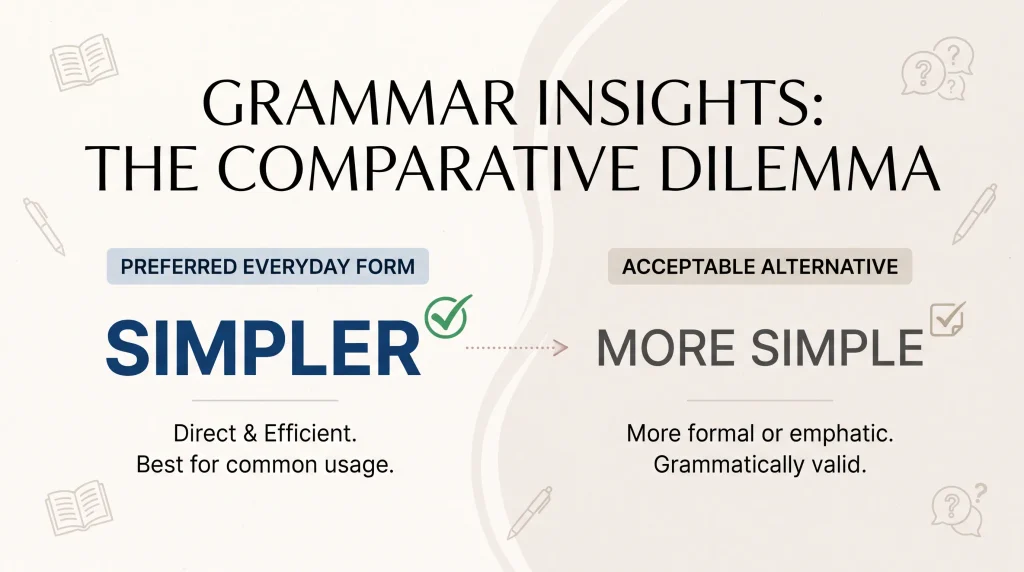
Both simpler and more simple are grammatically acceptable comparative forms of the adjective simple. However, simpler is the usual and more natural choice in modern English. Use it when comparing two things, ideas, methods, or situations that differ in complexity. Although more simple is possible, it is less common and may sound unnecessarily wordy in ordinary conversation and writing. Therefore, when in doubt, choose simpler.
What Does Simpler Mean?
Simpler is the comparative form of the adjective simple. It describes something that is less complicated, easier to understand, or less difficult to use than something else.
In other words, when one thing has fewer complications or requires less effort than another, you can describe it as simpler.
For example:
- This explanation is simpler than the previous one.
- The new software is simpler to use.
- Her approach is simpler and more practical.
- We need a simpler solution to this problem.
- The updated instructions make the process simpler.
Notice that simpler directly compares two things. You can also use it without mentioning the second item when the comparison is already clear from the context.
For example:
“Let’s find a simpler way to complete this task.”
Here, the listener understands that the suggested method should be less complicated than the current one.
What Does More Simple Mean?
More simple is an alternative comparative construction. It uses the word more before the adjective instead of adding the comparative ending -er.
For example:
- This explanation is more simple than the previous one.
- The design looks more simple without extra decoration.
- We need a more simple approach to this problem.
- The revised process is more simple than the original one.
These sentences are grammatically possible. However, more simple is generally less common than simpler.
In everyday English, most writers would naturally choose:
“This explanation is simpler than the previous one.”
Rather than:
“This explanation is more simple than the previous one.”
Both communicate the same basic comparison. Nevertheless, the first version is shorter and more conventional.
Read also: Catalogue or Catalog: The Spelling Difference Explained
Why Do People Confuse Simpler and More Simple?
The confusion comes from the way English forms comparative adjectives.
A comparative adjective describes a higher or lower degree of a quality. English commonly creates these comparisons in two ways:
- Add -er to an adjective.
- Place more before an adjective.
For example:
- Small → Smaller
- Fast → Faster
- Beautiful → More beautiful
- Expensive → More expensive
However, English does not follow one completely fixed rule for every adjective.
Simple is a two-syllable adjective that commonly forms its comparative with -er. Therefore, simpler is the usual form.
At the same time, English also permits more simple as an alternative. The important distinction is that grammatical possibility does not mean both forms are equally natural or equally common.
The Core Rule: Simpler or More Simple?
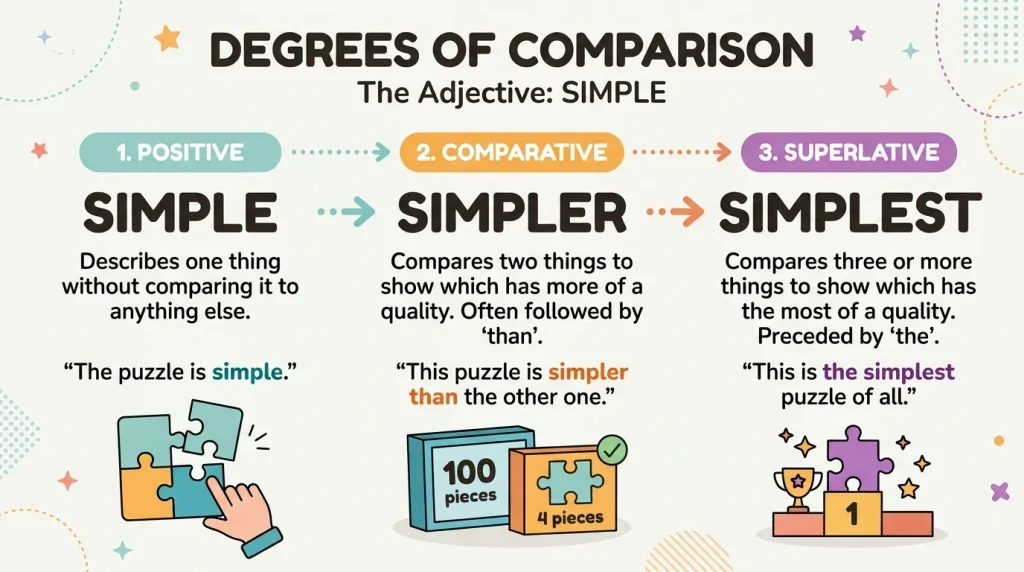
The simplest way to remember the difference is:
Use simpler as your default comparative form. More simple is acceptable, but less commonly preferred.
The basic forms are:
| Grammatical Form | Word | Example |
|---|---|---|
| Positive | Simple | The task is simple. |
| Comparative | Simpler | This task is simpler. |
| Alternative comparative | More simple | This task is more simple. |
| Superlative | Simplest | This is the simplest task. |
| Alternative superlative | Most simple | This is the most simple task. |
A comparative form generally compares two things or situations. In contrast, a superlative identifies the highest or lowest degree within a group.
For example:
- Comparative: This method is simpler than the previous one.
- Superlative: This is the simplest method available.
Although most simple is possible, simplest is the usual and more natural superlative.
ALSO CHECKOUT: Passed vs. Past: What’s the Difference? Meaning, Rules & Examples
How to Use Simpler and More Simple
Understanding the grammar is useful. However, knowing when each form sounds natural is even more important.
1. Use Simpler for Ordinary Comparisons
In most situations, simpler is the best choice.
For example:
- We need a simpler explanation.
- This method is simpler than the old one.
- The new application has a simpler interface.
- Can you suggest a simpler solution?
These sentences sound natural in everyday conversation, professional communication, and academic writing.
2. Use More Simple When the Sentence Supports It
Although more simple is less common, it can appear in standard English.
For example:
- The design is more simple in appearance than in structure.
- We wanted something more simple in style.
- The first version was more simple in its presentation.
However, do not assume that adding more makes a sentence more formal or sophisticated. In most ordinary comparisons, simpler remains the better choice.
3. Use the Correct Superlative Form
When comparing more than two things, you will often need the superlative form.
The usual pattern is:
Simple → Simpler → Simplest
Examples:
- This chapter is simpler than the previous chapter.
- This is the simplest explanation in the textbook.
- Of all the available methods, this one is the simplest.
Although most simple is possible, simplest is generally preferred.
4. Use Comparative Intensifiers Correctly
You can also use words such as much, far, slightly, and considerably to show the degree of difference.
For example:
- This method is much simpler.
- The new instructions are far simpler than the old ones.
- The updated process is slightly simpler.
- Her explanation is considerably simpler.
These expressions are completely natural. Importantly, the intensifier strengthens or modifies the comparison without creating a double comparative.
5. Do Not Confuse Simpler with More Simply
This is another important distinction that English learners often overlook.
Simpler is an adjective. It describes a person, thing, idea, or situation.
More simply is an adverb phrase. It describes how someone performs an action.
Compare:
- The explanation is simpler.
- The teacher explained the subject more simply.
In the first sentence, simpler describes the explanation. In the second, more simply describes how the teacher explained the subject.
Therefore, choose the form that matches the grammatical role you need.
See also: Animal Similes: 100+ Examples With Meanings and Sentences
Correct Examples of Simpler and More Simple
Here are original examples from everyday conversation, emails, education, workplaces, and other situations.
1. Everyday Conversation
“Can you give me a simpler explanation? I’m finding this topic difficult.”
The speaker wants an explanation that is easier to understand.
2. Professional Email
“Could you please provide a simpler version of the instructions before we send them to customers?”
Here, simpler makes the request clear and professional.
3. Academic Writing
“The revised model provides a simpler explanation of the experimental results.”
The comparative adjective describes a model that is less complicated.
4. Workplace Communication
“We should introduce a simpler process for approving employee requests.”
The sentence compares the proposed process with the existing one.
5. Social Media
“Sometimes, a simpler approach produces better results.”
This is a natural way to express the value of avoiding unnecessary complexity.
6. Business Presentation
“Our new platform offers a simpler way to manage customer information.”
The word describes a more straightforward process.
7. School Assignment
“The second method is simpler than the one explained in the previous chapter.”
This example makes a direct comparison between two methods.
8. Text Message
“Can you explain it in simpler words? I don’t quite understand.”
The expression simpler words is natural when requesting an easier explanation.
9. Technical Documentation
“The updated software uses a simpler configuration process.”
The sentence explains an improvement in the software’s structure or operation.
10. More Simple in a Sentence
“The new design is more simple in appearance, although its internal structure is still complex.”
This is a possible alternative construction. However, simpler in appearance would usually be the more concise choice.
11. Job Interview
“I prefer a simpler approach to problem-solving because it helps me focus on the main issue.”
The adjective describes the candidate’s preferred working method.
12. Academic Discussion
“Researchers are looking for a simpler way to explain the relationship between these variables.”
The word communicates reduced complexity without changing the meaning of the sentence.
Incorrect vs. Correct: Common Simpler and More Simple Mistakes
Not every less natural sentence is grammatically incorrect. Therefore, it is important to distinguish genuine grammar errors from choices that are simply less conventional.
| ❌ Incorrect or less natural | ✅ Better version | Why |
|---|---|---|
| This method is more simpler. | This method is simpler. | More and -er create a double comparative. |
| This is the most simplest option. | This is the simplest option. | Most and -est should not be combined here. |
| I need a more simpler explanation. | I need a simpler explanation. | Use one comparative marker. |
| This process is more simple than the previous one. | This process is simpler than the previous one. | The original is possible, but the revised version is more natural. |
| Can you make it more simpler? | Can you make it simpler? | The original uses two comparative markers. |
| She explained the topic simpler. | She explained the topic more simply. | An adverb is needed to describe how she explained it. |
| This is the simpler of all five options. | This is the simplest of all five options. | The superlative is generally appropriate when identifying the least complicated option in a group. |
| We need most simpler instructions. | We need simpler instructions. | The original combines incompatible comparative and superlative marking. |
| This explanation is more simpler than yours. | This explanation is simpler than yours. | Avoid double comparatives. |
| The system is simple than before. | The system is simpler than before. | A comparative form is needed before than. |
| This is the most simple solution. | This is the simplest solution. | The original is possible, but the revised version is the usual choice. |
Important: More simple is not inherently incorrect. The actual grammatical problem in expressions such as more simpler is the unnecessary combination of two comparative markers.
Why People Make This Mistake
Several factors explain why learners confuse simpler and more simple.
1. Overgeneralising Comparative Rules
Some learners assume that all adjectives require more to form comparisons.
However, English uses different comparative patterns.
For example:
- Tall → Taller
- Small → Smaller
- Simple → Simpler
- Beautiful → More beautiful
- Important → More important
Therefore, applying one comparative rule to every adjective can lead to mistakes.
2. Confusion About Two-Syllable Adjectives
Many two-syllable adjectives have flexible comparative forms.
For example:
- Friendly → Friendlier / More friendly
- Quiet → Quieter / More quiet
- Clever → Cleverer / More clever
- Simple → Simpler / More simple
However, these alternatives are not always equally common.
With simple, the -er form is the usual choice.
3. Double Comparatives
Another common problem occurs when learners combine two comparative markers.
For example:
- Incorrect: This solution is more simpler.
- Correct: This solution is simpler.
The ending -er already indicates comparison. Consequently, adding more is unnecessary.
4. Confusing Adjectives and Adverbs
Some learners use simpler when they need more simply.
For example:
- Incorrect: Please explain the instructions simpler.
- Correct: Please explain the instructions more simply.
The difference is grammatical: an adjective describes a noun, whereas an adverb describes an action or another modifier.
5. Translation Interference
Learners sometimes translate comparative expressions directly from their first language.
However, comparative structures do not work identically across all languages. A construction that is natural in one language may sound unusual in English.
The best approach is to learn common English patterns through complete sentences rather than translating individual words.
Common Mistakes Checklist
Before submitting an assignment or publishing an article, check these common errors.
- Using more simpler: This is a double comparative. Replace it with simpler.
- Using most simplest: This is a double superlative. Use simplest instead.
- Assuming more simple is always wrong: It is grammatically possible, although less common.
- Using simpler when you need an adverb: Use more simply when describing how an action is performed.
- Confusing simpler and easiest: Simpler focuses on reduced complexity, while easier focuses more directly on reduced difficulty.
- Using simple before than: When making a comparison, use the comparative form: simpler than.
- Assuming every two-syllable adjective takes more: Some two-syllable adjectives naturally take -er.
- Using most simple as the default superlative: Prefer simplest in ordinary English.
Simpler vs. More Simple in Real English
Grammatically Correct
Both simpler and more simple are acceptable comparative constructions. For example, “This method is simpler than the previous one” and “This method is more simple than the previous one” communicate essentially the same comparison. Neither form is automatically a grammatical error. However, the first follows the usual comparative pattern and is generally preferred in modern English.
Grammatically Possible but Less Natural
The sentence “We need a more simple explanation” is grammatically possible, but many readers would find “We need a simpler explanation” more direct and natural. Similarly, “The new design is more simple” can usually become “The new design is simpler.” The alternative construction is not wrong; it is simply less conventional in these ordinary contexts.
Natural, Everyday English
In everyday English, expressions such as “Let’s make things simpler,” “Can you explain it in simpler words?” and “This is a much simpler solution” sound natural and straightforward. People commonly choose simpler because it communicates the comparison without unnecessary wording. Therefore, English learners and professional writers should generally use this form unless the alternative construction serves a clear purpose.
American vs. British English
There is no meaningful American-versus-British spelling difference between simpler and more simple.
Both forms are recognized in both varieties of English. Furthermore, the preferred comparative form remains simpler in ordinary American and British writing.
| Feature | American English | British English |
|---|---|---|
| Preferred comparative | Simpler | Simpler |
| Alternative comparative | More simple | More simple |
| Preferred superlative | Simplest | Simplest |
| Alternative superlative | Most simple | Most simple |
| Spelling difference | None | None |
| General preference | Simpler | Simpler |
For example:
- American English: This software is simpler to use.
- British English: This software is simpler to use.
Both sentences are identical and natural.
Formal vs. Informal Usage
There is no strict formality difference between simpler and more simple. Both can appear in formal and informal writing. Nevertheless, simpler is usually preferred because it is concise and follows the conventional comparative pattern.
| Situation | Recommended Expression |
|---|---|
| Academic writing | A simpler explanation |
| Business reports | A simpler process |
| Professional emails | A simpler solution |
| Everyday conversation | A simpler way |
| Social media | Keep things simpler |
| Technical documentation | A simpler configuration |
For formal writing, clarity matters more than choosing a longer expression. Therefore, do not use more simple simply because you think it sounds more sophisticated.
Simpler vs. More Simple vs. Easier: What’s the Difference?
Although these expressions are related, they do not always communicate exactly the same idea.
Simpler focuses on reduced complexity or a less complicated structure.
More simple generally expresses the same comparison as simpler, but it is less commonly preferred.
Easier focuses on reduced difficulty or the amount of effort required.
Compare these examples:
| Expression | Example | Main Meaning |
|---|---|---|
| Simpler | This explanation is simpler. | Less complicated |
| More simple | This explanation is more simple. | Less complicated |
| Easier | This explanation is easier. | Less difficult to understand |
For example:
- This mathematical formula is simpler than the previous one.
This suggests that the formula has a less complicated structure.
- This mathematical exercise is easier than the previous one.
This suggests that the exercise requires less effort or is less difficult to solve.
Although the meanings sometimes overlap, choosing the more precise adjective makes your writing clearer.
How to Remember the Difference
You do not need a complicated grammar trick to remember these forms.
Simply remember:
Simple → Simpler → Simplest
Use these three guidelines:
- Choose simpler for ordinary comparisons.
- Recognize more simple as a grammatically possible alternative.
- Avoid more simpler because it creates a double comparative.
Here is an easy memory example:
- Correct: This explanation is simpler.
- Also possible: This explanation is more simple.
- Incorrect: This explanation is more simpler.
Remember that -er already expresses comparison. Therefore, adding more to simpler is unnecessary.
Frequently Asked Questions
1. Is simpler or more simple correct?
Both are grammatically acceptable. However, simpler is the usual comparative form and is generally more natural in everyday English. Use it as your default choice.
2. Is more simple grammatically wrong?
No. More simple is an acceptable alternative comparative construction. Nevertheless, it is less common than simpler in ordinary writing and conversation.
3. Can I say more simpler?
No. In standard English, more simpler is considered a double comparative because both more and the ending -er express comparison. Use simpler or more simple, but not both together.
4. What is the comparative form of simple?
The usual comparative form is simpler. The complete pattern is simple → simpler → simplest. Although more simple is possible, simpler is generally preferred.
5. What is the superlative of simple?
The preferred superlative form is simplest. For example, “This is the simplest solution.” You may also encounter most simple, but it is less common.
6. Is simpler used in both American and British English?
Yes. Simpler is standard in both American and British English. There is no regional spelling difference between the two forms.
7. Is simpler more formal than more simple?
Neither form is inherently more formal. However, simpler is usually preferred in professional and academic writing because it is concise and conventional.
8. What is the difference between simpler and more simply?
Simpler is an adjective that describes something. In contrast, more simply is an adverb phrase that describes how an action is performed.
For example:
- This explanation is simpler.
- She explained the topic more simply.
9. Is simpler the same as easier?
Not exactly. Simpler usually refers to reduced complexity, whereas easier refers to reduced difficulty or effort. However, they can sometimes be used in similar contexts.
10. Can I use much simpler?
Yes. Much simpler is completely correct. The word much strengthens the comparison.
For example: “The new system is much simpler than the old one.”
11. Should I use simpler or more simple in academic writing?
Generally, choose simpler. It is concise, natural, and appropriate for academic writing. However, more simple is not automatically incorrect if it suits the sentence.
12. Is the most simple ever correct?
Yes. Most simple is a possible superlative construction, but simplest is the more conventional choice in ordinary English. Therefore, prefer simplest unless the context gives you a reason to use the alternative.
Quick Summary
Simpler and more simple are both grammatically acceptable comparative forms of the adjective simple. However, simpler is the more common, natural, and preferred choice in everyday conversation, academic writing, and professional communication. Use it when comparing two methods, explanations, ideas, or situations. Although more simple is possible, it is generally less concise and less conventional. The usual grammatical pattern is simple → simpler → simplest. Also, remember that more simply is an adverb phrase, not another form of the adjective simpler. Most importantly, avoid more simpler because it combines two comparative markers. When in doubt, choose simpler.
Quick Knowledge Test
Test your understanding with these five questions.
1. Which is generally the preferred comparative form of simple?
A. More simpler
B. Simpler
C. Most simple
2. Is more simple grammatically acceptable?
A. Yes
B. No
C. Only in British English
3. Which sentence contains a double comparative?
A. This method is simpler.
B. This method is more simple.
C. This method is more simpler.
4. What is the usual superlative form of simple?
A. Most simplest
B. Simplest
C. Simpler
5. Which sentence uses the adverb correctly?
A. She explained the topic simpler.
B. She explained the topic more simply.
C. She explained the topic more simple.
Answer Key:
- B — Simpler.
- A — Yes.
- C — More simpler.
- B — Simplest.
- B — More simply.