
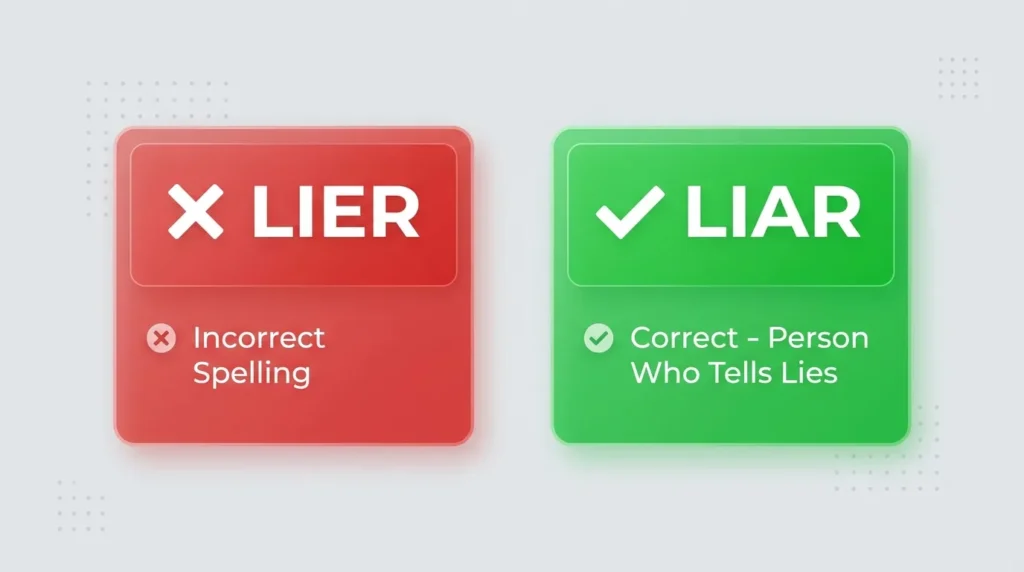

The correct spelling for someone who tells untruths is liar. The spelling lier is an error when used to describe a dishonest person. While “lier” exists as an archaic dictionary entry referring to someone lying down, it is essentially obsolete in modern English. Always use liar when calling someone untruthful.
What Is a Liar?
A liar is a noun defined as a person who intentionally tells false statements or untruths (a lie). The word specifically denotes conscious deception.
In English word formation, many agent nouns (words describing a person who performs an action) end in -er (e.g., teacher, driver, runner). However, liar is an irregular agent noun ending in -ar.
Why It Matters
Using lier instead of liar in professional communications, academic essays, or public posts undermines your credibility instantly. Because spelling checkers or autocorrect engines sometimes fail to flag “lier” (since it exists as an archaic entry or a word in other languages like French), written errors can slip into emails, articles, and legal documents unnoticed.
Getting this single letter wrong signals a lack of foundational spelling attention. In professional environments—such as investigative journalism, legal briefings, or corporate audits—clarity and precision in language reinforce your authority.
The Core Rule
The Core Rule:
Someone who tells a lie is always a LIAR.
Liar ends in -AR.
Lier is an error in modern contexts.
How to Use It
Normal Cases
Whenever you need a noun to represent someone engaged in deception or falsehood, use liar:
- “He proved to be a deceitful liar during the trial.”
- “Calling someone a liar without proof can lead to defamation claims.”
The Obsolete Exception (“Lier”)
You may occasionally run into “lier” in historical texts or specialized archaic dictionaries. In those contexts, a “lier” refers to an individual or object resting in a horizontal position (e.g., “a lier in wait”). In contemporary prose, modern writers use recliner, sleeper, or phrases like “one who lies down” instead.
Correct Examples
- Workplace: “Our project manager emphasized that falsifying timesheets will brand an employee as a liar.”
- Email: “I am writing to clarify that the allegations calling our representative a liar are entirely unfounded.”
- Academic: “In philosophical discourse, a liar paradox challenges our understanding of truth values.”
- Conversation: “Don’t believe a word he says; he is a compulsive liar.”
- Social Media: “Fact-checkers quickly exposed the account as a dishonest liar spreading viral hoaxes.”
- Legal: “The attorney questioned the witness’s credibility, attempting to establish that he was a habitual liar.”
- Journalism: “The investigative report revealed how the official acted as a blatant liar regarding public funds.”
- Literature: “The novel’s protagonist is an unreliable narrator and a self-confessed liar.”
- School/Education: “The teacher explained that being a liar destroys trust between friends.”
- Everyday Life: “My little brother is a terrible liar because he giggles whenever he tells a tall tale.”
Incorrect vs. Correct Usage
| ❌ Incorrect Usage | ✅ Correct Usage | Why It Is Incorrect |
| He is a proven lier who cannot be trusted. | He is a proven liar who cannot be trusted. | “Lier” is misspelled when referring to someone telling lies. |
| Stop calling me a lier! | Stop calling me a liar! | “Liar” requires the -ar ending for human dishonesty. |
| She realized her business partner was a lier. | She realized her business partner was a liar. | The noun form for deceiving people uses -ar. |
| The news anchor exposed the politician as a lier. | The news anchor exposed the politician as a liar. | Deceptive speakers are strictly “liars”. |
| Pathological liers often believe their own stories. | Pathological liars often believe their own stories. | Plural of the deceptive noun requires liars. |
| You don’t have to be a lier to keep a secret. | You don’t have to be a liar to keep a secret. | Standard English mandates liar for deceit. |
| He felt ashamed of being a habitual lier. | He felt ashamed of being a habitual liar. | Habitual falsehoods require the spelling liar. |
| Autocorrect changed my message to call him a lier. | Autocorrect changed my message to call him a liar. | Standard English dictionaries classify “lier” as an incorrect variant for deception. |
| The suspect was identified as a serial lier. | The suspect was identified as a serial liar. | Criminal or dishonest behavior uses liar. |
| Is it wrong to label a child a lier? | Is it wrong to label a child a liar? | The noun for telling untruths ends in -ar. |
Why People Make This Mistake
1. The Rule Generalization Trap
English speakers learn early that verbs usually transform into agent nouns by adding -er:
- Speak $\rightarrow$ Speaker
- Write $\rightarrow$ Writer
- Lie $\rightarrow$ Lier (Incorrect Assumption)
Because lie ends in -e, writers naturally assume adding -r creates the noun. Liar breaks this standard phonetic pattern.
2. Autocorrect and Spellcheck Bypassing
Because “lier” is a valid French verb (meaning to tie/bind) and exists in specialized English word bases as an obsolete term, spellcheckers do not always flag it with a red underline. Writers assume that because no error squiggly appears, the word is correct.
3. Vowel Reduction in Pronunciation
In spoken English, unstressed vowels in suffixes reduce to a neutral schwa sound ($\partial$). The endings -er, -or, and -ar often sound identical in normal conversation (“liar” and “layer” can sound remarkably similar in fast speech).
Common Mistakes Checklist
- Mistake: Writing “lier” when you mean someone who lies.
- Why it happens: Applying the standard -er suffix rule directly to the verb lie.
- How to avoid: Remember that dishonesty uses -AR.
- Mistake: Confusing “lying” with “liar”.
- Why it happens: The verb lie becomes lying in the present participle (changing ie to y), leading people to look for strange spelling roots.
- How to avoid: Keep verb forms (lie/lying) distinct from the agent noun (liar).
- Mistake: Assuming “lier” and “liar” are alternate British/American spellings.
- Why it happens: Misinterpreting regional variants (like color vs colour).
- How to avoid: Recognize that liar is the universal standard in all regional varieties of English.
Lier vs Liar in Real English
Grammatically Correct vs. Natural Usage
While “lier” can technically be defended using historical dictionary entries for “a person lying down,” using it in standard conversation or writing sounds unnatural and incorrect to native speakers.
- Unnatural (Archaic): “The sunbather was a peaceful lier on the beach.” (52 words)
- Explanation: While grammatically constructible in ancient English, modern native speakers will perceive “lier” as a typo. Instead, natural English relies on descriptive phrasing or standard nouns like “person lying down” or “lounger.”
- Natural Everyday Usage: “He lied about his credentials, making him a complete liar.” (60 words)
- Explanation: In contemporary written and spoken discourse, “liar” is the sole accepted term for describing someone who utters falsehoods. Native speakers instinctively use “liar” across all formal, casual, and professional settings without variation.
American vs. British English
There is no regional difference between American English, British English, Canadian English, or Australian English regarding this word.
Both dialects strictly use liar to describe a dishonest person. Neither dialect accepts lier in modern usage.
ALSO READ: Invest On or Invest In? The Correct Usage Explained.
Formal vs. Informal Usage
- Informal Settings: “Liar” is common in casual speech, though direct accusatory usage can sound aggressive or emotionally charged.
- Formal/Legal Settings: While “liar” is grammatically correct in formal contexts, professional and legal documentation often prefers precise, objective terms such as:
- Perjurer (someone who lies under oath)
- Deceiver
- Misleading witness
- Falsifier
Comparison Table
| Feature | Liar | Lier |
| Primary Meaning | A person who tells lies or falsehoods | Archaic term for one who lies down / French verb “to bind” |
| Standard Usage | Fully active and universally accepted | Obsolete in modern English |
| Correctness (Deception) | ✅ Correct | ❌ Incorrect |
| Suffix | Irregular -ar | Regular -er (non-standard for this noun) |
| Example | “She called him a liar.” | “Avoid using this spelling.” |
Real-Life Situations
1. Job Interview
- Context: Discussing background checks and resume accuracy.
- Correct Usage: “Falsifying employment dates on your resume will cause HR to view you as a liar, instantly disqualifying your application.”
2. Legal Deposition
- Context: Analyzing witness statements.
- Correct Usage: “The defense attorney argued that the witness was an unreliable liar whose statements contradicted physical evidence.”
3. Casual Text Message
- Context: Texting a friend about a lighthearted joke.
- Correct Usage: “You said you were five minutes away an hour ago! You are such a liar 😂.”
Practice Quiz
Test your understanding by choosing the correct word for each sentence below. (Answers are listed below the quiz).
- The investigator discovered that the key witness was a compulsive (lier / liar).
- It is unfair to label someone a (lier / liar) over an honest mistake.
- She felt betrayed when she learned her partner was a habitual (lier / liar).
- Never write (lier / liar) on a formal document when accusing someone of misrepresentation.
- Autocorrect failed to catch the spelling error when he typed (lier / liar) instead of liar.
Quiz Answers
- liar
- liar
- liar
- lier (referring to the incorrect spelling string)
- lier (referring to the wrong spelling)
FAQ
Is “lier” ever a correct spelling for someone who tells a lie?
No. “Lier” is never correct when referring to someone who tells lies. The only correct word for a dishonest person is liar.
Does the word “lier” actually exist in the English dictionary?
Yes, “lier” exists as an obscure, archaic noun meaning “one who lies down” (reclines), but it is virtually obsolete in modern standard English.
Why is “liar” spelled with an -ar instead of -er?
The spelling “liar” stems from Old English lyge combined with an agent suffix -ere that evolved under historical linguistic shifts into -ar, setting it apart from standard -er verb-to-noun transformations.
How do you spell “lying” in verb form?
“Lying” is the present participle for both untruths (telling a lie) and reclining (lying on a bed).
What is a quick trick to remember the spelling of liar?
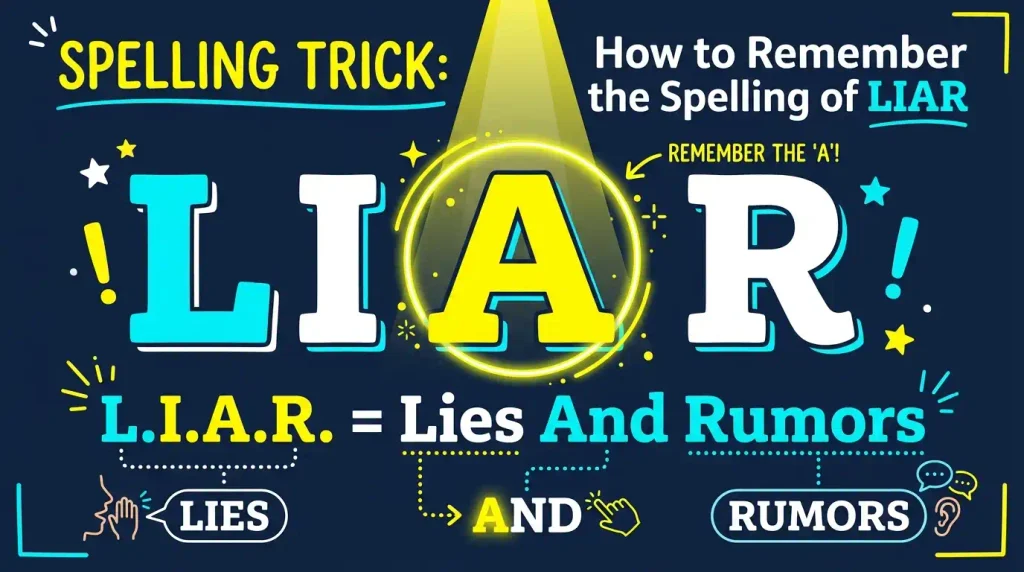
Remember that a LIAR tells Lies And Rumors, or notice that LIAR contains the letter A as in Always untruthful.
Is “lier” used in legal or professional contexts?
In modern legal and professional contexts, “lier” is never used for someone committing perjury or misrepresentation. The term is always “liar” or formal equivalents like “perjurer”.
What is the plural form of liar?
The plural form of liar is liars.
Does “lier” mean something in French?
Yes, “lier” is a common French verb meaning “to bind”, “to tie”, or “to link”. This often causes spelling confusion for French learners of English.
Quick Summary
Choosing between lier vs liar comes down to a simple rule: liar is the only correct spelling for a person who tells untruths. Although English typically creates nouns by adding -er to verbs, liar is an exception that takes an -ar ending. The word lier is an obsolete term for someone lying down and is considered a spelling mistake when referring to dishonesty. Because digital spellcheckers occasionally miss “lier,” writers must manually ensure they use liar across all professional, academic, and casual writing. Remember: a liar tells Lies And Rumors.