


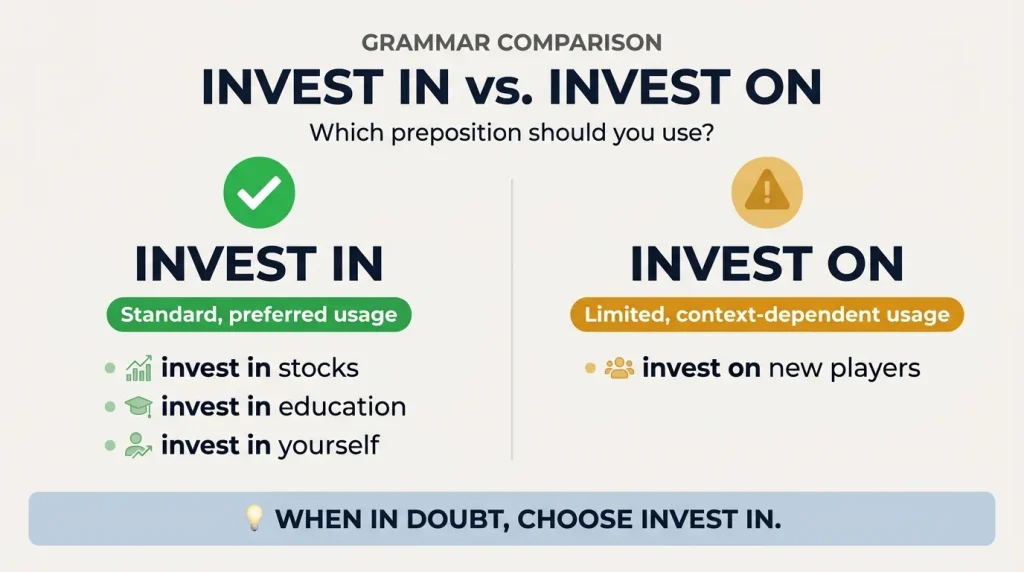
If you’re unsure whether to write invest on or invest in, invest in is the standard choice in most situations. Use it when talking about putting money into stocks, property, a business, or a project, and when describing the time or effort devoted to something. However, invest on can occur in some established usage, particularly when organizations spend resources on improvements or specific initiatives. The best choice depends on the sentence’s meaning and structure.
Invest On or Invest In?
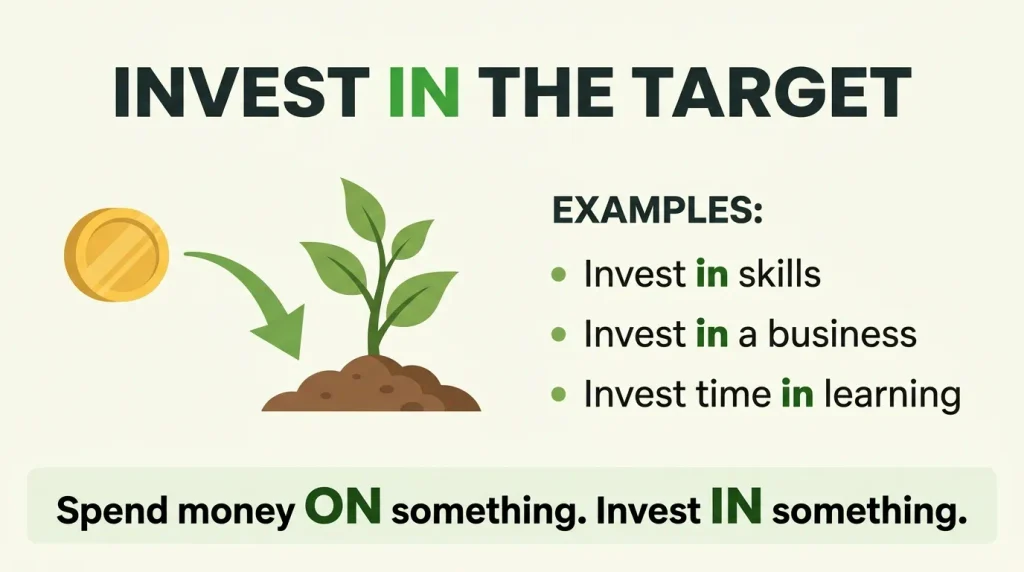
Use invest in when identifying the usual target of an investment: invest in stocks, invest in a business, invest in education, or invest time in learning English. The verb commonly takes in before the thing receiving the investment. However, on is possible in certain contexts, especially when discussing organizational spending on something, such as new equipment or players. For most everyday, academic, and professional writing, invest in is the safest and most natural choice.
What Is the Difference Between Invest On and Invest In?
The difference concerns the preposition that follows the verb invest. A preposition is a word that helps show a relationship between other words, such as direction, place, time, or purpose.
Invest in is the usual construction when naming the thing, person, activity, or area into which money, time, effort, or resources are committed.
Examples:
- The company invested in renewable energy.
- She invests in the stock market.
- He invested time in improving his writing.
- The school invested in new computers.
Invest on is less common as a direct way of identifying an investment target. However, it does appear in some accepted English usage, particularly in organizational contexts where money or resources are spent on something to improve it.
For example:
– The team invested millions on new players.
This construction is accepted in some American English dictionary usage, although invested millions in new players is also standard and is the more broadly useful pattern for learners.
The practical lesson is simple: choose in by default, but consider the intended meaning and the construction rather than treating every occurrence of on near invest as automatically ungrammatical.
Why It Matters?
Preposition errors can make otherwise clear English sound less natural. They can also distract readers from the message you’re trying to communicate.
Consider these situations:
- At work: “We need to invest on staff training” may make a business proposal sound less polished than “We need to invest in staff training.”
- In academic writing: “The government invested on public education” is less suitable for standard formal prose than “The government invested in public education.”
- In a financial discussion: “I want to invest on shares” should normally be “I want to invest in shares.”
- In everyday conversation: “I’m investing in myself” is a natural way to describe spending time and effort on personal development.
Using the standard construction makes your meaning easier to follow and helps you communicate confidently in professional and academic settings.
The Core Rule
The rule to remember:
Use invest in + the investment target as your default structure.
Examples:
- Invest in a company.
- Invest in property.
- Invest in education.
- Invest in new technology.
- Invest time in learning.
- Invest effort in improving a process.
Remember: invest in is the safest general-purpose choice. Invest on has limited accepted uses, so choose it only when the particular construction and meaning support it.
How to Use Invest In Correctly?
1. Use Invest In for Financial Investments
When you put money into an asset, company, business, or project with the hope of making a profit or gaining an advantage, invest in is the normal construction.
Examples:
- She plans to invest in property.
- They invested in a small technology company.
- We are considering investing in government bonds.
- He invested his savings in a local business.
- The fund invests in renewable energy companies.
The same pattern works whether the investment is large or small and whether the sentence describes a current plan, a past decision, or a general habit.
2. Use Invest In for Education and Skills
The verb invest is not limited to financial transactions. It can also describe using time, effort, or resources to achieve a worthwhile result.
Examples:
- I want to invest in my education.
- She invests in professional development.
- Our company invests in employee training.
- He invested years in mastering the language.
- They are investing in skills that will help them find better jobs.
These sentences communicate that the resource is being committed to something expected to provide a future benefit.
3. Use Invest Time In + a Noun or -ing Form
You can put a noun such as time, effort, or money between invest and in.
The basic structure is:
Invest + resource + in + activity or target
Examples:
- I invest time in reading.
- She invested a lot of effort in the project.
- They are investing money in upgrading the software.
- He invests energy in maintaining strong relationships.
- We invested considerable time in testing the product.
Notice that the activity after in can take the -ing form: reading, upgrading, or testing. This is a common way to describe an activity as the target of your investment.
4. Use Invest In for Personal Development
When you describe improving yourself, invest in is a natural choice.
Examples:
- Invest in yourself before pursuing a new career.
- She is investing in her health and well-being.
- I decided to invest in learning another language.
- He invests in developing his leadership skills.
This use is figurative: you are not necessarily buying an asset. You are committing resources to personal growth.
5. When Can Invest On Be Used?
The construction invest on does appear in English, so it is too absolute to say that it can never be correct.
For example, an American English dictionary records organizational uses such as investing money on new players. In this context, on presents the expenditure as money spent on a particular initiative or item rather than following the most common investment-target pattern.
Compare:
- Broadly preferred: The club invested millions in new players.
- Also attested in some usage: The club invested millions on new players.
For learners, the first sentence is the more versatile option. In financial writing, academic work, and most business communication, prefer invest in unless you have a specific reason to use another construction.
Also distinguish the following:
- Invest on behalf of someone: The phrase on behalf of means acting for another person or organization. It does not mean that invest on is the standard verb-preposition combination.
- Spend money on something: On belongs naturally with spend. That does not mean it automatically transfers to invest.
- Invest in something: This is the usual construction for naming the target of the investment.
Correct Examples of Invest In
Here are 12 original examples from everyday, academic, and professional situations.
- Conversation: “I’m thinking of investing in a small apartment.”
- Email: “We would like to invest in additional staff training this quarter.”
- School: “Our school invested in a new science laboratory.”
- Workplace: “The company plans to invest in better cybersecurity.”
- Social media: “Invest in yourself, even when progress feels slow.”
- Academic writing: “The study examines how governments invest in public health.”
- Finance: “She decided to invest in a diversified portfolio.”
- Small business: “We invested in better packaging to improve the customer experience.”
- Technology: “The university is investing in artificial intelligence research.”
- Personal development: “He invests time in learning new skills.”
- Relationships: “Strong friendships grow when people invest time in one another.”
- Project management: “The team invested considerable effort in improving the final design.”
Each example identifies a target for money, time, effort, or other resources. That target is normally introduced by in.
Incorrect vs. Correct: 12 Common Examples
The following table shows common learner errors and the standard alternatives. The incorrect sentences are examples of usage to avoid in ordinary formal or neutral English; the table does not imply that every conceivable use of invest on is ungrammatical.
| ❌ Incorrect or less preferred | ✅ Correct or preferred | Why |
|---|---|---|
| I want to invest on stocks. | I want to invest in stocks. | In is the usual preposition for financial assets. |
| She invested on real estate. | She invested in real estate. | Real estate is the target of the investment. |
| We should invest on education. | We should invest in education. | Invest in is the established expression for education and similar areas. |
| The company invested on new software. | The company invested in new software. | In is the broadly preferred construction here. |
| He invested on his future. | He invested in his future. | Invest in your future is the standard figurative expression. |
| They invested on the startup. | They invested in the startup. | The startup is the recipient of the investment. |
| I invest on learning English. | I invest time in learning English. | The natural structure is invest time in + activity. |
| We invested on research. | We invested in research. | Invest in research is standard in professional writing. |
| She is investing on her career. | She is investing in her career. | Invest in is the usual construction for career development. |
| The government invested on public transport. | The government invested in public transport. | In is the safer general-purpose choice. |
| He invested his savings on a business. | He invested his savings in a business. | The construction is invest something in something. |
| The school invested money on new computers. | The school invested money in new computers. | In clearly identifies the investment target. |
Important nuance: Some speakers and publications use invest on in specific organizational-spending contexts. The alternatives above are recommended because they are broadly accepted and work well across different varieties and registers of English.
Why People Make This Mistake
1. Confusion with Spend On
One of the main reasons learners say invest on is that they already know the expression spend money on something.
Both verbs can describe financial activity, but their common patterns differ:
- Spend money on advertising.
- Invest money in advertising.
Because on follows spend, learners may assume that it must follow invest as well. English does not work that way: prepositions are often tied to individual verbs and their established patterns.
2. Overgeneralization
Overgeneralization occurs when a learner takes a rule that works in one situation and applies it to other situations where it does not fit.
For example, a learner might correctly say “spend money on a course” and then produce “invest money on a course.” The meaning is understandable, but the usual construction is “invest money in a course.”
3. Translation from Another Language
Some languages use a preposition equivalent to on, at, or for where English normally uses in. Translating directly can therefore produce a sentence that sounds logical in the learner’s first language but less natural in English.
A better approach is to learn the entire phrase as a unit:
- invest in a company
- invest in education
- invest in property
- invest time in practice
These combinations are called collocations: words that commonly occur together.
4. Similarity Between Financial Verbs
English has several verbs for handling money, and they do not all use the same prepositions.
| Verb | Common pattern | Example |
|---|---|---|
| Invest | invest in | Invest in a business. |
| Spend | spend on | Spend money on supplies. |
| Pay | pay for | Pay for the course. |
| Contribute | contribute to | Contribute to the project. |
| Allocate | allocate to | Allocate funds to research. |
Learning each pattern separately is more reliable than trying to apply one preposition to every financial verb.
5. Autocomplete and Spellcheck
Spellcheckers can miss preposition errors because both in and on are correctly spelled English words. A sentence may contain no spelling mistakes while still sounding unnatural.
For example, a basic spelling checker may not flag “We invested on education.” A grammar-aware editor may identify a possible problem, but automated suggestions can still miss context or offer alternatives that do not fit the intended meaning.
When proofreading, check the relationship between the verb and the following phrase, not just the spelling of individual words.
Common Mistakes Checklist
Use this checklist when reviewing a sentence containing invest.
Check the investment target.
If you’re naming a company, asset, project, skill, or area of development, use invest in as your default.
Check whether a resource comes between the verb and preposition.
“Invest time in learning” is correct. Do not automatically replace the second in with on just because the activity involves effort.
Do not copy the pattern from spend.
“Spend money on a course” and “invest money in a course” use different conventional patterns.
Do not confuse a nearby phrase with the verb’s preposition.
“Invest on behalf of a client” is correct because on behalf of means acting for someone else.
Proofread for natural phrasing, not spelling alone.
A sentence can be spelled correctly and still use an awkward verb-preposition combination.
Invest In or Invest On in Real English
Grammatically Correct and Natural
“Invest in” is grammatically correct and natural when it identifies the target of an investment. Sentences such as “She invested in the company,” “They invest in education,” and “I invest time in learning” fit common contemporary usage. The pattern works in conversation, emails, business reports, and academic writing. When you’re unsure which preposition to choose, this is the most reliable construction to reach for.
Grammatically Possible but Less Broadly Preferred
“Invest on” is not equally suitable in every context. It is attested in some organizational-spending uses, including examples involving spending on new players. Nevertheless, many readers will find “invest in new players” more familiar and more broadly suitable. If your goal is clear international English, use invest in unless the context or a specific established usage gives you a reason to choose otherwise.
Natural, Everyday English
In everyday English, people naturally say “invest in yourself,” “invest in a house,” “invest in a business,” and “invest time in your studies.” These expressions are easy to recognize across a range of situations. People also say “spend money on a house” or “spend time on a project,” but those patterns belong to spend. Choosing the preposition that normally accompanies the verb makes your sentence sound more fluent.
ALSO READ: Will Be Send or Will Be Sent?
American vs. British English
There is no simple rule that British English uses invest in while American English uses invest on, or vice versa.
Both varieties use invest in extensively. However, an American English dictionary also records certain organizational uses of invest on, such as spending money on new players. That is a context-specific usage, not a general difference that learners should apply to all sentences.
For international communication, the safest approach is to use invest in for investments in money, assets, education, skills, projects, time, and effort.
Formal vs. Informal Usage
Formal English
Use invest in in business reports, academic essays, proposals, financial discussions, and professional emails.
Examples:
- The organization plans to invest in sustainable infrastructure.
- The study examines how countries invest in public health.
- We recommend investing in employee development.
These constructions are clear, conventional, and suitable for formal writing.
Informal English
The same pattern is natural in conversation and casual messages.
Examples:
- I want to invest in myself this year.
- They’re investing in a new gaming setup.
- You should invest in a good pair of shoes.
You do not need a different preposition just because the situation is informal. The main difference is the subject matter and tone, not the core construction.
Comparison Table: Invest In, Invest On, Spend On, and Invest Into
| Feature | Invest in | Invest on | Spend on | Invest into |
|---|---|---|---|---|
| Main use | Standard investment target | Limited, context-dependent usage | Money or time used for something | Alternative construction found in some usage |
| Financial example | Invest in shares. | Invest on new players, in certain usage | Spend money on shares | Invest money into a business |
| Time and effort | Invest time in learning | Not the usual learner pattern | Spend time on homework | Invest time into learning, in some usage |
| Best for formal writing | Yes | Only when justified by context | Yes, where the meaning fits | Often less direct than invest in |
| Best default for learners | Yes | No | Use when the meaning is spend | Prefer invest in for simplicity |
Is Invest Into Correct?
Invest into appears in English, especially where speakers emphasize putting resources into something. However, invest in is generally the simpler and more broadly recommended construction.
Compare:
- We invested in a new business.
- We invested money into a new business.
Both can be understood, but the first is the more straightforward choice for most contexts. You do not need into to communicate that an investment goes toward a target.
Real-Life Situations
1. During a Job Interview
Less suitable: “I want to invest on my professional skills.”
Better: “I want to invest in developing my professional skills.”
The corrected version uses the established invest in pattern and makes the activity being developed clear.
2. In a Business Meeting
Less suitable: “We should invest on better customer service.”
Better: “We should invest in better customer service.”
The improved version is appropriate for a discussion about business priorities and resource allocation.
3. In an Email to a Manager
Less suitable: “The department invested on employee training last year.”
Better: “The department invested in employee training last year.”
The second sentence is the more conventional choice for a professional email or report.
4. In a Text Message
Less suitable: “I’m going to invest on a course to improve my English.”
Better: “I’m going to invest in a course to improve my English.”
The corrected phrase works naturally in casual conversation as well as formal writing.
5. In an Academic Essay
Less suitable: “Governments must invest on public education.”
Better: “Governments must invest in public education.”
The second construction is standard and suitable for academic argument.
6. In a Financial Discussion
Less suitable: “She invested her savings on the company.”
Better: “She invested her savings in the company.”
The corrected sentence identifies the company as the target of the investment.
Practice Quiz: Invest In or Invest On?
Choose the better option for each sentence. Use the usual standard-English construction unless the context specifically supports another usage.
Test your understanding
0 of 8 answered
1. The company plans to invest ___ renewable energy.inon
2. I spend too much money ___ takeaway meals.inon
3. She invests time ___ improving her pronunciation.inon
4. The government should invest ___ public transport.inon
5. They invested their savings ___ a small business.inon
6. He wants to invest ___ his education.inon
7. The team invested millions ___ new players.inon
8. We need to invest more effort ___ solving the problem.inon
Check answers
FAQ
Is “invest on” ever correct in English?
It can occur in some established contexts, particularly organizational spending, but it is not the usual construction for naming an investment target. In most everyday and professional sentences, use invest in. For example, write “invest in a company” rather than “invest on a company.”
Should I say “invest in a person” or “invest on a person”?
Use invest in a person when you mean committing time, money, effort, or resources to that person’s growth or success.
For example: “The company is investing in its employees by providing professional training.”
Is “invest in myself” grammatically correct?
Yes. “Invest in myself” is a natural expression meaning that you are committing time, effort, money, or other resources to your own development. It can refer to education, health, skills, confidence, or career growth.
Is “invest on myself” correct?
It is not the standard expression for personal development. Write “I want to invest in myself” or “I’m investing in my personal growth.” The preposition in is the conventional choice for this meaning.
Do I say “invest in stocks” or “invest on stocks”?
Say invest in stocks. This is the standard expression for putting money into shares or other financial assets. For example: “She plans to invest in stocks for the long term.”
Is “invest in time” correct, or should I say “invest time in”?
Both sequences can occur, but they serve different grammatical purposes.
- “We should invest in time-saving technology.” Here, in introduces the technology.
- “We should invest time in learning.” Here, time is the resource being committed, and the second in introduces the activity.
The second pattern is particularly useful when discussing effort and personal development.
What is the difference between “invest in” and “invest into”?
Both constructions occur in English, but invest in is generally the simpler and more widely recommended choice. “We invested in new equipment” is a straightforward sentence for everyday, academic, and professional writing. Use into only when it suits the phrasing and emphasis of your particular sentence.
Is “invest on behalf of someone” correct?
Yes. The phrase on behalf of someone means acting for another person or organization. For example, “I will invest on behalf of my client” is correct. Here, on belongs to the expression on behalf of; it is not the preposition introducing the investment target.
Which phrase should I use in a formal email: “invest on” or “invest in”?
Use invest in in most formal emails. For example, “We recommend investing in employee training” is clear, professional, and conventional. If you’re describing a specific organizational spending construction, check whether on is appropriate in that context, but do not choose it merely because you would say “spend money on.”
What is the easiest way to remember the correct preposition?
Remember the pattern invest in something. Think of a business, property, education, technology, or personal development as the target receiving your resources. When you mean using money for a purchase or expense, remember the separate pattern spend money on something. Learning these combinations as complete phrases helps you avoid translating prepositions word for word.
Quick Summary
The standard expression is invest in, not invest on, when naming the usual target of an investment. Use invest in stocks, invest in a business, invest in education, and invest in yourself. When describing time or effort, say invest time in learning or invest effort in improving a process. The confusion often arises because English uses spend money on something, but prepositions do not automatically transfer from one verb to another. Although invest on appears in certain established organizational-spending contexts, invest in is the safest and most versatile choice for everyday, academic, financial, and professional writing. Remember the simple pattern: invest in the target; spend money on something.