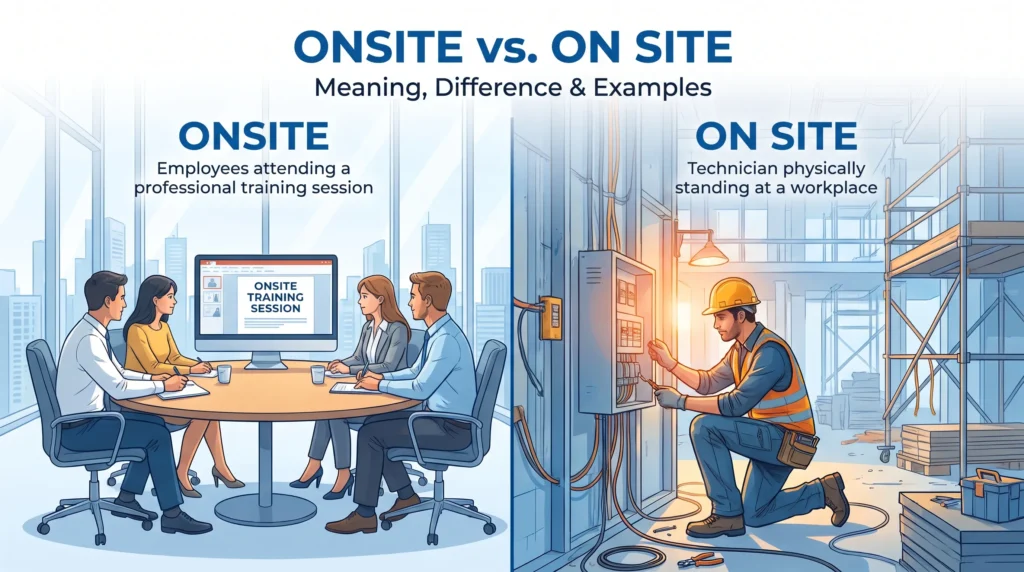

Is it onsite or on site? Both spellings are correct, but choosing the right one depends on how you use the expression in a sentence.
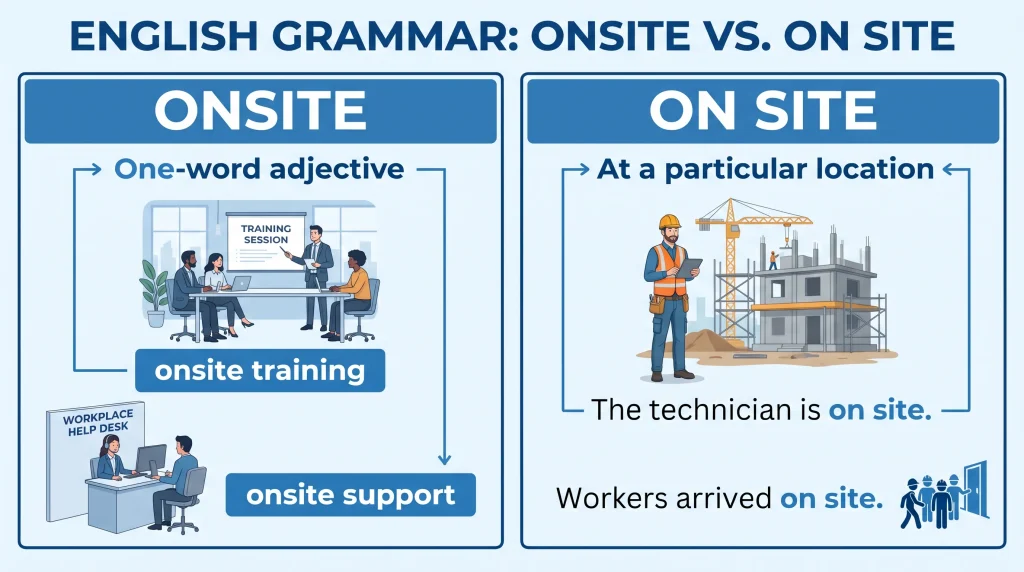
Onsite is generally written as one word when it describes a service, facility, activity, or resource available at a particular location. On site is a two-word phrase meaning at a specific place or location.
For example:
- The company provides onsite training for new employees.
- The instructor is on site today.
In the first sentence, onsite describes the training. In the second, on site tells us where the instructor is.
You may also encounter on-site, a hyphenated form commonly used as an adjective. It is also correct.
Read also: Passed vs. Past: What’s the Difference? Meaning, Rules & Examples
Onsite or On Site?
| Spelling | Meaning | Example |
|---|---|---|
| Onsite | At or provided at a particular location; commonly an adjective | We offer onsite support. |
| On site | At a specific physical location | The technician is on site. |
| On-site | Hyphenated adjective with the same general meaning as onsite | We provide on-site training. |
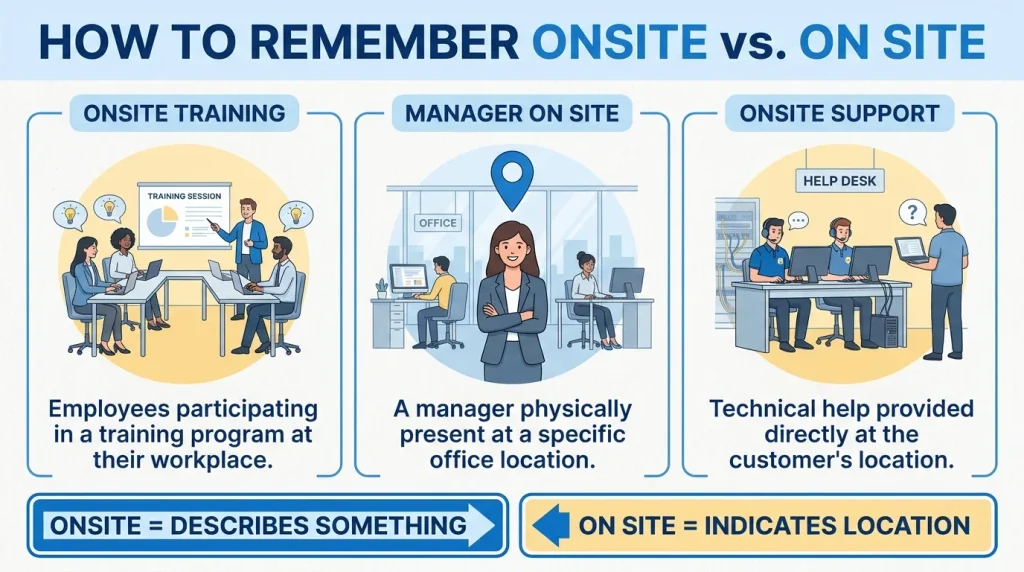
The easiest way to remember:
- Use onsite or on-site to describe a service or facility.
- Use on site to indicate someone’s or something’s location.
This is a helpful guideline rather than an absolute rule because onsite is also used as an adverb in modern English.
Read also: Animal Similes: 100+ Examples With Meanings and Sentences
What Does Onsite Mean?
Onsite is an adjective meaning located, available, or provided at the place where an activity or service takes place.
It is frequently used in workplaces, schools, hospitals, hotels, construction projects, and business settings.
Examples of Onsite in Sentences
- The company provides onsite training for new employees.
- Our office has an onsite medical facility.
- The hotel offers an onsite restaurant.
- The school provides onsite counseling services.
- We offer onsite technical support.
- The project requires an onsite inspection.
- Employees have access to onsite parking.
- The hospital operates an onsite pharmacy.
- The organization provides onsite childcare.
- Customers can receive onsite assistance.
In these examples, onsite describes a noun, such as training, facility, restaurant, support, or parking.
What Does On Site Mean?
On site is a two-word phrase meaning at the location where an activity is happening or where a person or object is situated.
It commonly appears after verbs such as be, arrive, work, remain, and stay.
Examples of On Site in Sentences
- The technician is on site.
- Our manager will be on site tomorrow.
- The construction workers arrived on site early.
- The engineer remained on site until the inspection was complete.
- Is the project supervisor on site today?
- The equipment must remain on site.
- Our representative will be on site during the event.
- The maintenance team is working on site.
- The security staff stayed on site overnight.
- The inspector is already on site.
In these examples, on site indicates a person’s or object’s physical location.
Also checkout: Emigrate vs. Immigrate: Meaning, Difference, Rules, and Examples
Onsite vs. On Site: Key Differences
| Feature | Onsite | On site |
|---|---|---|
| Spelling | One word | Two words |
| Common grammatical role | Adjective; also used adverbially | Prepositional phrase |
| Main purpose | Describes something associated with a location | Indicates where something happens |
| Common use | Before a noun | Often after a verb |
| Example | Onsite training | Training takes place on site |
| Example | Onsite facilities | The facilities are available on site |
The distinction is useful, but it is not a strict grammatical rule. The one-word form is also common in sentences such as “The technician works onsite.”
When to Use Onsite
Use onsite when describing a service, facility, activity, or resource associated with a particular physical location.
1. Before a Noun
This is one of the most common uses of onsite.
Examples include:
- onsite training
- onsite support
- onsite parking
- onsite accommodation
- onsite inspection
- onsite facilities
- onsite services
- onsite assistance
- onsite childcare
- onsite medical care
Example: The company offers onsite training to help employees develop new skills.
2. In Business and Workplace Writing
Onsite is especially common in professional communication.
Examples:
- Our organization provides onsite IT support.
- The company has an onsite HR department.
- Employees can attend onsite meetings.
- We offer onsite customer service.
- The business provides onsite technical assistance.
3. In Education and Healthcare
Examples:
- The school provides onsite counseling.
- The clinic offers onsite testing.
- The hospital has an onsite pharmacy.
- Students receive onsite supervision.
- The university provides onsite accommodation.
When to Use On Site
Use on site when referring to someone’s or something’s presence at a particular physical location.
1. After Verbs
Examples:
- The technician is on site.
- The workers arrived on site.
- The supervisor remained on site.
- The contractor is working on site.
- The inspector will be on site tomorrow.
2. When Describing Someone’s Location
Examples:
- The doctor is on site today.
- Our manager will be on site this afternoon.
- The security team stayed on site overnight.
- The inspector is already on site.
- The project director is on site this morning.
3. When Describing Where an Activity Happens
Examples:
- The repairs were completed on site.
- The inspection will take place on site.
- The materials are stored on site.
- The event will be managed on site.
- The equipment was assembled on site.
Incorrect vs. Correct Examples
The following table shows common spelling preferences. Some alternatives are also accepted in contemporary English, so they should not all be considered grammatical errors.
| Less preferred | Preferred in this context |
|---|---|
| We provide on site training. | We provide onsite training. |
| The company offers on site support. | The company offers onsite support. |
| We have on site parking. | We have onsite parking. |
| The hotel has on site facilities. | The hotel has onsite facilities. |
| The technician is onsite. | The technician is on site. |
| The workers arrived onsite. | The workers arrived on site. |
| The manager will remain onsite. | The manager will remain on site. |
| The inspection will take place onsite. | The inspection will take place on site. |
Remember: The preferred forms in this table are editorial choices, not universal rules. For example, “The technician is onsite” is also acceptable in modern usage.
Onsite vs. On-Site: Is the Hyphen Necessary?
Yes, on-site is a widely accepted spelling, especially when the expression functions as an adjective before a noun.
Examples:
- We provide on-site training.
- The company offers on-site support.
- The hotel has an on-site restaurant.
- Employees receive on-site assistance.
- The hospital operates an on-site pharmacy.
Both onsite and on-site are used as adjectives. Different dictionaries, publishers, and organizational style guides may prefer one form over the other.
If you’re writing an article, report, or business document, choose one spelling convention and use it consistently.
Real-Life Examples of Onsite vs. On Site
Here are practical examples from everyday situations.
At the Workplace
- The company provides onsite training for new staff.
- The HR manager is on site today.
- We offer onsite technical support.
- The IT specialist will be on site at 9 a.m.
- Employees can use the onsite cafeteria.
At a Hotel
- The hotel has an onsite fitness center.
- The maintenance worker is on site.
- Guests can enjoy the onsite restaurant.
- The event coordinator will be on site throughout the evening.
- The hotel offers onsite laundry facilities.
At a Construction Site
- The contractor arranged an onsite inspection.
- The architect is on site.
- Workers receive onsite safety training.
- The supervisor must remain on site until the work is finished.
- Materials are stored on site.
At a School
- The school offers onsite medical services.
- The counselor is on site every Monday.
- Students have access to onsite facilities.
- A nurse will be on site during the sports event.
- The school provides onsite childcare for staff.
Are Onsite and On Site Interchangeable?
Sometimes, yes. Both forms can refer to something happening at or being available at a particular location.
However, the sentence structure often determines which form sounds more natural.
Compare these examples:
- Onsite training: Onsite describes the training.
- Training on site: On site indicates where the training takes place.
- The trainer is on site: On site indicates the trainer’s location.
- The trainer works onsite: Onsite is used adverbially to describe where the trainer works.
The meanings are closely related, and modern English allows some variation between the forms.
Onsite vs. On Site in American and British English
There is no major difference in meaning or basic usage between American and British English.
Both varieties use:
- onsite
- on-site
- on site
Spelling preferences may vary between dictionaries, publications, and organizations. Neither variety has an exclusive claim to one spelling.
Common Mistakes to Avoid
- Assuming only one spelling is correct: Both onsite and on site are accepted.
- Treating on-site as incorrect: The hyphenated adjective is also widely used.
- Adding a space automatically: “Onsite training” is a common standard construction.
- Removing the space in every sentence: “The technician is on site” is also a natural construction.
- Mixing spellings unnecessarily: Choose a preferred style and maintain consistency.
- Assuming onsite can only be an adjective: It is also commonly used adverbially, as in “The technician works onsite.”
Easy Way to Remember Onsite vs. On Site
Use this simple memory trick:
- Onsite: Think of a service, facility, or activity at a particular location.
- On site: Think of someone or something physically present at a location.
Remember these examples:
- Onsite training is available.
- The trainer is on site.
- The company offers onsite support.
- The support team is on site today.
The distinction becomes easier when you focus on the role each expression plays in the sentence.
Practice Quiz: Onsite or On Site?
Choose the most natural option in each sentence.
Test your understanding
0/5 answered
1. The company provides _____ training.onsiteon site
2. The engineer is _____ right now.onsiteon site
3. Our hotel has an _____ restaurant.onsiteon site
4. The workers arrived _____ early this morning.onsiteon site
5. We offer _____ customer support.onsiteon site
Check answers
Frequently Asked Questions
1. Is onsite one word or two?
Onsite is one word, while on site is two words. Both are correct, depending on the sentence and writing convention.
2. Is onsite grammatically correct?
Yes. Onsite is an accepted adjective meaning located, available, or provided at a particular place. It is also used adverbially.
3. Is on site grammatically correct?
Yes. On site is a two-word phrase meaning at a particular physical location.
4. Is it onsite training or on-site training?
Both are correct. Onsite training and on-site training are commonly used adjective constructions.
5. Should I write onsite or on site at work?
It depends on the sentence. Write “onsite facilities” when describing facilities and “The manager is on site” when describing the manager’s location.
6. Is onsite hyphenated?
It can be. On-site is a widely accepted hyphenated adjective, while onsite is also commonly written as one word.
7. Is onsite the same as in person?
No. Onsite refers to a particular physical location, whereas in person means physically present rather than communicating remotely. The meanings can overlap, but they are not identical.
8. What is the opposite of onsite?
Depending on the context, possible opposites include off-site, remote, and off-premises.
9. Is onsite used in American and British English?
Yes. Both American and British English use onsite, on-site, and on site. Preferences may vary by publication and style guide.
10. Is it correct to say “I work onsite”?
Yes. “I work onsite” is common and grammatically acceptable. “I work on site” is also used.
11. Which is more professional: onsite or on-site?
Both are professional. The best choice depends on the dictionary or style guide followed by your organization. Consistency is more important than choosing one universally preferred form.
12. Can I use on site at the beginning of a sentence?
Yes. For example: “On site, technicians inspect the equipment before installation.” The phrase indicates where the inspection takes place.
Final Summary
The difference between onsite and on site is mainly a matter of grammatical function and writing convention.
- Onsite: A one-word form commonly used as an adjective, as in “onsite training.”
- On-site: A hyphenated adjective, as in “on-site support.”
- On site: A two-word phrase indicating location, as in “The technician is on site.”
All three forms are accepted. Choose the spelling that fits your sentence and follow a consistent style throughout your writing.