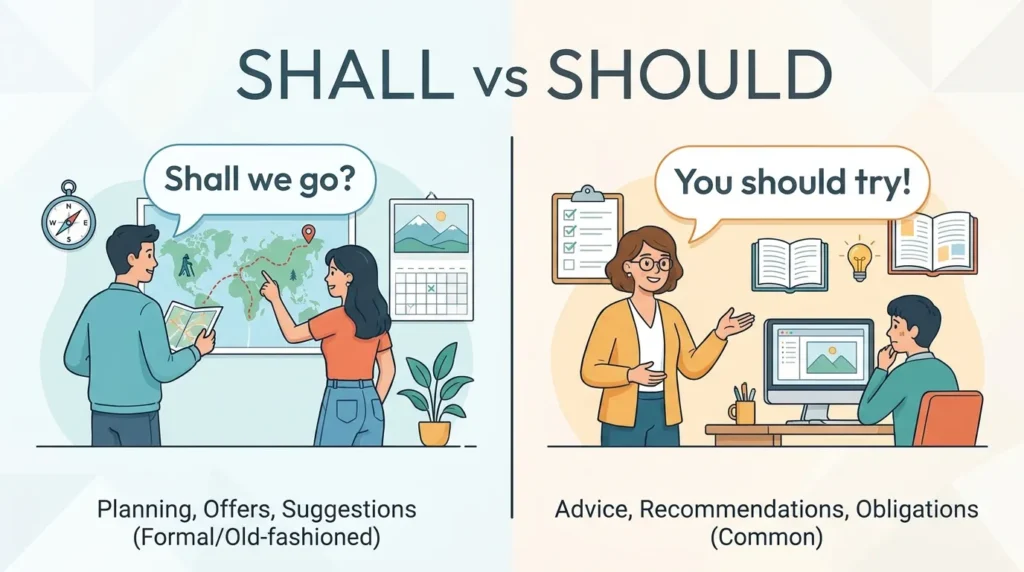

Shall and should are both modal verbs, but they communicate different meanings. Shall is commonly used to make offers, suggestions, ask for instructions, and express formal future intentions. Should is mainly used to give advice, make recommendations, express expectations, and describe what is the right thing to do. For example, “Shall we begin?” asks for a suggestion, while “You should begin” gives advice.
Read also: Waste vs Waist: Meaning, Difference & Easy Memory Trick
What Is the Difference Between Shall and Should?
The main difference between shall and should is their purpose in a sentence.
- Shall is used to make offers, suggestions, proposals, and formal statements about the future.
- Should is used to give advice, express duty or expectation, and recommend an action.
Although both are modal auxiliary verbs, they are not interchangeable in every situation.
What Does Shall Mean?
Shall is a modal auxiliary verb used to express offers, suggestions, intentions, and formal obligations.
In everyday English, it is especially common in questions such as:
- Shall we go for a walk?
- Shall I open the window?
- What shall we do next?
It can also appear in formal or legal writing to express requirements or obligations.
Examples:
- I shall return tomorrow.
- We shall overcome these difficulties.
- The tenant shall pay the rent on the first day of each month.
What Does Should Mean?
Should is a modal auxiliary verb used to express advice, recommendations, expectations, and what is considered right or appropriate.
It is often used when someone wants to suggest the best action without making it an absolute requirement.
Examples:
- You should drink enough water.
- Students should complete their assignments on time.
- We should respect other people’s opinions.
- The package should arrive tomorrow.
In everyday English, should is much more common than shall in many advice-giving situations.
See also: On Tuesday Morning vs. In the Tuesday Morning: Which Is Correct?
Why Does the Difference Between Shall and Should Matter?
Choosing the wrong modal verb can change the purpose or tone of your sentence.
Consider these examples:
- Shall we leave now? — You are asking whether leaving now is a good idea.
- Should we leave now? — You are asking for advice about whether leaving is the right decision.
The difference may seem small, but it affects how your message sounds.
Understanding these words is especially useful when:
- Speaking English: You can make suggestions and ask for advice naturally.
- Writing emails: You can make professional requests without sounding unnecessarily demanding.
- Workplace communication: You can distinguish between a formal obligation and a recommendation.
- Examinations: You can select the correct modal verb in grammar exercises.
- Daily conversations: You can communicate intentions, expectations, and suggestions clearly.
See more: Did You Had vs Did You Have: Which One Is Correct?
The Core Rule: Shall vs Should
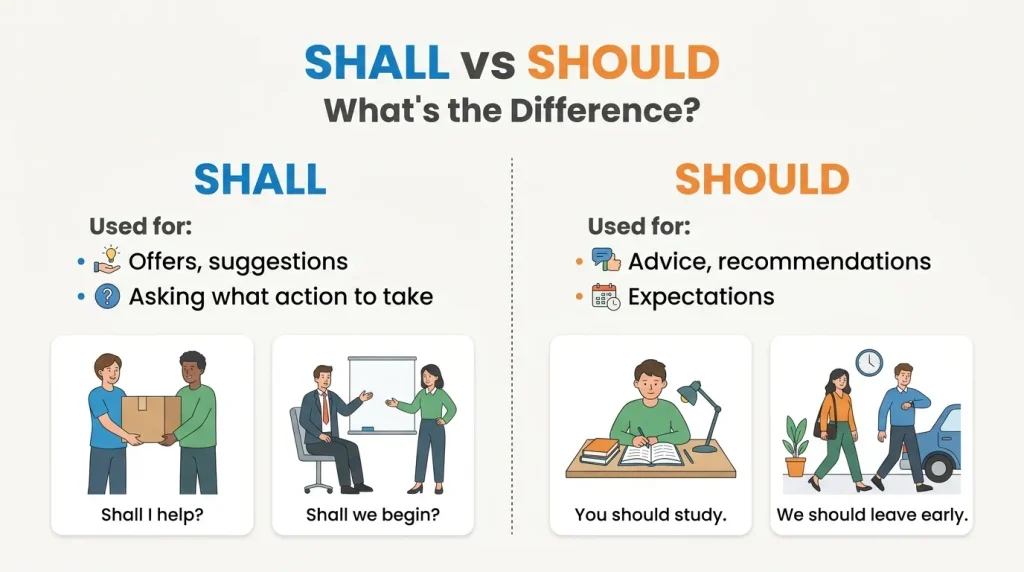
SHALL
SHALL = Offers, suggestions, intentions, and formal obligations.
Examples:
- Shall I help you?
- Shall we start?
- I shall return.
SHOULD
SHOULD = Advice, recommendations, expectations, and appropriate actions.
Examples:
- You should study regularly.
- We should leave early.
- He should be home soon.
Easy memory trick: Shall asks or proposes what to do. Should advises what is best to do.
How to Use Shall and Should Correctly
When to Use Shall
There are several common situations in which shall is appropriate.
1. Making Suggestions
Use shall to suggest an activity, particularly with we.
Examples:
- Shall we watch a movie tonight?
- Shall we discuss this problem?
- Shall we meet after lunch?
2. Making Offers
Use shall when offering to do something for someone.
Examples:
- Shall I carry your bag?
- Shall I help you with your homework?
- Shall I make you a cup of tea?
3. Asking for Instructions or Decisions
Use shall when asking someone what action should be taken.
Examples:
- What shall I write in this application?
- Where shall we go?
- Which topic shall I choose?
4. Expressing Formal Future Intentions
In formal or traditional English, shall can express future intentions, especially with I and we.
Examples:
- I shall contact you tomorrow.
- We shall meet again.
- I shall complete the assignment by Friday.
In everyday modern English, will is generally more common for ordinary future statements.
5. Expressing Legal or Contractual Obligations
In legal documents and formal regulations, shall is traditionally used to express a requirement.
Examples:
- The employee shall follow the company’s safety rules.
- The tenant shall maintain the property.
- The applicant shall provide accurate information.
In modern legal drafting, the intended meaning of shall can sometimes be unclear, so writers often prefer more precise wording such as must for obligations.
When to Use Should
Use should in the following situations.
1. Giving Advice
Use should when recommending something that someone ought to do.
Examples:
- You should exercise regularly.
- You should practise English every day.
- He should apologize for his mistake.
2. Making Recommendations
Use should when suggesting a suitable choice or action.
Examples:
- You should try this restaurant.
- We should choose a better solution.
- Students should read more books.
3. Expressing Duty or Responsibility
Use should when describing something considered right or responsible.
Examples:
- Everyone should respect others.
- Drivers should follow traffic rules.
- Parents should encourage their children.
4. Expressing Expectations
Use should when something is expected to happen.
Examples:
- The train should arrive soon.
- She should be at the office by now.
- Your results should be available tomorrow.
5. Talking About Past Mistakes or Regrets
Use should have + past participle to describe an action that would have been better in the past but did not happen.
Examples:
- I should have studied harder.
- You should have told me earlier.
- They should have arrived on time.
This structure often expresses regret, criticism, or an unfulfilled expectation.
Correct Examples of Shall and Should in Everyday English
These examples demonstrate how both modal verbs are used in different situations.
Examples of Shall
- Conversation: Shall we go out for dinner tonight?
- Email: Shall I send you the updated document?
- School: What shall we write in the introduction?
- Workplace: Shall we schedule the meeting for Monday?
- Social media: Shall we share this announcement with everyone?
- Travel: Where shall we stay during our holiday?
- Customer service: Shall I arrange a replacement for you?
- Formal writing: We shall continue to support the project.
- Instructions: The applicant shall submit all required documents.
- Daily life: Shall I make some tea for you?
Examples of Should
- Conversation: You should get some rest.
- Email: You should review the attached document before the meeting.
- School: Students should complete their homework regularly.
- Workplace: We should improve our communication with customers.
- Social media: Everyone should be kind to one another.
- Health: You should drink enough water throughout the day.
- Travel: We should book our tickets in advance.
- Academic writing: Governments should invest more in education.
- Personal development: You should practise English every day.
- Daily life: We should leave early to avoid traffic.
Shall vs Should: Incorrect vs Correct Examples
The following examples show common mistakes and explain how to correct them.
| ❌ Incorrect | ✅ Correct | Why |
|---|---|---|
| You shall exercise every day. | You should exercise every day. | Advice is normally expressed with should. |
| Shall I visit a doctor? (when asking for health advice) | Should I visit a doctor? | Should asks whether an action is advisable. |
| I should help you with your bag? (offering help) | Shall I help you with your bag? | Shall I is a natural way to make an offer. |
| Shall we respect our parents? (general moral advice) | We should respect our parents. | Should expresses a general recommendation or duty. |
| What should we do next? (asking for a suggestion) | What shall we do next? | Shall is natural when asking what action or plan to choose, especially in British English. |
| He should be here tomorrow. (expressing an ordinary formal intention) | He shall be here tomorrow. | In traditional formal future usage, shall can express an intention with first-person subjects, but neither version is a good correction here. Better: “He will be here tomorrow.” |
| I shall to call you. | I shall call you. | A modal verb is followed by the base form without to. |
| She shoulds study harder. | She should study harder. | Modal verbs do not take an -s ending with third-person subjects. |
| Do you should attend the meeting? | Should you attend the meeting? | Questions with should use subject-verb inversion, not do. |
| We should have went earlier. | We should have gone earlier. | Use the past participle after should have. |
| You should not to worry. | You should not worry. | The base verb follows should without to. |
| Shall I to open the window? | Shall I open the window? | The verb after shall must be in its base form. |
Important: Not every sentence containing shall is incorrect when giving advice or discussing responsibility. The choice depends on the intended meaning, context, and English variety. The table focuses on the most natural alternatives for the situations described.
Why Do People Confuse Shall and Should?
Although shall and should have different uses, English learners often mix them up for several reasons.
1. Their Grammatical Relationship
Should is historically the past-form counterpart of shall. This relationship can make learners assume that the two words have almost identical meanings.
However, modern English uses should extensively for advice, recommendations, expectations, and obligations.
2. Both Are Modal Auxiliary Verbs
A modal auxiliary verb is a helping verb that expresses ideas such as possibility, advice, intention, or obligation.
Both words follow similar grammatical patterns:
- I shall go.
- I should go.
- We shall leave.
- We should leave.
Because the sentence structures look alike, learners sometimes confuse their meanings.
3. Similar Questions Can Have Different Meanings
Consider these sentences:
- Shall I call him?
- Should I call him?
The first usually offers to make the call or asks whether the speaker should do it as part of a plan.
The second asks for advice about whether making the call is a good idea.
4. Translation Interference
In some languages, the ideas expressed by shall and should may be translated using similar words.
This can make it difficult for learners to understand the difference between offering an action and recommending an action.
Instead of memorizing direct translations, learn the words through complete English sentences.
5. Autocorrect Does Not Always Identify the Problem
Both words are correctly spelled. Therefore, a spelling checker may accept a sentence even when the modal verb communicates the wrong meaning.
For example:
- You shall study harder.
- You should study harder.
Both sentences are grammatically possible, but the first can sound like a formal command, while the second is a natural way to give advice.
Common Mistakes Checklist
Use this checklist when writing or speaking English.
- Using shall for ordinary advice: Prefer should when recommending an action.
- Using should for an offer: Use Shall I…? when naturally offering to do something, particularly in British English.
- Confusing suggestions with advice: Shall we…? often proposes a plan, whereas Should we…? asks whether the plan is advisable.
- Adding “to” after a modal: Write “You should study,” not “You should to study.”
- Adding -s to should: Write “He should work,” not “He shoulds work.”
- Using do in modal questions: Write “Should I go?” rather than “Do I should go?”
- Confusing should have with should: Use should have + past participle to discuss an unfulfilled past action.
- Overusing shall in ordinary future statements: In modern everyday English, will is generally more natural for ordinary future predictions.
Shall and Should in Real English
Knowing the grammar rules is only part of learning English. You also need to understand how these words sound in everyday communication.
1. Grammatically Correct and Natural
“Shall we start the meeting?” is grammatically correct and natural, particularly in British English. It invites the other people to agree to a proposed action. Similarly, “You should arrive early” is natural English because it gives advice or expresses what is recommended. Both sentences are common examples of how the two modal verbs perform different functions.
2. Grammatically Possible but Unnatural in Everyday Conversation
“I shall go to the market tomorrow” is grammatically correct, but it can sound formal or old-fashioned in ordinary modern conversation. Most speakers would normally say “I will go to the market tomorrow” or “I’m going to the market tomorrow.” The original sentence is not grammatically wrong; its tone and frequency of use are simply different.
3. Natural Everyday English
English speakers frequently use should in expressions such as “You should try this,” “I should get going,” and “We should talk.” Meanwhile, shall I and shall we are familiar ways to offer help or suggest an activity, especially in British English. In American English, questions such as “Should I help?” and “Should we go?” are often preferred.
American vs British English: Shall vs Should
There is a genuine difference in how frequently shall is used in American and British English.
| Feature | American English | British English |
|---|---|---|
| Shall in everyday conversation | Less common | More common |
| Shall I…? | Less common; alternatives include Can I…? | Common for offers |
| Shall we…? | Less common; should we is often preferred | Common for suggestions |
| Should for advice | Very common | Very common |
| Shall for ordinary future statements | Rare | Formal or traditional |
| Shall in legal documents | Used, but must be interpreted carefully | Used, but can be ambiguous |
American English examples:
- Should I call you later?
- Should we order some food?
- I’ll see you tomorrow.
British English examples:
- Shall I open the window?
- Shall we go for a walk?
- I shall see you tomorrow. (formal or traditional)
These are differences in common usage, not strict rules. American speakers can use shall, and British speakers frequently use will for future statements. Cambridge Dictionary+3
Formal vs Informal Usage
Both words can appear in formal and informal communication, but their functions and tone vary.
Formal Usage
Shall can appear in formal declarations, traditional official language, and legal documents.
Examples:
- The parties shall comply with the agreement.
- I shall contact the department regarding this matter.
Should is suitable for professional recommendations and formal advice.
Examples:
- Employees should follow the established safety procedures.
- The report should include supporting evidence.
One important distinction: in contracts and regulations, shall has traditionally been used to express obligations, but modern legal writing often prefers must because it states a requirement more clearly.
Informal Usage
In everyday conversation, should is extremely common.
Examples:
- You should try this restaurant.
- I should get some sleep.
- We should hang out sometime.
Shall is also natural in certain informal questions, especially in British English.
Examples:
- Shall we go?
- Shall I help you?
- What shall we eat?
Shall vs Should: Comparison Table
| Feature | Shall | Should |
|---|---|---|
| Word type | Modal auxiliary verb | Modal auxiliary verb |
| Main use | Offers, suggestions, formal intentions | Advice, recommendations, expectations |
| Common question | Shall I…? / Shall we…? | Should I…? / Should we…? |
| Advice | Not the usual choice | Very common |
| Offer | Common with Shall I…? | Possible in some contexts, but different in tone |
| Future meaning | Formal or traditional with I and we | Expected or probable future outcome |
| Past-related use | Used in reported speech and traditional forms | Should have + past participle |
| Negative | Shall not / shan’t | Should not / shouldn’t |
| Verb after it | Base form | Base form |
| American usage | Less common | Very common |
| British usage | More common in questions | Very common |
| Example | Shall we begin? | We should begin. |
Real-Life Situations: When to Use Shall or Should
1. During a Job Interview
Situation: You want to offer to provide additional information.
Natural response: “Shall I explain my previous work experience in more detail?”
Here, shall introduces an offer.
2. During a Business Meeting
Situation: You want to recommend a better strategy.
Natural response: “We should review the marketing strategy before launching the campaign.”
Here, should expresses a recommendation.
3. Writing a Professional Email
Situation: You want to offer assistance.
Natural response: “Shall I arrange a meeting with the project manager?”
Alternatively, “Would you like me to arrange a meeting?” is also natural and professional.
4. Talking to a Friend
Situation: Your friend is preparing for an examination.
Natural response: “You should revise your notes before the exam.”
Here, should gives friendly advice.
5. Planning a Weekend Trip
Situation: You want to suggest an activity.
Natural response: “Shall we visit Lahore this weekend?”
Here, shall we invites the other person to agree to a plan.
Frequently Asked Questions (FAQ)
1. Is shall stronger than should?
Not necessarily. Shall and should communicate different meanings rather than simply different levels of strength. Shall can express a formal requirement or intention, while should usually expresses advice, recommendation, or expectation.
2. Can I use should instead of shall?
Sometimes. For example, “Shall we leave?” and “Should we leave?” are both correct questions, but they have different purposes. The first commonly suggests an action, while the second asks whether the action is advisable.
3. Is should the past tense of shall?
Historically, yes. Should developed as the past-form counterpart of shall. However, in modern English, it has many independent uses, including giving advice, expressing expectations, and discussing responsibilities.
4. Is shall still used in modern English?
Yes. It remains common in questions such as “Shall I help?” and “Shall we begin?” It also appears in formal and legal writing, although ordinary future statements usually use will.
5. Can I say “I shall” instead of “I will”?
Yes. “I shall return tomorrow” is grammatically correct, especially in formal or traditional English. However, “I will return tomorrow” is more common in everyday modern English.
6. What is the difference between shall I and should I?
“Shall I?” usually offers to do something or asks what action to take. “Should I?” asks whether an action is advisable or the right decision.
7. What is the negative form of shall and should?
The negative forms are:
- Shall → Shall not / Shan’t
- Should → Should not / Shouldn’t
Examples:
- I shall not attend the meeting.
- You shouldn’t ignore your responsibilities.
8. Can should express future expectations?
Yes. Should can express that something is expected or likely to happen.
Example: “The delivery should arrive tomorrow.”
It does not simply mean that something will happen; it suggests an expectation based on available information.
9. Is “Shall we” more polite than “Should we”?
They serve slightly different purposes. “Shall we?” often sounds like a friendly proposal, whereas “Should we?” asks whether an action is advisable. Neither is automatically more polite in every situation.
10. Can shall and should be used with he, she, and it?
Yes, both can be used with third-person subjects, although their uses differ.
Examples:
- He shall remain responsible for the project. (formal requirement)
- She should take some rest. (advice)
- It should arrive tomorrow. (expectation)
11. Is “you shall” grammatically correct?
Yes. It can express a formal command, requirement, determination, or emphatic statement. However, for ordinary advice, “you should” is generally more natural.
12. Which word should English beginners learn first?
Learn should first because it is widely used for everyday advice, recommendations, and expectations. After that, practise shall in questions such as “Shall I help?” and “Shall we go?”
Shall vs Should: Practice Quiz
Test your understanding with these 10 questions. Select the correct modal verb for each sentence.
Choose the correct answer
0/10 answered
1. ______ I open the window for you? (Offering help)ShallShould
2. You ______ study regularly to improve your English.shallshould
3. ______ we go out for dinner tonight? (Making a suggestion)ShallShould
4. You ______ consult a doctor if the pain continues.shallshould
5. The train ______ arrive in about ten minutes.shallshould
6. What ______ I do with these documents?shallshould
7. We ______ respect other people’s opinions.shallshould
8. I ______ return your book tomorrow. (Formal future)shallshould
9. You ______ have informed me earlier.shallshould
10. ______ I carry your luggage? (Offering assistance)ShallShould
Check my answers
Summary: Shall vs Should
Shall and should are modal auxiliary verbs, but they serve different purposes in English. Shall is commonly used to make offers, suggestions, ask for instructions, and express formal or traditional future intentions. Should is mainly used to give advice, make recommendations, express responsibilities, and describe expectations. For example, “Shall we start?” proposes an action, while “We should start” recommends it. Both words are followed by the base form of a verb without to. In British English, shall is more common in everyday questions than in American English. Remember: use shall to propose an action and should to recommend what is best.