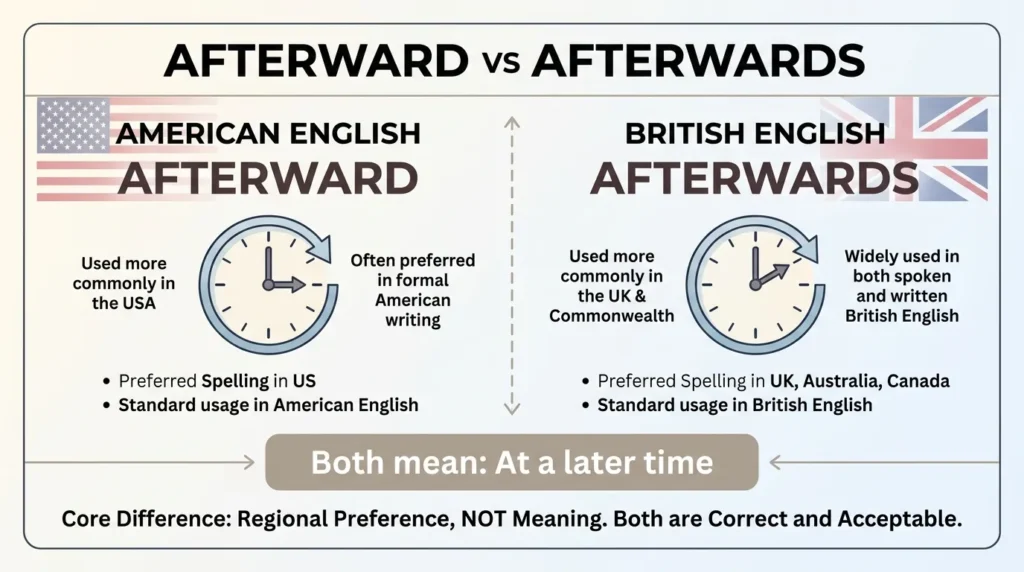

Afterward and afterwards have exactly the same meaning. Both are adverbs that mean “at a later time” or “after something has happened.” The main difference is regional preference: afterward is more common in American English, while afterwards is more common in British English. Both spellings are grammatically correct, so you can use either without changing the meaning of your sentence.
What Is the Difference Between Afterward and Afterwards?
The difference between afterward and afterwards is mainly spelling preference, not meaning or grammar.
- Afterward: Generally preferred in American English.
- Afterwards: Generally preferred in British English and also used in other English varieties.
Both words describe something that happens after an event, action, or particular moment.
For example:
- We went shopping and had dinner afterward.
- We went shopping and had dinner afterwards.
Both sentences are correct. They communicate exactly the same idea.
What Does Afterward Mean?
Afterward is an adverb that means at a later time or following a particular event.
It tells readers when something happens in relation to another action.
Examples:
- We had lunch and went for a walk afterward.
- She completed her examination and felt relieved afterward.
- The meeting ended, and everyone returned to their offices afterward.
The word is commonly used in American English.
What Does Afterwards Mean?
Afterwards is also an adverb meaning at a later time or following an event.
It has the same meaning and grammatical function as afterward.
Examples:
- We watched a movie and went home afterwards.
- He apologized afterwards.
- The students discussed the lesson afterwards.
The spelling is particularly common in British English.
Read also: Shall vs Should: Meaning, Difference, Rules, and Examples
Why Does the Difference Between Afterward and Afterwards Matter?
Although these words have the same meaning, understanding their regional preferences helps you maintain consistency in your writing.
For example, an American English article will generally use afterward, while a British English article will often use afterwards.
This distinction matters when:
- Writing blog posts: Consistent spelling helps maintain a clear English variant.
- Writing professional emails: Choosing one spelling style makes your communication consistent.
- Preparing academic assignments: Following a consistent language style improves editorial quality.
- Learning English: Understanding both versions helps you read American and British materials confidently.
- Taking grammar examinations: You can recognize that both spellings are acceptable rather than treating one as universally incorrect.
Read more: Waste vs Waist: Meaning, Difference & Easy Memory Trick
The Core Rule: Afterward vs Afterwards
The simplest rule is that both words are correct and have the same meaning. Choose the spelling that matches your preferred English variety.
| Word | Preferred usage | Meaning |
|---|---|---|
| Afterward | American English | At a later time |
| Afterwards | British English | At a later time |
Easy memory trick:
- American English generally prefers the shorter spelling: afterward.
- British English commonly uses the longer spelling: afterwards.
Remember that this is a preference, not a strict grammatical rule.
See also: On Tuesday Morning vs. In the Tuesday Morning: Which Is Correct?
How to Use Afterward and Afterwards Correctly
Both words function as adverbs. They describe when something happens, usually after another action or event.
When to Use Afterward
Use afterward when following American English spelling conventions or when it matches the style of your writing.
1. After an activity
- We went swimming and had lunch afterward.
- She finished her homework and watched television afterward.
2. After a meeting
- The manager spoke to the employees afterward.
- We discussed the proposal afterward.
3. After an examination
- I felt nervous before the test but relaxed afterward.
- The students compared their answers afterward.
4. After a social event
- We attended the wedding and visited our relatives afterward.
- They went to a restaurant afterward.
5. After a difficult experience
- He learned an important lesson afterward.
- She realized her mistake afterward.
When to Use Afterwards
Use afterwards when following British English spelling conventions or when it matches the style of your writing.
1. After completing a task
- I cleaned my room and went shopping afterwards.
- She submitted her assignment and relaxed afterwards.
2. After a conversation
- We talked for an hour and had coffee afterwards.
- He explained the situation afterwards.
3. After a business meeting
- The director answered questions afterwards.
- We prepared a detailed report afterwards.
4. After travelling
- They visited London and travelled to Manchester afterwards.
- We took several photographs and shared them afterwards.
5. After an important event
- The ceremony ended, and everyone celebrated afterwards.
- She received the award and thanked her teachers afterwards.
Correct Examples of Afterward and Afterwards
Here are 20 examples showing how these words appear in everyday English.
Examples of Afterward
- Conversation: Let’s finish dinner and discuss the movie afterward.
- Email: I will send you the meeting notes afterward.
- School: The teacher explained the lesson and gave us a test afterward.
- Workplace: We completed the presentation and answered questions afterward.
- Social media: I didn’t understand the experience at first, but everything made sense afterward.
- Academic writing: Participants completed the questionnaire and were interviewed afterward.
- Shopping: We visited the supermarket and went to the pharmacy afterward.
- Travel: We explored the city and returned to the hotel afterward.
- Business: The company reviewed the results and announced its decision afterward.
- Daily life: I exercised in the morning and took a shower afterward.
Examples of Afterwards
- Conversation: We can have coffee afterwards.
- Email: I will contact you afterwards to confirm the details.
- School: The students discussed the chapter afterwards.
- Workplace: The team reviewed the feedback afterwards.
- Social media: It was a wonderful experience, and I smiled about it for days afterwards.
- Academic writing: The researchers analyzed the samples and published their findings afterwards.
- Shopping: She bought a new dress and visited her friend afterwards.
- Travel: We visited the museum and explored the nearby streets afterwards.
- Business: The manager addressed the concerns and updated the team afterwards.
- Daily life: He prepared breakfast and cleaned the kitchen afterwards.
Afterward vs Afterwards: Incorrect vs Correct Examples
One important point: neither spelling is inherently incorrect. The following table shows genuine usage problems and explains how to correct them.
| ❌ Incorrect | ✅ Correct | Why |
|---|---|---|
| We went home afterwardly. | We went home afterward. | Afterwardly is not the standard adverb. |
| I will call you afterwords. | I will call you afterwards. | Afterwords means something different and is not the intended spelling. |
| We ate dinner and afterwards went to home. | We ate dinner and went home afterwards. | Use go home, without to, in this expression. |
| She completed the work and afterwardly rested. | She completed the work and rested afterward. | Use the standard adverb afterward. |
| We met afterwoods. | We met afterwards. | Afterwoods is a spelling error. |
| I will explain it in the afterwards. | I will explain it afterwards. | Afterwards is an adverb and does not normally take the article the. |
| He left the office afterwords. | He left the office afterward. | Afterward is the correct spelling for the intended meaning. |
| We discussed the issue afterwardsly. | We discussed the issue afterwards. | The standard form is afterwards. |
| She went to school and returned home afterward to. | She went to school and returned home afterward. | Do not add an unnecessary to. |
| They celebrated afterward’s. | They celebrated afterwards. | Do not use an apostrophe in afterwards. |
Remember: “We went home afterward” and “We went home afterwards” are both correct. Do not mark either spelling as a grammatical error simply because it belongs to a different regional preference.
Why Do People Confuse Afterward and Afterwards?
There are several reasons English learners and writers find these words confusing.
1. The Extra Letter S
The most noticeable difference is the final letter s.
- Afterward
- Afterwards
Because the spellings are nearly identical, writers sometimes wonder whether the final s changes the meaning.
It does not. Both words mean the same thing.
2. American and British English Differences
American and British English often have different spelling preferences.
For example:
- American English: Color
- British English: Colour
- American English: Center
- British English: Centre
- American English: Afterward
- British English: Afterwards
This pattern can make learners assume that one version must be incorrect. However, both forms are standard.
3. Overgeneralizing Grammar Rules
Some learners assume that adding s to an adverb changes its grammatical function.
However, the final s in afterwards does not create a different tense, meaning, or grammatical category.
Both words are adverbs.
4. Spellcheck and Autocorrect
Spellcheckers generally recognize both afterward and afterwards as valid words.
However, they may not tell you which spelling is more appropriate for your chosen English variety.
Therefore, use a consistent language setting and review your article before publishing.
5. Translation Interference
In some languages, there may be one common expression for both forms.
English learners may therefore assume that the two spellings have different meanings.
The easiest solution is to remember that they are regional alternatives rather than words with separate definitions.
Common Mistakes Checklist
- Treating afterwards as incorrect: It is standard English, particularly in British usage.
- Treating afterward as incorrect: It is also standard English and is especially common in American usage.
- Writing afterwords: This is a different word. Afterwords can refer to concluding remarks in a book.
- Writing afterwardly: This is not the standard form. Use afterward or afterwards.
- Adding unnecessary apostrophes: Write afterwards, not afterward’s.
- Using both spellings inconsistently: Choose one preferred form for a consistent article.
- Confusing afterward with after: After can function as a preposition, conjunction, or adverb, whereas afterward and afterwards are adverbs.
Afterward and Afterwards in Real English
1. Grammatically Correct and Natural
“Let’s have lunch and discuss the project afterward” is natural American English. Similarly, “Let’s have lunch and discuss the project afterwards” is natural British English. Both sentences are grammatically correct, and neither sounds unusual simply because of its spelling. The choice depends mainly on the variety of English being used.
2. Grammatically Possible but Inconsistent with Regional Style
An American writer may use afterwards, and a British writer may use afterward. Neither choice is grammatically wrong. However, if an article consistently follows American English conventions, afterward will usually fit better. Likewise, afterwards will generally fit a British English article. This is an editorial consistency issue, not a grammar rule.
3. Natural Everyday English
Both words appear naturally in everyday expressions such as “I’ll call you afterward,” “We can talk afterwards,” and “What happened afterward?” They can appear at the end of a sentence or after the subject, depending on the sentence structure. For example, “She afterwards changed her mind” is possible, although “She later changed her mind” may sound more straightforward in many everyday contexts.
American vs British English: Afterward vs Afterwards
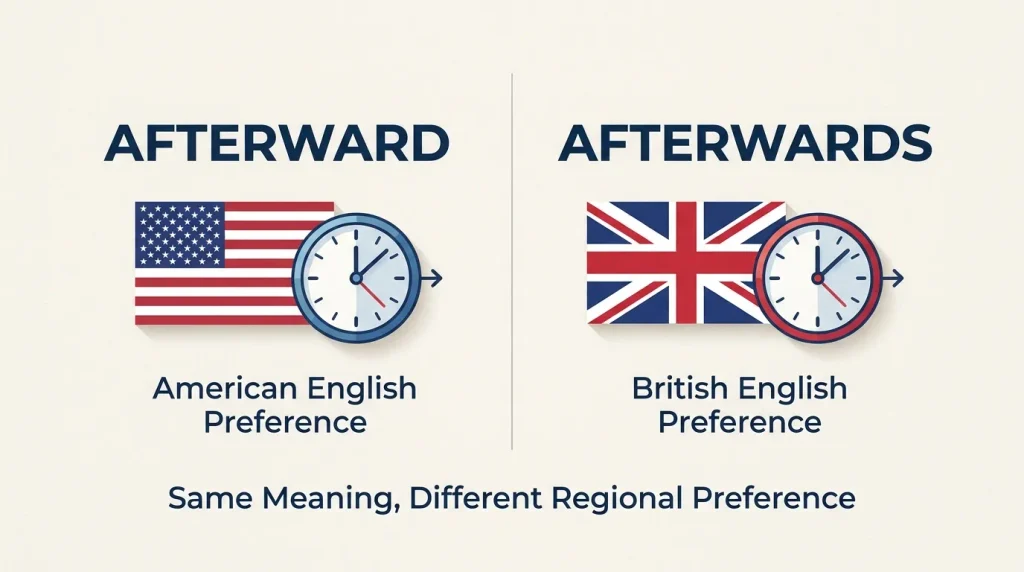
This is where the main distinction between the two words appears.
| Feature | American English | British English |
|---|---|---|
| Preferred spelling | Afterward | Afterwards |
| Meaning | At a later time | At a later time |
| Part of speech | Adverb | Adverb |
| Pronunciation | Same basic pronunciation | Same basic pronunciation |
| Formal writing | Afterward is common | Afterwards is common |
| Informal conversation | Afterward is common | Afterwards is common |
| Is the alternative accepted? | Yes | Yes |
American English Examples
- I’ll call you afterward.
- We went shopping afterward.
- She felt better afterward.
British English Examples
- I’ll call you afterwards.
- We went shopping afterwards.
- She felt better afterwards.
Important: These are preferences, not exclusive rules. American writers can use afterwards, and British writers can use afterward.
Formal vs Informal Usage
Both words are appropriate in formal and informal English.
Formal Usage
Examples:
- The participants completed the assessment and were interviewed afterward.
- The committee reviewed the proposal and announced its decision afterwards.
- The findings were evaluated afterward.
Informal Usage
Examples:
- Let’s grab something to eat afterward.
- I’ll see you afterwards.
- We can talk about it afterward.
There is no meaningful difference in formality between the two spellings. Regional preference and consistency are more important.
Afterward vs Afterwards: Comparison Table
| Feature | Afterward | Afterwards |
|---|---|---|
| Meaning | At a later time | At a later time |
| Part of speech | Adverb | Adverb |
| Spelling | Without final s | With final s |
| American English | More common | Also correct |
| British English | Also correct | More common |
| Pronunciation | /ˈæf.tɚ.wɚd/ (typical American) | /ˈɑːf.tə.wəd/ (typical British) |
| Grammatical function | Describes when something happens | Describes when something happens |
| Formal usage | Accepted | Accepted |
| Informal usage | Accepted | Accepted |
| Example | We talked afterward. | We talked afterwards. |
Real-Life Situations: When to Use Afterward or Afterwards
1. During a Job Interview
Situation: You explain that you will provide additional documents after the interview.
American English: “I can send you the documents afterward.”
British English: “I can send you the documents afterwards.”
2. During a Business Meeting
Situation: Your manager asks when the team will review the presentation.
American English: “We can discuss the presentation afterward.”
British English: “We can discuss the presentation afterwards.”
3. Writing a Professional Email
Situation: You want to explain that you will send an update following a meeting.
American English: “I’ll share the updated report afterward.”
British English: “I’ll share the updated report afterwards.”
4. Talking to a Friend
Situation: You are planning to watch a movie and have dinner.
American English: “Let’s have dinner afterward.”
British English: “Let’s have dinner afterwards.”
5. Writing an Academic Assignment
Situation: You are explaining the order of a research procedure.
American English: “The samples were collected and analyzed afterward.”
British English: “The samples were collected and analyzed afterwards.”
Both versions are correct, provided you maintain consistent spelling conventions throughout your work.
Summary: Afterward vs Afterwards
Afterward and afterwards are two correct spellings of the same adverb. Both mean “at a later time” or “after something has happened.” The main difference is regional preference: afterward is more common in American English, while afterwards is more common in British English. Neither spelling is grammatically superior, and both can be used in formal and informal writing. For example, “We went shopping afterward” and “We went shopping afterwards” communicate exactly the same meaning. The important thing is to choose one spelling and use it consistently throughout your article, email, or academic assignment. Remember: American English generally prefers the shorter form, while British English commonly uses the form ending in s.