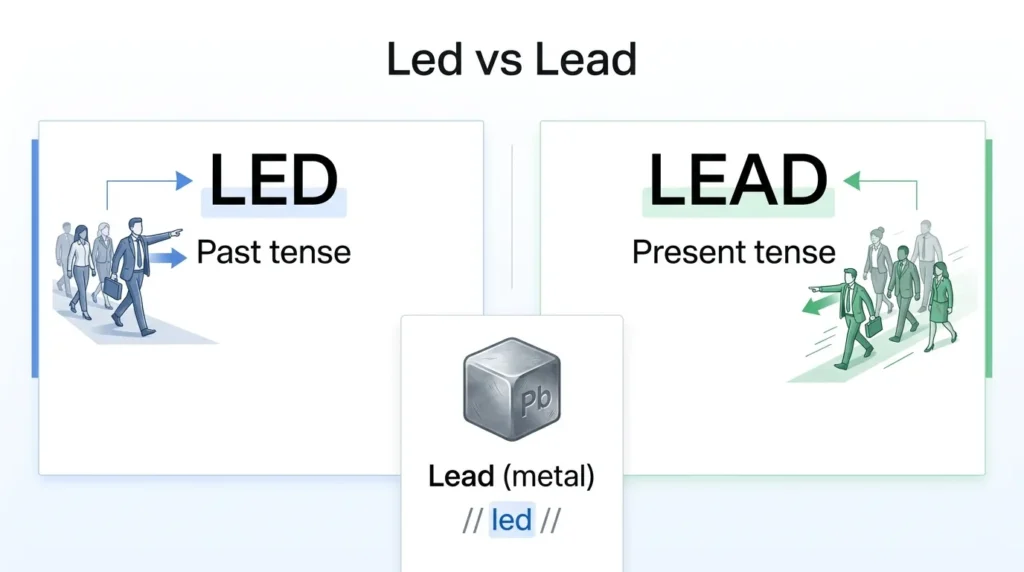

Led is the past tense and past participle of the verb lead, meaning to guide, direct, or be in charge. Lead is the present-tense form of that verb, pronounced “leed.” It can also mean a heavy metal, pronounced “led.” For example, “She led the team yesterday” is correct, while “She lead the team yesterday” is incorrect. Remember: if the action happened in the past, use led.
What Is the Difference Between Led and Lead?
The difference between led and lead depends on the meaning and tense of the word.
- Led (pronounced like “red”) is the past tense of the verb lead. It describes an action that already happened.
- Lead (pronounced like “leed”) is the present-tense form of the verb lead. It means to guide, direct, or be in charge.
- Lead (pronounced like “led”) is also a noun referring to a heavy metal.
The confusion comes from the fact that the past-tense verb led and the metal lead sound exactly alike but have different spellings and meanings.
| Word | Meaning | Pronunciation | Example |
|---|---|---|---|
| Led | Past tense of lead | Red | She led the team. |
| Lead | Present-tense verb | Leed | She will lead the team. |
| Lead | A heavy metal | Led | The pipe contains lead. |
Read also: Afterward vs Afterwards: Meaning, Difference, and How to Use Them Correctly
Why Does the Difference Matter?
Using lead instead of led can make a sentence look unprofessional, especially in business emails, reports, academic writing, and job applications.
The mistake is easy to overlook because both words are pronounced alike in certain contexts. However, readers rely on spelling to understand whether you are describing a past action, a current responsibility, or a material.
Consider these examples:
- Incorrect: The manager lead the meeting yesterday.
- Correct: The manager led the meeting yesterday.
The incorrect version uses the present-tense spelling to describe a completed action.
A similar mistake can change the meaning of a sentence:
- She will lead the project. (She will guide it.)
- She led the project. (She guided it in the past.)
Knowing which form to use helps you communicate clearly and accurately.
Read more: Shall vs Should: Meaning, Difference, Rules, and Examples
The Core Rule: When to Use Led or Lead
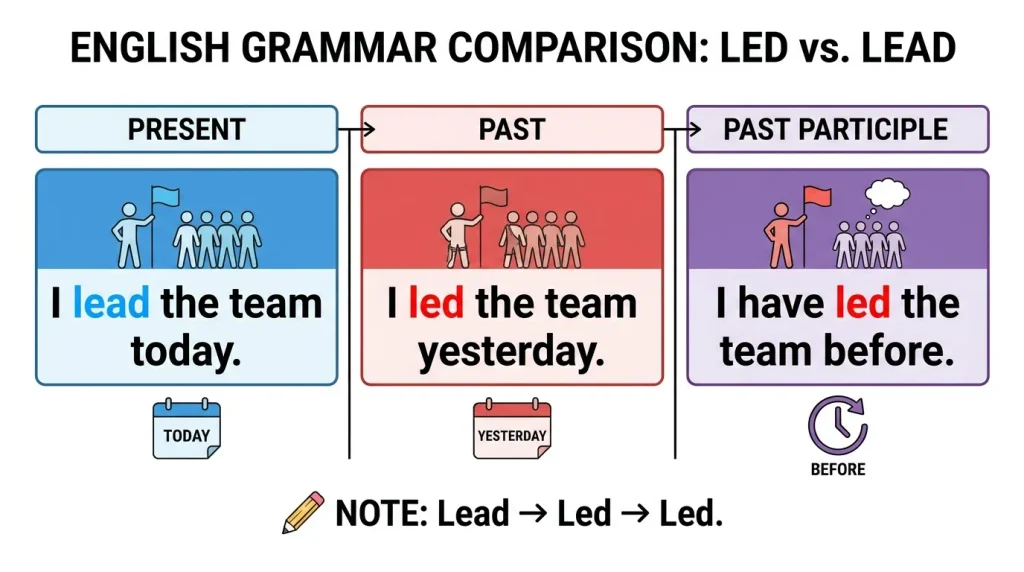
Use led for the past tense of lead. Use lead for the present tense, future actions, and the metal.
The verb lead is irregular. This means it does not form its past tense by simply adding -ed.
Its main forms are:
| Base form | Past tense | Past participle |
|---|---|---|
| Lead | Led | Led |
The past participle is the form used with helping verbs such as has, have, and had.
For example:
- Present: I lead the team.
- Past: I led the team.
- Present perfect: I have led the team.
- Past perfect: I had led the team.
Notice that led is used in both the simple past and the perfect tenses.
See more: Waste vs Waist: Meaning, Difference & Easy Memory Trick
How to Use Led and Lead
1. Use Led for a Completed Action
Use led when someone guided, directed, or was in charge of something in the past.
Examples:
- She led the discussion yesterday.
- The guide led us through the forest.
- Our team led the competition last year.
- His advice led me to reconsider my decision.
The action may have happened recently or long ago. The important point is that the verb describes a past action.
2. Use Led After Has, Have, or Had
Use led after these helping verbs when forming perfect tenses.
Examples:
- She has led several successful projects.
- They have led the organization for years.
- He had led the team before becoming a director.
Do not write has lead, have lead, or had lead when you mean the past participle of the verb lead.
3. Use Lead for Present Actions
Use lead when the action happens now or is generally true.
Examples:
- I lead a small marketing team.
- She leads the morning meeting every Monday.
- Good communication can lead to better results.
For third-person singular subjects such as he, she, and it, use leads, not lead.
4. Use Lead for Future Actions
Use lead after will, shall, or other expressions referring to the future.
Examples:
- She will lead the next meeting.
- Who will lead the project?
- I am going to lead the training session.
The helping verb will is followed by the base form of the main verb.
5. Use Lead When Talking About the Metal
When lead refers to the chemical element, it is a noun pronounced like led.
Examples:
- Lead is a heavy metal.
- The old pipes contained lead.
- The laboratory tested the sample for lead.
The spelling remains lead, even though the pronunciation is the same as the past-tense verb led.
6. Use Lead for a Position or Advantage
Lead can also be a noun meaning the first position, an advantage, or the main role.
Examples:
- The runner took the lead.
- Our team has a two-point lead.
- She played the lead role in the production.
In these examples, lead is a noun, not a past-tense verb.
Correct Examples of Led and Lead
The following examples show how both words work in everyday writing.
In Conversation
- “I led the group to the restaurant last night.”
- “You can lead the way; I’ll follow.”
In Emails
- “I led the client presentation yesterday.”
- “Could you lead the discussion during tomorrow’s meeting?”
In School
- “Our teacher led us through the science experiment.”
- “The student who led the debate received an award.”
In the Workplace
- “She has led the department since January.”
- “I will lead the onboarding session next week.”
On Social Media
- “Our team led the tournament from start to finish.”
- “Let’s lead by example and support one another.”
In Academic Writing
- “The findings led researchers to reconsider the original hypothesis.”
- “The study examines factors that lead to improved learning outcomes.”
Incorrect vs. Correct: 10 Common Mistakes
| ❌ Incorrect | ✅ Correct | Why |
|---|---|---|
| She lead the team yesterday. | She led the team yesterday. | The action happened in the past. |
| He has lead three projects. | He has led three projects. | The past participle of lead is led. |
| They had lead the campaign before. | They had led the campaign before. | Had requires the past participle here. |
| The discovery lead to a breakthrough. | The discovery led to a breakthrough. | The discovery caused a past result. |
| Our coach lead us to victory. | Our coach led us to victory. | The sentence describes a completed action. |
| The manager lead the meeting last Friday. | The manager led the meeting last Friday. | The time expression indicates the past. |
| The pipe was made of led. | The pipe was made of lead. | The metal is spelled lead. |
| The team took the led. | The team took the lead. | The noun meaning an advantage is lead. |
| She will led the discussion. | She will lead the discussion. | Will takes the base form of the verb. |
| He is lead the group. | He is leading the group. | The present continuous uses is + -ing. |
Why People Confuse Led and Lead
1. They Sound the Same in Some Contexts
The past-tense verb led and the metal lead are homophones. Homophones are words that sound alike but have different meanings or spellings.
Because the two words sound identical, hearing the sentence does not always tell you which spelling to use.
2. The Spelling of Read Creates Confusion
The verb read keeps the same spelling in the present and past tense, although its pronunciation changes.
- I read every day. (Present, pronounced “reed.”)
- I read the book yesterday. (Past, pronounced “red.”)
Some writers assume that lead follows the same pattern. It does not.
- Present: I lead the team.
- Past: I led the team.
3. English Has Irregular Verbs
Many English verbs form their past tense by adding -ed, such as walked, played, and worked.
However, lead is irregular. Its past tense changes to led.
Other verbs follow a similar pattern:
| Present | Past |
|---|---|
| Feed | Fed |
| Bleed | Bled |
| Breed | Bred |
| Lead | Led |
4. Spellcheck Does Not Always Catch the Mistake
Both lead and led are valid English words. A spellchecker may accept either spelling without knowing whether the sentence uses the correct tense.
For example, “She lead the team yesterday” contains a real English word, but it is not the correct form for the intended meaning.
Always check the sentence’s meaning, not just the spelling.
5. Translation Can Add to the Confusion
Some languages use one form of a verb for several English tenses or rely on context to show when an action happened.
English often changes the verb form itself. Learners may therefore write lead when they mean led, especially when translating directly from their first language.
The safest approach is to learn the three main forms together: lead, led, led.
Common Mistakes Checklist
Before submitting your writing, check these common errors.
- Using lead for a past action: Ask whether the action has already happened. If it has, use led.
- Writing has lead or have lead: Use has led or have led when the verb means to guide or direct.
- Writing will led: After will, use the base form lead.
- Using led for the metal: The chemical element is always spelled lead.
- Confusing lead and leads: Use leads with he, she, or it in the simple present.
- Relying only on pronunciation: Both led and the metal lead sound like “red.” Use the meaning to decide the spelling.
- Assuming every form ends in -ed: English has irregular verbs. Memorize lead, led, led rather than applying a general spelling rule.
Led vs. Lead in Real English
Grammatically Correct: “She Led the Team.”
This is the standard form when describing a completed action. It is correct in conversation, formal writing, business communication, and academic work. For example, “She led the team through a difficult transition” clearly places the leadership in the past. The sentence remains correct whether the event happened yesterday or several years ago.
Grammatically Possible but Incorrect for the Intended Meaning: “She Lead the Team Yesterday.”
The word lead is a valid English word, but this sentence uses it incorrectly if the writer means that she guided the team yesterday. The past-tense form must be led. The sentence may be understood because the intended meaning is clear, but understanding a sentence does not make its verb form correct.
Natural Everyday English: “She’s Leading the Team.”
This is a natural way to describe an action or responsibility happening now. The present continuous form, is leading, emphasizes that the activity is ongoing or temporary. It is often more suitable than she leads the team when describing a current project or a role that is not permanent. Both forms are grammatically correct, but their emphasis differs.
American vs. British English
There is no difference between American and British English in the spelling of led and lead when the words refer to the verb to lead or the metal.
Both varieties use:
- Lead for the present-tense verb.
- Led for the past tense and past participle.
- Lead for the metal.
The same rule applies in formal and informal writing.
Formal vs. Informal Usage
The spelling rule is the same in formal and informal English. The difference is in the sentence structure and the context.
| Context | Example |
|---|---|
| Informal conversation | “I led them there yesterday.” |
| Business email | “I led the project last quarter.” |
| Academic writing | “The results led to further investigation.” |
| Formal report | “The findings have led to a revised recommendation.” |
In professional writing, using the correct form is especially important because errors can distract readers from the message.
Comparison Table: Led vs. Lead
| Feature | Led | Lead |
|---|---|---|
| Part of speech | Verb | Verb or noun |
| Verb tense | Past tense and past participle | Present tense or base form |
| Pronunciation | /lɛd/ | /liːd/ as a verb; /lɛd/ as a metal |
| Meaning | Guided or directed in the past | Guide, direct, or be in charge |
| Metal meaning | Not used for the metal | A heavy metallic element |
| Example | She led the group. | She will lead the group. |
| Helping verbs | Has led, have led, had led | Will lead, can lead, should lead |
Real-Life Situations
1. In a Job Interview
A candidate is describing a previous leadership role.
Incorrect: “I lead a team of five people in my last job.”
Correct: “I led a team of five people in my last job.”
The past-tense form is needed because the job has ended.
2. During a Meeting
A manager is discussing responsibilities for an upcoming project.
Correct: “I will lead the project, and Sarah will manage the budget.”
The project has not started, so lead is the correct base form after will.
3. In an Email
A colleague is describing a completed training session.
Correct: “The workshop I led last week received excellent feedback.”
The verb led describes the completed workshop.
4. In a Text Message
A friend is asking who will guide the group.
Correct: “You lead, and I’ll follow.”
The action is in the future, so lead is appropriate.
5. In an Exam
A student must complete the sentence:
“Yesterday, the guide ___ us through the museum.”
The correct answer is led because yesterday identifies a past action.
Quick Memory Trick: How to Remember Led vs. Lead
Use this simple rule:
Led = past. Lead = present or future.
A useful way to remember the past-tense spelling is to connect led with red. Both have three letters and rhyme.
You can also remember the verb forms together:
Lead → Led → Led
- I lead the team today.
- I led the team yesterday.
- I have led the team before.
If you are talking about the metal, remember that lead is spelled with ea, even though it sounds like led.
Mini Quiz: Led or Lead?
Choose the correct word for each sentence.
- She ___ the discussion yesterday.
- I will ___ the team next year.
- The discovery has ___ to new questions.
- The old pipes contained ___.
- Who will ___ the meeting tomorrow?
FAQ: Led vs. Lead
Is it led or lead in the past tense?
Led is the past tense of the verb lead. For example, “She led the team last year.” The spelling lead is incorrect when used as the past tense of this verb.
Is it led or lead in the sentence “I have ___ the team”?
The correct word is led. The sentence should read, “I have led the team.” The verb have requires the past participle, which is led.
Is it “lead to” or “led to”?
Both can be correct, depending on the tense.
- Present: Poor planning can lead to delays.
- Past: Poor planning led to delays.
Use led to when describing a result that occurred in the past.
Is “I lead the team yesterday” correct?
No. The correct sentence is “I led the team yesterday.” The word yesterday indicates that the action happened in the past, so the verb must be led.
Is lead pronounced like led?
Sometimes. The metal lead is pronounced like led, rhyming with red. However, the verb lead, meaning to guide or direct, is pronounced “leed,” rhyming with need.
Is it “has led” or “has lead”?
The correct form is has led when the verb means to guide or direct.
For example: “She has led several successful projects.”
The word led is the past participle of lead.
Is led an irregular verb?
Led is the past tense and past participle of the irregular verb lead. An irregular verb does not follow the usual pattern of adding -ed to form the past tense.
The main forms are lead, led, led.
Can lead ever be used as a past-tense verb?
The ordinary verb lead, meaning to guide or direct, uses led as its past tense. However, leaded is a separate, less common form used when referring to treating or adding the metal lead to something.
For example: “The glass was leaded with lead compounds.”
This is not the same verb meaning to guide or direct.
What is the difference between led and lead in pronunciation?
Led and the metal lead are pronounced /lɛd/, rhyming with red. The verb lead, meaning to guide or direct, is pronounced /liːd/, rhyming with need.
How do I remember whether to use led or lead?
Remember the verb forms lead, led, led.
Use lead for the present tense and future actions, and use led for the past tense and past participle.
Quick Summary
The difference between led and lead depends on meaning and tense. Led is the past tense and past participle of the verb lead, meaning to guide, direct, or be in charge. Lead is the present-tense form of that verb and is also used for the heavy metal. Although the past-tense verb led and the metal lead sound alike, their spellings are different. Remember the verb forms lead, led, led. Use led for completed actions and after has, have, or had. Use lead for present actions, future actions, and the metal. The easiest rule is simple: if the action happened in the past, write led.