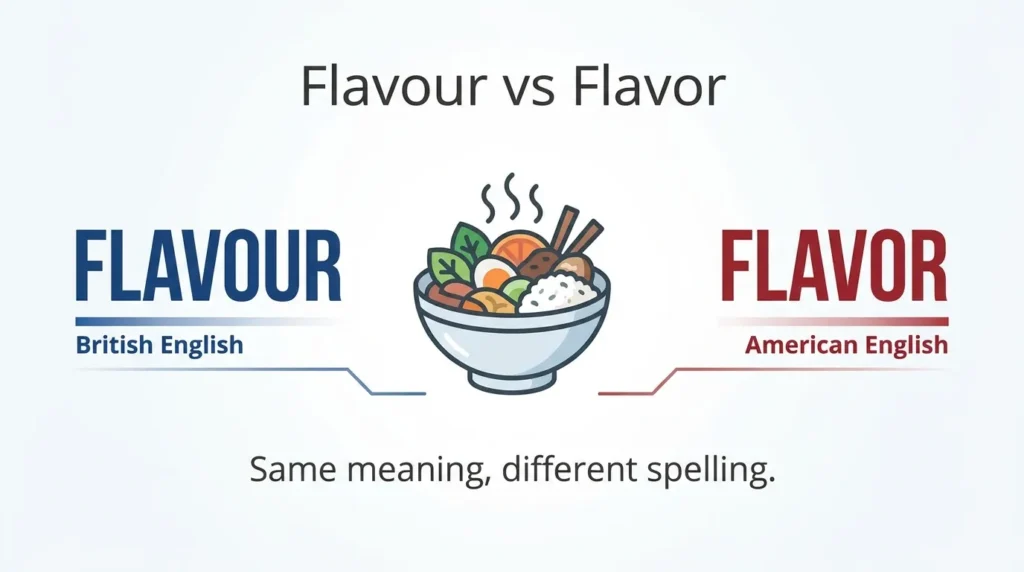

Flavour and flavor are both correct spellings of the same word. The difference is regional: flavour is the standard spelling in British English, while flavor is the standard spelling in American EnglisBoth words refer to the taste of food or drink, or to a distinctive quality or character. The meaning does not change when you switch between the two spellings.
Use flavour when writing in British English, including most British-style writing in Pakistan, the UK, Canada, Australia, and New Zealand. Use flavor when writing in American English.
For example:
- British English: The ice cream has a rich chocolate flavour.
- American English: The ice cream has a rich chocolate flavor.
Neither spelling is incorrect. The important thing is to follow the English variety you are using and remain consistent throughout your writing.
Read also: Led vs Lead: The Simple Rule That Stops the Confusion
What Is the Difference Between Flavour and Flavor?
The only difference is the spelling. Both words have the same meaning and pronunciation.
| Word | English variety | Example |
|---|---|---|
| Flavour | British English | I love the flavour of this tea. |
| Flavor | American English | I love the flavor of this tea. |
The word can refer to the taste of something, such as a fruit or a meal. It can also describe a distinctive quality, style, or atmosphere.
For example, a writer might describe a story as having a “traditional flavour” or a “traditional flavor.”
Also checkout: Afterward vs Afterwards: Meaning, Difference, and How to Use Them Correctly
Why Does the Difference Matter?
Choosing the correct spelling helps your writing match your audience.
For instance, a British English reader expects flavour, while an American English reader usually expects flavor. Using the other spelling is still understandable, but it may look inconsistent if the rest of your writing follows a different spelling convention.
This matters especially in:
- School assignments and examinations
- Business emails and reports
- Website content and blog articles
- Product descriptions and packaging
- Academic writing
If you are writing for an international audience, choose one spelling system and use it consistently.
Read more: Shall vs Should: Meaning, Difference, Rules, and Examples
British English uses flavour. American English uses flavor. Both have the same meaning.
The same spelling difference appears in other words:
| British English | American English |
|---|---|
| Flavour | Flavor |
| Colour | Color |
| Honour | Honor |
| Favourite | Favorite |
| Neighbour | Neighbor |
A useful memory trick is that British English usually keeps the u in these words, while American English often drops it.
How to Use Flavour and Flavor
1. Use Flavour in British English
Choose flavour when following British spelling conventions.
Examples:
- This soup has a wonderful flavour.
- The flavour of fresh mango is delicious.
- The restaurant offers several flavours of ice cream.
2. Use Flavor in American English
Choose flavor when following American spelling conventions.
Examples:
- This soup has a wonderful flavor.
- The flavor of fresh mango is delicious.
- The restaurant offers several flavors of ice cream.
3. Use the Same Spelling Throughout Your Writing
Consistency matters more than choosing one spelling over the other.
For example, if your article uses colour, favourite, and neighbour, then flavour is the consistent choice.
On the other hand, if you use color, favorite, and neighbor, choose flavor.
4. Follow the Spelling Used by a Brand or Publication
Sometimes, a company or publication has its own spelling preferences.
For example, if a product’s official name includes Flavor, retain that spelling when referring to the brand, even if your article otherwise uses British English.
Proper names and official titles should generally keep their original spelling.
Correct Examples
Here are examples of both spellings in everyday writing.
British English
- The flavour of the coffee was excellent.
- I prefer the natural flavour of fresh fruit.
- This cake has a rich chocolate flavour.
- The restaurant offers a variety of flavours.
- The herbs add a distinctive flavour to the dish.
American English
- The flavor of the coffee was excellent.
- I prefer the natural flavor of fresh fruit.
- This cake has a rich chocolate flavor.
- The restaurant offers a variety of flavors.
- The herbs add a distinctive flavor to the dish.
Figurative Meaning
- The novel captures the flavour of village life.
- The novel captures the flavor of village life.
In these examples, flavour and flavor describe the distinctive character of a place or experience, rather than the taste of food.
Incorrect vs. Correct
The spelling itself is not incorrect in either variety. However, mixing the two systems can create inconsistency.
| Inconsistent or incorrect | Consistent or correct | Why |
|---|---|---|
| The colour has a rich flavor. | The colour has a rich flavour. | British spelling is used consistently. |
| The color has a rich flavour. | The color has a rich flavor. | American spelling is used consistently. |
| My favorite ice cream has a chocolate flavour. | My favourite ice cream has a chocolate flavour. | British English uses favourite and flavour. |
| My favourite ice cream has a chocolate flavor. | My favorite ice cream has a chocolate flavor. | American English uses favorite and flavor. |
| This product comes in three flavour options. | This product comes in three flavour options. | The spelling is correct in British English. |
| This product comes in three flavor options. | This product comes in three flavor options. | The spelling is correct in American English. |
The first four examples show mixed spelling systems. The final two demonstrate that both spellings are correct within their respective varieties.
Why People Confuse Flavour and Flavor
1. The Pronunciation Is Identical
Both words are pronounced the same way. Therefore, you cannot hear which spelling someone is using.
2. Both Spellings Are Accepted
Unlike a typical spelling mistake, flavour and flavor are both standard English words. Spellcheck may accept either one, even if it does not match the rest of your article.
3. English Has Regional Spelling Differences
Words such as colour/color, centre/center, and travelling/traveling follow similar regional patterns.
Once you understand the pattern, remembering flavour and flavor becomes easier.
Flavour or Flavor in Real English
Grammatically Correct
Both spellings are grammatically correct. For example, “The flavour of the curry is excellent” and “The flavor of the curry is excellent” communicate exactly the same meaning. The choice depends on the spelling convention you are following, not on the sentence’s grammar.
Natural Everyday English
Both words are natural in everyday English. British English speakers generally write flavour, while American English speakers generally write flavor. Neither spelling sounds unusual when it matches the variety of English being used.
Formal and Informal Writing
The spelling difference applies equally to formal and informal writing. A British business report uses flavour, just as a British text message does. Similarly, an American academic paper uses flavor, just as an American social media post does.
American vs. British English
This is a genuine spelling difference between the two varieties.
| British English | American English |
|---|---|
| Flavour | Flavor |
| Flavours | Flavors |
| Flavoured | Flavored |
| Flavouring | Flavoring |
Notice that the difference continues in related words. British English keeps the u in flavoured, while American English drops it.
Formal vs. Informal Usage
There is no difference in formality between flavour and flavor.
Both are appropriate in:
- Formal reports
- Academic papers
- Business communication
- Casual conversation
- Advertising and product descriptions
Choose the spelling that matches your audience or publication’s style guide.
Comparison Table
| Feature | Flavour | Flavor |
|---|---|---|
| English variety | British | American |
| Meaning | Taste or distinctive quality | Taste or distinctive quality |
| Pronunciation | Same | Same |
| Grammar | Noun or verb | Noun or verb |
| Plural | Flavours | Flavors |
| Past tense | Flavoured | Flavored |
| Correctness | Correct | Correct |
Real-Life Situations
In a School Assignment
If your teacher expects British English, write:
“The flavour of the fruit was sweet.”
In an American Business Email
Write:
“Our new product is available in three different flavors.”
In a Food Blog
If your blog uses British spelling, write:
“This recipe brings out the natural flavour of the spices.”
On Product Packaging
Follow the spelling used by the brand and the intended market. A product sold in the United States may use flavor, while a product sold in the UK may use flavour.
Quick Memory Trick
Remember:
British English = Flavour
American English = Flavor
British English keeps the u, just as it does in colour and favourite. American English removes it.
If you are unsure which spelling to use, check the other spelling choices in your writing. If you use colour, choose flavour. If you use color, choose flavor.
Mini Quiz: Flavour or Flavor?
Choose the spelling that best matches each sentence’s English variety.
- British English: The ice cream has a delicious ___.
- American English: My favorite ___ is chocolate.
- British English: The chef added herbs to improve the ___.
- American English: This product comes in several ___.
Answers: 1. flavour; 2. flavor; 3. flavour; 4. flavors.
FAQ
Is flavour or flavor correct in the UK?
Flavour is the standard British English spelling. It is used in the UK and in other varieties that follow British spelling conventions.
Is flavor or flavour correct in the USA?
Flavor is the standard American English spelling. It is used in American writing, including academic, professional, and everyday communication.
Is flavour British or American?
Flavour is the British English spelling. The American spelling is flavor.
Do flavour and flavor mean the same thing?
Yes. Both words refer to the taste of food or drink, or to a distinctive quality or character.
Is flavouring or flavoring correct?
Both are correct. Flavouring is British English, while flavoring is American English.
Is flavoured or flavored correct?
Both are correct. British English uses flavoured, while American English uses flavored.
Which spelling should I use in Pakistan?
British English spelling is commonly used in Pakistani educational and formal writing. Therefore, flavour is generally the preferred choice. However, follow your institution’s or publication’s style guide if it specifies American English.
Does flavour have a different pronunciation from flavor?
No. Both spellings have the same pronunciation.
Can I use flavour and flavor in the same article?
You can, but it is generally better to use one spelling consistently. Mixing British and American spelling may make your writing look inconsistent.
Which spelling is better for SEO?
Neither spelling is inherently better for SEO. Use the spelling that matches your target audience. If your content targets British English readers, use flavour. If it targets American English readers, use flavor.
Quick Summary
Flavour and flavor are two correct spellings of the same word. The difference is regional: British English uses flavour, while American English uses flavor. Both refer to the taste of food or drink and can also describe a distinctive quality or character. The pronunciation and meaning remain the same. British English also uses flavours, flavoured, and flavouring, while American English uses flavors, flavored, and flavoring. To choose the correct spelling, consider your audience and the English variety used throughout your writing. Most importantly, remain consistent. Neither spelling is universally better or more correct than the other.