
Mother tongue and native language usually mean the same thing: the language a person learns first during childhood. Both expressions are correct and can often be used interchangeably. However, mother tongue often emphasizes family, culture, or identity, while native language emphasizes early language acquisition. The exact meaning can depend on the context, especially in education, language research, and multilingual communities.
What Is the Difference Between Mother Tongue and Native Language?
The difference between mother tongue and native language is usually one of emphasis rather than meaning. Both terms commonly refer to a language acquired during early childhood, often through interaction with family members and the surrounding community.
What Is a Mother Tongue?
A mother tongue is generally the first language a person learns as a child.
It is often the language spoken at home by parents, grandparents, or other family members. The term can also carry cultural or emotional meaning because it is associated with family traditions, identity, and early experiences.
Examples:
- My mother tongue is Punjabi.
- She grew up speaking Arabic as her mother tongue.
- He wants his children to learn their mother tongue.
The word mother does not mean that the language must have been taught by the person’s biological mother. A child might learn a language from a father, grandparents, caregivers, or the wider community.
What Is a Native Language?
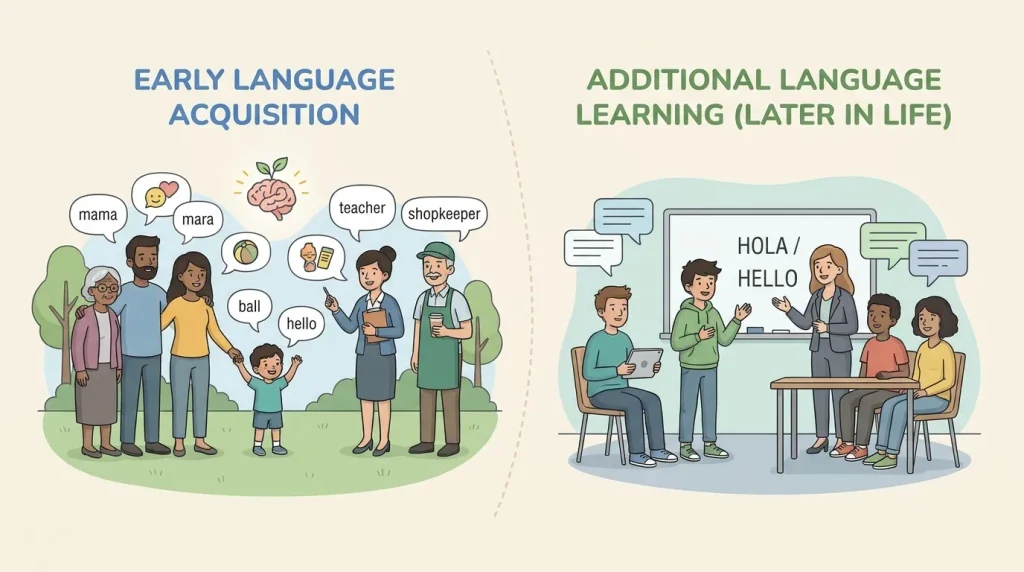
A native language is a language a person acquires naturally during early childhood, rather than learning it later as a foreign or additional language.
The expression emphasizes early acquisition. It is commonly used when discussing language proficiency, education, translation, and communication.
Examples:
- English is her native language.
- He speaks his native language at home.
- The teacher explained the concept in the students’ native language.
A native language is not necessarily the official language of the country where someone lives. A person may have a native language that differs from the country’s dominant language.
Why Does the Difference Matter?
Although the expressions often mean the same thing, choosing the appropriate term can make your writing clearer.
Language Learning
When discussing how someone acquired a language, native language and first language are often useful terms.
For example:
“Children generally acquire their first language through interaction with the people around them.”
Education
Schools may ask students which language they learned first or which language they use at home. These questions may have different answers.
Cultural Identity
A person may feel strongly connected to a language because of family traditions, even if they no longer speak it fluently.
Translation and Research
Translators, educators, and researchers may distinguish between a person’s first language, native language, home language, and dominant language. These terms are related, but they do not always describe the same thing.
For everyday conversations, however, you usually do not need to worry about choosing between mother tongue and native language.
The Core Rule
Mother tongue = Native language
Both normally refer to the language a person acquires first during childhood.
Use either expression when discussing someone’s first language. Choose mother tongue when family or cultural background is relevant, and native language when discussing language acquisition.
Remember: A language learned later in life is not normally called your mother tongue or native language simply because you become highly fluent in it.
See more: Led vs Lead: The Simple Rule That Stops the Confusion
How to Use Mother Tongue and Native Language
1. Use Either Expression When Identifying Your First Language
Both terms work naturally when describing the language a person learned during childhood.
- My mother tongue is Urdu.
- My native language is Urdu.
Both sentences are correct.
2. Use Mother Tongue When Discussing Family or Culture
The expression is particularly suitable when the conversation focuses on heritage, family traditions, or cultural background.
Example:
“My grandparents taught me our mother tongue, and I want to pass it on to my children.”
The phrase connects the language with the speaker’s family and cultural identity.
3. Use Native Language When Discussing Language Acquisition
Native language is common when discussing the language someone acquired naturally as a child.
Example:
“Children often acquire their native language through everyday interaction.”
This wording is especially suitable for educational or linguistic discussions.
4. Use First Language When You Need a Neutral Term
First language is another common expression for a language acquired first.
It is particularly useful in educational and linguistic contexts because it does not imply that the language was taught by a mother or that the person identifies with a particular cultural group.
Example:
“English is her first language, but she learned French at school.”
5. Do Not Confuse Native Language With the Language You Speak Best
A person’s first language and strongest language may not always be the same.
Someone who moves to another country during childhood may eventually become more proficient in the new language than in the language they learned first.
Example:
“Although Spanish is his native language, English is now the language he uses most comfortably at work.”
This sentence is perfectly logical. Native language describes early acquisition, not necessarily current ability.
Correct Examples of Mother Tongue and Native Language
The following examples show how both expressions work in different situations.
| Situation | Example |
|---|---|
| Everyday conversation | My mother tongue is Punjabi, but I also speak English. |
| Family | My parents encouraged me to speak my native language at home. |
| Could you please confirm your mother tongue on the application form? | |
| School | The children receive some lessons in their native language. |
| Workplace | English is not my native language, but I use it every day at work. |
| Interview | I grew up speaking Sindhi as my mother tongue. |
| Social media | I love reading poetry in my native language. |
| Academic writing | The study examined how children acquire their first language. |
| Translation | She translates English documents into her native language. |
| Language learning | I learned German as an additional language, not as my mother tongue. |
| Education | Students can discuss the topic in their mother tongue before presenting it in English. |
| Personal identity | My mother tongue is an important part of my cultural identity. |
Incorrect vs. Correct: Common Usage Mistakes
The following examples focus on mistakes involving meaning, context, and natural English usage. Some incorrect examples are grammatically possible sentences but communicate the wrong idea.
| Incorrect | Correct | Why |
|---|---|---|
| My mother tongue is English because I learned it at university. | English is the language I learned at university. | A language learned at university is not normally a mother tongue. |
| My native language is French because I speak it fluently now. | French is my strongest language now. | Fluency alone does not make a language native. |
| My mother tongue is my mother’s language. | My mother tongue is the first language I learned as a child. | The term does not necessarily refer to the mother’s own language. |
| I have only one native language because people cannot have two. | I grew up acquiring two native languages. | Some people acquire two languages from early childhood. |
| My mother tongue is the official language of my country. | My mother tongue is the language I learned first. | A country’s official language is not necessarily everyone’s first language. |
| I learned my native language when I was 25. | I learned a new language when I was 25. | A language learned in adulthood is not normally described as native. |
| Urdu is my mother tongue, but I never learned it first. | Urdu is my family’s language, but English was my first language. | The first language and family language may be different. |
| My native language is the language I use most often. | My dominant language is the language I use most often. | The language used most often is not necessarily the native language. |
| I speak my mother tongue as a foreign language. | I am learning my mother tongue again. | A mother tongue is not ordinarily classified as a foreign language for the person who acquired it first. |
| English is my native language because I was born in England. | English is my native language because I acquired it in early childhood. | Birthplace alone does not establish which language a person acquired first. |
Why People Confuse Mother Tongue and Native Language
The expressions are easy to confuse because they overlap in meaning and are frequently used as synonyms.
1. They Describe Similar Experiences
Both terms commonly refer to the language learned during childhood. This makes it difficult to identify a clear difference in everyday conversation.
2. The Word Mother Creates a Misleading Impression
Some learners assume that mother tongue must mean the language spoken by their mother.
In reality, the term refers to a person’s early language acquisition, not necessarily the language spoken by their biological mother.
3. People Assume Native Means Fluent
A native language is often associated with high proficiency, but the two concepts are not identical.
Someone may acquire a language naturally during childhood and later lose much of their ability to speak it. It can still be described as their native language.
4. Translation Can Create Confusion
In many languages, the expressions for mother tongue, native language, and first language overlap closely.
A learner may translate a familiar expression directly into English without considering whether the English phrase carries the same emphasis.
5. Language-Learning Definitions Are Sometimes Oversimplified
Learners may be taught that mother tongue, native language, and first language are always identical.
That is a useful starting point, but it does not cover every situation. Some people acquire two languages simultaneously, while others grow up speaking one language at home and another in the wider community.
Common Mistakes Checklist
Confusing Native Language With Birthplace
The mistake: Assuming that the language of your birthplace must be your native language.
Why it happens: People often connect nationality and language.
How to avoid it: Consider which language or languages you actually acquired during childhood.
Confusing Mother Tongue With Your Mother’s Language
The mistake: Assuming that your mother tongue must be the language your biological mother speaks.
Why it happens: The word mother creates a misleading impression.
How to avoid it: Think about the language you learned first, regardless of who taught it to you.
Confusing Native Language With Current Fluency
The mistake: Calling the language you speak best your native language.
Why it happens: Native speakers are often associated with high proficiency.
How to avoid it: Use dominant language or strongest language when describing your current language ability.
Assuming Everyone Has One Native Language
The mistake: Believing that a person can have only one native language.
Why it happens: Many people learn one language first, but not everyone has the same childhood experience.
How to avoid it: Recognize that some people acquire two languages simultaneously or from very early childhood.
Confusing Home Language With First Language
The mistake: Assuming that the language spoken at home must be the language learned first.
Why it happens: Home language and first language often overlap.
How to avoid it: Use home language for the language spoken in the household and first language for the language acquired first.
Mother Tongue vs. Native Language in Real English
Grammatically Correct and Natural
“English is my native language.”
This is a natural, everyday way to identify the language a person acquired during childhood. It is appropriate in conversation, interviews, language-learning discussions, and professional settings. The expression does not require the speaker to prove that English is their strongest language today. It simply identifies English as a language acquired naturally from an early age.
Grammatically Possible but Potentially Misleading
“My mother tongue is English because my mother speaks English.”
This sentence is grammatically correct, but the explanation does not establish that English is the speaker’s mother tongue. The person may have learned another language first, even if their mother speaks English. A clearer statement would identify the language the person actually acquired during childhood, rather than assuming that the mother’s language determines the child’s first language.
Natural Everyday English
“My first language is Punjabi, but I speak English more comfortably now.”
This is a natural way to explain that early language acquisition and present-day language ability are different. The sentence is particularly useful for multilingual speakers who use one language with family and another at school or work. It avoids suggesting that a person must always be most fluent in the language they learned first.
American vs. British English
There is no major difference in the meaning of mother tongue and native language between American and British English.
Both expressions are understood in both varieties.
| Expression | American English | British English |
|---|---|---|
| Mother tongue | Correct and commonly understood | Correct and commonly understood |
| Native language | Correct and commonly understood | Correct and commonly understood |
| First language | Correct and commonly understood | Correct and commonly understood |
The choice is not determined by whether you are writing American or British English.
Formal vs. Informal Usage
Both expressions are appropriate in formal and informal English.
| Context | Recommended Expression | Example |
|---|---|---|
| Everyday conversation | Either | My native language is Urdu. |
| Family and cultural discussions | Mother tongue | I want my children to learn our mother tongue. |
| Academic writing | First language or native language | The participants acquired English as their first language. |
| Language-learning applications | Native language or first language | Select your native language. |
| Official forms and surveys | Follow the form’s definition | Please indicate your mother tongue. |
In formal research, the most important consideration is not which expression sounds more formal. It is whether the term has been clearly defined.
For example, a survey may define mother tongue as the first language learned at home. Another may ask about the first language acquired, regardless of where it was learned.
When answering a form, follow its instructions rather than assuming that every organization uses the same definition.
Comparison Table: Mother Tongue vs. Native Language vs. First Language
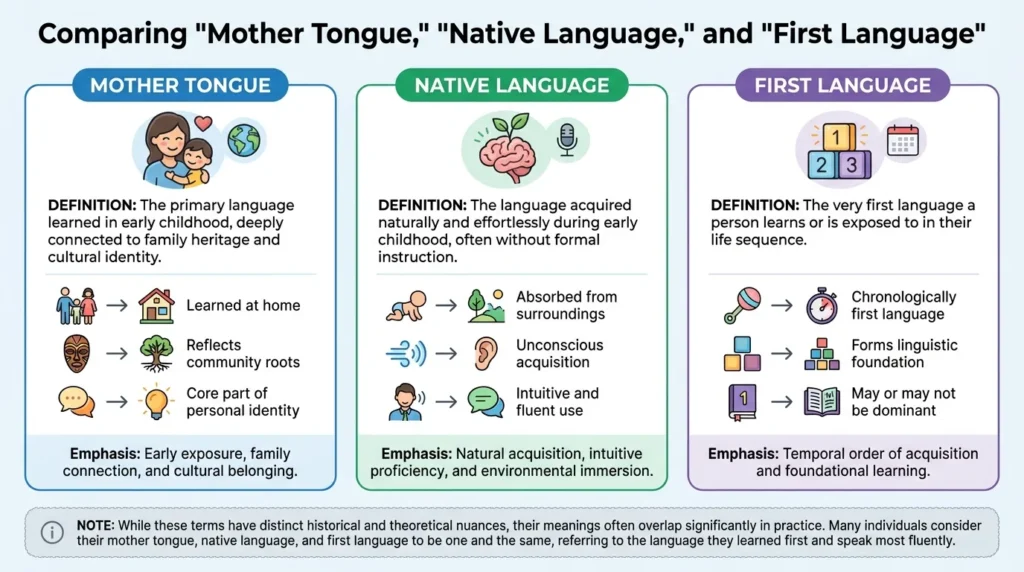
| Feature | Mother Tongue | Native Language | First Language |
|---|---|---|---|
| Basic meaning | Language learned first in childhood | Language acquired naturally in early childhood | Language acquired first |
| Main emphasis | Early language and often family or cultural background | Early acquisition and native-language status | Order of acquisition |
| Family connection | Often associated with family | Not necessarily emphasized | Not necessarily emphasized |
| Can refer to two languages? | Yes, in some definitions | Yes | Yes |
| Suitable for everyday English? | Yes | Yes | Yes |
| Suitable for academic writing? | Yes, when defined | Yes, when defined | Yes |
| Does it mean the language spoken best? | Not necessarily | Not necessarily | Not necessarily |
| Does it mean the official language of a country? | No | No | No |
Related Terms You Should Know
| Term | Meaning |
|---|---|
| Home language | A language spoken in a person’s home. It may or may not be their first language. |
| Dominant language | The language a person currently uses most often or knows best in a particular context. |
| Second language | A language learned in addition to a first language. |
| Foreign language | A language learned that is not generally used as the main language of the surrounding community. |
| Heritage language | A language connected to a person’s family or cultural background, often learned or maintained within a minority-language community. |
| Mother tongue | Usually the first language acquired in childhood, often associated with family or cultural identity. |
| Native language | Usually a language acquired naturally during early childhood. |
Real-Life Situations
1. During a Job Interview
An interviewer asks:
“What is your native language?”
You can answer:
“My native language is Punjabi, but I am also fluent in English.”
This answer identifies your early language and explains your current language ability separately.
2. When Completing an Application Form
A form asks:
“Please state your mother tongue.”
You can write:
“Urdu.”
If you learned Urdu first, this is an appropriate answer.
3. In a Workplace Meeting
A colleague asks:
“Would you prefer to discuss this in your native language?”
You can respond:
“Yes, that would make it easier for me to explain the details.”
The expression is natural and appropriate in a professional conversation.
4. In an Academic Essay
You are writing about language acquisition.
You could write:
“Children generally acquire their first language through interaction with the people around them.”
This is a clear and suitable sentence for academic writing.
5. In a Text Message
A friend asks:
“Do you speak your mother tongue at home?”
You can reply:
“Yes, we usually speak Punjabi at home.”
The phrase is natural in an informal conversation.
Quick Quiz: Mother Tongue vs. Native Language
Choose the most appropriate answer for each sentence.
1. English is the language I learned naturally as a child. It is my ______.
A. foreign language
B. native language
C. second language
2. My parents speak Punjabi at home, and I learned it first. Punjabi is my ______.
A. mother tongue
B. foreign language
C. official language
3. I learned French at university and now speak it fluently. French is my ______.
A. native language
B. mother tongue
C. additional language
4. Which sentence is correct?
A. My native language is English because I was born in England.
B. My native language is English because I acquired it during childhood.
C. My native language is English because I learned it last year.
5. Can a person have two native languages?
A. Yes, if they acquired both during early childhood.
B. No, everyone has exactly one.
C. Only if they live in two countries.
Quiz Answers
- B — Native language.
- A — Mother tongue.
- C — Additional language.
- B — Early acquisition, not birthplace alone, determines native-language status.
- A — Some people acquire two languages simultaneously or from very early childhood.
FAQ
Is mother tongue the same as native language?
Yes. In everyday English, the two expressions usually refer to the same thing: the language a person learns first during childhood. They can often be used interchangeably, although mother tongue may carry more cultural or family emphasis.
Can I have two mother tongues?
Yes. Some people grow up learning two languages at the same time. They may describe both as their mother tongues or native languages. The exact terminology can depend on the definition used by a particular organization or study.
Is mother tongue always the language spoken by my mother?
No. A mother tongue is not necessarily the language spoken by your biological mother. You may acquire your first language from your father, grandparents, caregivers, or the surrounding community.
Is my mother tongue the language I speak best?
Not necessarily. Your mother tongue is generally the language you learned first. You may become more fluent in another language later in life, particularly if you use it more frequently at school, work, or home.
Can English be my native language if my parents speak another language?
Yes. Your native language depends on the language or languages you acquired during childhood, not simply the languages your parents speak. You may acquire English as your native language even if your parents speak another language at home.
Can a language be my mother tongue if I no longer speak it?
Yes, depending on the definition being used. A person may retain a cultural or historical connection to a language they acquired in childhood, even if they no longer speak it fluently. Some surveys, however, require respondents to still understand their first language.
What is the difference between mother tongue and home language?
A mother tongue is usually the first language a person acquired during childhood. A home language is a language spoken in the person’s home. These may be the same, but they do not have to be. For example, a child may learn one language from their parents and another at school.
Is first language better than mother tongue in academic writing?
Not automatically. First language is often a useful neutral term in academic writing, but mother tongue is also appropriate when it matches the subject and is clearly defined. The best choice depends on the research question and the terminology used by the study.
Is native language the same as dominant language?
No. Native language usually refers to early language acquisition, while dominant language refers to the language a person currently uses most often or knows best in a particular context. A person’s native language and dominant language may be different.
Which expression should I use on an English-learning application?
Use the expression requested by the application. If both are accepted, either is generally correct. If the application asks about the language you learned first, first language is also an appropriate choice.
Quick Summary
Mother tongue and native language usually have the same meaning: the language a person learns first during childhood. Both expressions are correct, and you can generally use either in everyday conversation, writing, and professional communication. Mother tongue often emphasizes family or cultural identity, while native language emphasizes early language acquisition. Neither term necessarily means the language you speak best today. Some people acquire two languages during childhood and have two native languages or mother tongues. If you need a neutral expression, first language is also a good choice. Remember that a person’s native language is not automatically the official language of their country, their mother’s language, or the language they currently use most often.