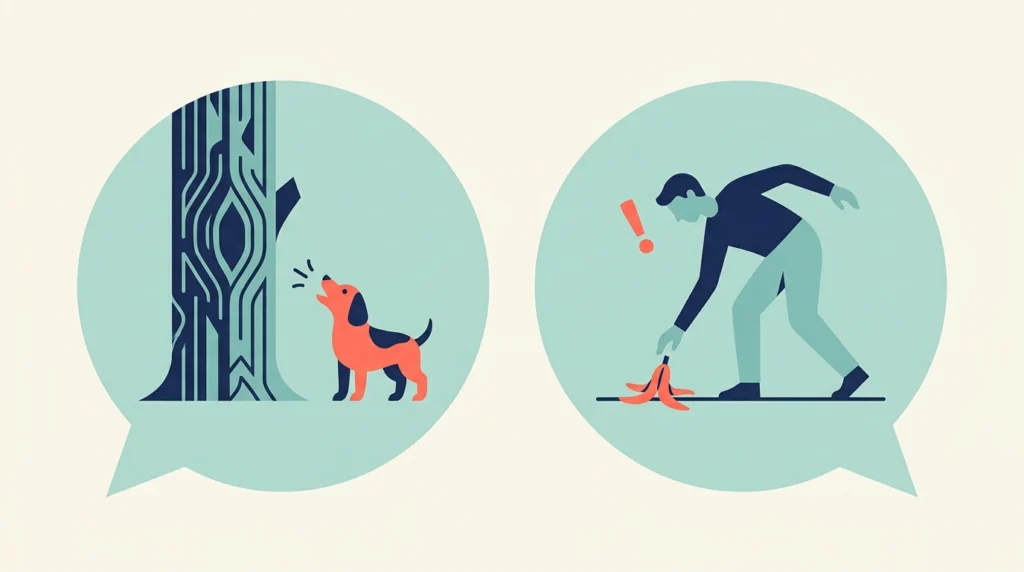

Puns and jokes are both forms of humor, but they are not exactly the same. A pun is a type of wordplay that creates humor through multiple meanings or similar-sounding words, while a joke is any humorous remark or story intended to amuse people. A pun can be a joke, but a joke does not have to contain a pun. The easiest way to tell them apart is to ask whether the humor depends on the words themselves or on the situation, story, or unexpected ending.
What Is the Difference Between Puns and Jokes?
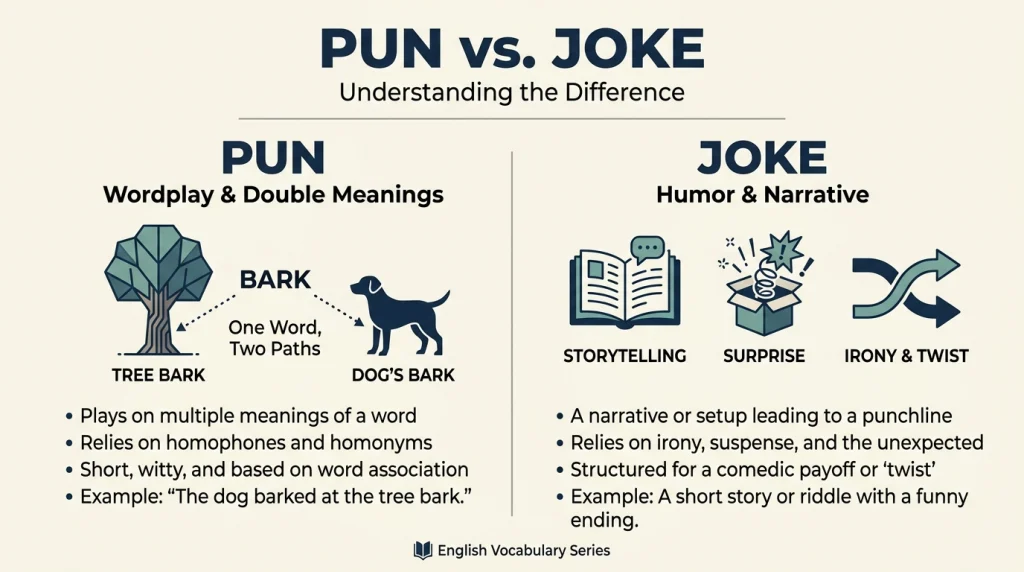
The main difference is how the humor works.
A pun plays with language. It uses a word’s different meanings, similar sounds, or occasionally its spelling to create a humorous effect. For example, someone might say, “The bicycle couldn’t stand on its own because it was two-tired.” The humor comes from two-tired sounding like too tired.
A joke is a broader form of humor. It may use wordplay, a surprising ending, an amusing situation, irony, exaggeration, or a short story. Consider this example:
“I told my suitcase we weren’t going on vacation. Now it’s dealing with emotional baggage.”
This joke uses the double meaning of baggage: luggage and emotional burdens. Because the humor relies on wordplay, it is also a pun-based joke.
Not every joke works this way. A joke about an unexpected event can be funny without using any double meanings or similar-sounding words.
What Is a Pun?
A pun is a humorous use of language that brings together two meanings or exploits words that sound alike but mean different things. It is also called a play on words.
For example:
- “The calendar’s days are numbered.”
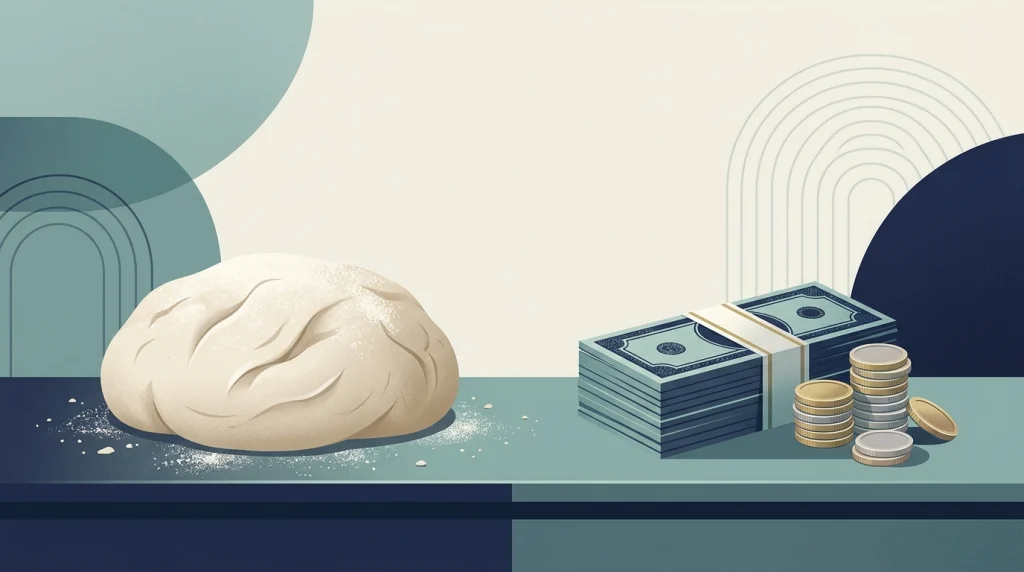
- “I wanted to become a baker, but I couldn’t make enough dough.”
- “The electrician was shocked by the results.”
In the first example, numbered can mean that the calendar’s days are marked with numbers, while days are numbered can suggest that something will soon end. In the second, dough means both bread mixture and money. In the third, shocked can describe an emotional reaction or an electric shock.
The humor comes from understanding both meanings at once.
What Is a Joke?
A joke is something said or written to amuse people. It can be a short question-and-answer exchange, a one-line remark, a story, or a longer comic performance.
For example:
“I started exercising every morning, but my bed keeps convincing me to postpone the meeting.”
This is a joke because it presents an ordinary struggle in an amusing way. It personifies the bed, treating it as if it could persuade someone. The humor does not depend on two meanings of a particular word.
Jokes can use many techniques, including surprise, exaggeration, irony, wordplay, and misunderstandings. A pun is just one possible technique.
Why the Difference Matters
Understanding puns and jokes helps you describe humor accurately, write more engaging content, and understand English wordplay.
The distinction is especially useful in these situations:
- English learning: Recognizing puns helps you understand expressions that may seem confusing when interpreted literally.
- Creative writing: A pun can make a headline, caption, poem, or advertisement more memorable.
- Conversation: Knowing why a line is funny can help you understand humor and respond naturally.
- Teaching: The distinction helps explain multiple meanings, homophones, and other features of English vocabulary.
- Professional writing: A writer can deliberately choose wordplay for a lighthearted message or use straightforward humor when clarity matters more.
Puns also depend heavily on language. A pun involving dough and money may work in English but lose its humor when translated into a language that uses unrelated words for those meanings.
The Core Rule
Every pun is a form of wordplay, and a pun can be a joke. However, not every joke is a pun.
Remember these two questions:
- Does the humor depend on a word having two meanings or sounding like another word? It is probably a pun.
- Does the humor come from a funny situation, story, surprise, or other comic technique? It may be a joke without being a pun.
These categories can overlap. You do not have to choose between calling something a pun and calling it a joke when it qualifies as both.
ALSO READ: Invest or Invest In: Which Is Correct?
How to Recognize and Use Puns and Jokes
When to Use a Pun
Use a pun when you want to make language itself part of the humor. Puns work particularly well in short, memorable writing.
Common places to use them include:
- Social media captions
- Greeting cards and birthday messages
- Advertising slogans
- Blog titles and creative headlines
- Casual conversations
- Comedy writing and word games
For example, a florist advertising a sale might write, “We’re rooting for your garden.” The line connects the idea of supporting someone with the roots of plants.
A pun is most effective when readers can understand both meanings without struggling to decode the sentence. If the wordplay needs a long explanation, the humor may lose its impact.
When to Use a Joke
Use a joke when your goal is to amuse an audience, regardless of whether the humor relies on wordplay.
Jokes are useful in:
- Casual conversations
- Comedy routines
- Personal stories
- Friendly presentations
- Entertainment writing
- Lighthearted messages
For example:
“My new alarm clock is very ambitious. It believes I can accomplish everything before 6 a.m.”
The humor comes from exaggeration and the contrast between an ambitious alarm clock and a sleepy person.
How to Tell Them Apart in Three Steps
- Find the source of the humor. Identify the word, situation, action, or ending that makes the line amusing.
- Check for wordplay. Look for double meanings, similar sounds, or a deliberate switch between meanings.
- Allow for overlap. If the wordplay forms the humorous punchline, the line can be both a pun and a joke.
You do not need to memorize technical terms to use this method. Focus on what makes the line funny.
Correct Examples of Puns and Jokes
The following examples show how both forms of humor work in everyday situations.
Puns in Everyday English
1. Conversation
“I used to be afraid of hurdles, but I got over them.”
Why it works: Getting over a hurdle can mean physically clearing an obstacle or overcoming a difficulty.
2. Email
Subject: A Bright Idea
“Our team has a bright future, and this lighting project will help us see it clearly.”
Why it works: Bright refers to both physical light and a promising future. The wordplay suits a lighthearted message about a lighting project.
3. School
“The geography teacher’s career really took off because she knew how to map out her future.”
Why it works: Map out means to plan something and also refers to creating a map.
4. Workplace
“Our new accountant is great with figures. She always knows how to make the numbers add up.”
Why it works: Figures refers to numerical values, while add up can mean both perform an arithmetic operation and make sense.
5. Social media
“Planting a garden is a growing concern of mine.”
Why it works: Growing refers literally to plants developing and figuratively to an increasing interest or concern.
6. Academic writing
“The study offers a fresh perspective on the subject, although its conclusions should be taken with a grain of salt.”
Why it works: The familiar expression a grain of salt suggests caution. If used alongside a discussion of mineral samples or salt chemistry, it could also create a deliberate pun. In an ordinary academic paper, however, the expression is usually figurative rather than a joke.
7. Friendly text message
“I’m reading a book about anti-gravity. I can’t put it down.”
Why it works: Can’t put it down means the book is so interesting that the reader wants to continue. The anti-gravity topic adds a second, literal interpretation.
Jokes That Do Not Depend on Puns
8. Conversation
“I tried to organize my schedule, but I needed a break after writing down all the things I had to do.”
Why it works: The humor comes from the contradiction between organizing tasks and immediately feeling overwhelmed.
9. Workplace presentation
“My first attempt at public speaking taught me an important lesson: confidence is easier to find when the microphone is switched off.”
Why it works: The line relies on an awkward situation and a humorous reversal, not on a double meaning.
10. School
A student says, “I studied all night for the test. Unfortunately, the test covered the chapters I planned to read this morning.”
Why it works: The unexpected contrast between the student’s plan and the test’s content creates the humor.
11. Email to a friend
“I planned a relaxing weekend with no responsibilities. Then Monday sent me a reminder that it was only a weekend.”
Why it works: The joke personifies Monday and contrasts the desire to relax with the return of everyday responsibilities.
12. Social media
“My fitness tracker says I should move more. I moved it to the other side of the desk, so we are both making progress.”
Why it works: The humor comes from deliberately interpreting the advice in an overly literal way.
These examples illustrate the central distinction: some lines rely on language with multiple meanings, while others rely on an amusing situation or unexpected idea.
Incorrect vs. Correct: Common Confusions
The difference between a pun and a joke is conceptual rather than a strict grammar rule. Many mistakes happen because people treat the two words as opposites or assume that all short, funny sentences are puns.
| ❌ Incorrect assumption or wording | ✅ Correct understanding | Why |
|---|---|---|
| A pun and a joke are completely different things. | A pun can be a type of joke. | The categories overlap because a joke can use wordplay. |
| Every joke is a pun. | Some jokes use wordplay; others use situations, stories, or surprise. | A joke is a broader category. |
| A pun must be a question-and-answer joke. | A pun can be a single word, phrase, sentence, or part of a longer joke. | Wordplay does not require a particular format. |
| A joke must have a punchline involving a double meaning. | A joke can end with a surprise or an amusing observation. | Double meanings are only one source of humor. |
| A pun is always a single word. | A pun can involve an entire phrase or sentence. | The wordplay may depend on the relationship between several words. |
| A sentence containing two meanings is automatically a pun. | The double meaning generally needs to contribute to the intended humor or effect. | Ambiguity alone does not guarantee wordplay or humor. |
| Puns and riddles are exactly the same. | A riddle asks the reader to solve a question; a pun uses wordplay. | A riddle may contain a pun, but the terms describe different features. |
| A funny sentence is always grammatically incorrect. | Humor can use perfectly grammatical language. | Wordplay often works because the same correct wording supports two interpretations. |
| Puns only work in spoken English. | Puns can appear in speech, writing, advertising, and visual media. | Written spelling and visual presentation can also create wordplay. |
| If people groan at a pun, it is not really a joke. | A pun can be deliberately silly or corny and still be a joke. | Humor depends on audience and intention, not universal laughter. |
The most important correction is that pun describes a particular way of creating humor, whereas joke describes a broader humorous expression or performance.
Why People Confuse Puns and Jokes
1. Both Are Designed to Amuse
In everyday conversation, people often use pun and joke loosely because both are associated with humor. Someone may say, “I have a pun for you,” or “I have a joke for you,” and introduce the same line.
Neither introduction is necessarily wrong. Calling a pun a joke is perfectly reasonable. Calling a joke a pun is accurate only when it contains the relevant wordplay.
2. Puns Can Sound Like Ordinary Statements
A pun often looks like a normal sentence until the reader notices a second meaning.
Consider: “The baker needed more dough.”
This could be a straightforward statement about bread-making. If the surrounding context suggests a shortage of money, dough can carry both meanings. Context helps the reader recognize the intended wordplay.
3. Some Jokes Combine Several Techniques
A single joke can include wordplay, exaggeration, irony, and an unexpected ending. It may be difficult to assign it to only one category.
The best approach is to identify its main humorous mechanism rather than force it into an exclusive label.
4. Translation Can Hide the Wordplay
Puns often rely on the sound, spelling, or multiple meanings of English words. When translated, the wording may change and the joke may stop working.
For English learners, this can make a pun appear nonsensical even when its original wording is clever. Understanding the two meanings is usually more useful than translating the sentence word for word.
5. Spellcheck Cannot Explain Humor
Spellcheck and grammar tools can help identify spelling and grammar problems, but they cannot reliably tell you why a sentence is funny or whether a particular line is a pun.
For instance, a tool may accept a pun as grammatically correct without recognizing the wordplay. That is not necessarily an error: grammar and humor are different aspects of language.
Common Mistakes Checklist
Use this checklist when identifying or writing puns and jokes.
- Treating puns and jokes as opposites. Remember that a pun can be a joke. Ask whether the humor depends on wordplay.
- Assuming every joke uses a double meaning. Look for humor based on surprise, exaggeration, irony, or an amusing situation.
- Confusing wordplay with accidental ambiguity. A sentence with two possible meanings is not automatically a successful pun; the meanings must contribute to the intended effect.
- Forcing a pun into a formal message. Consider your audience and purpose. A clever line can be distracting when the reader needs direct information.
- Using unfamiliar words without enough context. Readers need to recognize both meanings for most verbal puns to work.
- Expecting every reader to understand the same pun. Language knowledge, cultural references, and personal taste influence how humor is received.
- Judging a joke only by its length. A one-line joke can be a pun, while a longer joke can contain no wordplay at all.
The simplest way to avoid these mistakes is to separate the purpose of the line (to amuse) from the technique used to achieve it (such as wordplay).
Puns and Jokes in Real English
Grammatically Correct
Both puns and jokes can use standard, grammatically correct English. For example, “The musician got locked out because he lost his keys” can be a straightforward sentence, while “The musician couldn’t find the right key” can create a musical double meaning if the context supports it. The second line uses ordinary grammar to produce wordplay. A pun does not need a spelling mistake, an incomplete sentence, or incorrect grammar to be funny.
Grammatically Possible but Unnatural
A sentence may be grammatically possible yet feel awkward because its wordplay is difficult to understand. For example, inventing an obscure technical meaning for a common word may allow a writer to construct a double interpretation, but readers might not recognize the intended connection. The sentence could still be a pun in principle, yet fail as effective humor. Clear wording and familiar meanings usually make a pun easier to understand.
Natural, Everyday English
In everyday conversation, people often use joke as the general term for something funny and pun when they want to emphasize wordplay. Someone might say, “That’s a good joke,” after hearing a story, or “That’s a terrible pun,” after hearing a deliberate play on words. These are natural ways to describe humor, but they are not rigid rules. A speaker can also call a clever pun a joke without causing confusion.
American vs. British English
There is no major difference between American and British English in the basic distinction between pun and joke. Both varieties use pun for humor based on wordplay and joke for a broader range of humorous remarks and stories.
Spelling also remains the same: pun, puns, joke, jokes. The past-tense verb forms are punned and joked, respectively.
Some puns work better in one variety because pronunciation, vocabulary, or cultural references differ. For example, a pun that depends on an American pronunciation may not be immediately understood by every British English speaker, and vice versa. That is a difference in how individual puns work, not a difference in the basic definitions.
Formal vs. Informal Usage
Puns and jokes are not limited to informal English, but their suitability depends on the context.
Puns can be effective in headlines, advertising, speeches, creative writing, and lighthearted workplace communication. In formal academic or technical writing, avoid unnecessary wordplay when it could make the meaning less precise.
Jokes are common in everyday conversation, entertainment, speeches, and informal messages. In a professional setting, a joke may help establish rapport, but it should suit the audience and avoid undermining a serious subject.
For example, “Our results provide a strong foundation for future research” is suitable for an academic report. A pun about foundations might work in a presentation about construction, but it would not necessarily improve a research paper.
Neither term is inherently formal or informal. The surrounding language, audience, and purpose determine whether the humor is appropriate.
Comparison Table: Pun vs. Joke
| Feature | Pun | Joke |
|---|---|---|
| Meaning | A form of wordplay used for humor or rhetorical effect | A humorous remark, story, or performance |
| Main technique | Multiple meanings, similar sounds, or other wordplay | Any comic technique, including wordplay |
| Must involve wordplay? | Yes, that is its defining feature | No |
| Can be a single sentence? | Yes | Yes |
| Can be a longer story? | Yes, as part of a larger piece | Yes |
| Can use a surprise ending? | Yes | Yes |
| Can be both? | Yes, when the pun functions as a joke | Yes, when the joke relies on wordplay |
| Common settings | Captions, headlines, word games, conversation | Conversation, comedy, stories, presentations |
| Example | “The baker made enough dough to rise in the business.” | “I made a to-do list, then added ‘make a to-do list’ to it.” |
| Best identification question | Does the humor depend on language? | Is the expression intended to amuse? |
Real-Life Situations: Which Word Should You Use?
Situation 1: A Friendly Conversation
Your friend says, “I used to work in a shoe factory, but I just couldn’t fit in.”
You can respond, “That’s a pun!”
The humor comes from fit in, which can refer to belonging socially and fitting into footwear. You could also call it a joke because it is a humorous remark.
Situation 2: A Workplace Meeting
A colleague says, “We need to keep our plans flexible. After all, we’re working with a bendable budget.”
If the word flexible is being used to connect adaptability with physical bending, the line may be a pun. If the colleague simply makes an amusing observation about changing plans, it may be a joke without a clear pun.
Situation 3: A Social Media Caption
A photograph shows a cat sitting beside a computer.
Caption: “This employee is great at mouse management.”
This is a pun because mouse can mean a computer device or an animal. The caption is also a joke, but pun identifies the wordplay more precisely.
Situation 4: An Email
You are sending a friendly message to a colleague who has finished a gardening project.
You write: “Congratulations on completing the project. It looks like all your hard work has really blossomed.”
The word blossomed connects the garden with the idea of progress. This is a light pun or figurative wordplay. Whether it is appropriate depends on your relationship and the email’s tone.
Situation 5: An English Exam
A question asks you to define a pun.
A strong answer would be: “A pun is a form of wordplay that uses multiple meanings or similar-sounding words to create humor.”
Do not define it simply as “a funny story.” That describes some jokes, but it does not explain the specific feature that makes a pun a pun.
A Simple Way to Remember the Difference
Think of a joke as the larger category and a pun as one possible method of creating humor.
Memory trick: A joke makes you laugh; a pun makes you think about words.
This is only a memory aid, not a strict rule. Some puns make people laugh immediately, and some jokes require very little thought. The key is whether the humor depends on wordplay.
If the funny effect disappears when you replace a word with a synonym, that can be a useful clue that the original wording contains a pun. For example, changing dough to money in a joke about a baker may remove the connection between baking and earnings. However, this test is not foolproof because many other jokes also depend on precise wording.
Quick Summary
Puns and jokes are closely related, but they describe different things. A pun is a form of wordplay that creates humor through multiple meanings, similar sounds, or other features of language. A joke is a broader humorous remark, story, or performance that can use wordplay, surprise, irony, exaggeration, or an amusing situation. A pun can therefore be a joke, but many jokes are not puns. To tell them apart, identify what makes the line funny. If the humor depends on the wording or a double meaning, it is likely a pun. If it depends on a story, situation, or unexpected outcome, it may be a joke without a pun. Both can be grammatically correct, and their effectiveness depends on context, clarity, and audience.