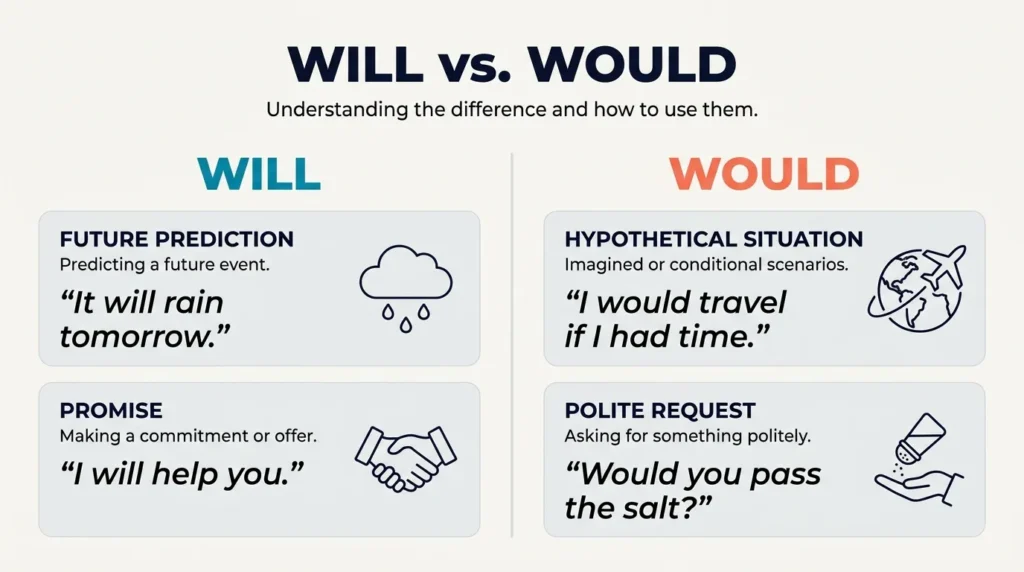

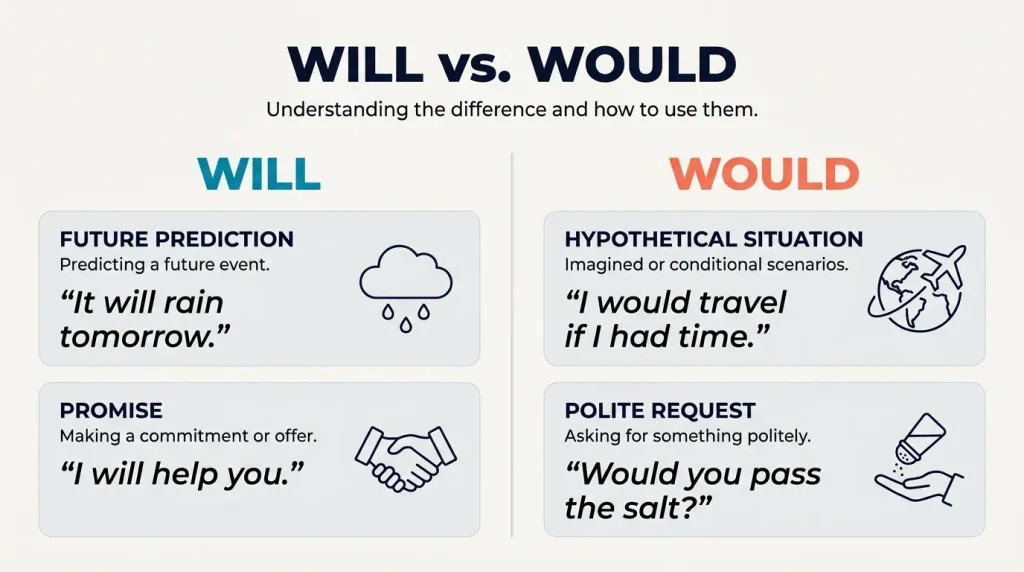
Use will to talk about expected future events, predictions, promises, decisions, and willingness. Use would to describe hypothetical situations, polite requests, preferences, past habits, and future events viewed from a past point in time. For example, “I will help you” expresses a commitment, while “I would help you if I could” describes an action that depends on a condition. Both words are modal verbs, and the correct choice depends on your intended meaning.
What Are Will and Would?
Will and would are modal verbs. Modal verbs are helping verbs that express ideas such as possibility, willingness, prediction, obligation, and hypothetical results.
They come before the base form of a main verb. The base form is the simplest form of a verb, without endings such as -s, -ed, or -ing.
For example:
- I will call you tonight.
- I would call you if I had your number.
- She will attend the meeting.
- She would attend if she were available.
Both words can refer to the future, but they do not always express the same meaning.
Will often presents an event as expected, intended, or decided. Would often introduces a condition, creates distance from a direct statement, or describes a future event from a past viewpoint.
However, these are general patterns rather than absolute rules. Context determines the exact meaning.
Why the Difference Between Will and Would Matters
Choosing between will and would can change the meaning, tone, or certainty of a sentence.
Consider these examples:
- I will accept the offer. You are expressing a decision or commitment.
- I would accept the offer. You are describing a hypothetical decision, often with an unstated or stated condition.
- Will you send me the report? You are making a direct request.
- Would you send me the report? You are making a less direct, often more polite request.
These distinctions matter in everyday conversations, job interviews, professional emails, academic writing, and examinations.
In a workplace, for instance, “I will finish the project by Friday” sounds like a commitment. “I would finish the project by Friday if I received the data today” makes the commitment conditional.
The words are similar, but the messages are different.
The Core Rule: When to Use Will vs. Would
Use will for an expected or intended action, and use would for an imagined result, a softened request, a past viewpoint, or a repeated past action. Then check the surrounding sentence to confirm the meaning.
Remember these common patterns:
- Will + base verb: I will study.
- Would + base verb: I would study.
- If + present simple, will + base verb: If I have time, I will study.
- If + past simple, would + base verb: If I had time, I would study.
- Past reporting verb + would: She said she would study.
The conditional examples describe common patterns, not every possible conditional sentence. English also uses other structures for real, hypothetical, and past situations.
How to Use Will
1. Use Will for Future Predictions
Use will when you predict or expect something to happen in the future.
Examples:
- The weather will improve tomorrow.
- I think our team will win the match.
- Your package will arrive next week.
- The new policy will affect several departments.
- This exercise will help you understand modal verbs.
A prediction expresses what someone believes is likely to happen. It does not guarantee that the event will occur.
Compare:
- It will rain tomorrow. — A prediction about the future.
- It would rain tomorrow if the storm moved east. — A hypothetical result that depends on a condition.
2. Use Will for Decisions Made at the Moment of Speaking
English speakers often use will for decisions made as they speak.
Examples:
- The phone is ringing. I will answer it.
- I forgot my notebook. I will borrow a sheet of paper.
- You look tired. I will make you some tea.
- We need another volunteer. I will help.
In these situations, the speaker decides what to do at that moment.
For previously arranged plans, the present continuous or going to may sound more natural, depending on the context.
For example, “I am meeting the client tomorrow” often emphasizes an arrangement, while “I will call the client now” can express a decision made at the moment.
3. Use Will for Promises and Commitments
Use will when you promise to do something or commit to an action.
Examples:
- I will keep your information confidential.
- We will deliver the revised document by Monday.
- I will never forget your kindness.
- Our team will investigate the problem.
- I will pay you back next week.
The word communicates intention or commitment. It does not, by itself, prove that the speaker will fulfill the promise.
4. Use Will to Express Willingness
Will can show that someone is willing to do something.
Examples:
- I will help you carry those boxes.
- She will explain the instructions again.
- They will support the proposal.
- My brother will lend me his bicycle.
In negative sentences, won’t can express refusal or unwillingness.
For example:
- He won’t listen to my advice.
- The child won’t eat vegetables.
- The manager won’t approve the request.
Depending on the context, won’t can also describe a failure to happen, as in “The door won’t close.” The meaning is not always a deliberate refusal.
5. Use Will in First Conditional Sentences
A first conditional sentence describes a real or possible future situation and its likely result.
The common structure is:
If + present simple, will + base verb.
Examples:
- If you study regularly, you will improve.
- If she arrives early, we will start the meeting.
- If it rains, we will stay indoors.
- If you submit the form today, we will review it tomorrow.
Notice that the verb after if is normally in the present simple in this pattern, even though the condition refers to the future.
Correct: If he comes tomorrow, we will discuss the issue.
Incorrect for this intended meaning: If he will come tomorrow, we will discuss the issue.
There are special uses of will in some conditional clauses, particularly when it expresses willingness or insistence. However, the ordinary first conditional generally uses the present simple after if.
6. Use Will for Requests and Offers
Will can make a request or offer.
Examples:
- Will you help me move this table?
- Will you please check the figures?
- I will carry that bag for you.
- We will show you how the system works.
A question with will can sound direct, but it is not necessarily rude. Tone, context, and the relationship between speakers all matter.
For a softer request, would is often a good alternative.
How to Use Would
1. Use Would for Hypothetical Situations
A hypothetical situation is imagined rather than presented as an established fact.
Use would to describe what might happen under a particular condition.
Examples:
- I would travel more if I had more money.
- She would accept the job if the salary were higher.
- We would move abroad if we found the right opportunity.
- He would feel better if he got more sleep.
- They would buy the house if the price were lower.
The usual second conditional pattern is:
If + past simple, would + base verb.
For example:
“If I lived near the office, I would walk to work.”
The past form lived does not necessarily refer to past time here. It marks the situation as hypothetical or more distant from reality.
In this example, the speaker is imagining living near the office, not necessarily describing a previous home.
2. Use Would for Polite Requests
Would often makes requests less direct.
Compare:
- Will you open the window?
- Would you open the window?
Both sentences are grammatically correct. The second often sounds more considerate because it presents the request less directly.
Other examples include:
- Would you check this document for me?
- Would you mind waiting a moment?
- Would you please lower your voice?
- Would you be able to attend the meeting tomorrow?
A particularly common structure is would you mind + verb-ing.
Correct: Would you mind closing the door?
Incorrect: Would you mind to close the door?
The expression takes an -ing form because mind is followed by a gerund in this construction.
3. Use Would Like for Polite Wishes and Offers
The expression would like is a polite way to express what someone wants.
Examples:
- I would like a glass of water.
- I would like to speak with the manager.
- We would like to thank everyone who attended.
- Would you like some coffee?
- Would you like to join us for dinner?
In ordinary service interactions, “I would like a receipt, please” is a natural, polite request.
Do not automatically replace would like with will like. The two expressions serve different purposes.
“I would like a cup of tea” expresses a present desire.
“You will like this tea” predicts that someone will enjoy it.
4. Use Would for Reported Speech
Reported speech communicates what someone said without necessarily repeating their exact words.
When a statement containing will is reported from a past viewpoint, will commonly changes to would.
Direct speech: Maya said, “I will email you tonight.”
Reported speech: Maya said that she would email me that night.
More examples:
- He said he would arrive before noon.
- They promised they would pay the invoice.
- The teacher explained that the results would be available on Friday.
- I thought the interview would take an hour.
This change is called backshift. It means that a verb form moves back when the statement is reported from a past viewpoint.
However, the change is not compulsory in every context. If something remains true or the speaker wishes to preserve the original time perspective, will may sometimes remain appropriate.
5. Use Would for the Future in the Past
Sometimes we describe what someone expected or planned to happen in the future from a point in the past.
In this case, would expresses the future as viewed from an earlier moment.
Examples:
- I knew she would understand.
- He believed the business would succeed.
- We expected the train would arrive before sunset.
- They promised that the new system would solve the problem.
Consider this timeline:
In 2024, Ali said, “I will become a teacher.”
Later, you report his words: Ali said he would become a teacher.
The becoming was in the future from Ali’s original viewpoint. The reporting takes place from a later viewpoint, so would fits the sentence.
This use of would does not automatically mean that the action is imaginary. It may describe a genuine expectation about the future.
6. Use Would for Repeated Past Actions
Would can describe actions that happened repeatedly in the past, especially in memories and stories.
Examples:
- Every summer, we would visit our grandparents.
- My father would read to us before bedtime.
- After dinner, the neighbors would gather in the garden.
- During the holidays, she would bake bread for the family.
In these examples, would emphasizes a repeated action or habit.
However, it is not generally used in the same way to describe a past state.
Natural: I used to live in Lahore.
Usually unnatural for this meaning: I would live in Lahore.
The distinction is that live describes a state in the second example, rather than a repeated action. Used to can describe both past states and past habits, while habitual would generally describes repeated actions.
7. Use Would for Preferences
Use would rather to express a preference.
Examples:
- I would rather stay at home tonight.
- She would rather travel by train.
- We would rather discuss the matter privately.
- Would you rather have tea or coffee?
The pattern is:
Subject + would rather + base verb.
Correct: I would rather wait.
Incorrect: I would rather to wait.
When comparing two choices, would rather makes your preference clear without requiring a separate sentence about what you do not want.
8. Use Would to Soften Opinions and Advice
Would can make opinions, suggestions, and advice sound more tentative or less forceful.
Examples:
- I would suggest reviewing the figures again.
- I would recommend applying before the deadline.
- I would think carefully before accepting the offer.
- I would say that the second option is more practical.
This use is common in professional discussions because it allows the speaker to offer a view without presenting it as an absolute instruction.
Compare:
“You should revise the report.” — Direct advice.
“I would suggest revising the report.” — A softer recommendation.
Both can be appropriate. The best choice depends on the relationship, purpose, and tone.
Will vs. Would: Correct Examples in Everyday English
The following examples show how the choice changes across different situations.
- Conversation: “I will meet you outside the station at six.” — A plan or commitment.
- Conversation: “I would join you, but I have an appointment.” — A hypothetical action limited by a real obstacle.
- Email: “I will send the updated file this afternoon.” — A commitment.
- Email: “Would you please confirm receipt of the document?” — A polite request.
- School: “The teacher said the test would begin at nine.” — A future event reported from a past viewpoint.
- Workplace: “We will review the proposal on Thursday.” — A planned or intended future action.
- Workplace: “I would recommend testing the software first.” — A softened recommendation.
- Social media: “I will never forget this trip!” — A strong statement about the future.
- Social media: “I would go back in a heartbeat if I could.” — A hypothetical preference.
- Academic writing: “The proposed method will reduce processing time if the assumptions hold.” — A prediction conditional on the assumptions.
- Academic writing: “The model would produce a different result under these conditions.” — A hypothetical result.
- Customer service: “Would you like a printed copy?” — A polite offer.
- Family life: “When we were children, our grandmother would tell us stories.” — A repeated past action.
- Interview: “I will take responsibility for the project.” — A commitment.
- Interview: “I would approach the problem by first identifying its cause.” — A hypothetical or tactfully framed description of an approach.
The important point is that will does not always mean certainty, and would does not always mean the past. Each word has several uses.
Incorrect vs. Correct: Common Will and Would Mistakes
The following table covers common errors, including incorrect verb forms and cases where the grammar may be possible but the intended meaning is different.
| ❌ Incorrect | ✅ Correct | Why |
|---|---|---|
| I will to call you. | I will call you. | Modal verbs take the base verb without to. |
| She would goes there. | She would go there. | The main verb does not take -s after would. |
| If I will have time, I will visit you. | If I have time, I will visit you. | The usual first conditional uses the present simple after if. |
| If I have more money, I would buy a car. | If I had more money, I would buy a car. | For the intended hypothetical meaning, use the past simple in the if-clause. |
| I would help you yesterday. | I would have helped you yesterday if I had known. | A hypothetical past action commonly uses would have + past participle. |
| He said he will call me the next day. | He said he would call me the next day. | Would commonly replaces will in reported speech from a past viewpoint. |
| Would you mind to wait? | Would you mind waiting? | Mind is followed by the -ing form here. |
| I would rather to stay home. | I would rather stay home. | Would rather takes the base form of the verb. |
| I would like go home. | I would like to go home. | Would like is followed by a noun or to-infinitive. |
| I would live in that house when I was young. | I used to live in that house when I was young. | Used to is the normal choice for a past state. Would is more suitable for repeated past actions. |
| Would you like that I help you? | Would you like me to help you? | Use would like + object + to-infinitive for this meaning. |
| If she studied, she will pass. | If she studies, she will pass. / If she studied, she would pass. | Choose a consistent conditional pattern to express your intended meaning. |
Some incorrect examples are clear grammar errors. Others become incorrect only for the intended meaning. English allows different structures when the speaker has a different meaning in mind.
For example, “He said he will call me tomorrow” can be appropriate if the speaker deliberately keeps the original future perspective. “He said he would call me the next day” is the standard backshifted version when reporting from the past.
Why People Confuse Will and Would
1. They Have Similar Forms and Meanings
Both words are modal verbs, and both can refer to future events. This overlap makes them easy to confuse.
Compare:
- I will help if I have time.
- I would help if I had time.
The first presents the condition as a real possibility. The second presents the situation as more hypothetical or contrary to the current circumstances.
The difference is not simply about time. It is also about how the speaker presents the situation.
2. Learners Overgeneralize the Past-Tense Rule
Many learners memorize that would is the past form of will. That is useful, but incomplete.
Consider:
- She said she would return.
- Would you open the door?
- I would buy it if it were cheaper.
Only the first example directly illustrates the common past-form relationship in reported speech. The second is a polite request, and the third describes a hypothetical situation.
Memorizing a single rule without learning the different uses can lead to mistakes.
3. Pronunciation and Contractions Can Cause Confusion
In everyday speech, will and would often appear in contracted forms:
- I will → I’ll
- I would → I’d
- We will → We’ll
- We would → We’d
The contraction I’d can mean either I would or I had. The verb that follows usually helps you identify the meaning.
- I’d go if I had time. — I would go.
- I’d finished before noon. — I had finished.
Because contractions are common in speech and informal writing, learners should practice recognizing the grammar around them.
4. Spellcheck Cannot Always Identify the Wrong Word
Both will and would are correctly spelled English words. A spelling checker may accept either one even when the sentence communicates the wrong meaning.
For example:
“I would attend the meeting tomorrow” is grammatically possible, but it may not communicate a definite commitment. If you are confirming your attendance, “I will attend the meeting tomorrow” is usually clearer.
Proofreading must include meaning, not just spelling.
5. Translation Can Lead to Incorrect Choices
Some languages express hypothetical meaning, politeness, or future time differently from English. Direct translation may therefore lead learners to use will where English normally uses would, or the other way around.
For example, a learner may translate a polite request word for word and produce a sentence that sounds unusually direct in English.
Instead of translating each word separately, learn complete patterns such as:
- Would you mind helping me?
- I would like to ask a question.
- If I had more time, I would study.
- She said she would call.
Learning these patterns makes the distinction easier to apply naturally.
Will vs. Would in Real English
Grammatically Correct
“I will help you if I have time” is grammatically correct. It uses the common first conditional structure to describe a possible future result. The speaker is willing or intending to help if the condition is met. The sentence does not guarantee that the speaker will have time, but it communicates a real possibility rather than an explicitly imagined situation.
Grammatically Possible but Unnatural for the Intended Meaning
“I would live in this apartment when I was a student” may be understood in a context where the speaker is describing a hypothetical situation, but it is not the usual way to describe a former residence. If the meaning is simply that the apartment was the speaker’s home, “I used to live in this apartment when I was a student” is more natural. The problem is the mismatch between the intended meaning and the chosen structure.
Natural, Everyday English
“I’d love to help, but I’m working late” is a natural everyday expression. Here, I’d means I would, and the phrase communicates willingness while acknowledging a limitation. Speakers commonly use would love to, would like to, and would rather in conversation. These expressions should be learned as useful grammatical patterns rather than translated word for word from another language.
Grammatically Correct
“She said she would call me” is a standard way to report a past statement about a future action. At the time she spoke, the call was still in the future. The reporting verb said places the statement in a past viewpoint, so would is appropriate. The sentence does not tell us whether she eventually called; it only reports what she said she would do.
Grammatically Possible but Dependent on Context
“Would you send me the file?” is a normal, polite request. “Will you send me the file?” is also correct and may be entirely natural, particularly when the speaker wants a direct answer or confirmation. The choice depends on context, tone, and relationship. It is inaccurate to say that will is always rude or that would is always more polite in every situation.
Natural, Everyday English
“If I were you, I’d talk to the manager” is a common way to offer advice. The phrase if I were you introduces an imagined situation, and I’d means I would. The speaker is not claiming to be the other person. Instead, they imagine what they would do in that person’s circumstances. In everyday English, this pattern is widely used for recommendations, warnings, and personal opinions.
ALSO CHECKOUT: Ola or Hola: Which Is Correct? Meaning & Examples.
Will vs. Would: Comparison Table
| Feature | Will | Would |
|---|---|---|
| Main use | Predictions, intentions, promises, willingness | Hypothetical results, polite requests, preferences, past viewpoints |
| Future predictions | It will rain tomorrow. | It would rain if the clouds moved inland. |
| Conditional sentences | If I have time, I will help. | If I had time, I would help. |
| Reported speech | She says she will call. | She said she would call. |
| Polite requests | Will you wait a moment? | Would you wait a moment? |
| Offers and wishes | I will help you. | Would you like some help? |
| Past habits | Sometimes describes typical present or future behavior | Often describes repeated past actions |
| Verb after the modal | Base verb | Base verb |
| Negative form | Will not / won’t | Would not / wouldn’t |
| Common contraction | I’ll | I’d |
| Degree of certainty | Often presents an expectation or intention | Often presents a hypothetical or less direct idea |
| Past hypothetical | Not the usual structure for this meaning | I would have helped if I had known. |
The table gives the most common patterns, not rigid rules. Neither word has one meaning in every sentence.
Formal vs. Informal Usage
Both will and would are appropriate in formal and informal English. The main difference is often the communicative purpose, not the level of formality alone.
In Formal Writing
Use will to express a clear commitment, forecast, or intended outcome.
Examples:
- The committee will publish its findings next month.
- The revised procedure will take effect on January 1.
- We will provide a response within five business days.
Use would to express a conditional outcome, a reported expectation, or a carefully framed recommendation.
Examples:
- The proposed policy would reduce administrative costs.
- The director stated that the changes would begin in January.
- I would recommend further testing before implementation.
In academic writing, would is especially useful when discussing hypothetical results or the consequences of assumptions. It should not be used merely to make every claim sound more formal.
In Informal Conversations
Both words appear frequently in ordinary speech.
Examples:
- I’ll see you later.
- I’d love to come.
- Will you grab my jacket?
- Would you mind moving over a little?
- I’d rather stay in tonight.
Contractions are common in casual conversation. In formal reports, legal documents, or highly formal correspondence, full forms may be preferred depending on the style guide and context.
ALSO READ: Analyze or Analyse: What Is the Difference?
American vs. British English
There is no major difference between American and British English in the basic distinction between will and would. Both varieties use them for predictions, promises, hypothetical situations, reported speech, and polite requests.
The following sentences are standard in both varieties:
- I will call you tomorrow.
- I would help if I could.
- She said she would return.
- Would you mind opening the window?
Differences in pronunciation, conversational style, or personal preference may occur, but the central grammar rules remain the same.
For international learners, the best approach is to learn the shared structures first and pay attention to local preferences in the English they use most often.
Real-Life Situations: Will or Would?
Situation 1: A Job Interview
The interviewer asks how you will contribute to the company.
Appropriate answer: “I will use my project management experience to improve the team’s workflow.”
Why it works: You are describing an intended contribution and making a confident commitment.
If the interviewer asks what you would do in a difficult situation, the hypothetical form is appropriate:
“If a deadline were at risk, I would identify the main obstacle and discuss a revised plan with the team.”
Situation 2: A Professional Email
You need a colleague to review a document.
Appropriate request: “Would you please review the attached document by Thursday?”
Why it works: The request is polite and gives the recipient a clear deadline.
If you are confirming your own action, use will:
“I will send the final version by Thursday afternoon.”
Situation 3: A Meeting
Your manager asks whether you can prepare the slides.
Appropriate answer: “I will prepare them before the meeting.”
Why it works: You are accepting responsibility for a future action.
If you are explaining a hypothetical alternative, use would:
“I would prepare additional slides if we had more time.”
Situation 4: A Text Message
Your friend invites you to a concert.
If you intend to go, you might reply:
“I’ll be there at seven!”
If you want to go but cannot, you might reply:
“I’d love to go, but I have to work.”
The first expresses an intention or commitment. The second expresses a desire that is limited by the circumstances.
Situation 5: An Exam Question
You need to complete this sentence:
“If I knew the answer, I ___ tell you.”
The correct answer is would.
“If I knew” establishes a hypothetical condition, so “I would tell you” expresses the imagined result.
Now consider:
“If I find the answer, I ___ tell you.”
The usual answer is will, because the sentence describes a possible future condition and its result.
Situation 6: Customer Service
A server asks whether you want another drink.
Appropriate question: “Would you like another drink?”
Why it works: Would you like is a conventional expression for polite offers.
If a customer asks for assistance, a staff member might say:
“I will check that for you.”
The choice reflects the purpose of each sentence: offering something versus committing to an action.
Common Mistakes Checklist
Use this checklist when proofreading your writing.
- Using to after a modal: Write “will go,” not “will to go.” Both will and would take the base verb directly.
- Adding an ending to the main verb: Write “she would work,” not “she would works.” The verb does not take third-person -s after a modal.
- Mixing conditional patterns: Write “If I have time, I will help” or “If I had time, I would help,” according to your intended meaning.
- Treating every use of would as past time: Check whether the sentence describes a hypothetical situation, polite request, preference, or repeated past action.
- Forgetting would have for hypothetical past results: Write “I would have called if I had known” when imagining a different past outcome.
- Using would for a past state: Prefer “I used to live there” when describing a former home or other past state.
- Using will in a conventional expression with would: Write “Would you like some tea?” for a polite offer.
- Confusing I’d with I had: Check the following verb. “I’d go” means “I would go,” while “I’d gone” means “I had gone.”
- Assuming would always sounds better: Use the form that accurately expresses your meaning. Direct statements with will are often appropriate and professional.
- Trusting spellcheck alone: Read the sentence for meaning, not just spelling and punctuation.
The Easiest Way to Remember Will vs. Would
Use this three-step method.
- Ask whether you mean an expected or intended future action. If so, will is often the right choice: “I will finish the task today.”
- Ask whether the action depends on an imagined condition. If so, would is often appropriate: “I would finish the task today if I had the information.”
- Check for a familiar expression or a past viewpoint. Phrases such as would you mind, would like, and would rather use would. Reported statements such as “She said she would call” commonly use it too.
A useful memory aid is:
WILL = intended or expected. WOULD = imagined, softened, or viewed from the past.
This is a starting point, not a substitute for context. For example, would can also describe repeated past actions, and will can express willingness or refusal.
Practice Quiz: Will or Would?
Choose the best answer for each sentence.
Questions
- I think the train ___ arrive in ten minutes.
- A. will
- B. would
- If I had a bigger kitchen, I ___ bake bread every day.
- A. will
- B. would
- Daniel said he ___ call me after work.
- A. will
- B. would
- ___ you mind closing the door?
- A. Will
- B. Would
- If she studies consistently, she ___ improve her results.
- A. will
- B. would
- When we were children, our grandfather ___ tell us stories at bedtime.
- A. will
- B. would
- I ___ like to ask a question, please.
- A. will
- B. would
- If I had known about the delay, I ___ have left later.
- A. will
- B. would
- The manager promised that the team ___ receive an update soon.
- A. will
- B. would
- The door ___ not close properly, even when I pushed it.
- A. will
- B. would
Answer Key and Explanations
- A. will — This is a prediction about the near future.
- B. would — The larger kitchen is an imagined condition.
- B. would — The past reporting verb said commonly leads to backshift.
- B. Would — Would you mind + -ing is the conventional structure.
- A. will — This is a first conditional describing a possible future result.
- B. would — Would describes a repeated past action.
- B. would — Would like is the standard polite expression.
- B. would — The hypothetical past structure is would have + past participle. The complete sentence is “If I had known about the delay, I would have left later.”
- B. would — Would commonly reports a future commitment from a past viewpoint.
- B. would — Would not close can describe a past failure or resistance. Here, the sentence describes what happened in the past.
Scoring guide
- 9–10 correct: You understand the main distinction well.
- 7–8 correct: Review conditional sentences and reported speech.
- 5–6 correct: Practice recognizing hypothetical meanings and polite expressions.
- 0–4 correct: Start with the core rule and work through the examples again.
Quick Summary: Will vs. Would
Will and would are modal verbs that express different meanings depending on context. Use will for predictions, decisions, promises, willingness, and common first conditional sentences. Use would for hypothetical situations, polite requests, preferences, repeated past actions, and future events reported from a past viewpoint. Both words are followed by the base form of the main verb: “will go” and “would go,” not “will to go” or “would goes.” In conditional sentences, “If I have time, I will help” describes a possible future, while “If I had time, I would help” describes a hypothetical situation. Learn the common patt
1. Is would the past tense of will?
Yes. Would is commonly used as the past form of will in reported speech and when describing the future from a past viewpoint. For example, “She said she would call” reports an earlier statement about a future action. However, would also expresses hypothetical situations, polite requests, preferences, and repeated past actions.
2. Can will and would be used in the same sentence?
Yes. They can appear in the same sentence when they serve different grammatical purposes. For example, “I will explain what I would do in that situation” uses will for the future action of explaining and would for the hypothetical action being described.
3. Should I use will or would after if?
It depends on the meaning. Use will in a common first conditional: “If I have time, I will help.” Use would in a common second conditional: “If I had time, I would help.” The first presents a possible future condition; the second presents a hypothetical situation.
4. Is would more polite than will?
Often, yes, particularly in requests. “Would you help me?” is generally less direct than “Will you help me?” However, both can be polite depending on the context, tone, and relationship between speakers. Would is not automatically the better choice in every conversation.
5. Why do we say would like instead of will like?
Would like is a conventional expression for a present desire or a polite request. For example, “I would like a cup of tea” expresses what you want. Will like usually makes a prediction about someone’s future enjoyment, as in “You will like this book.”
6. Can would refer to the future?
Yes. Would can describe a future event viewed from a past point in time: “She knew she would succeed.” It can also describe a hypothetical future result: “I would travel next year if I could afford it.” Therefore, would does not always refer to a completed past event.
7. What is the difference between would and would have?
Would commonly describes an imagined present or future result, as in “I would help if I had time.” Would have commonly describes an imagined past result: “I would have helped if I had known.” The second sentence refers to a past opportunity or outcome that did not happen as imagined.
8. Is I’d short for I would or I had?
It can mean either. The following verb usually clarifies the meaning. In “I’d go,” it means “I would go.” In “I’d finished,” it means “I had finished.” Context can also help identify which expansion is intended.
9. Can I use would to describe past habits?
Yes. Would can describe repeated past actions, especially in stories and memories. For example, “Every evening, my grandmother would read to us.” However, used to is generally preferable for past states: “I used to live near the school.”
10. Which is correct: I will help you or I would help you?
Both are grammatically correct, but they communicate different meanings. “I will help you” expresses an intention or commitment. “I would help you” often suggests a hypothetical situation, an implied condition, or a more tentative response. Choose the version that matches what you actually mean.
11. Do American and British English use will and would differently?
The core grammar is the same in American and British English. Both varieties use will for predictions and commitments and would for hypothetical situations, polite requests, and reported speech. Minor differences in style or preference may occur, but learners do not need separate sets of basic rules.
12. What verb form follows will and would?
The base form of the verb follows both modal verbs. Write “will work,” “would work,” “will be,” and “would be.” Do not add to, -s, or -ed directly after the modal. However, would have is followed by a past participle, as in “would have worked.”