
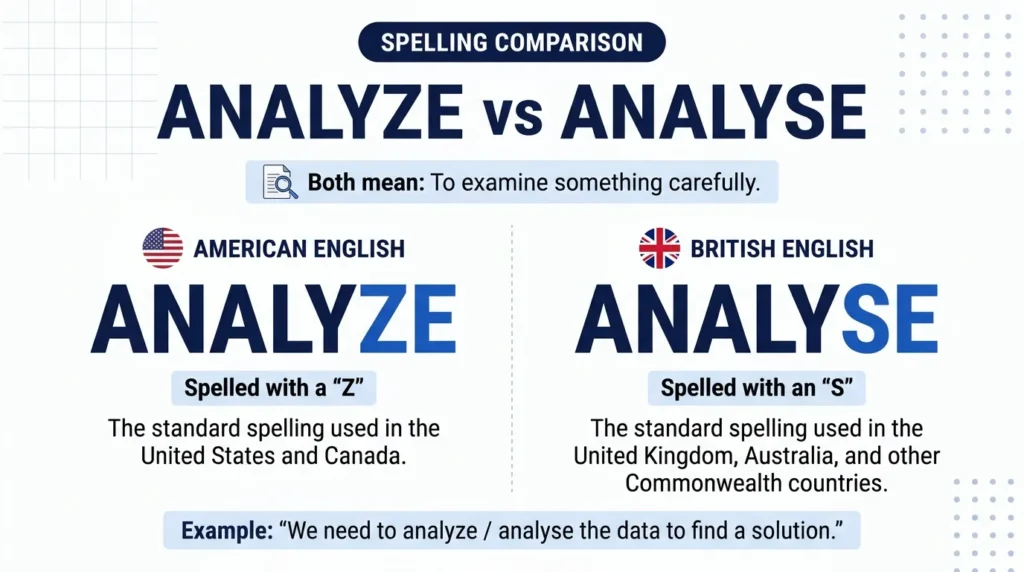

Analyze is the standard American English spelling, while analyse is the standard British English spelling. Both words mean to examine something carefully to understand its parts, meaning, causes, or patterns. Therefore, neither spelling is universally wrong. The correct choice depends on the English variety or style guide you are following.
Analyze or Analyse?
Use analyze when writing in American English and analyse when following standard British English spelling. Both words have the same meaning and pronunciation. For example, an American writer might say, “We will analyze the results,” whereas a British writer would usually write, “We will analyse the results.” The same regional distinction applies to analyzed/analysed and analyzing/analysing.
What Is the Difference Between Analyze and Analyse?
Analyze and analyse are two regional spellings of the same verb. A verb is a word that expresses an action or state. In this case, the action involves examining something carefully to understand it better.
The difference is spelling, not meaning.
- Analyze: The standard spelling in American English.
- Analyse: The standard spelling in British English.
For example:
- American English: The researcher will analyze the survey results.
- British English: The researcher will analyse the survey results.
Both sentences communicate exactly the same idea. In each case, the researcher will examine the results carefully to identify useful information or patterns.
The distinction also appears in education, business, science, and everyday writing. However, you do not need to learn two definitions. You simply need to choose the spelling that matches your intended audience or publication style.
Why Does the Difference Between Analyze and Analyse Matter?
Although the two spellings are correct, consistency matters in professional and academic writing. Choosing the appropriate regional spelling helps your work follow the expectations of your readers, institution, or publisher.
Consider these situations:
- School assignments: Your teacher may expect American or British spelling, depending on the curriculum.
- Academic papers: A university or journal may require a particular English style.
- Business reports: Consistent spelling helps a document look carefully edited.
- Websites and blogs: Using one spelling convention across your content creates a consistent reading experience.
- International communication: Matching the spelling to your audience reduces unnecessary corrections and confusion.
For instance, if you are preparing a report for an American company, analyze is generally the appropriate choice. Conversely, if you are following British English conventions for a UK publication, analyse is the usual form.
The important point is that using the other regional spelling does not change the meaning. It simply may not match the style you have chosen.
The Core Rule: When Should You Use Analyze or Analyse?
Use analyze for American English and analyse for British English. Both spellings have the same meaning.
Remember this simple guide:
- US English → analyze
- UK English → analyse
- Australian English → analyse is the usual standard spelling
- Canadian English → usage can vary by institution and style guide
If you are unsure which convention to follow, check your assignment instructions, employer’s style guide, or publisher’s requirements. Once you have chosen a variety, apply it consistently throughout the document.
How to Use Analyze and Analyse Correctly

1. Use Analyze in American English
In American English, analyze is the standard spelling. It can describe examining data, evidence, literature, business performance, or almost any subject that requires careful study.
Examples:
- We need to analyze the survey results before making a decision.
- The scientist will analyze the samples tomorrow.
- Students must analyze the author’s argument.
- Our team analyzes customer feedback every month.
- The software helps users analyze large amounts of data.
Notice that the spelling remains consistent even when the subject or situation changes.
2. Use Analyse in British English
In British English, analyse is the standard spelling. It has the same uses as the American form.
Examples:
- We need to analyse the survey results before making a decision.
- The scientist will analyse the samples tomorrow.
- Students must analyse the author’s argument.
- Our team analyses customer feedback every month.
- The software helps users analyse large amounts of data.
Although the spelling changes, the meaning and grammatical function remain the same.
3. Learn the Other Verb Forms
The difference between analyze and analyse continues in several related verb forms. Therefore, learning the full word family helps you avoid inconsistent spelling.
| Grammatical form | American English | British English |
|---|---|---|
| Base form | analyze | analyse |
| Third-person singular | analyzes | analyses |
| Past tense | analyzed | analysed |
| Past participle | analyzed | analysed |
| -ing form | analyzing | analysing |
| Noun | analysis | analysis |
| Plural noun | analyses | analyses |
| Related adjective | analytical | analytical |
| Person who examines something | analyst | analyst |
The noun analysis is spelled the same way in both varieties. Its plural, analyses, is also identical in spelling, although the pronunciation differs from the singular.
Be especially careful with analyses. It can be the plural noun, as in “The report contains three analyses,” or the third-person singular verb in British English, as in “She analyses the data.”
4. Follow the Correct Spelling in Academic Writing
Academic writing often requires a consistent spelling convention. For example, a research paper written in American English should normally use analyze, analyzed, and analyzing.
By contrast, a paper following British English conventions would normally use analyse, analysed, and analysing.
The same principle applies to essays, dissertations, laboratory reports, and literary criticism. Check the required style guide first, especially if your institution has its own preferences.
5. Remember That Related Words May Not Change
Not every word in the same family has two regional spellings.
For example:
- Analysis
- Analyses (plural noun)
- Analyst
- Analytical
These forms generally retain the same spelling in American and British English. Consequently, you should not change every letter S to Z or every Z to S simply because you are switching regional conventions.
Correct Examples of Analyze and Analyse
The following examples show how both spellings work in everyday, academic, and professional contexts.
| Situation | American English | British English |
|---|---|---|
| Conversation | Let’s analyze the problem. | Let’s analyse the problem. |
| I will analyze the figures today. | I will analyse the figures today. | |
| School assignment | Analyze the main character. | Analyse the main character. |
| Workplace report | We analyzed last month’s sales. | We analysed last month’s sales. |
| Social media | I’m analyzing the latest results. | I’m analysing the latest results. |
| Academic research | The study analyzes climate data. | The study analyses climate data. |
| Scientific work | Researchers analyzed the samples. | Researchers analysed the samples. |
| Business meeting | We need to analyze our options. | We need to analyse our options. |
| Technical documentation | This tool analyzes performance. | This tool analyses performance. |
| University essay | The author analyzes the poem. | The author analyses the poem. |
| Future plan | They will analyze the evidence. | They will analyse the evidence. |
| Ongoing investigation | She is analyzing the results. | She is analysing the results. |
Each pair expresses the same meaning. Only the regional spelling changes.
Incorrect vs. Correct: 10 Common Examples
The examples below illustrate spelling inconsistencies and common mistakes. Remember that a regional variant is not automatically incorrect; the problem arises when it conflicts with the spelling convention you are following.
| ❌ Incorrect in the stated context | ✅ Correct | Why |
|---|---|---|
| US report: We will analyse the results. | We will analyze the results. | American English normally uses analyze. |
| UK report: We will analyze the results. | We will analyse the results. | Standard British English normally uses analyse. |
| US report: The team analysed the figures. | The team analyzed the figures. | The American past-tense form ends in -yzed. |
| UK report: The team analyzed the figures. | The team analysed the figures. | The British form ends in -ysed. |
| US report: She is analysing the data. | She is analyzing the data. | American English uses analyzing. |
| UK report: She is analyzing the data. | She is analysing the data. | British English uses analysing. |
| US report: He analyzes the evidence. | He analyzes the evidence. | This is already the standard American form. |
| UK report: He analyzes the evidence. | He analyses the evidence. | Standard British English uses analyses for this verb form. |
| US report: The software analyses the results. | The software analyzes the results. | American English uses analyzes for the third-person singular verb. |
| UK report: The report contains three analysis. | The report contains three analyses. | The plural of the noun analysis is analyses in both varieties. |
The seventh example is intentionally already correct. It is included to reinforce that analyzes is the proper American form, not analysizes or analysises.
Similarly, the noun analyses is not a British-only spelling. It is the standard plural noun in both American and British English.
Why Do People Confuse Analyze and Analyse?
1. The Pronunciation Is the Same
Both spellings are generally pronounced the same way. Therefore, hearing the word does not tell you whether the writer intends to use American or British spelling.
For example, someone might hear a teacher say the word and write analyse, even though the assignment follows American English conventions.
The solution is to identify the required spelling variety before writing.
2. Both Forms Are Correct
Many spelling mistakes involve one accepted word and one misspelling. However, analyze and analyse are both standard forms in their respective varieties.
As a result, writers may assume that they can switch freely between them within a document. Although readers will understand both, mixing conventions can make writing look inconsistent.
3. The Word Family Contains Several Different Forms
The forms analyzes, analyses, analyzed, analysed, analyzing, and analysing can be confusing.
In particular, analyses is both a plural noun and a verb form. Its grammatical role depends on the sentence.
For example:
- The two analyses reached similar conclusions. — Analyses is a plural noun.
- She analyses the survey results. — Analyses is a verb in British English.
Looking at the subject and sentence structure helps you identify the correct form.
4. Spellcheck May Use the Wrong Language Setting
A spellchecker can flag a valid spelling if your software is configured for another variety of English. For instance, an American English setting may flag analyse even when you are deliberately writing for a British audience.
Therefore, check your document’s language settings before changing every flagged word.
5. Writers May Overgeneralize the -ize and -ise Rule
Many English words have regional spelling variants such as organize/organise and realize/realise. However, not every word follows exactly the same pattern.
Analyse is the standard British form, while analyze is the standard American form. Some British style systems accept -ize in other words, so it is inaccurate to assume that all British writing must use -ise.
Common Mistakes Checklist
Before submitting an essay, report, or article, check the following points.
- Mixing American and British spellings: Choose a regional convention and apply it consistently.
- Changing the noun analysis unnecessarily: The singular noun is spelled analysis in both varieties.
- Using the wrong plural: Write analyses when referring to more than one analysis.
- Confusing a noun with a verb: In “three analyses,” the word is a noun; in “she analyses,” it is a verb.
- Forgetting the -ing form: Use analyzing in American English and analysing in British English.
- Trusting spellcheck without checking settings: A valid regional spelling may be flagged if the software uses another variety.
- Assuming every British word uses -ise: British spelling conventions are more nuanced than that.
- Changing a quotation unnecessarily: Preserve the original spelling in a direct quotation unless your editorial policy explicitly allows changes.
- Ignoring the publication’s house style: A publisher or university may specify which form to use.
- Treating the two spellings as different meanings: They describe the same action, so you do not need to learn separate definitions.
ALSO CHECKOUT: What Is the Difference Between Hear and Here?
Analyze or Analyse in Real English
Grammatically Correct
Both analyze and analyse are grammatically correct verbs. The choice depends on the spelling variety, not on the sentence’s grammar. For example, “The researchers analyzed the samples” follows American spelling, while “The researchers analysed the samples” follows British spelling. Both sentences use the past tense correctly and describe the same action. Neither spelling is universally superior or more grammatical than the other.
Grammatically Possible but Inconsistent
A sentence such as “We analyzed the data and then analysed the results” is understandable, but it mixes American and British spelling conventions. The problem is not sentence structure; it is consistency. In a document following American English, use analyzed in both places. In a document following British English, use analysed in both. However, quotations, proper names, and source titles may retain their original spellings.
Natural, Everyday Usage
Both forms are natural in their respective English varieties. American readers commonly encounter analyze, while British readers commonly encounter analyse. The verb can be used for many subjects, including data, evidence, literature, problems, and business performance. For example, “Let’s analyze the results” and “Let’s analyse the results” are equally natural when they match the writer’s spelling convention. The best choice is the one that fits your audience and remains consistent.
ALSO READ: Ola or Hola: Which Is Correct? Meaning & Examples.
American vs. British English

The difference between analyze and analyse is a genuine regional spelling distinction.
American English
American English normally uses analyze, along with analyzes, analyzed, and analyzing.
Examples:
- The team will analyze the results.
- She analyzes customer behavior.
- We analyzed the evidence yesterday.
- They are analyzing the latest figures.
These forms are appropriate for documents following standard American English spelling.
British English
British English normally uses analyse, along with analyses, analysed, and analysing.
Examples:
- The team will analyse the results.
- She analyses customer behaviour.
- We analysed the evidence yesterday.
- They are analysing the latest figures.
Notice that British English often uses behaviour, whereas American English uses behavior. That is another regional spelling difference, separate from the verb analyse.
What About Australian, Indian, Pakistani, and Canadian English?
Australian English generally follows British spelling for this word, so analyse is the usual choice. British spelling conventions are also widely used in many educational and professional settings in India and Pakistan, although local institutions may specify their own rules.
Canadian English can vary by word and editorial style. Therefore, Canadian writers should follow their organization’s or publisher’s guidance rather than assuming that every word must follow either the American or British pattern.
Formal vs. Informal Usage
There is no special formal or informal difference between analyze and analyse. Both forms are suitable for professional writing, academic work, and everyday communication when used according to the relevant spelling convention.
For example, an American business report might say, “We analyzed the quarterly results.” A British report would normally say, “We analysed the quarterly results.”
In an informal conversation, the spelling is usually less noticeable because both forms sound alike. Nevertheless, when you write an email, report, or assignment, matching the intended English variety is good editorial practice.
Analyze vs. Analyse: Comparison Table
| Feature | Analyze | Analyse |
|---|---|---|
| Standard variety | American English | British English |
| Meaning | Examine carefully | Examine carefully |
| Part of speech | Verb | Verb |
| Pronunciation | Same | Same |
| Third-person singular | Analyzes | Analyses |
| Past tense | Analyzed | Analysed |
| -ing form | Analyzing | Analysing |
| Singular noun | Analysis | Analysis |
| Plural noun | Analyses | Analyses |
| Correct in formal writing? | Yes, in the appropriate style | Yes, in the appropriate style |
The simplest way to remember the distinction is to associate the Z spelling with standard American usage and the S spelling with standard British usage. However, always check the relevant style guide when writing for a specific institution or publication.
Real-Life Situations: Which Spelling Should You Choose?
Situation 1: Writing a University Essay
Your university requires American English.
Correct: “This essay will analyze the causes of the economic crisis.”
Why: Analyze follows American spelling conventions.
Situation 2: Preparing a British Business Report
Your company follows British English.
Correct: “The report will analyse the company’s annual performance.”
Why: Analyse is the usual British spelling.
Situation 3: Sending an Email to an International Team
Your team has no stated regional preference.
Best approach: Check the organization’s established style or use the convention already followed in its documents.
Why: Consistency is more useful than switching spellings based on individual preference.
Situation 4: Editing a Research Paper
The journal specifies British English.
Correct: “The researchers analysed the data and presented their findings.”
Why: The past-tense form should match the publication’s spelling convention.
Situation 5: Writing for a US Website
Your website consistently follows American English.
Correct: “Our tool helps you analyze website traffic.”
Why: The spelling aligns with the website’s established American English style.
Practice Quiz: Analyze or Analyse?
Choose the form that best fits the stated context.
- An American student must ______ the poem.
- A British researcher will ______ the results.
- The American team is ______ the survey responses.
- The British company ______ customer feedback every month.
- The American researchers ______ the samples yesterday.
- The British report describes three separate ______.
- The American analyst is ______ the figures now.
- The British scientist ______ the evidence carefully.
Answer Key
- Analyze — American English.
- Analyse — British English.
- Analyzing — American English.
- Analyses — British English, third-person singular verb.
- Analyzed — American English, past tense.
- Analyses — Plural noun, spelled the same in both varieties.
- Analyzing — American English, -ing form.
- Analyses — British English, third-person singular verb.
Quick Summary
Analyze and analyse are two correct spellings of the same verb. Analyze is the standard American English form, while analyse is the standard British English form. Both mean to examine something carefully to understand its parts, patterns, or meaning. The regional distinction continues in forms such as analyzes/analyses, analyzed/analysed, and analyzing/analysing. However, the noun analysis, its plural analyses, and related words such as analyst and analytical are generally spelled the same in both varieties. To avoid mistakes, check your audience or style guide, choose the appropriate spelling, and keep it consistent throughout your writing.
Frequently Asked Questions
Is analyse wrong in American English?
Analyse is a recognized British spelling, but analyze is the standard form expected in American English. Therefore, use analyze when following a US style guide.
Is analyze accepted in British English?
Analyze is associated with American English, while analyse is the standard British form. Some British spelling systems accept -ize in other words, but that does not make analyze the usual British spelling of this particular verb.
Do analyze and analyse have different pronunciations?
No. In standard usage, both are pronounced the same way, approximately “AN-uh-lyze.” The difference is written rather than spoken.
What is the noun form of analyze or analyse?
The noun is analysis in both American and British English. It refers to the process or result of examining something carefully.
Is analyses singular or plural?
It can be either a plural noun or a verb. In “The report contains two analyses,” it is a plural noun. In “She analyses the data,” it is a third-person singular verb in British English.
Should I use analyze or analyse in IELTS writing?
Follow the spelling convention you can apply consistently and accurately. Both American and British English spellings are generally understood, but mixing them unnecessarily can make your writing less consistent. If your institution or instructor specifies a variety, follow that guidance.
Which spelling should I use for SEO content?
Choose the spelling that fits your target audience and your website’s established editorial style. If your site targets American readers, use analyze. If it targets British English readers, use analyse. Search intent and content quality matter more than repeating both spellings unnaturally.
Is analyzing or analysing correct?
Both are correct. Analyzing is the American English form, while analysing is the standard British English form.
Is analyzed or analysed correct?
Both are correct. American English normally uses analyzed, while British English normally uses analysed.
Why is analysis spelled the same in American and British English?
The noun analysis does not follow the same regional spelling difference as the verb analyze/analyse. Consequently, the spelling remains analysis in both varieties.
Can I mix American and British spellings in one document?
You can, and readers will usually understand you. However, mixing conventions without a reason can make the document look inconsistent. Choose one style unless you are preserving a quotation, proper name, or other text that must retain its original spelling.
What is the easiest way to remember analyze vs. analyse?
Use this quick reminder: Z for American analyze; S for British analyse. Then remember that the noun analysis keeps the same spelling in both varieties.