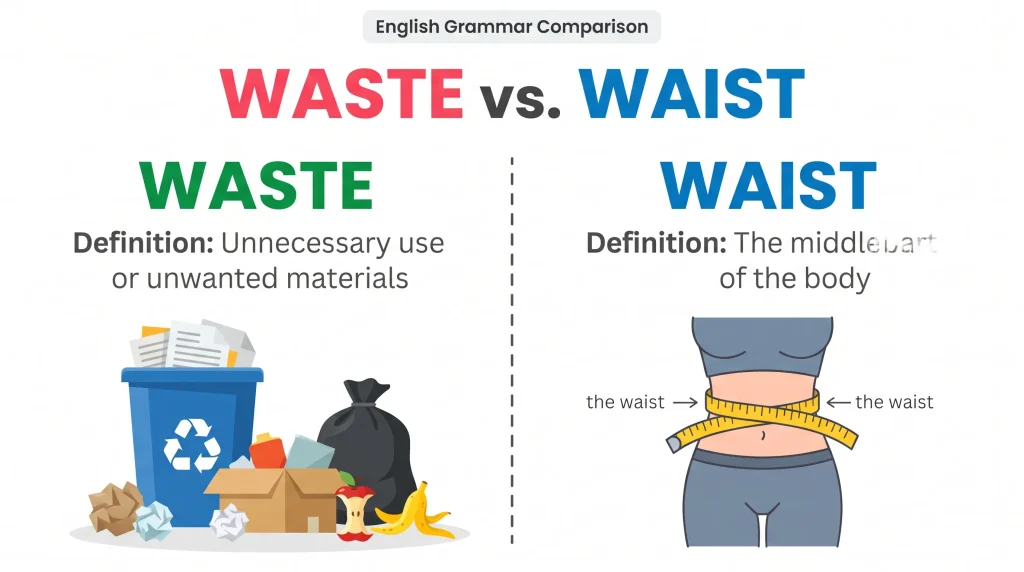
The difference between waste and waist is simple: waste means to use something carelessly, unnecessarily, or without a good result, while waist is the part of your body between your ribs and hips. Both words are pronounced the same way, but they have completely different meanings. Use waste when discussing time, money, resources, or rubbish. Use waist when talking about the body, clothing, or measurements.
What Is the Difference Between Waste and Waist?
Although waste and waist sound identical, they belong to different word categories and describe different things.
What Does Waste Mean?
Waste can function as a noun, verb, or adjective. Its meaning depends on how it appears in a sentence.
As a noun, waste refers to something that is unwanted, unused, or used unnecessarily.
Examples:
- Throw the food waste into the bin.
- Buying things you never use is a waste of money.
- The factory produces a large amount of plastic waste.
As a verb, waste means to use something carelessly or fail to make good use of it.
Examples:
- Don’t waste your time on unnecessary arguments.
- She wasted her savings on things she didn’t need.
- We shouldn’t waste clean drinking water.
As an adjective, waste can describe land or materials that are unused or unsuitable for their intended purpose.
Example:
– The company purchased waste land outside the city.
Read also: On Tuesday Morning vs. In the Tuesday Morning: Which Is Correct?
What Does Waist Mean?
Waist is a noun that refers to the narrow or middle part of the human body between the ribs and hips.
It is commonly used when discussing:
- Body measurements
- Clothing sizes
- Belts and trousers
- Dresses and skirts
- Physical appearance
Examples:
- She measured her waist before ordering the dress.
- This belt is too tight around my waist.
- The trousers have an adjustable waist.
Unlike waste, the word waist does not normally function as a verb.
See also: Did You Had vs Did You Have: Which One Is Correct?
Why Does the Difference Between Waste and Waist Matter?
Confusing these words can change the meaning of an entire sentence.
For example:
- Correct: I need to reduce food waste.
- Incorrect meaning: I need to reduce food waist.
The second sentence refers to the wrong concept. A reader may understand that you made a spelling mistake, but it still affects the clarity and professionalism of your writing.
This distinction matters particularly in:
- Workplace communication: Discussing wasted resources is different from discussing waist measurements.
- Shopping: Clothing sizes often include waist measurements.
- Education: Using the wrong word can cost marks in grammar and spelling tests.
- Social media: A spelling mistake can make a caption confusing.
- Business writing: Accurate word choice makes instructions and reports easier to understand.
See more: Froze vs Frozen: Meaning, Difference, and Correct Usage
The Core Rule: Waste vs Waist
WASTE
WASTE = Loss, rubbish, or unnecessary use.
Remember it when discussing time, money, food, energy, or resources.
- Waste time
- Waste money
- Food waste
WAIST
WAIST = The middle part of your body.
Remember it when discussing body measurements and clothing.
- Waist size
- Waist measurement
- Waist belt
Easy memory trick: Your waist is where you wear your waistband. Meanwhile, waste is what you want to avoid wasting.
How to Use Waste and Waist Correctly
The easiest way to choose the right word is to identify what you are describing.
When to Use Waste
Use waste when talking about unnecessary use, lost opportunities, or unwanted materials.
1. Talking about time
- Don’t waste your time waiting for him.
- Watching unnecessary videos can waste several hours.
2. Talking about money
- Buying unnecessary items is a waste of money.
- He wasted his salary on expensive gadgets.
3. Talking about food and rubbish
- Please separate plastic waste from other rubbish.
- Restaurants should reduce food waste.
4. Talking about resources
- We must not waste electricity.
- The factory is trying to reduce water waste.
5. Talking about missed opportunities
- Don’t waste this opportunity to improve your skills.
- She wasted her chance to win the competition.
When to Use Waist
Use waist when referring to the middle part of the body or something associated with that area.
1. Body measurements
- My waist measures 32 inches.
- She has a waist measurement of 70 centimetres.
2. Clothing
- These jeans are tight around the waist.
- The dress has a beautiful waistline.
3. Belts and accessories
- He wears a leather belt around his waist.
- This belt is adjustable at the waist.
4. Fitness and exercise
- She performs exercises to strengthen her waist and core muscles.
- The trainer measured his waist before starting the fitness programme.
5. Fashion and tailoring
- The tailor adjusted the waist of my trousers.
- This jacket has a fitted waist.
Correct Examples of Waste and Waist in Everyday English
The following examples show how both words appear in different situations. Notice how the surrounding words help identify the intended meaning.
Examples of Waste
- Conversation: Don’t waste your energy arguing about something so small.
- Email: Please avoid wasting company resources during the project.
- School: Students should not waste valuable time before examinations.
- Workplace: Our department needs to reduce unnecessary paper waste.
- Social media: Every minute is precious, so don’t waste your time comparing yourself with others.
- Academic writing: Food waste remains a serious environmental challenge.
- Shopping: Buying products you don’t need is a waste of money.
- Daily life: We should never waste clean drinking water.
- Business: The company introduced new policies to minimize material waste.
- Personal development: Don’t waste an opportunity to learn something valuable.
Examples of Waist
- Conversation: My waist hurts after wearing these tight trousers.
- Email: Could you please confirm the waist measurement before dispatching the order?
- School: The human waist is located between the ribs and hips.
- Workplace: The tailor adjusted the waist of the employee’s uniform.
- Social media: I finally found jeans that fit comfortably around my waist.
- Academic writing: Researchers recorded participants’ waist measurements during the study.
- Shopping: I need a pair of trousers with a 32-inch waist.
- Daily life: He tied a towel around his waist.
- Fashion: The dress has a fitted waist and a flowing skirt.
- Fitness: The trainer measured my waist before starting the exercise programme.
Waste vs Waist: Incorrect vs Correct Examples
These examples highlight common spelling errors and explain why the alternative is correct.
| ❌ Incorrect | ✅ Correct | Why |
|---|---|---|
| Don’t waist your time. | Don’t waste your time. | Waste means to use time unnecessarily. |
| My waste is 30 inches. | My waist is 30 inches. | Body measurements use waist. |
| Stop wasting your money on unnecessary things. | Stop wasting your money on unnecessary things. | This sentence is already correct. |
| She tied a belt around her waste. | She tied a belt around her waist. | A belt is worn around the body. |
| Food waist is a serious problem. | Food waste is a serious problem. | Unused or discarded food is called food waste. |
| What is your waste size? | What is your waist size? | Clothing measurements refer to the waist. |
| We should reduce plastic waist. | We should reduce plastic waste. | Discarded plastic is a form of waste. |
| The dress is tight around my waste. | The dress is tight around my waist. | The sentence describes clothing fit. |
| Don’t waste this opportunity. | Don’t waste this opportunity. | This is already correct because it describes a missed opportunity. |
| He measured his waste before buying trousers. | He measured his waist before buying trousers. | Tailors measure the waist when fitting trousers. |
| Industrial waist pollutes rivers. | Industrial waste pollutes rivers. | The sentence refers to unwanted industrial materials. |
| She has a beautiful waste line. | She has a beautiful waistline. | Waistline is the correct word for the body’s waist contour. |
Why Do People Confuse Waste and Waist?
There are several reasons these two words cause spelling problems, especially for English learners.
1. They Are Homophones
A homophone is a word that sounds the same as another word but has a different spelling or meaning.
Both waste and waist are pronounced /weɪst/ (WAYST).
Consequently, you cannot identify the correct spelling simply by listening. You must understand the meaning of the sentence.
2. Their Spellings Look Similar
Both words contain the same beginning and ending sounds. The main spelling difference is the vowel combination:
- Waste: W-A-S-T-E
- Waist: W-A-I-S-T
Because the difference is small, writers can easily select the wrong spelling when typing quickly.
3. People Overgeneralize Spelling Rules
English learners sometimes assume that words with similar sounds should follow similar spelling patterns. However, English spelling does not always work that way.
For example, waste and waist share a pronunciation but have different meanings and grammatical functions.
Therefore, remembering the meaning is more reliable than guessing from the spelling.
4. Autocorrect Does Not Always Help
Modern spellcheckers recognize both words as correctly spelled English words.
For example:
- Don’t waste your time.
- Don’t waist your time.
A spelling checker may accept both because neither word is misspelled individually. Nevertheless, the second sentence uses the wrong word for the intended meaning.
Always review the context rather than relying entirely on autocorrect.
5. Translation Can Cause Confusion
Some languages use one expression for ideas that English separates into different words.
As a result, learners may remember the general meaning but struggle to select the correct English spelling.
The best solution is to learn each word through complete sentences rather than memorizing translations alone.
Common Mistakes Checklist
Before publishing an article, writing an email, or completing an English exercise, check these common mistakes.
- Writing “waist your time”: Use waste your time because time is being used unnecessarily.
- Writing “waste measurement”: Use waist measurement when discussing clothing or body size.
- Writing “food waist”: Use food waste when referring to discarded food.
- Writing “around my waste”: Use around my waist when describing something positioned around the body.
- Assuming spellcheck is always correct: Both spellings are valid words, so check their meanings.
- Confusing nouns and verbs: Waste can be a noun or a verb, whereas waist is a noun.
- Ignoring compound words: Learn related forms such as wastewater, wasteland, waistband, and waistline.
Waste and Waist in Real English
Understanding dictionary meanings is important. However, knowing how people naturally use these words in everyday English makes your writing more accurate.
1. Grammatically Correct and Natural English
“Don’t waste your time waiting for someone who isn’t coming” is both grammatically correct and natural English. Similarly, “My waist measurement is 30 inches” sounds completely normal in a clothing or fitness conversation. These expressions are common because each word appears in a familiar context. In everyday communication, speakers use waste for unnecessary use and waist for body measurements.
2. Grammatically Possible but Incorrect for the Intended Meaning
“She measured her waste before buying a dress” is grammatically possible as a sentence, but it does not communicate the intended meaning. The word waste is a valid English word, yet it does not refer to a person’s body measurement. The correct expression is “She measured her waist before buying a dress.” This illustrates why grammar and spelling tools cannot replace an understanding of meaning.
3. Natural Everyday Expressions
English speakers commonly use expressions such as “a waste of time,” “waste of money,” “food waste,” and “waste management.” Meanwhile, “waist size,” “around the waist,” “waistline,” and “waistband” are familiar expressions in clothing and everyday conversation. Learning these word combinations helps you remember the correct spelling because you associate each word with the situations in which it naturally appears.
American vs British English: Waste vs Waist
There is no spelling or meaning difference between American and British English for these two words.
| Feature | American English | British English |
|---|---|---|
| Spelling | Waste / Waist | Waste / Waist |
| Meaning of waste | Unnecessary use or unwanted material | Unnecessary use or unwanted material |
| Meaning of waist | Middle part of the body | Middle part of the body |
| Pronunciation | /weɪst/ | /weɪst/ |
| Common usage | Waste time / Waist size | Waste time / Waist size |
Both varieties use the same spellings and meanings. However, accents may produce slight differences in pronunciation.
Formal vs Informal Usage
Both waste and waist are appropriate in formal and informal English. Their spelling and meanings do not change according to the situation.
Formal examples:
- The organization aims to minimize industrial waste.
- The participant’s waist measurement was recorded during the assessment.
Informal examples:
- Don’t waste your money on that.
- These jeans are too tight around my waist.
In professional reports, academic writing, everyday conversations, and social media posts, the same distinction applies.
Waste vs Waist: Comparison Table
| Feature | Waste | Waist |
|---|---|---|
| Pronunciation | /weɪst/ | /weɪst/ |
| Main meaning | Unnecessary use or unwanted material | Middle part of the body |
| Part of speech | Noun, verb, adjective | Noun |
| Refers to | Time, money, food, resources, rubbish | Body and clothing |
| Verb form | Waste, wastes, wasted, wasting | No standard verb form |
| Plural | Wastes (in appropriate countable uses) | Waists |
| Common phrases | Waste time, food waste | Waist size, waistline |
| Example | Don’t waste water. | Measure your waist. |
| Memory trick | Waste goes in the bin. | Waist wears a belt. |
Real-Life Situations: When to Use Waste or Waist
Let’s look at five situations where choosing the correct word matters.
1. During a Job Interview
Situation: An interviewer asks how you manage resources.
Correct response: “I always try to avoid waste and use company resources efficiently.”
Here, waste refers to unnecessary use of resources.
2. During a Business Meeting
Situation: A manager discusses production costs.
Correct response: “We need to reduce material waste to improve production efficiency.”
The word waste describes unwanted or unused materials.
3. While Shopping Online
Situation: A customer wants to order trousers.
Correct response: “Could you tell me whether these trousers have a 34-inch waist?”
The word waist refers to a clothing measurement.
4. In a Text Message
Situation: Your friend is spending too much time on unnecessary activities.
Correct response: “Don’t waste your whole evening scrolling through your phone!”
In this situation, waste describes the unnecessary use of time.
5. During a Grammar Examination
Situation: A student must complete a sentence.
Question: “The tailor measured my ______ before adjusting the trousers.”
Correct answer: Waist.
The sentence describes a body measurement, so waist is the appropriate word.
Waste vs Waist: Practice Quiz
Test your understanding with these 10 questions. Choose the correct word for each sentence.
Choose the correct spelling
0/10 answered
1. Don’t ______ your time on unnecessary activities.wastewaist
2. She measured her ______ before ordering the dress.wastewaist
3. The factory produces a lot of plastic ______.wastewaist
4. This belt is too tight around my ______.wastewaist
5. Buying unnecessary products is a ______ of money.wastewaist
6. My trousers have an adjustable ______.wastewaist
7. We should reduce food ______.wastewaist
8. The tailor adjusted the ______ of my jacket.wastewaist
9. Never ______ an opportunity to learn.wastewaist
10. He tied a towel around his ______.wastewaist
Check my answers
Frequently Asked Questions (FAQ)
1. Is waste or waist correct?
Both spellings are correct English words. However, their meanings are different. Use waste for unnecessary use, rubbish, or lost resources. Use waist for the middle part of the body.
2. Are waste and waist pronounced the same?
Yes. Both words are pronounced /weɪst/ (WAYST). They are homophones, meaning they sound alike but have different spellings and meanings.
3. Is waste a noun or a verb?
Waste can be a noun, verb, or adjective. For example, “food waste” uses it as a noun, “Don’t waste time” uses it as a verb, and “waste materials” uses it as an adjective.
4. Can waist be used as a verb?
No. Waist is normally used as a noun. It identifies the middle part of the body or the corresponding part of a garment.
5. What is the plural of waist?
The plural is waists. For example: “The tailor measured the waists of all the customers.”
6. What is the difference between waist and waistline?
Waist refers to the middle part of the body. Waistline refers to the line or contour around that area, or the corresponding line of a garment.
7. What does “waste of time” mean?
“A waste of time” describes an activity that uses time without producing a worthwhile result. For example: “Arguing over something unimportant is a waste of time.”
8. Is “waste away” a correct expression?
Yes. Waste away is a phrasal verb meaning to become progressively weaker or thinner, often because of illness or lack of food. For example: “The illness caused him to waste away.”
9. What is the easiest way to remember waste vs waist?
Remember this simple association: Waste goes in the bin, while a belt goes around your waist. Think about the meaning before choosing the spelling.
10. Why does spellcheck sometimes miss waste and waist mistakes?
Spellcheck may accept both because they are correctly spelled individual words. However, it may not understand that one is inappropriate in a particular sentence. Always proofread for meaning as well as spelling.
Quick Summary: Waste vs Waist
Waste and waist are homophones, meaning they have the same pronunciation but different meanings and spellings. Waste refers to unnecessary use, unwanted materials, rubbish, or lost opportunities. It can function as a noun, verb, or adjective. In contrast, waist is a noun referring to the middle part of the body between the ribs and hips. It is also used when discussing clothing measurements and fit. For example, you should write “Don’t waste your time” but “Measure your waist.” Both words have the same spelling and meaning in American and British English. Remember: waste goes in the bin, while your waist wears a belt.