Both in the street and on the street are grammatically correct, but they don’t always describe the same situation.
Use in the street when you want to emphasize that someone or something is physically within the street, particularly the roadway where vehicles travel. Use on the street when referring to a general location, a street address, or someone’s presence along a street.
For example:
- The children are playing in the street. (They may be playing in the roadway.)
- The children are playing on the street. (This describes their general location along the street.)
The distinction also varies somewhat between American and British English. Understanding the meaning and context will help you choose the natural expression.
Use in the street to describe something physically within the street as an area, especially the roadway. Use on the street for a general street location, an address, or something situated along a street. For example, a ball lying in the street may obstruct traffic, while a restaurant on the street is simply located along that street. Both expressions are correct; context determines which one is appropriate.
What Is the Difference Between In the Street and On the Street?
The difference comes from how you picture the street.
The preposition in presents the street as an area or space. The preposition on presents it as a location, route, or surface.
Consider these two sentences:
- A dog is sleeping in the street.
- A dog is sleeping on the street.
In the first sentence, the dog is understood to be within the street area, potentially in the path of traffic.
In the second sentence, the focus is on the dog’s location along the street. It doesn’t necessarily suggest that the dog is in the middle of the roadway.
Neither expression is automatically incorrect. The difference is the perspective and meaning you want to communicate.
Why Does the Difference Matter?
Prepositions may be short words, but they can change the location a sentence describes.
Choosing the wrong one can create confusion, particularly when describing traffic, giving directions, writing addresses, or explaining where an incident happened.
For example:
- The child is in the street. This may suggest a safety risk because the child is in the roadway.
- The child is on the street. This gives a broader description of the child’s location.
- The shop is on the street. This identifies the shop’s location.
- The shop is in the street. This can suggest that the shop is physically occupying the roadway, which is probably not what the writer intends.
Understanding the difference helps you communicate more accurately and avoid sentences that technically make sense but create the wrong mental picture.
The Core Rule: In the Street vs On the Street
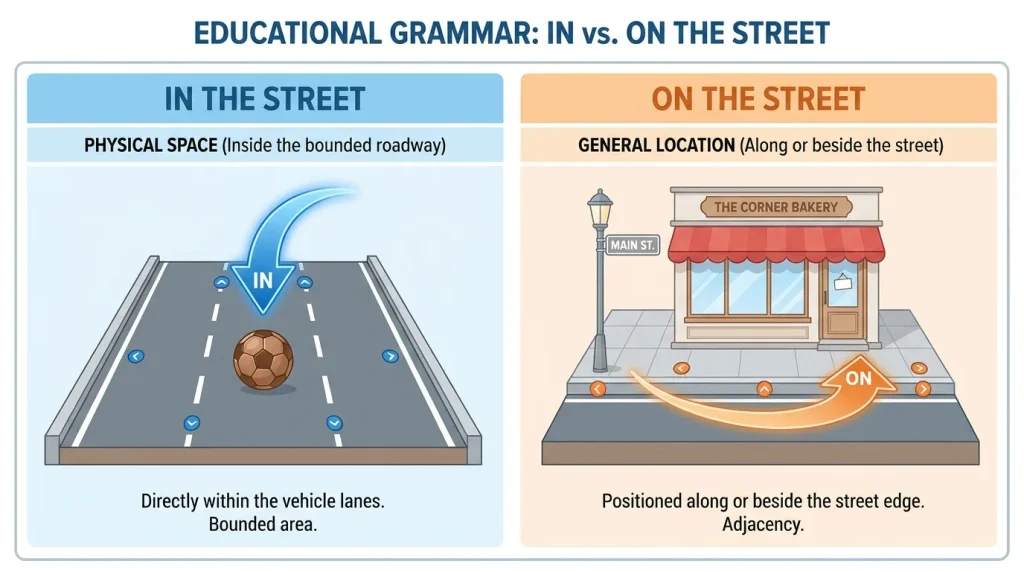
Use IN the street
When you mean within the street area, especially the part used by vehicles.
Example: A broken-down car is blocking the traffic in the street.
Use ON the street
When you mean a general location along a street, a street address, or something situated there.
Example: Our office is on Green Street.
Easy way to remember:
- IN = inside the street area.
- ON = located along the street or identified by its street location.
This is a useful general guide, not an absolute rule for every English dialect or situation.
How to Use In the Street and On the Street
1. When to Use In the Street
Use in the street when you want to describe someone or something within the physical area of a street.
It is particularly appropriate when the situation involves the roadway, traffic, or something occupying the space where vehicles normally travel.
Examples:
- A child is playing in the street.
- There is a large hole in the street.
- A delivery truck broke down in the street.
- Several people were dancing in the street.
- The police found a damaged bicycle in the street.
In these examples, the street is treated as a physical area rather than simply a location or address.
Common situations for in the street:
- Someone standing in the roadway.
- Children playing where vehicles travel.
- An object obstructing traffic.
- Road repairs or construction.
- An accident happening within the street.
2. When to Use On the Street
Use on the street when describing a general location along a street, a street address, or someone’s presence in a public street setting.
It is especially common when identifying where a building, business, or person is located.
Examples:
- My house is on Oak Street.
- There is a pharmacy on this street.
- We met an old friend on the street.
- The restaurant is on the main street.
- She works in an office on King Street.
Here, the street functions as a location or reference point. The sentences do not suggest that the people or buildings are standing in the middle of the roadway.
Common situations for on the street:
- Giving a street address.
- Describing where a business is located.
- Talking about meeting someone outside.
- Describing public activity along a street.
- Referring to street life or public opinion.
3. What About Walking In the Street and Walking On the Street?
Both expressions are possible, but the intended meaning matters.
- Walking in the street usually suggests walking within the roadway, where vehicles travel.
- Walking on the street can describe walking along the street, although the exact location may depend on the context and local usage.
For example:
- The children were walking in the street without looking for traffic.
- We walked on the street and explored the shops.
If you specifically mean the pedestrian path, walking on the sidewalk (American English) or walking on the pavement (British English) is clearer.
Don’t assume that every use of on the street means walking on the pavement. Context determines the exact location.
4. What About Street Names and Addresses?
When referring to a specific street name, on is the standard choice in American English.
Examples:
- She lives on Park Avenue.
- The new hotel is on Main Street.
- Our school is on Washington Road.
British English allows some variation. You may encounter expressions such as in the street when referring to a street as a residential or geographical location. However, on is also perfectly natural with street names, particularly when identifying the position of a building or business.
For international writing, on Main Street and on Oxford Street are widely understood choices.
Correct Examples of In the Street vs On the Street
The following examples show how both expressions work in everyday communication.
Examples of In the Street
1. Conversation: “Be careful! There’s a little boy playing in the street.”
2. Email: “The maintenance team will repair the damaged drainage cover in the street tomorrow.”
3. School writing: “The children gathered in the street to watch the parade.”
4. Workplace: “A delivery vehicle broke down in the street, causing a traffic delay.”
5. Social media: “There was a beautiful community celebration in the street last night.”
6. News reporting: “Several protesters were standing in the street when the police arrived.”
7. Everyday situation: “Someone left an old sofa in the street.”
8. Academic writing: “The study examined how pedestrian activity changes when vehicles are restricted in the street.”
9. Travel: “We found a damaged section of pavement in the street near our hotel.”
10. Safety warning: “Never allow young children to play unsupervised in the street.”
Examples of On the Street
1. Conversation: “I saw your brother on the street yesterday.”
2. Email: “Our new branch is located on Mill Road.”
3. School writing: “There is a beautiful historic building on the street.”
4. Workplace: “The company plans to open another office on Park Street.”
5. Social media: “We met some wonderful people on the street during our trip.”
6. Directions: “The pharmacy is on the street opposite the railway station.”
7. Everyday situation: “There are several small restaurants on this street.”
8. Academic writing: “The researchers interviewed pedestrians on the street.”
9. Travel: “We found a charming little café on the street near the museum.”
10. News reporting: “A reporter interviewed local residents on the street.”
Incorrect vs Correct: Common Usage Mistakes
Not every sentence below is universally incorrect in every dialect. Some are incorrect for the intended meaning or are less natural in standard usage. The explanations identify the specific problem.
| ❌ Incorrect or less suitable | ✅ Better choice | Why |
|---|---|---|
| I live in Main Street. | I live on Main Street. | American English normally uses on with street names when giving a location. |
| The children are playing on the street. (when emphasizing danger in the roadway) | The children are playing in the street. | In makes the roadway location clearer. |
| The restaurant is in Green Street. | The restaurant is on Green Street. | On is the usual choice for identifying a business’s street location. |
| There is a car blocking the road on the street. (when the car is in the traffic lane) | There is a car blocking the road in the street. | In emphasizes that the car occupies the roadway. |
| Our office is in Oxford Street. (in standard international or American usage) | Our office is on Oxford Street. | On is the more widely suitable choice for a building’s street location. |
| The ball rolled on the street and stopped in the middle of traffic. | The ball rolled into the street and stopped in the middle of traffic. | Into emphasizes movement from outside to inside the roadway. |
| He was standing on the street, directly in the traffic lane. (when emphasizing his position within the roadway) | He was standing in the street, directly in the traffic lane. | In better communicates the intended position. |
| The workers repaired the potholes on the street. (when referring to potholes within the roadway) | The workers repaired the potholes in the street. | In presents the street as the area containing the potholes. |
| My friend lives at the street. | My friend lives on the street. | At does not normally replace on in this address construction. |
| The dog was lying in the street, safely inside the shop. | The dog was inside the shop. | In the street and inside the shop describe different locations. |
The important lesson is that a preposition should communicate the intended location. Replacing in with on simply because one sounds more familiar can change the meaning.
Why People Confuse In the Street and On the Street
There are several reasons English learners struggle with these expressions.
1. The Meanings of In and On Overlap
In basic grammar, learners are often taught:
- In means inside something.
- On means on a surface.
This explanation is useful, but it does not cover every use of English prepositions.
A street is not a simple container or flat surface. It can refer to the roadway, the surrounding public space, or a named location.
That is why both expressions can be correct.
2. Overgeneralisation of Preposition Rules
Overgeneralisation happens when learners apply a grammar rule too broadly.
For example, someone may learn that people stand on surfaces and conclude that on the street must always be correct.
However, English also uses in the street to describe someone’s position within the roadway.
Learning individual examples alongside general rules helps prevent this mistake.
3. Translation Interference
Many languages use one preposition for situations where English uses different prepositions.
As a result, learners may translate a sentence directly from their first language.
For example, a learner might use in with a street address because the equivalent construction in their language uses a preposition meaning inside or within.
The problem is that English prepositions do not always follow direct translation patterns.
4. Pronunciation Is Not the Problem
Unlike confusing word pairs such as their and there, the expressions in the street and on the street do not involve similar pronunciation.
The confusion is mainly grammatical and semantic: learners understand both prepositions individually but struggle to choose the one that communicates the intended location.
5. Spellcheck and Autocomplete Cannot Always Help
Both expressions are grammatically possible.
A spelling checker may accept either phrase because neither contains a spelling error.
Even grammar-checking software may miss the difference if the surrounding sentence does not provide enough context.
For example, both sentences are grammatically possible:
- The children are in the street.
- The children are on the street.
A writer must still decide which location they intend to describe.
Common Mistakes Checklist
Use this checklist when proofreading your writing.
- Using in with a street address in American English: Write I live on Green Street, not I live in Green Street.
- Using on when you specifically mean within the roadway: Choose in the street if the person or object is in the traffic area.
- Assuming both expressions always mean exactly the same thing: Consider whether you mean a physical area or a general location.
- Confusing in the street with in the road: Both can describe a roadway location, but the choice also depends on regional usage and context.
- Using at instead of on with a street name: Write The office is on King Street.
- Forgetting the importance of movement: Use into the street when describing movement towards and into the roadway.
- Applying American usage to every variety of English: Remember that British English has some additional variation.
- Relying entirely on spellcheck: Check whether the preposition communicates the intended meaning.
In the Street vs On the Street in Real English
Knowing that a phrase is grammatically correct is not always enough. You also need to understand whether it communicates the intended meaning naturally.
Here are three important distinctions.
1. Grammatically Correct: In the Street
“The children are playing in the street.”
Correct and natural
This is a natural sentence in both American and British English. It describes children playing within the street area, potentially where vehicles travel.
The sentence is especially appropriate when discussing traffic safety or warning someone about children near moving vehicles.
2. Grammatically Correct: On the Street
“The new bookstore is on the street.”
Correct and natural
This is a natural construction when identifying a bookstore’s location along a street. However, the sentence may sound incomplete if the reader needs to know which street. A more informative version would be: “The new bookstore is on Market Street.”
3. Grammatically Possible but Context-Dependent: On the Street
“The children are playing on the street.”
Correct, context-dependent
This sentence is grammatically possible and is used in everyday English. Depending on the speaker and context, it may describe children playing outdoors along a street or on its roadway surface. If you specifically mean that they are playing in the traffic lane, in the street makes that meaning clearer.
The important point is not to treat every difference in preposition as a strict grammatical error. Sometimes both forms work, but one communicates the intended situation more precisely.
ALSO CHECKOUT: Feel or Felt: Difference, Meaning & Correct Usage
American vs British English
There is a genuine regional difference in how English speakers use these expressions, particularly when referring to street names and residential locations.
American English
American English generally prefers on the street when referring to a street as a location or giving a street address.
Examples:
- I live on Elm Street.
- The bank is on Main Street.
- There is a new restaurant on this street.
However, Americans also use in the street when referring to something within the roadway.
Examples:
- The children are playing in the street.
- A car broke down in the street.
- There is a large hole in the street.
British English
British English uses both expressions and has traditionally allowed in the street more freely when describing a residential street or a location within a named street.
Examples:
- I live in this street.
- There are several houses in the street.
- The children are playing in the street.
However, British speakers also naturally use on when identifying a building or business along a particular street.
Examples:
- The shop is on Oxford Street.
- There is a hotel on this street.
- The new library is on Baker Street.
The British distinction is not an absolute rule. Both regional usage and the intended meaning matter.
The British Council’s English-learning discussions also highlight this variation, noting the difference between street-as-address usage and street-as-physical-space usage. LearnEnglish+1
American vs British Comparison Table
| Situation | American English | British English |
|---|---|---|
| Giving a street address | On Main Street | On Main Street |
| Describing a residential street | On this street | In this street is also common |
| Children in the roadway | In the street | In the street |
| A shop’s location | On Oxford Street | On Oxford Street |
| A car obstructing the roadway | In the street | In the street |
Practical advice: If you are writing for an international audience, use on for street addresses and business locations, and in when you mean within the roadway. These choices are widely understood in both varieties.
ALSO CHECKOUT: A MA or an MA Degree? Which Is Correct?
Formal vs Informal Usage
There is no special formal-versus-informal grammar rule separating in the street from on the street.
Both expressions are suitable for everyday conversation, professional emails, academic writing, and formal reports.
The difference is mainly about meaning, not formality.
| Context | Natural expression | Example |
|---|---|---|
| Everyday conversation | In the street | A dog is running in the street. |
| Business email | On the street | Our new office is on King Street. |
| Academic writing | In the street | Pedestrians were observed in the street. |
| News reporting | On the street | Reporters interviewed residents on the street. |
| Safety instructions | In the street | Children should not play in the street. |
For formal writing, choose the expression that describes the location accurately. Avoid changing a correct preposition simply to make a sentence sound more professional.
Comparison Table: In the Street vs On the Street
| Feature | In the Street | On the Street |
|---|---|---|
| Main idea | Within the street area | Located along a street |
| Focus | Physical space | Location or position |
| Roadway context | Common | Also possible, depending on context |
| Street addresses | Less usual in American English | Standard in American English |
| British usage | Common, including some residential-location contexts | Also common with named streets |
| Buildings | Usually not the preferred choice | Common choice |
| Traffic obstruction | Natural | Possible, but may communicate a different perspective |
| Everyday conversation | Common | Common |
| Formal writing | Acceptable | Acceptable |
| General meaning | Inside or within the street area | At or along the street |
Real-Life Situations: Which Expression Should You Choose?
Understanding grammar becomes easier when you apply it to realistic situations.
1. During a Job Interview
Interviewer: Where is your previous office located?
Candidate: It was on Canal Road, near the city centre.
Why? The candidate is identifying the office’s street location, so on is appropriate.
2. During a Workplace Meeting
Manager: Why was the delivery delayed?
Employee: A large vehicle broke down in the street and blocked traffic.
Why? The vehicle was occupying the roadway, so in clearly communicates the situation.
3. Writing a Business Email
Incorrect: Our new branch is in Main Street.
Correct: Our new branch is on Main Street.
Why? In standard American and international usage, on is the appropriate choice for identifying a business’s street location.
4. Sending a Text Message
Friend: Where did you see Ahmed?
You: I saw him on the street near the shopping centre.
Why? The sentence describes a general public location, not necessarily the roadway.
5. Writing an English Exam
Question: The children were playing ___ the street, so their parents called them back.
Answer: In the street.
Why? The sentence emphasizes the children’s position within the street area, potentially exposing them to traffic.
6. Reporting a Road Accident
Reporter: Where did the accident happen?
Witness: A cyclist was lying in the street after the collision.
Why? In the street identifies the physical roadway area where the cyclist was lying.
How to Remember the Difference
Use this simple three-step method whenever you are unsure.
- Think about the location. Are you describing something within the physical street area? Consider in.
- Think about the address. Are you identifying a house, office, shop, or business along a street? Use on in standard American and international usage.
- Check the regional context. If you are writing British English, remember that in can also be used for some general residential street-location references.
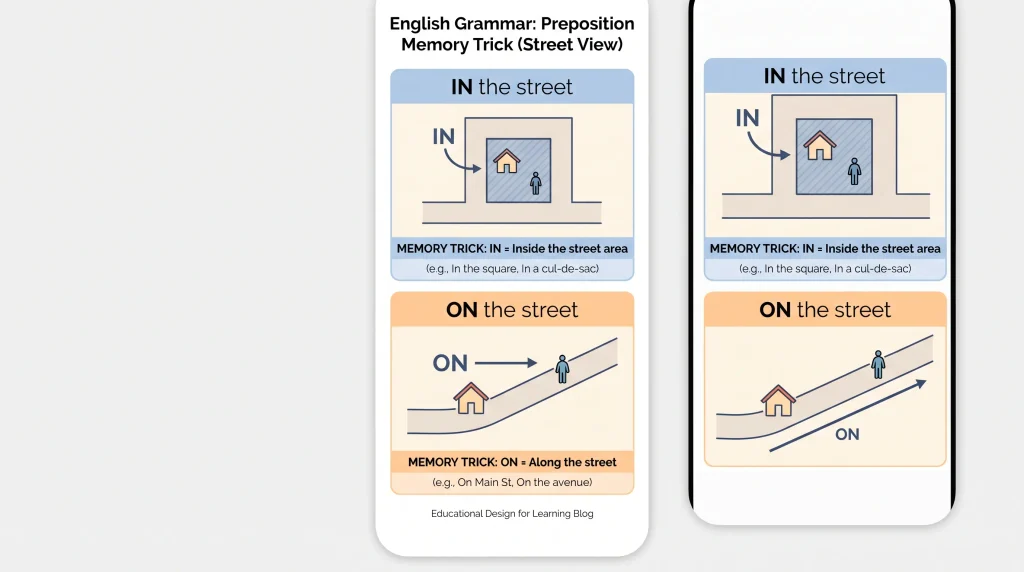
The easiest memory trick:
- IN the street = within the street area.
- ON the street = located along the street.
Don’t memorize the prepositions without understanding the picture they create.
Practice Quiz: In the Street or On the Street?
Test your understanding with these 10 questions. Choose the correct preposition for each sentence.
Your grammar practice
0/10 answered
1. The children are playing ___ the street, where cars are passing.inon
2. My new office is ___ Main Street.inon
3. A broken-down car is blocking traffic ___ the street.inon
4. We found a lovely café ___ Oxford Street.inon
5. I met an old friend ___ the street yesterday.inon
6. There is a large hole ___ the street near our house.inon
7. She lives ___ Park Avenue.inon
8. Several protesters were standing ___ the street, blocking vehicles.inon
9. The new bookstore is ___ this street.inon
10. The ball rolled ___ the street from the pavement.intoonto
Check my answers
Quick Summary
The difference between in the street and on the street depends mainly on the location you want to describe. Use in the street when referring to something within the physical street area, particularly the roadway where vehicles travel. Use on the street when describing a general location, street address, or building situated along a street. Both expressions are grammatically correct and commonly used. American English generally prefers on for street addresses, while British English allows some additional uses of in for residential street locations. Remember: in emphasizes the street as a physical space, whereas on identifies it as a location. Always consider context before choosing your preposition.
FAQ: In the Street vs On the Street
1. Which is correct: in the street or on the street?
Both are correct. In the street generally describes something within the physical street area, particularly the roadway. On the street usually describes a general location, address, or position along a street. The correct choice depends on what you mean.
2. Do Americans say in the street or on the street?
Americans use both expressions. They generally prefer on the street when referring to street addresses and locations, such as “I live on Oak Street.” They use in the street when describing something within the roadway, such as “The children are playing in the street.”
3. Do British people say in the street?
Yes. British English commonly uses in the street, including when referring to residential streets. For example, “I live in this street” is possible in British English. However, British speakers also use on the street, particularly when identifying the location of buildings and businesses.
4. Is on the street grammatically correct?
Yes. It is grammatically correct and widely used. For example, “There is a restaurant on this street” identifies the restaurant’s location. It is also used in expressions such as on the street, meaning homeless or living without permanent accommodation.
5. Is in the street grammatically correct?
Yes. It is a standard English expression. For example, “A child is playing in the street” describes a child within the street area. The expression is especially useful when discussing traffic, accidents, and activities taking place in the roadway.
6. Should I say walking in the street or walking on the street?
Both are possible, but the meanings can differ. Walking in the street usually suggests walking within the roadway. Walking on the street can describe walking along the street more generally. If you mean the designated pedestrian path, use walking on the sidewalk in American English or walking on the pavement in British English.
7. Is it correct to say I live on the street?
Yes. It is a standard expression when referring to a residential location. For example, “I live on Green Street.” However, live on the street can also mean living without a permanent home, depending on the context.
8. Can I use in the street when talking about a house?
Yes, particularly in British English, where expressions such as “There are several houses in this street” are natural. However, when giving a specific street address, on is generally the safer choice, especially in American and international English.
9. What is the difference between in the street and on the road?
In the street and in the road can both describe something within a roadway. On the road has additional meanings, including travelling, driving, or being away from home for work. For example, “The truck is in the road” describes its position, while “The truck is on the road” may describe its presence or journey on a route.
10. What is the easiest way to remember in the street vs on the street?
Remember that in emphasizes the street as a physical area, while on emphasizes its location or position along a street. For example, a ball can be in the street, while a shop can be on the street. This simple distinction will help you choose the appropriate preposition in most everyday situations.