
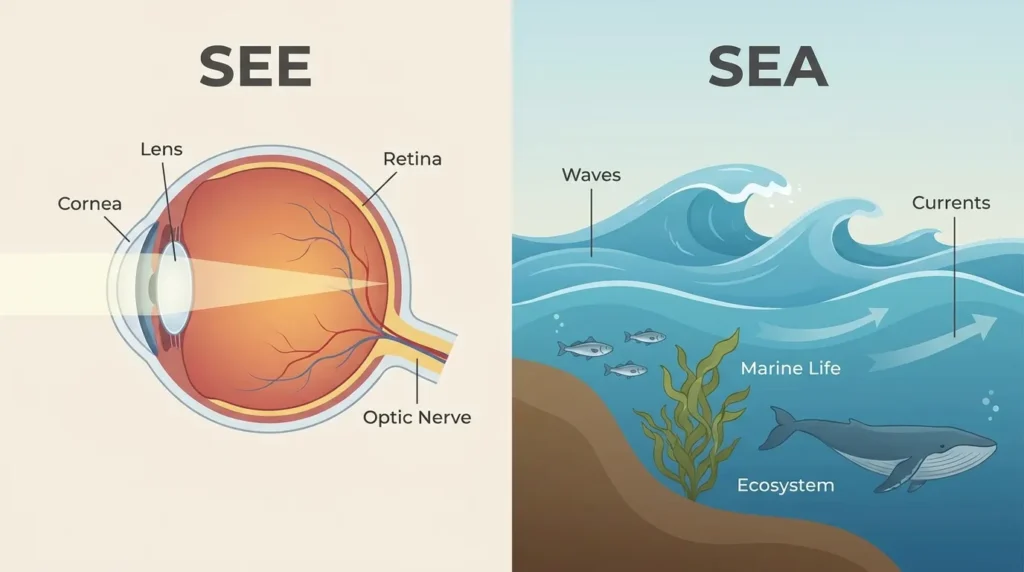

See and sea sound exactly the same, but they have completely different meanings. See is primarily a verb that means to notice something with your eyes, understand something, or meet someone. Sea is a noun that refers to a large body of salt water. Use see when talking about sight or understanding and sea when talking about water.
For example:
- I can see the sea from my window.
- We spent the afternoon swimming in the sea.
Both words are pronounced /siː/, so you cannot distinguish them by sound alone. You must understand the meaning of the sentence to choose the correct spelling.
What Is the Difference Between See and Sea?
See and sea are homophones. Homophones are words that have the same pronunciation but different spellings and meanings.
Although these words sound identical, they belong to different grammatical categories and perform different jobs in a sentence.
What Does See Mean?
See is primarily a verb. It means to notice something using your eyes, recognize something, understand an idea, or meet someone.
Examples:
- I can see a bird in the garden.
- Did you see the message I sent?
- Now I see what you mean.
- I will see my doctor tomorrow.
The word see also appears in common expressions such as:
- See you later.
- I see your point.
- Let’s see what happens.
- As far as I can see.
Its three main verb forms are:
| Verb Form | Word | Example |
|---|---|---|
| Base form | See | I see the problem. |
| Past tense | Saw | I saw the problem yesterday. |
| Past participle | Seen | I have seen the problem before. |
| -ing form | Seeing | I am seeing my friend tomorrow. |
Notice that saw and seen are forms of see, not different words with unrelated meanings.
What Does Sea Mean?
Sea is a noun. It refers to a large area of salt water, usually connected to an ocean and often partly surrounded by land.
Examples:
- The sea looks beautiful today.
- Many fish live in the sea.
- We walked along the sea after dinner.
- The ship disappeared into the open sea.
Sea can also describe a large amount or an overwhelming collection of something.
For example:
- The stadium was filled with a sea of people.
- She looked out at a sea of green fields.
In these expressions, sea does not refer to actual ocean water. It creates an image of something extending over a large area.
Why Does the Difference Between See and Sea Matter?
Choosing the wrong word can change the meaning of a sentence or make an otherwise correct sentence look careless.
Consider these examples:
- I can sea the mountains.
- I can see the mountains.
The first sentence uses the wrong word because the writer is talking about eyesight.
Now consider:
- We visited the see during our vacation.
- We visited the sea during our vacation.
The second sentence is correct because the sentence refers to a body of water.
These mistakes can appear in:
- School assignments and examinations.
- Professional emails and business reports.
- Social media posts and online comments.
- Travel blogs and personal stories.
- Academic writing and essays.
The problem is particularly common in writing because pronunciation offers no clue about the correct spelling.
The Core Rule: See vs Sea
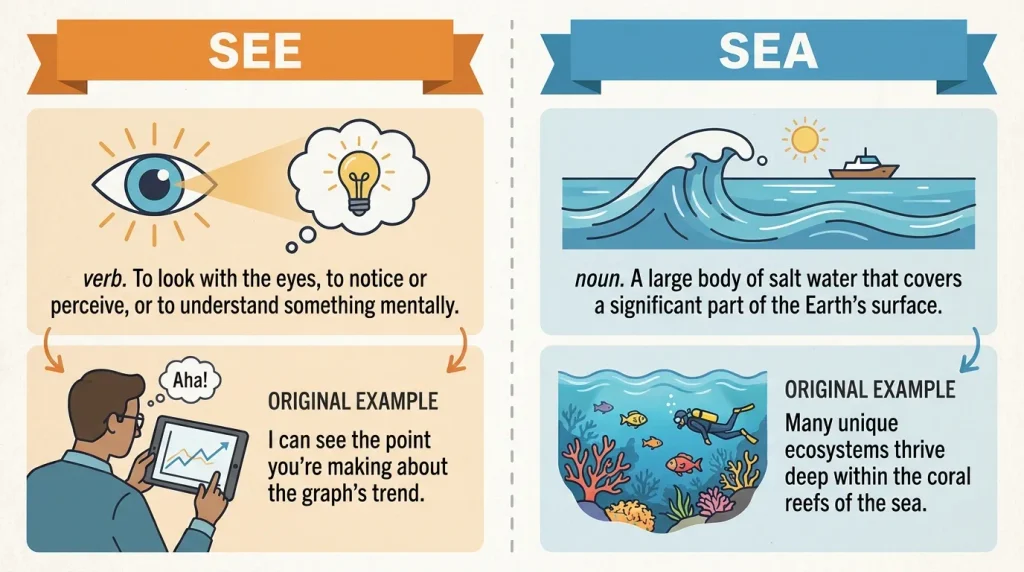
SEE = Sight and Understanding
Use see when you mean to look at, notice, understand, recognize, or meet someone.
Example: I can see the birds.
SEA = Salt Water
Use sea when referring to a body of salt water or a large expanse of something.
Example: The sea is calm today.
The easiest rule to remember:
- See = eyes.
- Sea = water.
If you are describing something you can look at or understand, choose see. If you are describing a body of water, choose sea.
How to Use See and Sea Correctly
Understanding their meanings is the first step. The next step is learning how they work in sentences.
When to Use See
Use see in the following situations.
1. When talking about eyesight
Use see when someone notices something through their eyes.
Examples:
- I can see the moon tonight.
- Can you see the board clearly?
- She saw a butterfly near the window.
2. When talking about understanding
See can also describe understanding an idea, explanation, or situation.
Examples:
- I see what you are trying to explain.
- Now I see why you were upset.
- Do you see the difference between these sentences?
3. When talking about meeting someone
See can mean visiting or spending time with another person.
Examples:
- I will see my grandparents tomorrow.
- She is going to see her teacher after class.
- We saw our old friends last weekend.
4. When talking about watching or experiencing something
See can refer to watching a performance, visiting a place, or experiencing an event.
Examples:
- Did you see the football match?
- We want to see the historical museum.
- I have never seen snow before.
When to Use Sea
Use sea in these situations.
1. When describing a body of salt water
Examples:
- The sea is warm in summer.
- Dolphins swim in the sea.
- The boat moved slowly across the sea.
2. When discussing coastal areas
Examples:
- Their hotel is close to the sea.
- We enjoyed a walk beside the sea.
- The village is famous for its beautiful sea views.
3. When referring to large expanses
Sea can describe a large or seemingly endless amount of something.
Examples:
- A sea of people filled the streets.
- The countryside looked like a sea of flowers.
- The audience raised a sea of colorful flags.
4. In compound words
Sea also appears in words connected with marine environments and coastal areas.
| Word | Meaning |
|---|---|
| Seaside | An area near the sea |
| Seawater | Water from the sea |
| Seashore | Land along the sea |
| Seafloor | The bottom of the sea |
| Seafarer | Someone who travels or works by sea |
| Seagull | A bird commonly found near the sea |
Correct Examples of See and Sea in Everyday English
Here are 12 original examples showing how these words appear in different situations.
See Examples
- Conversation: “Can you see the restaurant across the street?”
- Email: “I will see your revised proposal before the meeting.”
- School: “Students can see the difference between the two diagrams.”
- Workplace: “Let’s see whether we can finish the project by Friday.”
- Social media: “I can’t wait to see everyone at the event!”
- Academic writing: “The results allow researchers to see a clear pattern in the collected data.”
Sea Examples
- Conversation: “The sea looks especially beautiful this morning.”
- Email: “Our hotel reservation includes a room with a sea view.”
- School: “The sea contains a wide variety of marine organisms.”
- Workplace: “The company plans to expand its sea transport operations.”
- Social media: “Nothing feels better than watching the sunset beside the sea.”
- Academic writing: “Changes in sea temperature can affect marine ecosystems.”
These examples demonstrate that see describes an action or experience, whereas sea identifies a place, substance, or large expanse.
See vs Sea: Incorrect vs Correct Examples
The following table shows 12 common mistakes, their corrections, and the reasons behind them.
| ❌ Incorrect | ✅ Correct | Why? |
|---|---|---|
| I can sea the stars. | I can see the stars. | The sentence describes eyesight. |
| The see is very deep. | The sea is very deep. | The sentence refers to salt water. |
| I want to sea your new house. | I want to see your new house. | See means to visit or look at something. |
| We went to the see yesterday. | We went to the sea yesterday. | Sea identifies the body of water. |
| Can you sea the problem? | Can you see the problem? | See can mean understand or recognize. |
| The boat is sailing across the see. | The boat is sailing across the sea. | Sea is the noun needed here. |
| She saw the beautiful see. | She saw the beautiful sea. | The sentence describes water. |
| I have sea that movie. | I have seen that movie. | Seen is the past participle of see. |
| We will sea you tomorrow. | We will see you tomorrow. | See means meet or visit. |
| There was a beautiful see view. | There was a beautiful sea view. | Sea is used as a modifier in this expression. |
| He cannot sea without his glasses. | He cannot see without his glasses. | See refers to the ability to use one’s eyesight. |
| The fish live in the see. | The fish live in the sea. | Sea refers to their natural habitat. |
Important: Some mistakes involve more than choosing between see and sea. For example, “I have sea that movie” also needs the correct verb form, seen. Learning the difference between the two spellings helps, but using the correct verb tense matters too.
Why Do People Confuse See and Sea?
There are several reasons these words are easy to mix up.
1. They Have Identical Pronunciation
The main reason is that both words are pronounced /siː/.
When someone says either word, you hear exactly the same sound in standard English pronunciation.
For example:
“I can see the sea.”
Although the sentence contains both words, neither pronunciation tells you which spelling to use. You must rely on meaning and context.
2. Their Spellings Are Similar
The words differ by only one letter:
- See
- Sea
Both are short words with three letters, making it easy to select the wrong spelling when typing quickly.
3. People Focus on Sound Instead of Meaning
Some writers choose words based on how they sound rather than what they mean.
This approach fails with homophones because different words can have identical pronunciations.
The solution is to think about the meaning of the entire sentence before choosing a spelling.
4. Spellcheck Does Not Always Detect the Error
Modern spellcheckers can identify many spelling mistakes, but they may not recognize incorrect word choices when both words are correctly spelled.
For example:
“I can sea the building.”
A basic spellchecker may accept sea because it is a valid English word.
This is why proofreading should include checking meaning, not just spelling.
5. Translation Can Create Confusion
English learners sometimes translate words directly from their first language.
When two English words have the same pronunciation but different meanings, learners may find it difficult to remember which spelling represents which concept.
Learning both words in complete sentences is more effective than memorizing their translations separately.
ALSO CHECKOUT: In the Street vs On the Street: What’s the Difference?
Common Mistakes Checklist
Use this checklist to avoid confusing see and sea.
- Using sea when describing eyesight: Write “I can see the car,” not “I can sea the car.” Remember that see relates to looking.
- Using see when describing water: Write “The sea is beautiful,” not “The see is beautiful.” Remember that sea refers to salt water.
- Choosing a spelling based only on pronunciation: Both words sound identical. Check the meaning before writing.
- Forgetting the correct verb form: Write “I saw him yesterday” and “I have seen him before.” Do not use sea or substitute seen for saw.
- Confusing sea with ocean: Although related, the words are not always interchangeable in geographical contexts. An ocean is a major continuous body of salt water, while seas are often smaller or partly enclosed regions.
- Ignoring compound words: Remember spellings such as seaside, seawater, and seashore.
See vs Sea in Real English
Understanding dictionary meanings is useful, but it is equally important to know how people naturally use these words in everyday communication.
Grammatically Correct Usage
Both words are grammatically correct when they are used according to their meanings and sentence roles. For example, “I can see the sea” is completely correct because see functions as a verb and sea functions as a noun. Similarly, “We walked beside the sea” is correct because the sentence describes a location. These are ordinary expressions that work in conversation and formal writing.
Grammatically Possible but Unnatural Usage
Some sentences can be grammatically constructed but sound unusual because of their meaning or context. For example, “I observed the sea with my eyes” is grammatically possible, but it sounds unnecessarily elaborate in everyday conversation. Most speakers would simply say, “I looked at the sea” or “I could see the sea.” The issue is not incorrect grammar; it is an unnecessarily complicated choice of words.
Natural, Everyday English
In everyday English, people commonly use see in expressions such as “I see,” “See you later,” and “Let’s see.” These phrases are natural ways to express understanding, say goodbye, or consider a situation. Meanwhile, sea commonly appears in phrases such as “by the sea,” “across the sea,” and “sea view.” Both words fit naturally into ordinary conversations when their meanings are clear.
American vs British English: Is There a Difference?
There is no meaningful spelling or pronunciation difference between see and sea in standard American and British English.
Both varieties use:
- See for eyesight, understanding, and meeting someone.
- Sea for a large body of salt water.
Both words are pronounced /siː/ in standard American and British English.
The distinction is based on meaning, not regional spelling conventions.
Formal vs Informal Usage
There is no special formal or informal spelling rule for see and sea. Both words are appropriate in professional, academic, and everyday writing.
However, some expressions using see are more conversational than others.
| Expression | Register | Example |
|---|---|---|
| I see what you mean. | Conversational | I see what you mean about the schedule. |
| We will see the results. | Neutral | We will see the results next week. |
| Please see the attached document. | Professional | Please see the attached report. |
| The sea level is rising. | Neutral / Academic | Sea level changes affect coastal areas. |
| The vessel crossed the open sea. | Formal / Descriptive | The vessel crossed the open sea during the night. |
The important point is that the register may change the expression, but it never changes which spelling is correct.
See vs Sea: Comparison Table
| Feature | See | Sea |
|---|---|---|
| Part of speech | Primarily a verb | Noun |
| Main meaning | To notice with your eyes | A large body of salt water |
| Pronunciation | /siː/ | /siː/ |
| Spelling | S-E-E | S-E-A |
| Verb forms | See, saw, seen | Not an everyday verb |
| Refers to eyesight | Yes | No |
| Refers to understanding | Yes | No |
| Refers to water | No | Yes |
| Common expression | See you later | By the sea |
| Example | I can see the boat. | The boat is on the sea. |
See vs Sea: Which One Should You Choose?
Use this simple decision guide:
- Are you talking about looking at something? Use see.
- Are you talking about understanding an idea? Use see.
- Are you talking about meeting someone? Use see.
- Are you describing salt water? Use sea.
- Are you describing a large expanse, such as a sea of people? Use sea.
See and Sea in Real-Life Situations
Understanding these words becomes easier when you see them in practical situations.
1. During a Job Interview
Interviewer: “Can you see yourself working in this position?”
Candidate: “Yes, I can see myself contributing to the company’s long-term goals.”
Here, see means imagine or understand yourself in a particular situation.
2. During a Workplace Meeting
Manager: “Can everyone see the presentation on the screen?”
Employee: “Yes, we can see it clearly.”
The word see refers to visual perception.
3. In a Travel Email
Incorrect: “We would like a room with a see view.”
Correct: “We would like a room with a sea view.”
The room overlooks the sea, so the noun sea is required.
4. In a Text Message
Incorrect: “Can’t wait to sea you tomorrow!”
Correct: “Can’t wait to see you tomorrow!”
The writer is talking about meeting someone.
5. In a School Examination
Question: Which sentence is correct?
A. I can sea the birds.
B. I can see the birds.
Correct answer: B.
The sentence describes the ability to notice birds with your eyes.
Easy Memory Trick: How to Remember See vs Sea
The easiest way to remember the difference is to connect each spelling with its meaning.
SEE = EYES
The two letters “e” can remind you of two eyes.
You use your eyes to see.
Bright blue tropical sea with waves aerial view
SEA = WATER
The word sea is associated with the ocean, waves, beaches, and marine life.
Try remembering this sentence:
“I can see the sea.”
This short sentence contains both words and shows exactly how they are used.
- See = the action of looking.
- Sea = the body of water being observed.
Another useful trick is to remember:
Two E’s in SEE remind you of two eyes.
This is a simple spelling association that can help you recall the correct word when writing.
Practice Quiz: See vs Sea
Test your understanding by choosing the correct word in each sentence.
Choose the correct word
0/10 answered
1. I can ___ the mountains from my bedroom.SeeSea
2. The children played beside the ___.SeeSea
3. I will ___ my teacher after class.SeeSea
4. The boat disappeared into the ___.SeeSea
5. Now I ___ what you are trying to explain.SeeSea
6. Many marine animals live in the ___.SeeSea
7. We have ___ this film before.SeeSeaSeen
8. The hotel offers a beautiful ___ view.SeeSea
9. Can you ___ the sign across the road?SeeSea
10. They sailed across the ___.SeeSea
Check my answers
Quick Summary: See vs Sea
See and sea are homophones, meaning they have the same pronunciation but different spellings and meanings. See is primarily a verb used when talking about eyesight, understanding, meeting someone, or experiencing something. Sea is a noun that refers to a large body of salt water and can also describe a vast expanse of something. Both words are pronounced /siː/ in standard American and British English. The easiest way to remember the difference is to associate the two E’s in see with your two eyes and sea with water. Always consider the meaning of your sentence before choosing the spelling.
Frequently Asked Questions (FAQ)
1. Are see and sea homophones?
Yes. See and sea are homophones because they have identical pronunciations but different spellings and meanings. Both are pronounced /siː/. However, see is primarily a verb, while sea is a noun.
2. Is it see or sea you later?
The correct expression is “See you later.”
It is a common informal expression used when saying goodbye to someone. Here, see means meeting or seeing that person again.
3. Can I use see and sea in the same sentence?
Yes. Both words can appear naturally in the same sentence.
For example:
“I can see the sea from my bedroom window.”
Here, see describes the action of looking, while sea identifies the body of water.
4. Is sea a verb or a noun?
Sea is a noun in ordinary modern English. It refers to a large body of salt water.
For example: “The sea is calm today.”
It can also appear in expressions such as “a sea of people,” where it describes a large quantity of something.
5. Is see a verb or a noun?
See is primarily a verb. It means to notice something visually, understand something, or meet someone.
For example:
- I see a bird.
- I see your point.
- I will see my friend tomorrow.
There are also specialized noun uses of see, such as a bishop’s official seat or jurisdiction, but these are uncommon in everyday English.
6. Why do see and sea sound the same?
English spelling does not always represent pronunciation in a one-to-one way. Different combinations of letters can produce identical sounds.
In this case, both ee in see and ea in sea represent the same long vowel sound /iː/.
7. What is the past tense of see?
The past tense of see is saw.
Examples:
- I see the building every day.
- I saw the building yesterday.
Its past participle is seen, as in “I have seen that building before.”
8. Can sea mean a large amount of something?
Yes. Sea can be used figuratively to describe a very large or seemingly endless quantity of something.
For example:
- A sea of people filled the stadium.
- The field looked like a sea of flowers.
This is a figurative expression rather than a reference to actual salt water.
9. Is sea the same as ocean?
No. Although both words refer to large bodies of salt water, they are not exactly the same.
An ocean is one of Earth’s major continuous bodies of salt water. A sea is generally a smaller region of salt water, often partly enclosed by land or associated with an ocean. The distinction can vary in geographical naming.
10. What is the easiest way to remember see vs sea?
Remember this simple association:
- See = two E’s = two eyes.
- Sea = water = waves and beaches.
You can also practise with the sentence “I can see the sea.” It uses both words correctly and makes their different meanings easy to remember.


