


Should you write I feel happy or I felt happy? Both are grammatically correct, but they communicate different things.
The difference between feel and felt comes down to verb tense and sentence structure. Feel is the base form of the verb and is used in the simple present with certain subjects. Felt is its simple past form and past participle.
Understanding this difference will help you describe current emotions, past experiences, physical sensations, and opinions without making tense-related mistakes.
Feel or Felt?
Feel is the present-tense form of the verb, while felt is its simple past tense and past participle. Use feel to describe current feelings, general experiences, or sensations. Use felt when describing something experienced in the past or when forming perfect tenses with have, has, or had. For example, “I feel tired today” describes the present, while “I felt tired yesterday” describes the past.
What Is the Difference Between Feel and Felt?
Feel and felt are two forms of the same irregular verb. They describe emotions, physical sensations, opinions, and experiences, but they are used in different grammatical situations.
Feel is the base form. It appears in the simple present with I, you, we, and they. It also follows modal verbs such as can, will, should, and might.
Examples:
- I feel confident about my decision.
- They feel comfortable here.
- You should feel proud of your progress.
Felt is both the simple past form and the past participle. It describes an experience that happened earlier or forms perfect tenses with auxiliary verbs.
Examples:
- I felt nervous before the interview.
- She felt a sudden pain in her shoulder.
- We have felt this pressure before.
The important point is that felt does not always mean an experience happened at a specific time in the past. Its role also depends on the helping verb in the sentence.
Why Does Knowing the Difference Matter?
Choosing the correct verb form helps readers understand when an experience happened.
Consider these two sentences:
- I feel disappointed with the result.
- I felt disappointed with the result.
The first sentence describes a current emotional state. The second describes a past emotional state.
Using the wrong form can create confusion, especially in situations where timing matters.
For example:
- Workplace: Saying “I felt uncomfortable during the meeting” reports a previous experience.
- Email: Writing “I feel that this proposal needs revision” expresses a current opinion.
- Education: Using the correct verb form helps maintain consistent tense in essays and examinations.
- Everyday conversation: “I feel better now” and “I felt better yesterday” communicate different situations.
The distinction is particularly important when writing about personal experiences, reporting events, and explaining how circumstances have changed.
The Core Rule: When to Use Feel and Felt
Present and base form
FEEL
Use feel for current feelings, general truths, and after modal verbs.
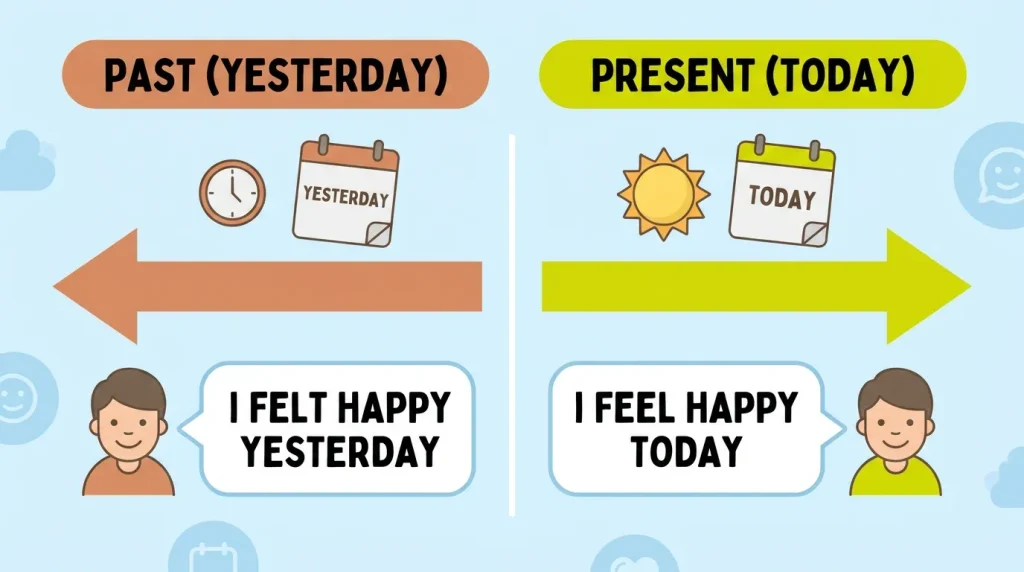
I feel happy today.
Past and past participle
FELT
Use felt for past experiences and after have, has, or had in perfect tenses.
I felt happy yesterday.
I have felt happy before.
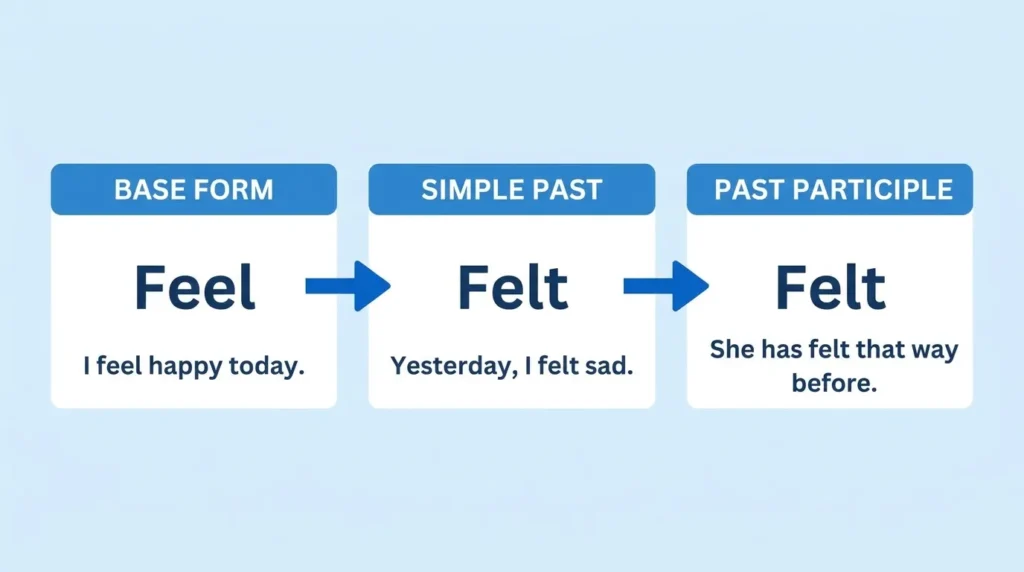
Remember: Feel → Felt → Felt
Base form → Past simple → Past participle
How to Use Feel and Felt Correctly
The easiest way to choose between these forms is to examine the complete sentence rather than looking at the verb alone.
1. Use Feel for Present Feelings and Experiences
Use feel when describing a current emotion, physical sensation, opinion, or general experience.
Examples:
- I feel relaxed after exercising.
- We feel welcome in this community.
- They feel nervous about the examination.
- I feel that we should reconsider the decision.
With he, she, it, or another singular third-person subject, use feels in the simple present.
Examples:
- She feels confident.
- He feels uncomfortable.
- The room feels cold.
Remember that feels is the correct present-tense form for third-person singular subjects. Do not use feel in an ordinary affirmative simple-present sentence with these subjects.
2. Use Felt for Past Experiences
Use felt when describing emotions, sensations, or experiences that occurred in the past.
Examples:
- I felt exhausted after the journey.
- She felt nervous before her presentation.
- They felt disappointed with the outcome.
- He felt a sharp pain in his back.
An important feature of felt is that it stays the same regardless of the subject.
- I felt tired.
- She felt tired.
- We felt tired.
- They felt tired.
Unlike the present tense, the simple past does not change felt according to the subject.
3. Use Felt After Have, Has, and Had
Felt is also the past participle of feel.
A past participle is a verb form used with helping verbs to build certain tenses.
Use these patterns:
| Structure | Example |
|---|---|
| Have + felt | I have felt this way before. |
| Has + felt | She has felt better recently. |
| Had + felt | They had felt nervous before the announcement. |
These structures describe experiences in different ways.
- Have felt: Connects a past experience to the present.
- Has felt: The same present-perfect construction with a singular third-person subject.
- Had felt: Places an experience before another past event.
Incorrect: I have feel nervous before.
Correct: I have felt nervous before.
The helping verb have requires the past participle, not the base form.
4. Use Feel After Modal Verbs
Modal verbs express ability, possibility, advice, intention, or obligation.
Common examples include can, could, will, would, should, and might.
After these verbs, use the base form feel.
Examples:
- I can feel the difference.
- You should feel proud of your work.
- She might feel uncomfortable.
- We will feel better tomorrow.
- They could feel the vibration.
Even when the sentence refers to the future or a hypothetical situation, the base form remains correct after a modal verb.
Incorrect: She might felt disappointed.
Correct: She might feel disappointed.
5. Use Feel After Did and Did Not
When forming questions and negative sentences in the simple past, use did or did not followed by the base form feel.
Examples:
- Did you feel nervous?
- Did she feel comfortable?
- I did not feel well yesterday.
- They didn’t feel ready for the interview.
Why?
The auxiliary verb did already marks the past tense. Adding felt would mark the past twice.
Incorrect: Did you felt happy?
Correct: Did you feel happy?
6. Use Feel in Infinitive Structures
An infinitive is the base form of a verb, often preceded by to.
Use feel after to in infinitive constructions.
Examples:
- I want to feel more confident.
- She needs to feel comfortable.
- They hope to feel better soon.
- He seems to feel responsible.
Do not write to felt. The infinitive requires the base form.
7. Use Feeling in Continuous Tenses
When describing an ongoing or temporary experience, use the -ing form feeling with the appropriate form of be.
Examples:
- I am feeling better today.
- She was feeling nervous before the interview.
- They are feeling optimistic about the project.
Both I feel better and I am feeling better are natural English.
The simple present often describes a state or general condition, while the continuous form can emphasize a temporary or changing experience.
Correct Examples of Feel and Felt
The following examples show how both forms work in different everyday situations.
Everyday Conversation
- I feel much better after taking a short break.
- She felt embarrassed when she forgot his name.
Emails and Professional Communication
- I feel that the proposed schedule is realistic.
- We felt that the previous arrangement was more effective.
School and Education
- Students feel more confident when they understand the lesson.
- I felt nervous before taking my final examination.
Workplace Communication
- Our team feels positive about the upcoming project.
- The employees felt appreciated after receiving recognition.
Social Media and Messaging
- I feel so lucky to have supportive friends.
- We felt excited when we heard the good news.
Academic Writing
- The participants felt anxious during the initial assessment.
- The findings suggest that students feel more motivated when feedback is constructive.
Notice that feel and felt can describe both emotions and physical experiences. Their meaning does not change; their grammatical form changes according to the sentence.
Feel vs. Felt: Incorrect and Correct Examples
Here are common mistakes learners make when choosing between feel and felt.
| ❌ Incorrect | ✅ Correct | Why |
|---|---|---|
| I felt happy every day now. | I feel happy every day now. | The sentence describes a current or habitual state. |
| She feel nervous today. | She feels nervous today. | A singular third-person subject takes feels in the simple present. |
| I have feel this pain before. | I have felt this pain before. | Have requires the past participle felt. |
| He will felt better soon. | He will feel better soon. | Will is followed by the base form. |
| Did you felt sad? | Did you feel sad? | Did already marks the past tense. |
| They has felt disappointed. | They have felt disappointed. | They takes have, not has. |
| She had feel uncomfortable. | She had felt uncomfortable. | Had requires the past participle. |
| I am felt tired. | I feel tired. | A simple present description does not need am before felt. |
| He didn’t felt well. | He didn’t feel well. | Didn’t is followed by the base form. |
| I want to felt happy. | I want to feel happy. | To-infinitives use the base form. |
| We feels excited. | We feel excited. | We takes the base form feel. |
| I have been felt nervous. | I have been feeling nervous. | The present-perfect continuous requires been + feeling. |
Why Do People Confuse Feel and Felt?
Although the distinction is straightforward, several language-learning habits can make these forms confusing.
1. Overgeneralising Regular Verb Rules
Many English verbs form their past tense by adding -ed.
For example:
- Work → Worked
- Play → Played
- Walk → Walked
Learners sometimes apply the same pattern to feel and produce feeled.
However, feel is an irregular verb. Its past form is felt.
The best approach is to learn irregular verbs as complete sets rather than applying the regular -ed rule to every verb.
2. Focusing Only on Time Words
Words such as yesterday, today, tomorrow, and already can help identify tense, but they do not determine the verb form on their own.
For example:
- I will feel better tomorrow.
- I felt better yesterday.
- I have felt better recently.
The sentence structure matters just as much as the time reference.
3. Confusing Helping Verbs
Helping verbs such as have, has, had, did, and will affect the form of the main verb.
Compare:
- I felt sick.
- I have felt sick.
- I did feel sick.
- I will feel sick.
Each sentence uses a different grammatical construction.
Memorising these patterns is more reliable than choosing a verb form based only on whether the sentence refers to the past or present.
4. Depending Too Much on Spellcheck
Autocorrect and grammar tools can identify many spelling and grammatical errors, but they may not understand the intended time reference.
For example, both of these sentences are grammatically correct:
- I feel disappointed.
- I felt disappointed.
A spellchecker cannot always know which one matches the situation you want to describe.
5. Translating Directly From Another Language
Some languages express tense differently from English. A learner may translate a sentence word for word and choose the wrong English verb form.
This is particularly common when the learner’s first language does not use the same auxiliary-verb patterns.
Instead of translating individual words, learn complete English structures such as did you feel, have felt, and will feel.
Feel and Felt in Real English
Understanding grammar rules is important, but knowing how people naturally use these forms makes your English more effective.
1. Grammatically Correct: I Feel Tired
“I feel tired” is grammatically correct and natural when describing your current physical or emotional condition. It works in everyday conversation, professional communication, and informal messages. You can also say “I am feeling tired” when emphasizing a temporary condition or how you feel at the moment. Both constructions are correct, but the second places more emphasis on the current experience.
2. Grammatically Correct: I Felt Tired
“I felt tired” is grammatically correct and natural when describing a previous experience. You might use it when explaining why you left a meeting early, describing your condition after travelling, or talking about a difficult day. The verb felt clearly places the experience in the past. It works in both formal and informal English without requiring any special expression or additional explanation.
3. Grammatically Correct but Structurally Different: I Have Felt Tired
“I have felt tired” is also correct, but it uses the present perfect tense rather than the simple past. It connects a previous experience to the present, often without specifying exactly when it happened. For example, “I have felt tired lately” describes an experience over a recent period. It is especially useful when the exact time is less important than the connection to now.
4. Grammatically Correct: I Will Feel Better
“I will feel better” is grammatically correct because will is followed by the base form of the verb. Even though the sentence refers to the future, you should not use felt. This construction is common in everyday conversation, reassuring messages, workplace discussions, and personal writing. For example, “I will feel more confident after completing the training” expresses an expected future condition.
5. Grammatically Correct: I Did Feel Nervous
“I did feel nervous” is grammatically correct, although it may sound more emphatic than the ordinary statement “I felt nervous.” The auxiliary did adds emphasis or contrast. For example, if somebody assumes you were completely comfortable, you might respond, “I did feel nervous, but I continued with the presentation.” In ordinary past-tense questions and negatives, did also takes the base form feel.
American vs. British English: Feel or Felt
There is no difference between American and British English in the basic conjugation of feel.
Both varieties use the same forms:
| Verb Form | American English | British English |
|---|---|---|
| Base form | Feel | Feel |
| Third-person singular | Feels | Feels |
| Simple past | Felt | Felt |
| Past participle | Felt | Felt |
| Present participle | Feeling | Feeling |
Examples:
- American: I felt uncomfortable during the meeting.
- British: I felt uncomfortable during the meeting.
Both sentences are correct.
The choice between feel and felt depends on tense and grammatical structure, not on whether you are writing American or British English.
ALSO CHECKOUT: A MA or an MA Degree? Which Is Correct?
Formal vs. Informal Usage
Feel and felt are suitable for both formal and informal communication. Neither word is inherently casual or unprofessional.
However, the expressions surrounding them may change depending on the situation.
| Situation | Example | Register |
|---|---|---|
| Casual conversation | I feel great today. | Informal |
| Text message | I felt so happy yesterday. | Informal |
| Workplace email | I feel that we should review the proposal. | Professional |
| Academic writing | Participants felt anxious during the assessment. | Formal |
| Business report | Employees reported that they felt supported. | Formal |
In professional writing, feel can also express an opinion politely.
For example:
“I feel that the proposed changes would improve the process.”
This is acceptable, although a more direct academic or business statement might be:
“The proposed changes would improve the process.”
The choice depends on whether you want to communicate a personal opinion or present a more direct conclusion.
Feel vs. Felt: Comparison Table
| Feature | Feel | Felt |
|---|---|---|
| Grammatical form | Base form | Past form and past participle |
| Simple present | Yes | No |
| Simple past | No | Yes |
| Past participle | No | Yes |
| Present example | I feel happy. | — |
| Past example | — | I felt happy. |
| After have/has | No | Yes |
| After had | No | Yes |
| After will | Yes | No |
| After did | Yes | No |
| After to (infinitive) | Yes | No |
| Third-person singular present | Feels | Not applicable |
| American/British difference | None | None |
Feel, Feels, Felt, and Feeling: Understanding All Four Forms
It is helpful to understand all the main forms of this verb rather than memorising only feel and felt.
| Form | Grammatical Function | Example |
|---|---|---|
| Feel | Base form and simple present | I feel confident. |
| Feels | Third-person singular present | She feels confident. |
| Felt | Simple past | She felt confident yesterday. |
| Felt | Past participle | She has felt confident before. |
| Feeling | Present participle / -ing form | She is feeling confident. |
This table also explains why feels and feeling sometimes appear in sentences where learners might expect feel.
Real-Life Situations: How to Choose Feel or Felt
The following scenarios demonstrate how the correct form works in practical communication.
1. During a Job Interview
Interviewer: How do you feel about working under pressure?
Candidate: I feel comfortable handling challenging situations.
The question asks about the candidate’s current attitude, so feel is appropriate.
2. During a Workplace Meeting
Manager: How did everyone respond to the new policy?
Employee: Most team members felt positive about the changes.
Felt is correct because the employee is reporting a previous reaction.
3. Writing a Professional Email
Subject: Feedback on the Project
“I feel that the current project timeline needs a few adjustments before we proceed.”
Feel expresses the writer’s present opinion.
4. Sending a Text Message
Friend: Were you nervous before your presentation?
You: Yes, I felt really nervous, but everything went well!
Felt describes an emotion experienced before the presentation.
5. Writing an Academic Essay
“The participants felt more confident after completing the training programme.”
Felt is appropriate because the sentence reports an experience during a completed study or assessment.
6. Talking About Future Plans
“I will feel more prepared after practising for another week.”
Feel is required after will, even though the sentence describes a future situation.
Common Mistakes Checklist
Use this checklist when proofreading your writing.
- Using feeled instead of felt: Feel is irregular, so its past form is felt. Memorise feel → felt → felt.
- Using feel with he, she, or it in the simple present: Use feels for third-person singular subjects. Write “She feels happy.”
- Writing have feel: Have, has, and had require the past participle felt. Write “I have felt this before.”
- Using felt after will: Will takes the base form. Write “I will feel better.”
- Using felt after did: Did already marks the past. Write “Did you feel nervous?”
- Using felt after to: The infinitive requires feel. Write “I want to feel happy.”
- Confusing felt and feeling: Use feeling after forms of be in continuous constructions. Write “I am feeling better.”
- Changing tense unnecessarily: Keep the verb tense consistent with the intended timeline unless there is a clear reason to change it.
How to Remember Feel or Felt Easily
The simplest memory trick is to learn the three principal forms together:
Feel → Felt → Felt
Feel
Base form
I feel
Felt
Past simple
I felt
Felt
Past participle
I have felt
Remember these three examples:
- I feel happy today.
- I felt happy yesterday.
- I have felt happy before.
If you are unsure which form to use, look for the helping verb.
- After will, can, should, or did → feel.
- After have, has, or had → felt.
- For a simple past statement → felt.
- For a simple present statement → feel or feels, depending on the subject.
This small pattern will help you avoid most feel-versus-felt mistakes.
Test Your Understanding: Feel or Felt?
Choose the correct verb form for each sentence. Try answering before checking the explanations.
Grammar practice
0 of 6 answered
1. I _____ much better today.feelfeltfeeling
2. She _____ nervous before the interview yesterday.feelfeelsfelt
3. Have you ever _____ this way before?feelfeltfeeling
4. They will _____ happy about the news.feltfeelsfeel
5. Did he _____ uncomfortable during the meeting?feltfeelfeels
6. My brother _____ tired after work every day.feelfeelsfelt
Check my answers
Quick Summary: Feel or Felt
Feel is the base form of an irregular English verb, while felt is its simple past tense and past participle. Use feel when describing present emotions, physical sensations, general experiences, and after modal verbs such as will, can, and should. Use felt when describing past experiences or after have, has, and had. Remember that he, she, and it take feels in ordinary simple-present sentences. After did, use feel rather than felt because did already marks the past tense. Both American and British English follow the same rules. The easiest way to remember the verb is: feel → felt → felt.
Frequently Asked Questions (FAQ)
1. Is feel or felt grammatically correct?
Both are grammatically correct. Feel is used for the base form and certain present-tense constructions, while felt is used for the simple past and past participle. The correct choice depends on the sentence structure and intended meaning.
2. Is felt the past tense of feel?
Yes. Felt is the simple past tense of feel. For example, “I feel nervous today” describes the present, while “I felt nervous yesterday” describes the past.
3. Is felt also a past participle?
Yes. Felt serves as both the simple past and past participle of feel. You can use it in perfect tenses, such as “I have felt this before” and “She had felt uncomfortable.”
4. Should I write I have feel or I have felt?
Write “I have felt.” The present perfect tense requires have or has followed by the past participle. Since felt is the past participle of feel, it is the correct form.
5. Is it correct to say I am felt?
Not in ordinary sentences where you mean that you are experiencing an emotion or sensation. Say “I feel happy” or “I am feeling happy.” However, “I am felt” can occur in a passive construction with a different meaning, although it is uncommon.
6. Why do we say Did you feel instead of Did you felt?
Because did is already the past-tense auxiliary verb. The main verb must remain in its base form. Therefore, “Did you feel happy?” is correct, while “Did you felt happy?” is incorrect.
7. Is it correct to say I have been feeling?
Yes. “I have been feeling” is the present-perfect continuous construction. It describes an experience that started in the past and continues into the present or has a connection to the present. For example, “I have been feeling tired lately.”
8. What is the difference between I feel and I am feeling?
Both are correct. “I feel” often describes a current state, opinion, or general condition. “I am feeling” can emphasize a temporary experience or a condition that is changing. For example, “I feel confident” and “I am feeling more confident today” are both natural.
9. Can I use felt for future situations?
Not directly after will. Use “I will feel better tomorrow.” However, felt can appear in future-related perfect constructions, such as “By tomorrow, I will have felt the effects of the treatment.”
10. Is feel an irregular verb?
Yes. Feel is an irregular verb because it does not form its past tense by simply adding -ed. Its three principal forms are feel, felt, and felt.
11. Is it correct to say I felt like crying?
Yes. “I felt like crying” is a natural English expression. It means you had the desire or emotional urge to cry at that time. The construction uses felt like followed by a noun or an -ing form.
12. What is the easiest way to remember feel and felt?
Remember the three principal forms: feel, felt, felt. Use feel after modal verbs and did, felt for simple past statements, and felt after have, has, or had. Learning these sentence patterns is more effective than memorising isolated examples.
- Present simple tense
- Past participle examples
- Modal verbs in English
- Subject-verb agreement
- Present perfect vs. simple past
- Common English grammar mistakes
- English verb conjugation
- Infinitive verb forms
- Present continuous tense
- Irregular verb exercises


