


The correct phrase in everyday English is “every person,” not “every people.” The word every normally takes a singular countable noun, so we say “every person,” “every student,” and “every employee.” If you want to refer to people collectively, use “all people.” There is one important exception: people can refer to a distinct nation or cultural group, although this meaning is specialized and “every people” is uncommon in modern everyday English.
ALSO CHECKOUT: Drier or Dryer: Which Spelling Is Correct?
What Is the Difference Between Every Person and Every People?
“Every person” means each individual human being in a group. It is the standard expression for conversations, emails, academic writing, workplace communication, and everyday situations.
“Every people” is generally incorrect when people means multiple individual human beings. However, people can also mean a distinct cultural, ethnic, or national group. In that specialized sense, the related plural peoples refers to multiple such groups.
Consider these examples:
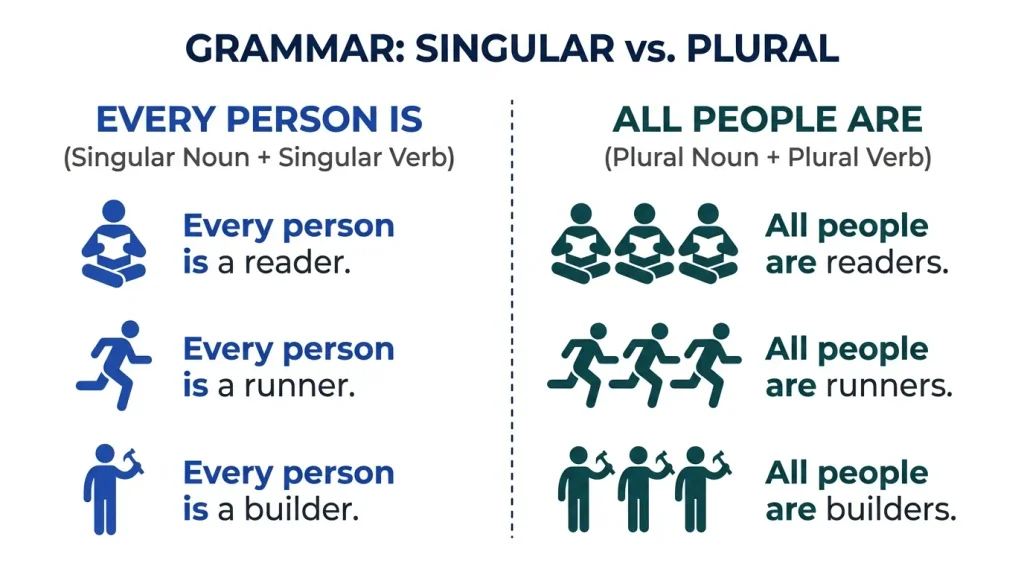
- Every person deserves respect. Correct: every is followed by the singular noun person.
- All people deserve respect. Correct: all can be followed by the plural noun people.
- Every people deserves respect. Not standard for the intended meaning of every individual human being.
- Every people has its own traditions. Possible in specialized writing if people means a distinct nation or cultural group, but usually clearer as “Every culture has its own traditions.”
The important point is that these expressions are not interchangeable in every context. The right choice depends on both grammar and meaning.
Why Does the Difference Matter?
Choosing the right expression helps your writing sound clear, natural, and grammatically accurate. Although readers may understand “every people” from context, the phrase can distract them from your message.
This matters particularly in situations where precise English is important:
- Academic writing: Incorrect word combinations can weaken an otherwise strong argument.
- Professional emails: Correct grammar helps your instructions and requests sound polished.
- Examinations: Questions about determiners, singular nouns, and plural nouns often test this exact rule.
- Public communication: Clear wording prevents readers from wondering whether you mean individuals, communities, or nations.
- English-language learning: Understanding the rule helps you correct similar errors, such as “every students” and “every employees.”
You do not need to memorize dozens of separate examples. Once you understand how every works, you can apply the same principle to many other nouns.
ALSO READ: Suing vs Sueing: Which Spelling Is Correct?
The Core Rule: Every Takes a Singular Noun
The rule to remember
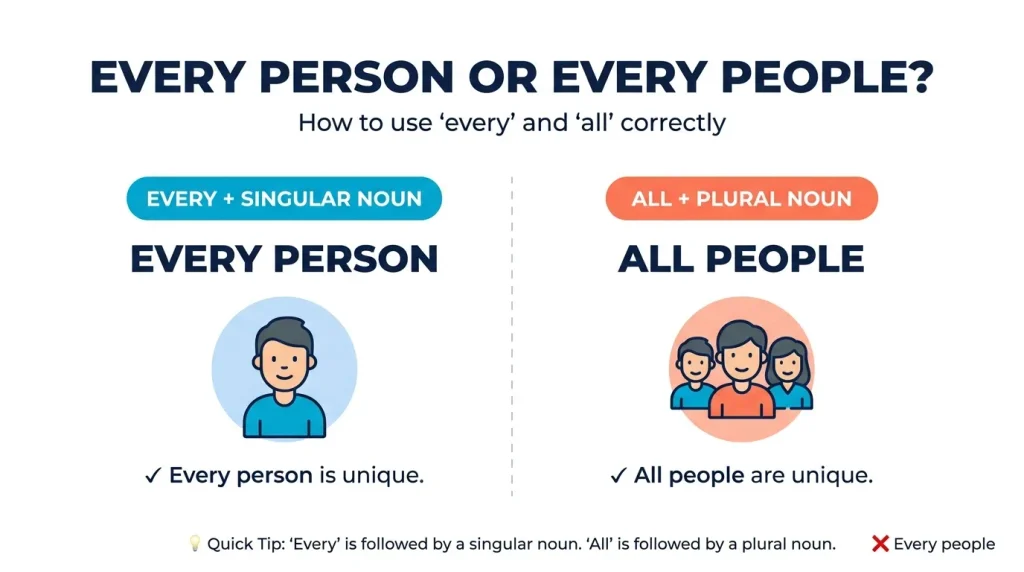
Use every + singular countable noun.
- Every person
- Every student
- Every teacher
- Every customer
- Every employee
For a plural noun, use all + plural noun when you mean the group collectively.
- All people
- All students
- All teachers
- All customers
- All employees
A countable noun is a noun that can be counted as one, two, three, and so on. For example, one person, two people, and three people.
The word every looks at the members of a group individually. That is why it normally takes a singular noun, even when the sentence refers to a large number of people.
For example:
- Every person is welcome.
- Every student has an assignment.
- Every employee needs training.
The nouns and verbs remain singular after every. You should not write “Every person are welcome” or “Every student have an assignment” in standard English.
How to Use Every Person and People Correctly
Use “every person” for individual human beings
Choose every person when you want to refer to each individual in a particular group or situation.
Examples:
- Every person in the classroom received a worksheet.
- Every person attending the meeting must sign the register.
- Every person deserves an opportunity to succeed.
- Every person on the team has a responsibility.
The group can contain two people, twenty people, or thousands of people. The grammatical pattern stays the same.
Use “all people” for people collectively
Choose all people when you want to make a statement about people as a whole or refer to multiple individuals collectively.
Examples:
- All people need access to clean drinking water.
- All people should be treated fairly.
- All people attending the event must register.
- All people in the building were evacuated.
Notice the different noun forms:
- Every person is invited.
- All people are invited.
The first sentence uses a singular noun and singular verb. The second uses a plural noun and plural verb.
Use “everyone” when you want a shorter expression
Everyone means every person. It is a singular indefinite pronoun, which means it refers to people without identifying them individually by name.
Examples:
- Everyone is invited.
- Everyone needs a chance to speak.
- Everyone has received the email.
- Everyone enjoyed the presentation.
Although everyone refers to multiple individuals, it takes a singular verb in standard English.
Say “Everyone is ready,” not “Everyone are ready.”
Use “each person” when emphasizing individuals separately
Each person is another correct alternative. It often draws attention to individual members rather than the group as a whole.
Examples:
- Each person received a different number.
- Each person must complete the form.
- Each person was given an opportunity to ask questions.
In many sentences, each person and every person are interchangeable. The difference is usually one of emphasis, not basic correctness.
Use “every people” only with care
In specialized historical, cultural, or academic writing, people can refer to a nation or distinct cultural group rather than individual human beings.
Even then, the wording “every people” may sound unfamiliar to general readers. Often, a more precise expression is preferable:
- Every nation has its own history.
- Every culture has its own traditions.
- Every ethnic group has its own identity.
When referring to several distinct groups collectively, peoples may be appropriate:
- The histories of Indigenous peoples deserve careful study.
- The region is home to many different peoples.
Here, peoples means distinct populations or cultural groups. It is different from the ordinary plural people, which means individual human beings.
Correct Examples of Every Person and Related Expressions
The following examples show how to use the correct forms in different situations.
Everyday conversation
- “Every person in our family has a different opinion.”
- “Everyone is waiting outside.”
- “All people need food, water, and shelter.”
Emails and workplace communication
- “Every person attending the training session must arrive by 9 a.m.”
- “Everyone has received a copy of the updated policy.”
- “All employees must complete the safety assessment.”
School and examinations
- “Every student must submit the assignment before Friday.”
- “Each person in the group will present one section of the project.”
- “All students are expected to follow the examination rules.”
Social media and public communication
- “Every person has a story worth hearing.”
- “Everyone deserves to feel welcome in this community.”
- “All people should have equal opportunities to learn.”
Academic and formal writing
- “Every participant was informed about the purpose of the study.”
- “All participants were asked to complete the questionnaire.”
- “Every individual has the right to make an informed decision.”
These examples demonstrate that every person, everyone, each person, and all people are all useful expressions. The best choice depends on whether you want to emphasize individual members, the entire group, or people in general.
Incorrect vs. Correct: 10 Common Mistakes
| ❌ Incorrect | ✅ Correct | Why |
|---|---|---|
| Every people deserves respect. | Every person deserves respect. | Every normally takes a singular countable noun. |
| Every students must attend. | Every student must attend. | The noun after every should be singular. |
| Every employees need training. | Every employee needs training. | Use a singular noun and singular verb. |
| Every person are welcome. | Every person is welcome. | The singular subject takes is, not are. |
| Every people are invited. | All people are invited. | Use all with the plural noun people. |
| Everyone are ready. | Everyone is ready. | Everyone takes a singular verb. |
| Every person have a ticket. | Every person has a ticket. | The singular subject requires has. |
| Every of the students passed. | Every one of the students passed. | Use every one of, not every of. |
| All person must register. | All people must register. | In this meaning, all is followed by the plural noun. |
| Every people in the room received a badge. | Every person in the room received a badge. | The sentence refers to individual human beings, not cultural groups. |
The key lesson is that you must check the whole sentence, not just the two words in isolation. Correct noun choice and correct subject–verb agreement work together.
Why Do People Make This Mistake?
1. They confuse meaning with grammatical form
The word every refers to all members of a group, so it may seem logical to follow it with a plural noun.
However, English separates the meaning of the whole expression from the grammatical form of the noun.
“Every person” can refer to an entire group, but person remains singular.
2. They assume “people” is always the right word for a group
Because people is the ordinary plural of person, learners may assume it should follow any word that refers to multiple individuals.
That reasoning works with some words:
- Many people
- Several people
- Some people
- All people
But it does not work with every, which normally requires a singular countable noun.
3. They overgeneralize a grammar rule
Learners sometimes remember that people means more than one person but overlook the specific rules of determiners.
A determiner is a word that introduces or specifies a noun. Words such as every, each, all, many, and some do not all work the same way.
Compare:
- Every person
- Each person
- Many people
- Some people
- All people
Learning these patterns is more reliable than trying to choose a noun based only on whether the meaning is singular or plural.
4. They trust spellcheck too much
Spellcheck tools may detect a misspelled word without identifying an incorrect grammatical combination. Both every and people are correctly spelled in “every people.”
A grammar checker may flag the phrase, but its suggestions still need to be evaluated in context. Specialized uses of people can differ from ordinary everyday usage.
5. They translate directly from another language
Some languages use a different structure for expressions meaning “every person,” “all people,” or “each member.” Translating word by word can produce a phrase that is understandable but not idiomatic in English.
The solution is to learn the English pattern as a complete unit: every person, all people, and everyone.
Common Mistakes Checklist
Use this checklist whenever you write a sentence involving every person or people.
- Check the noun after every. Use a singular countable noun, such as person, student, or employee.
- Check the verb. Use a singular verb with every person and everyone: “Every person is ready.”
- Do not confuse every with all. Write “every person” or “all people.”
- Remember the expression every one of. Write “every one of the students,” not “every of the students.”
- Check your intended meaning. If you mean individuals, use person or people in the appropriate construction. If you mean distinct cultural groups, consider peoples.
- Read the sentence naturally. If “every people” sounds awkward, determine whether “every person,” “everyone,” or “all people” expresses your meaning more clearly.
The quickest check is to look at the noun immediately after every. If it is the ordinary plural noun people, and you mean individual human beings, change the wording.
“Every Person” and “Every People” in Real English
Grammatically correct: “Every person”
“Every person” is the normal, grammatically correct choice when referring to individual human beings. It works in both formal and informal English, from “Every person needs identification” to “Every person has their own way of learning.” Even when the sentence refers to a large group, every takes the singular noun person. This is the expression to choose in ordinary conversation, essays, emails, and professional writing.
Grammatically possible but unusual: “Every people”
“Every people” may occur in specialized writing where people refers to a distinct nation or cultural group. However, this is not the ordinary meaning of people, and many readers will find the phrase unfamiliar or ambiguous. In most modern writing, “every nation,” “every culture,” or “every ethnic group” communicates the intended meaning more clearly. Avoid using “every people” to mean every individual human being.
Natural everyday English: “Everyone” and “all people”
“Everyone” is often the simplest choice when you mean every individual in a group. “All people” works well when you want to make a broad statement about people collectively. For example, “Everyone is welcome” sounds natural in an invitation, while “All people deserve equal treatment” works well in a general statement. Both expressions are standard English, but remember that everyone takes a singular verb and all people takes a plural verb.
American vs. British English
There is no meaningful American-versus-British grammar difference in the basic rule. Both varieties normally use every person, everyone, and all people in the same way.
| Meaning | American English | British English |
|---|---|---|
| Each individual | Every person is welcome. | Every person is welcome. |
| Everyone in a group | Everyone is ready. | Everyone is ready. |
| People collectively | All people are welcome. | All people are welcome. |
| Distinct cultural groups | Indigenous peoples | Indigenous peoples |
Spelling, vocabulary, and certain usage preferences can vary between American and British English, but they do not change the standard rule for every person versus every people.
Formal vs. Informal Usage
The basic grammar rule remains the same in both formal and informal English. The main difference is which expression fits the situation best.
| Context | Natural choice | Example |
|---|---|---|
| Casual conversation | Everyone | Everyone is coming tonight. |
| Friendly message | Every person | Every person gets a chance to choose. |
| Workplace email | Every employee | Every employee must complete the form. |
| Academic writing | Every participant | Every participant provided consent. |
| General public statement | All people | All people deserve equal treatment. |
| Legal or official wording | Every person / all persons | Every person entering the facility must register. |
| Historical or cultural research | Peoples, when appropriate | The histories of Indigenous peoples are diverse. |
In legal writing, persons is sometimes used as the plural of person. It is a formal alternative, not a replacement for the ordinary plural people in every situation.
For most readers, the best choice is the clearest one: use every person for individuals and all people for a group.
Comparison Table: Every Person, Every People, Everyone, and All People
| Expression | Grammar | Meaning | Everyday usage |
|---|---|---|---|
| Every person | Every + singular noun | Each individual | Very common |
| Every people | Every + noun; unusual in this sense | Potentially a distinct cultural or national group | Rare and specialized |
| Everyone | Singular pronoun | Every individual person | Very common |
| All people | All + plural noun | People collectively or every member of a group | Very common |
| Each person | Each + singular noun | Each individual separately | Very common |
| Every individual | Every + singular noun | Each separate person | Common, often formal |
| All persons | All + plural noun | All individuals | Formal or legal |
| Every one of the people | Every one of + plural noun phrase | Each member of a specified group | Common and correct |
A useful way to distinguish these forms is to ask what you want the sentence to emphasize.
- Each individual: Every person received a certificate.
- The whole group: All people received certificates.
- A concise general statement: Everyone received a certificate.
- A particular cultural or national group: Use wording such as “every nation” or “every cultural group” when it is clearer.
Real-Life Situations: Which Expression Should You Choose?
Situation 1: A job interview
You want to explain your approach to teamwork.
Less natural: “Every people in my team has a responsibility.”
Better: “Every person on my team has a responsibility.”
The corrected version uses the singular noun person and the singular verb has.
Situation 2: A workplace email
You are reminding staff to complete a form.
Incorrect: “Every employees must complete the form by Friday.”
Correct: “Every employee must complete the form by Friday.”
You could also write, “All employees must complete the form by Friday.” Both versions are correct.
Situation 3: A text message
You are inviting a group of friends.
Natural: “Everyone is welcome to join us.”
This is shorter and more conversational than “Every person is welcome to join us.” Both are grammatically correct.
Situation 4: An academic essay
You are writing about equal rights.
Clear option: “Every person should have equal access to education.”
Alternative: “All people should have equal access to education.”
Both are correct. The first emphasizes each individual; the second makes a statement about people collectively.
Situation 5: A cultural studies paper
You are discussing the traditions of different cultural groups.
Less clear: “Every people has its own customs.”
Clearer: “Every culture has its own customs.”
If your argument specifically concerns distinct populations, you might write, “Different peoples have developed distinct cultural traditions.” This uses peoples in its specialized sense.
Situation 6: An examination
You must complete a sentence: “_____ student must bring an identification card.”
Correct answer: “Every student must bring an identification card.”
The singular noun student fits the grammar of every.
How to Remember the Rule
Use this simple three-step method.
- Identify your meaning. Are you talking about individual people or a group collectively?
- Choose the expression. Use every person or everyone for each individual; use all people for people collectively.
- Check the verb. Write “Every person is” and “All people are.”
A short memory aid is:
Every person; all people; everyone is.
The three phrases cover most everyday situations and help you avoid the common mistake of using every with the ordinary plural noun people.
Practice Quiz: Every Person or Every People?
Choose the best answer for each sentence.
1. _____ in the room must sign the form.Every peopleEvery personAll person
2. _____ deserve equal opportunities.Every peopleAll peopleEvery persons
3. Everyone _____ expected to arrive on time.areiswere
4. Every one _____ the applicants was interviewed.offromwith
5. The histories of Indigenous _____ are diverse.peoplepeoplesevery people
Check answers
FAQ
Is “every people” grammatically correct?
Usually not when you mean each individual human being. In standard English, use “every person” or “everyone.” The phrase may appear in specialized writing where people refers to a distinct nation or cultural group, but clearer alternatives are often available.
Should I say “every person” or “all people”?
Use “every person” when emphasizing individual members. Use “all people” when referring to people collectively. Both are correct, but they follow different grammatical patterns: every takes a singular countable noun, while all can take a plural noun.
Is “every people are” correct?
No, not if people means individual human beings. Use “all people are” or “every person is.” In specialized contexts where people means a distinct cultural or national group, the sentence structure and intended meaning need careful consideration.
Is “every person is” or “every person are” correct?
“Every person is” is correct in standard English because person is singular. The verb must agree with the grammatical subject, not with the total number of people the sentence describes.
Can I use “everyone” instead of “every person”?
Yes. Everyone means every person and is often more concise. For example, “Every person is invited” and “Everyone is invited” both communicate the same basic meaning.
Is “every people” ever used by native English speakers?
It can occur, particularly in specialized discussions of nations, ethnic groups, or cultural populations. However, it is uncommon in ordinary English when referring to individuals. For everyday communication, “every person,” “everyone,” or “all people” is usually more appropriate.
What is the difference between “people” and “peoples”?
People is the ordinary plural of person. Peoples is used when referring to multiple distinct populations, nations, or cultural groups. For example, “Many people attended the festival” refers to individuals, while “The histories of different peoples” refers to distinct groups.
Is “every one of the people” correct?
Yes. “Every one of the people” is grammatically correct because the expression follows the pattern every one of + plural noun phrase. For example, “Every one of the people in the audience received a program.”
Is “every person” more formal than “everyone”?
Both expressions are suitable for formal and informal contexts. “Every person” can emphasize individual members, while “everyone” is often shorter and more conversational. Choose the expression that makes your meaning clearest.
Can I write “every people has its own culture”?
This is possible only if people is being used in the specialized sense of a distinct cultural or national group. For general writing, “Every culture has its own traditions” or “Every ethnic group has its own culture” is usually clearer.
Why does “every person” take a singular verb?
The noun after every is singular, so it takes a singular verb. For example, write “Every person has a right to speak,” not “Every person have a right to speak.” The same principle applies to “every student needs” and “every employee works.”
What is the easiest way to remember the difference?
Remember three expressions: every person, all people, everyone is. Use every person for individuals, all people for a plural group, and everyone when you want a concise alternative. This covers most everyday uses.
Quick Summary
“Every person” is the correct and natural expression when you mean each individual human being. The word every normally takes a singular countable noun, which is why we say “every person,” “every student,” and “every employee.” Use “all people” when referring to people collectively, or “everyone” for a shorter alternative. Remember that everyone takes a singular verb, as in “Everyone is welcome,” while “All people are welcome” uses a plural noun and verb. The phrase “every people” is unusual in everyday English, although people can have a specialized meaning referring to a cultural or national group. When in doubt, choose “every person” for individuals and “all people” for the group.