


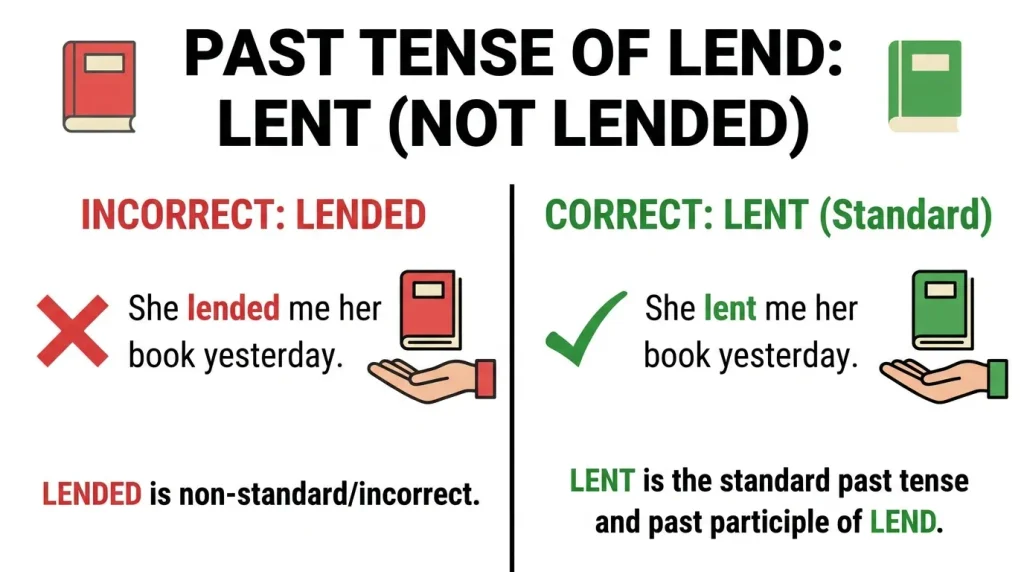
The correct past tense of lend is lent, not lended. Lent is also the past participle of lend, so it works with helping verbs such as has, have, and had. Although lended may seem correct because most English verbs form their past tense with -ed, lend is an irregular verb. Understanding this difference will help you avoid a common grammar mistake in everyday conversations, emails, and professional writing.
Lended or Lent?
Lent is the correct standard English form. Use lent as both the simple past tense and past participle of lend. Lended is a nonstandard form and should be avoided in formal, academic, and professional writing.
- Present: I lend my books to friends.
- Past: I lent my book to Sarah.
- Past participle: I have lent my book to Sarah.
Easy rule: Lend → Lent → Lent.
What Is the Difference Between Lended and Lent?
The difference is grammatical rather than a difference in meaning.
Lent is the established past tense and past participle of the verb lend. It describes giving someone something temporarily, usually with the expectation that the person will return it.
Lended is a nonstandard regularized form. People sometimes create it by applying the usual -ed past-tense pattern to lend. However, standard English uses lent instead.
Consider these examples:
- Incorrect: My brother lended me his bicycle.
- Correct: My brother lent me his bicycle.
Both sentences attempt to describe the same action, but only the second uses the standard verb form.
What Does Lend Mean?
Lend means to give something to another person temporarily, expecting to receive it back.
It can refer to physical objects, money, assistance, or even abstract things such as support and credibility.
Examples:
- I lend my laptop to my sister when she needs it.
- The bank lends money to qualified customers.
- Her experience lends credibility to the research.
- My colleague lent me a helping hand.
Notice that lend does not always involve a physical object. It can also describe providing something useful or valuable.
Why Does the Difference Matter?
Using the correct past tense helps your writing sound accurate and natural.
Although readers will probably understand what you mean when you write lended, the nonstandard form can distract them from your message.
This matters particularly in situations such as:
- Job applications: Correct grammar helps maintain a professional impression.
- Academic assignments: Standard verb forms are important in formal writing.
- Business emails: Accurate language makes communication clearer.
- English examinations: Using irregular verb forms correctly demonstrates grammatical knowledge.
- Everyday conversations: Natural verb forms help you communicate confidently.
You do not need complicated grammar knowledge to avoid this mistake. You only need to remember one irregular verb pattern.
The Core Rule: Lend, Lent, Lent
Lend → Lent → Lent
The verb lend has three important forms:
| Verb form | Correct word | Example |
|---|---|---|
| Base form | Lend | I lend books. |
| Simple past | Lent | I lent him a book. |
| Past participle | Lent | I have lent him a book. |
Remember:
Never replace lent with lended in standard English.
Why Is Lend an Irregular Verb?
English verbs generally follow two patterns when forming their past tense.
Regular verbs usually add -ed or -d:
- Walk → Walked
- Help → Helped
- Open → Opened
- Borrow → Borrowed
Irregular verbs do not follow this standard pattern. Their forms change in different ways.
For example:
- Send → Sent
- Spend → Spent
- Bend → Bent
- Keep → Kept
- Lend → Lent
Lend belongs to the irregular group. That is why adding -ed does not produce its standard past-tense form.
How to Use Lent Correctly
There are two main situations in which you should use lent: the simple past tense and the past participle.
1. Use Lent for Completed Past Actions
Use lent when describing something you gave to someone temporarily in the past.
The simple past tense describes an action that happened and finished in the past.
Examples:
- I lent my calculator to a classmate yesterday.
- She lent her car to her cousin last weekend.
- The library lent us several books.
- My father lent me some money last month.
The word lent stays the same regardless of the subject.
For example:
- I lent him my notes.
- She lent him her notes.
- They lent him their notes.
You do not need to add -s or -ed.
2. Use Lent After Has, Have, and Had
Lent is also the past participle of lend.
A past participle is a verb form used with helping verbs to create certain tenses, including the present perfect and past perfect.
Examples:
- I have lent my camera to a friend.
- She has lent her support to the project.
- They had lent us the equipment before the event.
- He has lent money to several small businesses.
The correct pattern is:
- Has + lent
- Have + lent
- Had + lent
Never write has lended, have lended, or had lended in standard English.
3. Use Lend After Did and Didn’t
This is another important rule.
When you use did or didn’t to form a past-tense question or negative sentence, the main verb returns to its base form.
Correct:
- Did she lend you her phone?
- I didn’t lend him my laptop.
- Did your father lend you the money?
- They didn’t lend us their equipment.
Incorrect:
- Did she lent you her phone?
- I didn’t lent him my laptop.
The helping verb did already indicates the past. Therefore, the main verb must remain lend.
4. Use Lent in Passive Sentences
You can also use lent in passive constructions.
A passive sentence focuses on the person or thing receiving an action rather than the person performing it.
Examples:
- The money was lent to the company.
- Several books were lent to the students.
- The equipment had been lent to another department.
- The vehicle was lent to a family member.
The verb form remains lent even when the sentence structure changes.
Correct Examples of Lent in Everyday English
Here are 12 original examples showing how to use lent naturally in different situations.
Everyday Conversation
- My neighbour lent me his ladder so I could repair the roof.
- I lent my headphones to my younger brother yesterday.
- She lent me her umbrella when it started raining.
Emails and Messages
- I have lent the office projector to the marketing team.
- Thanks for the calculator you lent me during the meeting.
- I lent Daniel the reference book, and he promised to return it tomorrow.
School and Education
- The teacher lent each student a dictionary for the exercise.
- My classmate lent me her revision notes before the examination.
Workplace and Business
- The company lent its training equipment to a partner organization.
- Our manager lent his support to the new employee during the transition.
Academic and Professional Writing
- The researcher lent additional credibility to the argument through carefully documented evidence.
- The institution had lent its resources to several community projects before the programme ended.
These examples demonstrate that lent works in both literal and figurative situations.
Lended vs Lent: Incorrect and Correct Examples
The following table highlights common mistakes and explains why the corrected versions work.
| ❌ Incorrect | ✅ Correct | Why |
|---|---|---|
| She lended me her notebook. | She lent me her notebook. | Lent is the simple past form of lend. |
| I have lended him some money. | I have lent him some money. | Lent is the correct past participle. |
| They lended us their car. | They lent us their car. | Lend does not follow the regular -ed pattern. |
| My teacher lended me a dictionary. | My teacher lent me a dictionary. | The past form remains lent regardless of the subject. |
| He had lended his tools to me. | He had lent his tools to me. | Had must be followed by the past participle lent. |
| Did you lent her your phone? | Did you lend her your phone? | Did takes the base form of the main verb. |
| I didn’t lended him my laptop. | I didn’t lend him my laptop. | Didn’t already expresses the past tense. |
| The bank has lended money to us. | The bank has lent money to us. | Has is followed by the past participle. |
| The books were lended to students. | The books were lent to students. | Lent is the standard form in passive constructions. |
| My friend lended his support. | My friend lent his support. | Figurative uses of lend also take lent in the past. |
The important point is that changing the sentence structure does not change the standard past form of lend.
Why Do People Make the Lended vs Lent Mistake?
There are several reasons why people naturally confuse these two forms.
1. Overgeneralising the -ed Rule
This is the biggest reason.
Most English verbs form their simple past tense by adding -ed.
For example:
- Work → Worked
- Play → Played
- Talk → Talked
- Clean → Cleaned
Because lend looks like a regular verb, learners naturally assume that its past tense must be lended.
However, English contains many irregular verbs that do not follow this pattern.
2. Confusion With Similar Verbs
Lend resembles several other verbs that have irregular past forms.
Consider:
- Send → Sent
- Spend → Spent
- Bend → Bent
- Lend → Lent
These similarities can actually help you remember the correct form.
3. Spelling-Based Confusion
The word lend ends in -end, which may encourage writers to preserve the entire spelling and simply add -ed.
However, English irregular verbs often change their spelling rather than taking the regular suffix.
For example, send becomes sent, not sended.
The same pattern applies to lend.
4. Autocorrect and Spellcheck Limitations
Spellcheckers are useful, but they do not always understand grammatical context.
Some may fail to flag a nonstandard form, especially when a word appears in an unusual context or an expanded dictionary.
A grammar checker may also overlook an error if it focuses on sentence structure rather than verb conjugation.
Therefore, it is useful to understand the underlying rule instead of depending entirely on software.
5. Translation Interference
Some languages use a more consistent pattern for forming past-tense verbs.
When learners translate directly from their first language into English, they may apply a regular past-tense pattern to lend.
This can produce lended even though English uses lent.
The solution is to learn irregular verbs as complete verb forms rather than translating them word by word.
Common Mistakes Checklist
Before using lend or lent, check these mistakes.
- Adding -ed to lend: Do not write lended. Use lent when referring to the past.
- Using lent after did: Write “Did you lend me the book?” rather than “Did you lent me the book?”
- Using lended after have: Write “I have lent him my notes.”
- Confusing lend with borrow: Lend means to give temporarily; borrow means to receive temporarily.
- Using the wrong preposition: Lend something to someone, but borrow something from someone.
- Using lent for the present tense: Write “I lend books,” not “I lent books” when describing a present habit.
- Changing lent according to the subject: Both “She lent” and “They lent” are correct.
- Assuming every verb takes -ed: Memorise irregular verb forms separately.
A quick review of these points can prevent most mistakes involving lend and lent.
Lended vs Lent in Real English
Understanding the difference between grammatical correctness and everyday usage is important.
Not every form that appears in conversation is accepted in standard written English.
Grammatically Correct: Lent
Lent is the standard past tense and past participle of lend. It is correct in everyday conversation, professional communication, academic writing, and formal documents. Whether you are talking about lending money, sharing equipment, or offering support, lent is the appropriate form when describing a past action. It is also the form you should use in examinations and edited English.
Grammatically Possible but Nonstandard: Lended
Lended appears occasionally in real-world English, usually because speakers apply the regular -ed pattern to an irregular verb. It can also appear in informal writing and unedited material. Its occasional appearance does not make it the standard conjugation. If your goal is accepted contemporary standard English, avoid lended and use lent instead. This distinction is particularly important in professional and academic writing.
Natural, Everyday English: Lent
Lent is the natural and established form in ordinary English. Native and fluent speakers routinely use expressions such as “She lent me her car” and “I’ve lent him some money.” It also sounds natural in figurative expressions, including “lent a hand” and “lent support.” You do not need a special formal context to use lent; it is appropriate in everyday conversation.
American vs British English: Is There a Difference?
There is no meaningful standard American-versus-British difference in the past tense of lend.
Both American English and British English use:
- Lend (present)
- Lent (simple past)
- Lent (past participle)
Examples:
| American English | British English |
|---|---|
| She lent me her phone. | She lent me her phone. |
| I have lent him my car. | I have lent him my car. |
| They lent us some money. | They lent us some money. |
The spelling and conjugation remain the same in both varieties.
You should therefore use lent regardless of whether you are writing for an American or British audience.
Formal vs Informal Usage
Unlike some confusing word pairs, lended and lent do not represent a formal-versus-informal distinction.
Lent is correct in both formal and informal English.
Use lent in:
- Professional emails
- Academic assignments
- Business reports
- Everyday conversations
- Text messages
- Social media posts
Although people sometimes say or write lended, this does not make it an accepted informal alternative.
The safest approach is to use lent in every register.
ALSO READ: Too Many or To Many: Which One Is Correct?
Lended vs Lent: Comparison Table
| Feature | Lended | Lent |
|---|---|---|
| Standard English | No | Yes |
| Base verb | Lend | Lend |
| Simple past | Nonstandard | Correct |
| Past participle | Nonstandard | Correct |
| Formal writing | Avoid | Use |
| Informal conversation | Avoid in standard usage | Use |
| American English | Nonstandard | Correct |
| British English | Nonstandard | Correct |
| Used with has/have/had | No | Yes |
| Used in passive sentences | Avoid | Yes |
The easiest way to remember the difference: If you are describing something you gave temporarily in the past, use lent.
Real-Life Situations: When Should You Use Lent?
Understanding grammar rules is easier when you see how they work in actual situations.
1. During a Job Interview
Imagine an interviewer asks whether you have experience sharing company resources.
Correct:
“I have lent my technical equipment to other departments whenever they needed it.”
Why? The present perfect structure uses have + lent.
2. During a Business Meeting
You want to explain that a colleague provided equipment yesterday.
Correct:
“James lent the presentation equipment to the sales team yesterday.”
Why? The action happened in the past, so use the simple past tense lent.
3. Writing a Professional Email
You want to confirm that you gave a colleague a document.
Correct:
“I have lent the original reference manual to the research department. Please let me know when it is returned.”
Why? Have lent describes a completed action that is relevant to the present.
4. Sending a Text Message
Your friend asks whether you gave someone your headphones.
Correct:
“Yes, I lent them to Ahmed this morning.”
Why? Lent describes the completed action.
5. Answering an English Examination Question
Question: Choose the correct word.
“She has _____ her notes to a classmate.”
- A. Lended
- B. Lent
- C. Lending
- D. Lend
Correct answer: B. Lent.
Why? The present perfect requires has + past participle.
ALSO CHECKOUT: Irregular verb pattern send sent spend spent lend lent.
How to Remember Lent Easily

The easiest memory trick is to connect lend with two familiar irregular verbs: send and spend.
The irregular verb memory trick
SEND
SENT
SPEND
SPENT
LEND
LENT
These three verbs follow a similar spelling pattern in the past tense.
Think: Send–Sent, Spend–Spent, Lend–Lent.
You can also memorise this short sentence:
“I lend today, I lent yesterday, and I have lent before.”
Repeating this pattern will help you remember both the simple past and past participle.
Practice Quiz: Lended or Lent?
Test your understanding with these questions.
Test your grammar
0 / 7 answered
1. My sister _____ me her camera last week.LendedLentLend
2. I have _____ my notes to a classmate.LendedLendingLent
3. Did you _____ him your bicycle?LentLendLended
4. The bank _____ money to the small business last year.LentLendedLending
5. She had _____ her support before the project began.LendedLendLent
6. Which sentence is correct?I didn’t lent him my book.I didn’t lend him my book.I didn’t lended him my book.
7. The equipment was _____ to another department.LendedLentLending
Check my answers
Quick Summary
Lent is the correct standard past tense and past participle of lend. Lended is a nonstandard form created by applying the regular -ed pattern to an irregular verb. Use lend when talking about the present, lent when describing a completed past action, and lent after helping verbs such as has, have, and had. Remember to use the base form lend after did and didn’t. Both American and British English use the same conjugation. The easiest way to remember it is to connect lend with send and spend: send becomes sent, spend becomes spent, and lend becomes lent. When in doubt, choose lent, not lended.
Frequently Asked Questions (FAQ)
Is lended ever correct in English?
Lended occasionally appears in nonstandard or unedited English, but it is not the accepted standard past tense of lend. Use lent in both formal and informal standard English.
What is the past tense of lend?
The past tense of lend is lent. For example: “My friend lent me his laptop yesterday.”
What is the past participle of lend?
The past participle is also lent. For example: “I have lent my dictionary to a classmate.”
Is it has lent or has lended?
The correct expression is has lent. The verb lend is irregular, so its past participle is lent rather than lended.
Is it lent me or borrowed me?
Use “lent me” when describing someone giving you something temporarily. For example, “She lent me her umbrella.” Use “borrowed from me” when describing the same situation from the receiver’s perspective: “She borrowed an umbrella from me.”
Can I say I have lent it?
Yes. “I have lent it” is grammatically correct. It uses the present perfect tense, which connects a completed past action with the present.
Should I write lent or lend after did?
Use lend after did because did already indicates past tense.
Correct: “Did you lend him your book?”
Incorrect: “Did you lent him your book?”
Is lent used in both American and British English?
Yes. Both American and British English use lent as the past tense and past participle of lend. There is no standard regional difference in this verb form.
What is the difference between lent and loaned?
Lent is the past tense of lend, while loaned is the past tense of loan when loan is used as a verb. Both can describe giving money or something temporarily, although usage and style preferences can vary. For example: “The bank lent me money” and “The bank loaned me money” are both acceptable.
What is an easy way to remember lend and lent?
Remember this irregular verb pattern: send–sent, spend–spent, and lend–lent. All three have a similar change in their past-tense spelling. Practise saying “I lend today, I lent yesterday” to remember the correct forms.


