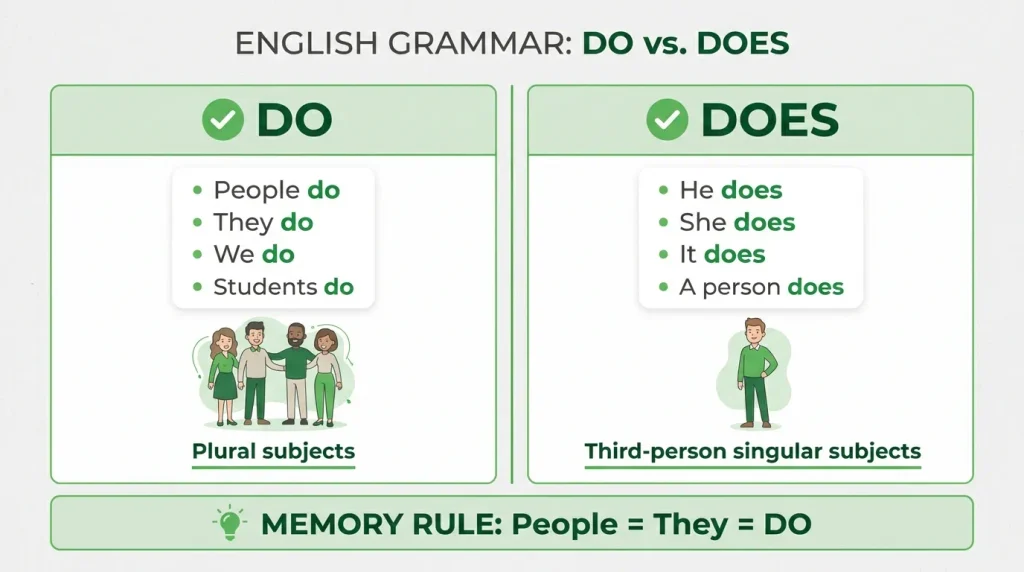
The correct expression is “people do,” not “people does.” The word people is plural, so it takes the plural verb do. Use does with singular third-person subjects such as he, she, it, or one person.
- ✅ People do their best.
- ❌ People does their best.
- ✅ One person does the work.
The easiest way to remember this rule is that people refers to more than one person, so it follows the same verb pattern as they.
What Does “People Do vs. People Does” Mean?
The difference between people do and people does comes from subject–verb agreement. This is the grammar rule that requires a verb to match its subject in number.
In ordinary English, people is the plural form of person. It refers to two or more individuals, so it takes the plural form of the verb.
Consider these examples:
- One person does the job.
- Two people do the job.
- Many people do the same work.
- People do things differently.
Notice how the verb changes when the subject changes from one person to people.
The word does is not an alternative spelling of do. It is the third-person singular form used with subjects such as he, she, and it.
Why Does the Difference Matter?
Using the wrong verb can make a sentence sound grammatically incorrect, even when the reader understands what you mean.
This matters in everyday conversations, professional emails, academic assignments, job applications, and business communication.
For example:
- Incorrect: People does not understand the new policy.
- Correct: People do not understand the new policy.
The second sentence follows standard English grammar because people is plural.
The mistake can also affect questions:
- Incorrect: Does people need more time?
- Correct: Do people need more time?
Learning this distinction helps you build correct questions, negative sentences, and statements without guessing which verb to choose.
The Core Rule: Use “Do” With People
People + Do
Use do whenever people refers to multiple individuals.
People + Does
Avoid does when people is the subject referring to multiple individuals.
Easy memory trick: People = They = Do.
The same rule applies to other plural subjects:
| Subject | Correct verb |
|---|---|
| People | Do |
| They | Do |
| Students | Do |
| Workers | Do |
| Children | Do |
| He | Does |
| She | Does |
| It | Does |
| One person | Does |
A useful way to check your sentence is to replace people with they. If they do sounds correct, people do is the right choice.
ALSO CHECKOUT: Anyone Has or Anyone Have? The Rule Made Simple
How to Use “People Do” Correctly
The verb do can serve two main purposes: it can express an action, or it can help form questions, negatives, and emphasis.
1. Use “Do” in Positive Sentences
When do is the main verb, it can mean perform, complete, carry out, or accomplish something.
Examples:
- People do their homework at different times.
- People do business with companies they trust.
- People do their best when they feel supported.
- People do many things to improve their lives.
In each sentence, people is the subject, and do is the main verb.
2. Use “Do” in Negative Sentences
To make a present-simple sentence negative, use do not or its contraction don’t with people.
Examples:
- People do not always agree.
- People don’t understand every situation.
- People do not need expensive equipment to exercise.
- People don’t always remember important details.
Both do not and don’t are grammatically correct.
Use do not more often in formal writing when you want a more formal tone. Use don’t in everyday conversation and informal writing.
3. Use “Do” in Questions
When asking a present-simple question about people, put do before the subject.
Examples:
- Do people really believe that?
- Do people need permission to enter?
- Why do people behave differently?
- What do people usually eat for breakfast?
The structure is:
Do + people + base-form verb + rest of the sentence?
A base-form verb is the simplest form of a verb, without an added ending such as -s or -es.
4. Use “Do” for Emphasis
Sometimes, do is added to emphasize that something is true.
Examples:
- People do care about their families.
- People do make mistakes.
- People do deserve equal opportunities.
Here, do adds emphasis. It does not change the subject’s plural form.
5. Use the Base Verb After “Do”
An important rule is that the main verb stays in its base form after the auxiliary verb do.
An auxiliary verb is a helping verb that supports the main verb.
Compare:
- ✅ People do work hard.
- ❌ People do works hard.
- ✅ Do people understand?
- ❌ Do people understands?
The auxiliary do already carries the grammatical information needed for the present tense. Therefore, the main verb does not need an additional -s.
Correct Examples of “People Do” in Everyday English
Here are 15 original examples showing how to use people do in different situations.
Conversation
- People do strange things when they are nervous.
- Why do people prefer living in busy cities?
- Some people do everything they can to help others.
Emails and Workplace Communication
- People do appreciate clear instructions from management.
- Our customers do expect reliable service.
- People do respond better when communication is respectful.
School and Education
- People do learn at different speeds.
- Do people understand the importance of regular reading?
- Students often do better when they prepare in advance.
Social Media
- People do share interesting stories online.
- Why do people post personal information on social media?
- Some people do follow trends without questioning them.
Academic and Professional Writing
- People do not always make decisions based on available evidence.
- Research participants do provide different responses to the same question.
- People do develop new skills through regular practice.
All these examples use do because people functions as a plural subject.
ALSO SEE: Sale vs Sail: Meaning, Difference & Easy Ways to Remember
Incorrect vs. Correct: 10 Common Sentence Corrections
The following table shows common mistakes involving people do and people does, along with the reason each correction is necessary.
| ❌ Incorrect | ✅ Correct | Why |
|---|---|---|
| People does hard work. | People do hard work. | People is plural. |
| People does not agree. | People do not agree. | Use do not with plural subjects. |
| Does people understand? | Do people understand? | Questions require do with people. |
| People doesn’t care. | People don’t care. | Doesn’t is for singular subjects. |
| People does their homework. | People do their homework. | The subject is plural. |
| Why does people complain? | Why do people complain? | Do agrees with people. |
| People does make mistakes. | People do make mistakes. | Emphatic do takes the plural form. |
| People does work here. | People do work here. | Use do in positive statements. |
| How does people learn? | How do people learn? | Do is required in this question. |
| People does different things. | People do different things. | The verb must agree with the plural subject. |
Remember that does is not always incorrect. It becomes correct when you change the subject to a singular third-person noun or pronoun.
For example:
- People do their work.
- A person does their work.
- She does her work.
The subject determines the verb.
ALSO READ: Both Work for Me or Both Works for Me: Which Is Correct?
Why Do People Make This Mistake?
Even though the rule is simple, English learners and sometimes fluent speakers confuse do and does. Several factors contribute to this mistake.
1. Overgeneralizing the Singular Rule
Learners often remember that he, she, and it take does. They then apply the same rule to other nouns without checking whether those nouns are singular or plural.
For example:
- He does his homework.
- She does her homework.
- People do their homework.
The solution is to identify the subject before choosing the verb.
2. Confusion Between “Person” and “People”
The words person and people are closely related, but they do not follow the same verb pattern.
- One person does something.
- Several people do something.
Because the two words express similar meanings, learners sometimes transfer the singular verb from person to people.
3. Pronunciation and Spoken Habits
In fast speech, unstressed words can be difficult for learners to distinguish. This may make it harder to notice whether someone has used the correct form.
However, do and does have different standard pronunciations:
- Do: /duː/
- Does: /dʌz/
Listening carefully and practising complete sentences can help you remember their different forms.
4. Autocomplete and Spellcheck
Spelling and grammar tools do not always catch every subject–verb agreement error. A sentence may contain correctly spelled words but still have incorrect grammar.
For example, a basic spellchecker might not flag:
People does important work.
The problem is not spelling. It is the relationship between the subject and the verb.
Always check the subject and verb together instead of relying entirely on automatic corrections.
5. Translation Interference
Some languages use verb forms differently from English. A learner may translate a sentence directly from their first language and select a verb that does not agree with the English subject.
The best solution is to learn English sentence patterns rather than translate each word individually.
Common Mistakes Checklist
Use this checklist to identify and avoid the most frequent errors.
- Using does with people: Remember that people is plural in its ordinary meaning. Use do.
- Writing people doesn’t: Replace doesn’t with don’t because people takes a plural auxiliary.
- Starting questions with does people: Use do people when asking about multiple individuals.
- Adding -s after do: Write people do work, not people do works.
- Confusing person with people: Use a person does but people do.
- Forgetting the subject in long sentences: Find the actual subject before choosing the verb.
- Trusting spellcheck without reviewing grammar: Check whether the verb agrees with the subject, even when every word is spelled correctly.
ALSO SEE: What Happen or What Happened: Which One Is Correct?
“People Do” in Real English
Understanding grammar is not only about memorizing rules. It also means knowing which expressions are correct and which ones sound natural in everyday communication.
Grammatically Correct: “People Do”
People do is grammatically correct whenever people refers to multiple individuals. It works in positive statements, negative sentences, questions, and emphatic expressions. You can use it in casual conversations, workplace emails, school assignments, and formal reports. For example, “People do need reliable information” is correct regardless of whether the sentence appears in a conversation or a professional document.
Grammatically Incorrect: “People Does”
In ordinary English, people does is grammatically incorrect when people means multiple individuals. Native speakers generally expect do because the subject is plural. Using does in this situation creates a subject–verb agreement error. Changing the sentence’s tone, audience, or level of formality does not make this combination correct. Use people do or change the subject to a singular noun.
Natural Everyday English: “People Do”
People do is also natural in everyday English. Speakers commonly use it when discussing habits, opinions, general behavior, and shared experiences. Expressions such as “People do make mistakes,” “People do care,” and “What do people think?” fit ordinary conversation. The phrase does not sound unusually formal or awkward. Its naturalness comes from using the correct verb with the intended plural subject.
American vs. British English
There is no meaningful American-versus-British English difference in this rule.
Both American and British English use people do when referring to multiple individuals.
| American English | British English |
|---|---|
| People do their jobs. | People do their jobs. |
| Do people agree? | Do people agree? |
| People don’t always understand. | People don’t always understand. |
The correct choice remains do in both varieties.
Do not confuse people with collective nouns such as team, family, or government. Those nouns can sometimes take singular or plural verbs depending on the variety of English and whether the group is being treated as a unit or as individual members. That variation does not change the ordinary plural agreement of people.
Formal vs. Informal Usage
The grammatical choice between do and does does not change in formal and informal English. However, the way you express a negative sentence can vary according to the situation.
| Situation | Example |
|---|---|
| Formal writing | People do not always agree with the decision. |
| Professional email | People do appreciate timely updates. |
| Everyday conversation | People don’t always agree. |
| Informal messaging | People do make mistakes sometimes. |
| Academic writing | People do not necessarily respond in the same way. |
Use do not when you want a more formal tone. Use don’t when a conversational tone is appropriate.
Both forms are grammatically correct.
People Do vs. People Does: Comparison Table
This table summarizes the main grammatical differences.
| Feature | People Do | People Does |
|---|---|---|
| Standard grammar | Correct | Incorrect for plural people |
| Subject | Plural | Incorrect agreement |
| Positive sentence | People do work. | People does work. |
| Negative sentence | People don’t work. | People doesn’t work. |
| Question | Do people work? | Does people work? |
| Everyday English | Natural | Nonstandard |
| Formal writing | Acceptable | Incorrect |
| Academic writing | Acceptable | Incorrect |
Related Forms: Do, Does, Don’t, and Doesn’t
Understanding the related forms makes the rule easier to apply.
| Subject | Positive | Negative |
|---|---|---|
| I | I do | I don’t |
| You | You do | You don’t |
| We | We do | We don’t |
| They | They do | They don’t |
| People | People do | People don’t |
| He | He does | He doesn’t |
| She | She does | She doesn’t |
| It | It does | It doesn’t |
| A person | A person does | A person doesn’t |
The important distinction is that do and don’t are used with plural subjects, while does and doesn’t are used with third-person singular subjects.
Real-Life Situations: How to Choose the Correct Form
Here are five practical situations where choosing the correct form matters.
1. During a Job Interview
Incorrect: Does people in this company work remotely?
Correct: Do people in this company work remotely?
Why: The candidate is asking about multiple employees, so the question needs do.
2. During a Business Meeting
Incorrect: People does not understand the new strategy.
Correct: People do not understand the new strategy.
Why: The speaker is discussing the opinions or understanding of multiple individuals.
3. In a Professional Email
Incorrect: People doesn’t respond well to unclear instructions.
Correct: People don’t respond well to unclear instructions.
Why: The subject is plural, so don’t is required.
4. In a Text Message
Incorrect: Why does people always complain?
Correct: Why do people always complain?
Why: The question refers to multiple people, so it begins with do.
5. During an Examination
Incorrect: People does different things for different reasons.
Correct: People do different things for different reasons.
Why: The plural subject requires the plural verb.
A Quick Way to Remember: People Do, Person Does
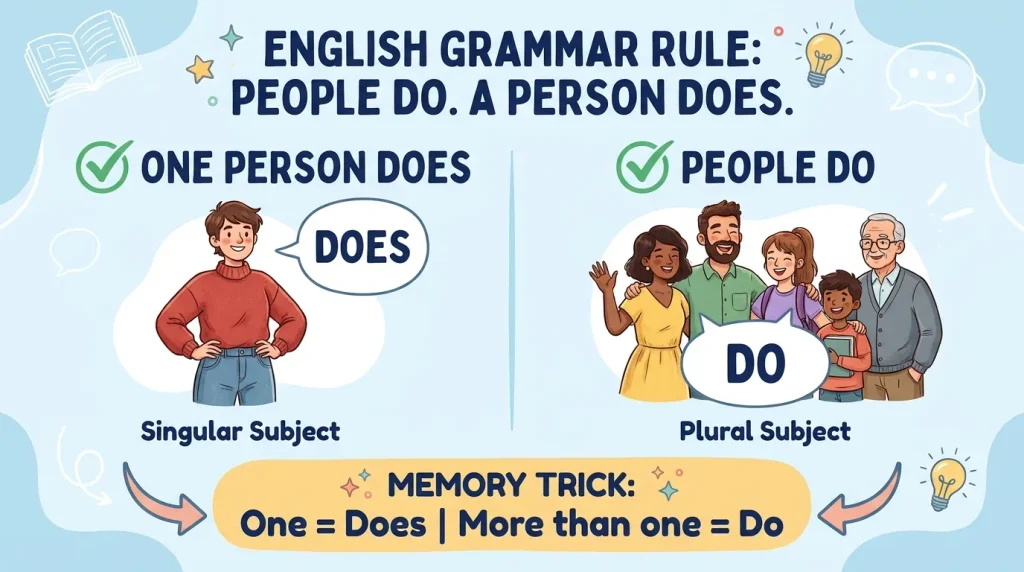
You do not need to memorize complicated grammar terminology to remember this rule.
Just remember:
- One person: Use does.
- More than one person: Use do.
- People: Treat it as plural in its ordinary meaning.
- They: Use do.
- He, she, or it: Use does.
The easiest memory sentence
People do.
A person does.
If you remember these two sentences, you can answer most everyday questions about this grammar rule.
Quick Summary
The correct expression is people do, not people does. The word people is plural when it refers to multiple individuals, so it takes the plural verb do. Use does with singular third-person subjects such as he, she, it, and a person. The same rule applies to questions and negative sentences: say Do people agree? and People don’t agree. After do or does, use the base form of the main verb. American and British English follow the same rule. The easiest way to remember it is to replace people with they: they do, so people do.
Quick Practice Quiz: Do or Does?
Test your understanding with these five questions.
Grammar knowledge check
0/5 answered
1. People ___ their best when they feel supported.dodoes
2. ___ people understand this rule?DoDoes
3. People ___ always agree with each other.don’tdoesn’t
4. One person ___ not make all the decisions.dodoes
5. Why ___ people make mistakes?dodoes
Check my answers
Frequently Asked Questions
1. Is “people do” grammatically correct?
Yes. People do is grammatically correct because people is a plural noun. For example, “People do their best when they have enough time.”
2. Is “people does” ever correct?
Not when people refers to multiple individuals. However, a people can refer to one nation or cultural group, in which case it is a singular noun phrase and can take a singular verb. This is a specialized meaning, not the ordinary meaning of people.
3. Should I write “people don’t” or “people doesn’t”?
Write people don’t. The contraction don’t means do not and agrees with plural subjects. Doesn’t means does not and is used with singular third-person subjects.
4. Which is correct: “Do people” or “Does people”?
Do people is correct when asking a question about multiple individuals.
Example: “Do people understand the new rules?”
5. Is “everyone do” or “everyone does” correct?
Everyone does is correct. Although everyone refers to a group of individuals, it is grammatically singular and takes a singular verb.
Example: “Everyone does their best.”
6. Should I use “people have” or “people has”?
Use people have because people is plural.
Example: “People have different opinions.”
Use has with singular subjects, such as “A person has different responsibilities.”
7. Is “many people does” correct?
No. Many people refers to multiple individuals, so it takes do.
Correct: “Many people do their shopping online.”
Incorrect: “Many people does their shopping online.”
8. Is “some people do” correct?
Yes. Some people do is correct because some does not change the plural nature of people.
Example: “Some people do prefer working independently.”
9. Why is “people do” correct but “everyone does” correct too?
The difference comes from grammatical number. People is plural, whereas everyone is grammatically singular. Therefore, use do with people and does with everyone.
10. Can I use “people did” instead of “people do”?
Yes. Use people did when describing an action in the past.
Example: “People did everything they could to solve the problem.”
The past-tense form did does not change according to whether the subject is singular or plural.