
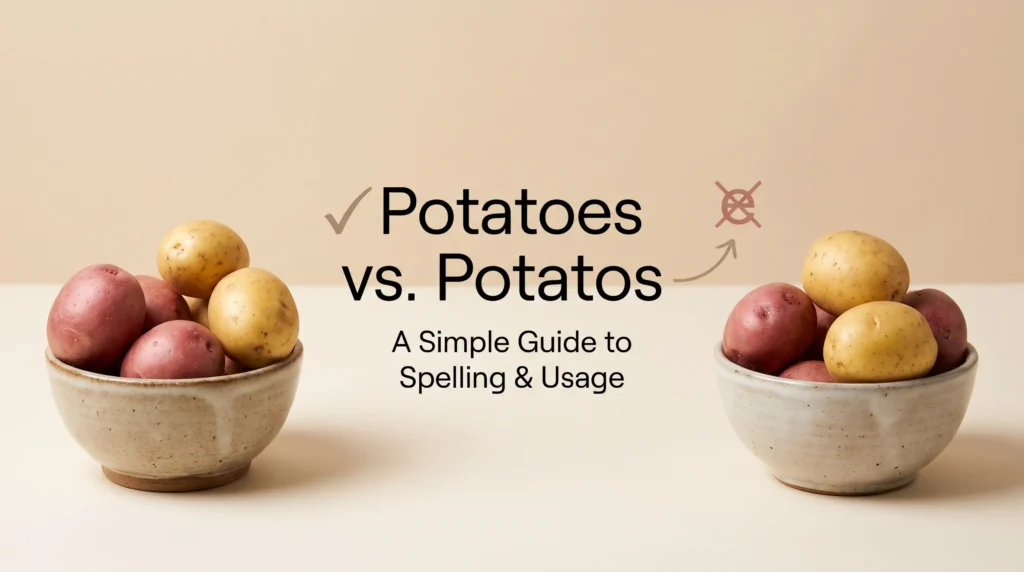

If you are unsure whether to write potatoes or potatos, the correct spelling is potatoes. The word potatos is a common spelling mistake and is not accepted as the standard plural form of potato.
The difference comes down to one small spelling detail: when forming the plural of potato, you add -es, not just -s. Understanding this pattern also helps you spell words such as tomatoes, heroes, and echoes correctly.
Potatoes or Potatos?
Potatoes is the correct spelling, while potatos is incorrect in standard English. The singular noun is potato, and its plural is potatoes. When you talk about one, write a potato. When you talk about two or more, write potatoes. Remember to include the letter e before the final s.
What Is the Difference Between Potatoes and Potatos?
The difference is spelling, not meaning. Both forms are usually intended to refer to more than one potato, but only potatoes is correct in standard written English.
Potatoes: The Correct Plural Form
CORRECT SPELLING
Potatoes is the standard plural of potato. It refers to two or more individual potatoes.
Examples:
- We bought five potatoes from the market.
- These potatoes need to be washed before cooking.
- She made roasted potatoes for dinner.
- Farmers grow potatoes in different climates.
Notice that the word contains an e between the final o and s.
Potatos: The Incorrect Spelling
INCORRECT SPELLING
Potatos is a misspelling of potatoes. It happens when someone assumes that adding a simple s is enough to make potato plural.
Examples:
- Incorrect: I bought four potatos.
- Correct: I bought four potatoes.
- Incorrect: The potatos are ready.
- Correct: The potatoes are ready.
Although readers can usually understand what potatos means, you should avoid it in schoolwork, professional documents, emails, and other standard writing.
Why Does Potato Become Potatoes?
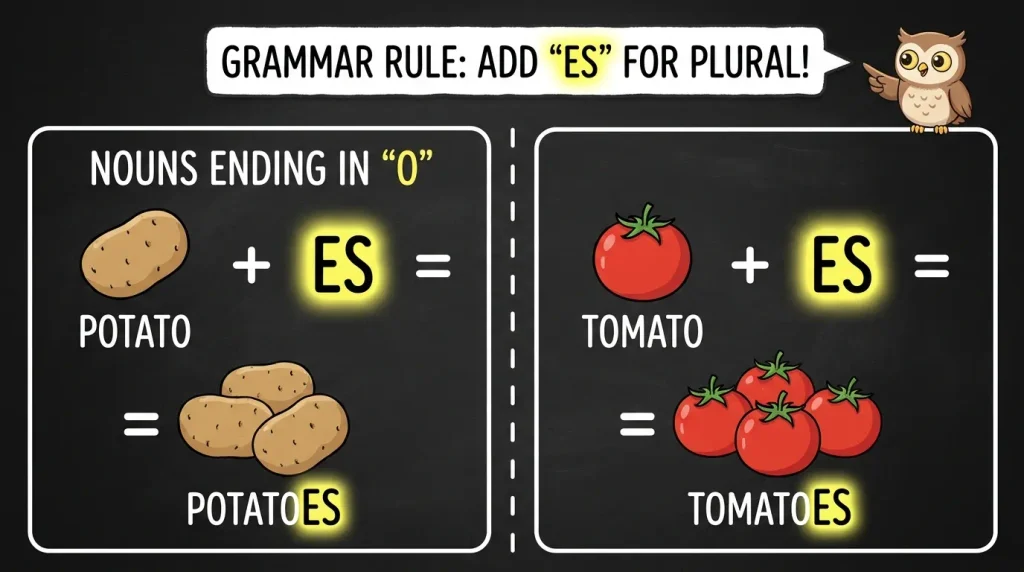
The plural of potato follows a traditional English spelling pattern for certain nouns ending in a consonant followed by o.
Instead of adding only s, you add es.
The formation is:
\[ \text{potato} + \text{es} = \text{potatoes} \]
This is why the spelling is potatoes, not potatos.
Other familiar examples include:
| Singular | Correct plural |
|---|---|
| Potato | Potatoes |
| Tomato | Tomatoes |
| Hero | Heroes |
| Echo | Echoes |
| Torpedo | Torpedoes |
| Veto | Vetoes |
However, there is an important detail: not every noun ending in -o takes -es.
For example:
| Singular | Correct plural |
|---|---|
| Photo | Photos |
| Radio | Radios |
| Piano | Pianos |
| Video | Videos |
| Zoo | Zoos |
| Studio | Studios |
The consonant-plus-o pattern is a useful guide, not an exception-free rule. Some words ending in a consonant and o still take only s. That is why learning common plural forms individually is helpful. Cambridge Dictionary+2
How to Use Potatoes Correctly
Use potatoes whenever you are referring to more than one potato.
The spelling does not change according to the type of potato, the cooking method, or the situation in which you use the word.
1. Use Potato for One
When referring to a single potato, use the singular form.
Examples:
- I need one potato for this recipe.
- She planted a potato in the garden.
- That potato is too small.
- He baked a potato for lunch.
2. Use Potatoes for Two or More
When referring to multiple potatoes, use the plural form.
Examples:
- We need six potatoes for dinner.
- The potatoes are in the kitchen.
- They harvested hundreds of potatoes.
- I prefer boiled potatoes to fried ones.
3. Use Potatoes After Numbers Greater Than One
Numbers make it clear that you are referring to more than one item.
Examples:
- Three potatoes are enough.
- I bought twelve potatoes.
- The recipe requires eight potatoes.
- There are twenty potatoes in the basket.
4. Use Potatoes With Plural Determiners
Determiners are words placed before nouns to clarify which items or how many items you mean.
Common examples include these, those, many, several, and few.
Examples:
- These potatoes are fresh.
- Those potatoes look delicious.
- Several potatoes were left over.
- Many potatoes were damaged during transportation.
Correct Examples of Potatoes in Sentences
Here are 12 original examples showing how to use potatoes in everyday and professional writing.
1. Everyday conversation: “Could you peel the potatoes while I prepare the vegetables?”
2. Cooking: The recipe requires four medium-sized potatoes and two onions.
3. Shopping: Please buy a bag of potatoes when you visit the grocery store.
4. Email: We have ordered additional potatoes for tomorrow’s catering event.
5. School assignment: Potatoes are an important food crop in many countries.
6. Workplace report: The supplier delivered 200 kilograms of potatoes this morning.
7. Social media: Homemade roasted potatoes make the perfect weekend snack.
8. Academic writing: Potatoes contain carbohydrates and provide an important source of dietary energy.
9. Agriculture: Local farmers harvested their potatoes earlier than expected this season.
10. Restaurant menu: Our grilled chicken is served with seasoned potatoes.
11. Text message: Don’t forget to bring the potatoes home!
12. Business communication: The company plans to expand its potato storage facilities to reduce post-harvest losses.
Each sentence uses potatoes as a plural noun.
Incorrect vs. Correct: Potatoes or Potatos
The following table highlights common spelling errors and their corrections.
| ❌ Incorrect | ✅ Correct | Why |
|---|---|---|
| I bought five potatos. | I bought five potatoes. | The plural requires -es. |
| The potatos are fresh. | The potatoes are fresh. | Potatoes is the standard plural. |
| We need more potatos. | We need more potatoes. | The noun must use its correct plural form. |
| She cooked three potatos. | She cooked three potatoes. | Three indicates more than one. |
| These potatos are expensive. | These potatoes are expensive. | Use the standard spelling with these. |
| Farmers grow potatos here. | Farmers grow potatoes here. | The correct plural is potatoes. |
| I peeled two potatos. | I peeled two potatoes. | Two requires the plural noun. |
| The bag contains ten potatos. | The bag contains ten potatoes. | The plural ending is -oes. |
| We sell organic potatos. | We sell organic potatoes. | Organic does not change the plural spelling. |
| Fried potatos are popular. | Fried potatoes are popular. | The adjective does not affect the noun’s spelling. |
The important point is that the spelling remains potatoes regardless of the sentence.
Why Do People Confuse Potatoes and Potatos?
Several common spelling habits explain why people write potatos instead of potatoes.
1. Overgeneralizing the Basic Plural Rule
Most English nouns form their plurals by adding s.
For example:
- Book → Books
- Apple → Apples
- Car → Cars
- Table → Tables
People naturally apply the same pattern to potato. However, English has additional spelling patterns, and some nouns ending in o require -es.
2. Confusing Spelling With Pronunciation
The final part of potatoes is not always pronounced as learners expect from its spelling.
In everyday speech, the final syllable can make the additional letter difficult to notice. As a result, someone may remember the spoken word but leave out the e when writing it.
3. Learning Similar Words Incorrectly
People encounter words such as photos, radios, and videos, which form their plurals with only s.
They may assume that potato follows the same pattern.
However, potato belongs to a different spelling pattern.
4. Depending Too Much on Autocorrect
Spellcheckers and predictive keyboards can help identify mistakes, but they should not replace spelling knowledge.
Depending on the application and its dictionary, an unusual or incorrectly entered word may not always be flagged as expected.
Always check the correct spelling when you are unsure.
5. Translation Interference
People learning English through another language may apply familiar plural rules from their first language.
Some languages use different endings or do not change nouns in the same way English does.
This can make English plural forms confusing, especially when several spelling patterns exist.
Common Mistakes Checklist
Check these points whenever you write the word potato.
- Writing potatos: This happens when you add only s. Write potatoes instead.
- Writing potatoe: The singular form does not contain a final e. Write potato.
- Using potato after a plural number: If you mean more than one, use potatoes. For example, write “four potatoes.”
- Adding an unnecessary apostrophe: Plurals do not normally require apostrophes. Write potatoes, not potato’s, when simply referring to multiple potatoes.
- Assuming every word ending in -o takes -es: This is not true. Words such as photos and radios take only s.
- Changing the spelling according to cooking method: Boiled potatoes, fried potatoes, and baked potatoes all use the same plural spelling.
Potatoes in Real English
Grammatically Correct: Potatoes
“Potatoes” is grammatically correct whenever you are referring to more than one potato. It works naturally in everyday conversation, recipes, grocery lists, academic writing, and professional communication. For example, “I bought three potatoes” is both grammatically correct and natural. This is the form you should use whenever you need the standard plural of potato.
Grammatically Possible but Unnatural: Potatos
“Potatos” is not an alternative standard plural spelling. A reader might understand the intended meaning because it resembles the correct word, but that does not make it grammatically or orthographically acceptable. It should not be treated as a casual variation or an informal spelling. Use potatoes even in text messages, social media posts, and other relaxed writing.
Natural, Everyday English: Potatoes
Native and fluent English speakers naturally use potatoes in ordinary situations. They might say, “We need some more potatoes,” while preparing dinner or “These potatoes taste great” at a restaurant. There is no need to choose a shorter or more informal spelling. The correct form is already the natural everyday form, so it works equally well in casual and formal contexts.
Similar Words: Potatoes, Tomatoes, Photos, and Radios
One of the easiest ways to understand the spelling of potatoes is to compare it with other nouns ending in o.
| Singular | Plural | Spelling pattern |
|---|---|---|
| Potato | Potatoes | Add -es |
| Tomato | Tomatoes | Add -es |
| Hero | Heroes | Add -es |
| Echo | Echoes | Add -es |
| Photo | Photos | Add -s |
| Radio | Radios | Add -s |
| Piano | Pianos | Add -s |
| Video | Videos | Add -s |
| Studio | Studios | Add -s |
| Zoo | Zoos | Add -s |
Remember that the ending alone does not determine every plural form. English has exceptions, so check an unfamiliar noun in a reliable dictionary.
ALSO CHECKOUT: Precede vs. Proceed: Meaning, Difference & Examples
Real-Life Situations: When Should You Write Potatoes?
1. During a Job Interview
Imagine you are applying for a position in a food-processing company.
You might say:
“Our company supplies fresh potatoes to supermarkets and restaurants.”
Using the correct spelling in written documents demonstrates attention to detail.
2. In a Business Email
Suppose you need to confirm a food order with a supplier.
You could write:
“We would like to confirm the delivery of 50 bags of potatoes for Friday.”
The plural form is appropriate because the order contains multiple bags and potatoes.
3. In a School Examination
A spelling question might ask:
Choose the correct plural of potato.
- A. Potatos
- B. Potato’s
- C. Potatoes
- D. Potato
Correct answer: C. Potatoes
4. In a Text Message
If you are asking someone to buy groceries, you might write:
“Please get some potatoes on your way home.”
Casual writing still follows standard spelling.
5. In an Academic Assignment
When discussing agriculture, nutrition, or food production, use the standard plural:
“Potatoes are cultivated in many regions and contribute significantly to global food production.”
The spelling remains unchanged in academic contexts.
ALSO READ: Pick Up vs Pickup: Which One Is Correct?
An Easy Way to Remember the Correct Spelling
Use this simple memory trick:
Potato becomes potatoes. Remember the E before the S.
You can also remember the pattern by pairing two familiar vegetables:
- Potato → Potatoes
- Tomato → Tomatoes
Both words take -es in their standard plural forms.
If you are ever unsure, remember the complete spelling:
P-O-T-A-T-O-E-S
Quick Practice Quiz: Potatoes or Potatos?
Test your understanding with these five questions.
Spelling knowledge check
0/5 answered
1. Which spelling is correct?PotatosPotatoesPotato’s
2. What is the plural of potato?PotatosPotatoesPotato
3. Which sentence is correct?I bought four potatos.I bought four potatoes.I bought four potato.
4. Which word follows the same -es pattern?PhotoRadioTomato
5. Which spelling is correct in a professional email?We ordered fresh potatos.We ordered fresh potatoes.We ordered fresh potato’s.
Check my answers
Quick Summary
Potatoes is the correct plural spelling of potato, while potatos is incorrect in standard English. To form the plural, add -es instead of just -s. This spelling pattern also appears in words such as tomatoes, heroes, and echoes. However, not every noun ending in o follows the same rule, as photos, radios, and pianos demonstrate. Use potato when referring to one item and potatoes when referring to two or more. Remember the simple spelling trick: potato + es = potatoes. The extra e is essential, whether you are writing a casual message, a school assignment, or a professional document.
Frequently Asked Questions
1. Is it potatoes or potatos?
Potatoes is correct. Potatos is a spelling mistake. The plural of potato requires the ending -es.
2. What is the plural of potato?
The plural of potato is potatoes. For example, “I bought one potato” becomes “I bought six potatoes.”
3. Why is potatoes spelled with an e?
English uses -es to form the plural of certain nouns ending in o. Potato follows this spelling pattern, so its plural is potatoes.
4. Is potatos ever correct?
No. Potatos is not an accepted standard spelling of the plural of potato. Use potatoes in formal and informal writing.
5. Is potato singular or plural?
Potato is singular. It refers to one potato. Its plural form is potatoes, which refers to two or more.
6. Is potatoe the correct singular spelling?
No. The correct singular spelling is potato, without an additional e at the end. The e appears when forming the plural: potatoes.
7. Do tomatoes and potatoes follow the same spelling rule?
Yes. Both words add -es to form their standard plurals:
- Potato → Potatoes
- Tomato → Tomatoes
8. Do all words ending in o take es in the plural?
No. Some words take -es, while others take only -s. For example, potato becomes potatoes, but photo becomes photos.
9. Is potatoes correct in American and British English?
Yes. Potatoes is the standard plural spelling in both American and British English. There is no difference in the spelling of this word between the two varieties.
10. How do you pronounce potatoes?
The pronunciation differs slightly between major English varieties:
- American English: /pəˈteɪ.toʊ/
- British English: /pəˈteɪ.təʊ/
Both pronunciations refer to the same plural word.
11. Is potatoes a countable noun?
Yes. Potato is a countable noun. You can count individual potatoes and use numbers with the plural form, such as two potatoes, five potatoes, or ten potatoes.
12. What is the easiest way to remember potatoes?
Remember the pair potato → potatoes. Think of tomato → tomatoes as another example. Both words add -es, not just -s.