The correct spelling is reevaluation, written as one word. The hyphenated form re-evaluation is also accepted, particularly in British English and some formal writing styles. However, re evaluation, written as two separate words without a hyphen, is generally incorrect when you mean the process of evaluating something again.
Reevaluation or Re Evaluation?
Use reevaluation as the standard one-word spelling, especially in American English. Re-evaluation is also correct and is commonly used in British English and by publishers that prefer hyphenated forms. However, re evaluation (two separate words) is not the standard spelling when referring to the process of evaluating something again.
- Correct Reevaluation
- Correct Re-evaluation
- Incorrect Re evaluation
What Is Reevaluation?
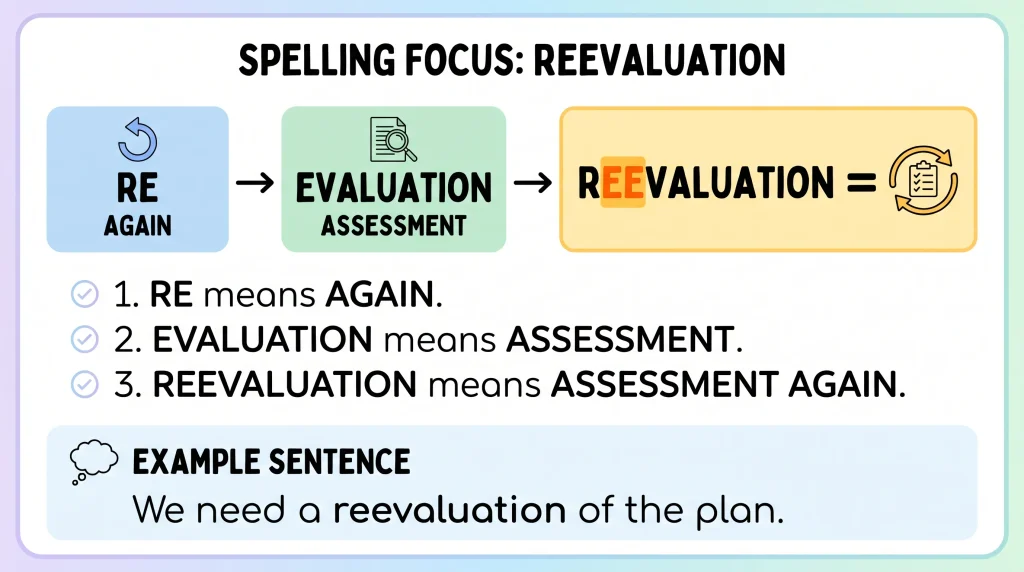
Reevaluation is the process of examining, assessing, or judging something again to decide whether your original opinion, decision, or conclusion should change.
The word combines two parts:
- Re-: A prefix meaning again or once more.
- Evaluation: The process of judging the quality, value, importance, or effectiveness of something.
When you combine them, reevaluation means evaluating something again.
For example:
- A teacher may conduct a reevaluation of a student’s academic performance.
- A business may request a reevaluation of its marketing strategy.
- An employee may ask for a reevaluation of their salary.
- A person may go through a reevaluation of their personal goals.
The spelling can appear as either reevaluation or re-evaluation. Both forms communicate the same meaning.
ALSO READ: Was There or Were There? Grammar Rules and Examples
Why Does the Correct Spelling Matter?
Choosing the correct spelling makes your writing easier to understand and more professional.
Although readers will probably understand what you mean when you write re evaluation, the spacing makes the expression look like two separate words rather than one established compound.
This matters in several situations:
1. Professional communication
In business emails, reports, and proposals, consistent spelling makes your writing look carefully edited.
2. Academic writing
Students and researchers often use this word when discussing research findings, assessment methods, and previous conclusions.
3. Workplace documents
Human resources departments may refer to performance reevaluations, salary reviews, and policy assessments.
4. Search and digital writing
Using a recognized spelling helps keep your headings, documents, and website content consistent.
The important point is that you do not need to memorize two completely different words. You only need to understand how the prefix re- combines with evaluation.
ALSO READ: Similes for Money: 35 Creative Comparisons with Meanings and Examples
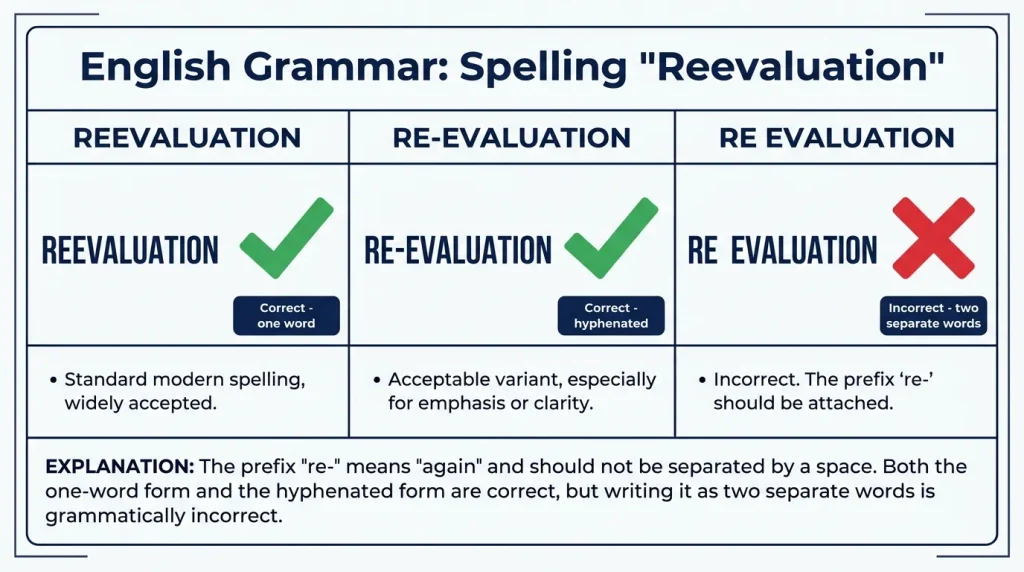
The Core Rule: Reevaluation vs. Re Evaluation
The spelling rule
When re- means “again” and combines with evaluation, write the resulting word as reevaluation or re-evaluation, depending on your preferred English convention or style guide.
Do not separate the prefix from the word as re evaluation when you mean a second evaluation.
Here is the easiest way to remember the difference:
| Spelling | Status | Explanation |
|---|---|---|
| Reevaluation | Correct | Standard closed spelling |
| Re-evaluation | Correct | Standard hyphenated alternative |
| Re evaluation | Incorrect | Not the standard compound spelling |
The prefix re- does not normally stand alone in this construction. It attaches to the word it modifies, either directly or with a hyphen.
SEE MORE: Inbetween vs. In Between: Which Spelling Is Correct?
How to Use Reevaluation Correctly
There are two accepted ways to spell this noun. Your choice should depend on your English variety, publication requirements, and consistency.
1. Use Reevaluation as One Word
The closed form, reevaluation, is particularly common in American English.
Use it in:
- Business reports and workplace documents.
- Academic assignments.
- Professional emails.
- Performance reviews.
- General writing.
Examples:
- The committee approved a complete reevaluation of the proposal.
- We need a reevaluation of our current expenses.
- The student’s reevaluation will take place next Monday.
2. Use Re-Evaluation With a Hyphen
The hyphenated form is also correct. It is particularly common in British English and in writing styles that retain a hyphen between re- and a following vowel.
Examples:
- The department requested a re-evaluation of its policies.
- A complete re-evaluation of the evidence is necessary.
- The school arranged a re-evaluation of the student’s progress.
The hyphen makes the word’s construction visually clear.
3. Avoid Re Evaluation as Two Words
When you mean a second assessment, do not insert a space between re and evaluation.
Incorrect:
The company requested a re evaluation of its financial position.
Correct:
The company requested a reevaluation of its financial position.
The issue is not the meaning. It is the standard spelling of the combined word.
4. Keep Related Word Forms Consistent
The same spelling choice applies to related forms:
| One-word form | Hyphenated form |
|---|---|
| Reevaluate | Re-evaluate |
| Reevaluated | Re-evaluated |
| Reevaluating | Re-evaluating |
| Reevaluation | Re-evaluation |
For example:
- We need to reevaluate the proposal.
- We reevaluated the proposal yesterday.
- The team is reevaluating its priorities.
- The reevaluation will begin tomorrow.
Avoid switching between styles without a reason.
Correct Examples of Reevaluation in Sentences
Here are 12 original examples showing how to use reevaluation naturally in different situations.
1. Everyday Conversation
“We should have a reevaluation of our weekend plans because the weather forecast has changed.”
This shows how the word can describe reconsidering an existing plan.
2. Professional Email
“Following our recent discussion, I would like to request a reevaluation of my current responsibilities.”
This is appropriate when communicating a request in a professional setting.
3. School Assessment
“The teacher recommended a reevaluation of the student’s reading skills before the next academic term.”
This demonstrates its use in education.
4. Workplace Performance
“Management scheduled a reevaluation of employee performance for the end of the quarter.”
This refers to assessing performance again.
5. Academic Research
“The unexpected findings led to a reevaluation of the original hypothesis.”
This is suitable for research papers and academic discussions.
6. Business Strategy
“Declining sales encouraged the company to conduct a reevaluation of its marketing strategy.”
This explains how businesses use the term when reviewing existing decisions.
7. Social Media
“Sometimes, a little distance gives you the opportunity for a complete reevaluation of your priorities.”
This uses the word in a personal and reflective context.
8. Financial Planning
“The bank requested a reevaluation of the property’s market value before approving the loan.”
This demonstrates its use in financial situations.
9. Medical Administration
“The patient’s changing circumstances resulted in a reevaluation of the treatment plan.”
This shows how the word can describe reviewing an existing plan. It does not imply that the original assessment was necessarily incorrect.
10. Government Policy
“The new economic figures prompted a reevaluation of the proposed tax policy.”
This is suitable for formal reports and public policy discussions.
11. Personal Development
“After completing the course, she began a reevaluation of her long-term career goals.”
This shows how the word applies to personal decisions.
12. Academic Discussion
“Our findings support a reevaluation of the assumptions used in earlier studies.”
This is an appropriate example of formal academic usage.
Incorrect vs. Correct: 12 Common Spelling Mistakes
The following table explains common errors involving reevaluation, its related forms, and similar expressions.
| ❌ Incorrect | ✅ Correct | Why |
|---|---|---|
| We need a re evaluation. | We need a reevaluation. | The prefix should not be separated by a space. |
| The reevaluaton is complete. | The reevaluation is complete. | The incorrect version is missing an i. |
| They requested a re-evaluaton. | They requested a re-evaluation. | The correct spelling includes the second i. |
| We will re evaluation the results. | We will reevaluate the results. | Reevaluation is a noun; reevaluate is the verb. |
| The reevaluation was very evaluate. | The reevaluation was very thorough. | Evaluate is a verb, not an adjective. |
| The company needs reevaluate. | The company needs to reevaluate. | The verb needs the infinitive marker to after needs. |
| We are reevaluation the plan. | We are reevaluating the plan. | The sentence requires the -ing verb form. |
| The manager reevaluated of the policy. | The manager reevaluated the policy. | The verb takes a direct object here without of. |
| They completed a re evaluation process. | They completed a reevaluation process. | The compound noun should be written as one word or hyphenated. |
| The reevaluation were successful. | The reevaluation was successful. | Reevaluation is singular, so it takes was. |
| She asked for an reevaluation. | She asked for a reevaluation. | Reevaluation begins with a consonant sound, so use a. |
| The results needs reevaluation. | The results need reevaluation. | The plural subject results takes need. |
Notice that not every mistake is a spelling mistake. Some involve grammar, word forms, or subject-verb agreement. Understanding these differences will help you use the word correctly in complete sentences.
Why People Make This Spelling Mistake
There are several reasons people confuse reevaluation, re-evaluation, and re evaluation.
1. The Prefix Re- Can Be Confusing
The prefix re- means again, but English does not use one universal spelling rule for every word beginning with it.
For example:
- Reconsider
- Rebuild
- Re-enter
- Re-examine
- Reevaluate
Some words are written together, while others retain a hyphen. Writers may assume that every prefix needs a space or that every word must follow the same pattern.
The solution is to learn established spellings rather than separating prefixes whenever they appear.
2. Two Consecutive Vowels Look Unusual
The spelling reevaluation contains two e’s next to each other.
One comes from re- and the other begins evaluation.
Some writers feel that two consecutive vowels look incorrect, so they insert a hyphen or space.
However, consecutive vowels are perfectly acceptable in English spelling. The closed form reevaluation is correct.
3. Pronunciation Does Not Reveal the Spelling
When spoken, reevaluation and re-evaluation sound the same.
There is no meaningful pronunciation difference that helps listeners identify which spelling the speaker intended.
As a result, writers may choose the version they find visually more familiar.
4. Spellcheck Does Not Always Explain Style Differences
Most modern spellcheckers recognize common spellings, but their suggestions may depend on the selected language, dictionary, and editorial settings.
A program may accept reevaluation while another prefers re-evaluation.
Both can be correct. A spellcheck suggestion does not automatically mean that another accepted spelling is wrong.
5. Translation Can Influence Word Separation
Some languages use spaces or different word-building systems when expressing the meaning of doing something again.
A learner may transfer that pattern directly into English and write re evaluation.
The best approach is to remember that English commonly combines prefixes with base words to form a single word or a hyphenated compound.
Common Mistakes Checklist
Use this checklist when proofreading your writing.
- Separating the prefix: Avoid writing re evaluation when you mean evaluating something again. Use reevaluation or re-evaluation.
- Mixing spelling styles: Do not alternate between reevaluation and re-evaluation without a style-based reason.
- Confusing the noun and verb: Use reevaluation for the process and reevaluate for the action.
- Forgetting the second e: Remember that the correct closed spelling is reevaluation, not revaluation.
- Using the wrong verb form: Write reevaluating the results, not reevaluation the results.
- Ignoring subject-verb agreement: Write The reevaluation is complete, not The reevaluation are complete.
- Assuming the hyphenated form is incorrect: Both reevaluation and re-evaluation are accepted spellings.
- Trusting every autocorrection: Check whether your spelling tool follows American or British English conventions.
ALSO SEE: Similes for Red: 50+ Creative Examples and Meanings
Reevaluation in Real English
Understanding dictionary spelling is important, but it is equally useful to know how the word functions in everyday communication.
Grammatically Correct: Reevaluation
“After reviewing the latest figures, the company decided to conduct a reevaluation of its financial strategy.”
This sentence is grammatically correct and natural. The noun reevaluation clearly describes a second assessment. It works especially well in business, education, academic writing, and formal discussions. The word is somewhat formal, but that does not make it unnatural. It is an appropriate choice whenever the writer wants to emphasize a systematic or deliberate review.
Grammatically Correct: Re-Evaluation
“The committee requested a re-evaluation of the proposed changes.”
This sentence is also grammatically correct and natural. The hyphen does not change the meaning, pronunciation, or grammatical function of the noun. Readers understand it as another evaluation. It is particularly familiar in British English and in publications that retain hyphens in certain prefix combinations. The important consideration is consistency with the chosen spelling convention.
Grammatically Incorrect: Re Evaluation
“The committee requested a re evaluation of the proposed changes.”
Although the intended meaning is understandable, this is not the standard spelling of the compound noun. The space incorrectly separates the prefix from the word it modifies. In edited English, use reevaluation or re-evaluation instead. This is a spelling issue rather than a problem with the sentence’s overall meaning or word order.
Natural Everyday English: A Second Look
“Let’s take another look at the proposal before making a final decision.”
This is a natural alternative in everyday conversation. Although reevaluation is correct, it can sound more formal than necessary when people are simply discussing a small decision. Expressions such as take another look, review it again, or think it over often sound more conversational. Choose the wording that matches the situation rather than using a formal noun unnecessarily.
American vs. British English: Reevaluation or Re-Evaluation?
There is a genuine spelling preference difference between American and British English.
| Feature | American English | British English |
|---|---|---|
| Common spelling | Reevaluation | Re-evaluation |
| Alternative accepted form | Re-evaluation | Reevaluation |
| Meaning | Evaluating again | Evaluating again |
| Pronunciation | Same | Same |
| Two-word spelling | Re evaluation is nonstandard | Re evaluation is nonstandard |
American English: The closed form reevaluation is widely used and is a natural choice for American writing.
British English: The hyphenated form re-evaluation is especially familiar because British spelling conventions often retain a hyphen when re- precedes another e.
However, this is a preference, not an absolute division. Both forms are recognized in major English dictionaries. For example, dictionary entries list the hyphenated form alongside the closed alternative. English meaning – Cambridge Dictionary+2
My recommendation: If you write primarily for an American audience, choose reevaluation. If your audience is British, re-evaluation is a sensible choice. Follow your organization’s style guide whenever one exists.
Formal vs. Informal Usage
The choice between reevaluation and re-evaluation is primarily a spelling decision, not a difference in formality.
Both spellings are appropriate in formal writing.
| Situation | Recommended wording | Example |
|---|---|---|
| Academic paper | Reevaluation / Re-evaluation | The findings warrant a reevaluation of the original hypothesis. |
| Business report | Reevaluation / Re-evaluation | Management approved a reevaluation of the budget. |
| Professional email | Reevaluation / Re-evaluation | I would like to request a reevaluation of my performance. |
| Everyday conversation | Another look / Review again | We should take another look at the plan. |
| Informal text message | Think again / Look again | Maybe we should rethink the decision. |
You do not need to avoid reevaluation in professional communication. However, a simpler expression may sound more relaxed in an informal conversation.
Comparison Table: Reevaluation vs. Similar Words
Several English words have meanings related to reviewing, reconsidering, or assessing something again. They are not always interchangeable.
| Word | Meaning | Example |
|---|---|---|
| Reevaluation | Evaluating something again | The school requested a reevaluation of the results. |
| Re-evaluation | Same meaning as reevaluation | The company ordered a re-evaluation of its policy. |
| Reassessment | Assessing something again | The patient’s condition requires reassessment. |
| Reconsideration | Thinking about a decision again | She requested reconsideration of the application. |
| Review | Examining something again | The manager scheduled a review of the report. |
| Reappraisal | Formally assessing value or importance again | The property needs a reappraisal. |
| Reexamination | Examining something again, often in detail | The evidence requires reexamination. |
| Rethinking | Considering an idea or plan differently | The results prompted a complete rethinking of the strategy. |
The main difference is the type of action involved.
- Reevaluation: Focuses on judging or measuring something again.
- Reassessment: Focuses on assessing a situation, condition, or performance again.
- Reconsideration: Focuses on thinking about a decision or opinion again.
- Review: A broad term for examining something.
- Reappraisal: Often emphasizes reconsidering value or importance.
Choose the word that communicates your intended action most accurately.
Real-Life Situations: When Should You Use Reevaluation?
Here are five practical situations showing how the word works in real communication.
1. During a Job Interview
Interviewer: “How do you respond when your performance is reviewed?”
Candidate: “I welcome a reevaluation of my performance because it helps me identify areas where I can improve.”
The word is appropriate because the candidate is discussing a formal assessment.
2. In a Business Meeting
Manager: “Our current strategy isn’t producing the expected results.”
Team Leader: “I think we need a complete reevaluation of our marketing approach.”
This shows how the word can be used when reconsidering business decisions.
3. In a Professional Email
Subject: Request for Performance Reevaluation
“Dear Manager,
I would like to request a reevaluation of my recent performance review. I believe some additional information may help provide a more complete assessment.
Thank you for your consideration.”
This is a suitable professional use of the noun.
4. In a Text Message
Friend: “Are you still planning to move next month?”
You: “I’m having a reevaluation of my plans. I might wait another month.”
The sentence is understandable, although “I’m reconsidering my plans” would sound more conversational.
5. During an Examination
A student writes:
“The unexpected results led to a reevaluation of the original hypothesis.”
This is an appropriate academic sentence because it describes examining an earlier conclusion again.
Frequently Asked Questions
Is reevaluation one word or two?
Reevaluation is one word in its standard closed spelling. Re-evaluation, with a hyphen, is also correct. Re evaluation, written as two separate words, is not the standard spelling when referring to the process of evaluating something again.
Is reevaluation or re-evaluation more correct?
Both are correct. Reevaluation is particularly common in American English, while re-evaluation is particularly familiar in British English. Neither spelling changes the meaning. Choose the version that matches your preferred English convention or publication style.
Is re evaluation grammatically incorrect?
Re evaluation is nonstandard when you intend the noun meaning a second evaluation. The correct forms are reevaluation and re-evaluation. The issue concerns compound spelling rather than sentence grammar.
What is the plural of reevaluation?
The plural is reevaluations.
Example: “The school completed several reevaluations during the academic year.”
The hyphenated alternative is also pluralized as re-evaluations.
What is the verb form of reevaluation?
The verb is reevaluate or re-evaluate.
Examples:
- We need to reevaluate our priorities.
- The manager will reevaluate the proposal.
- They are reevaluating the current policy.
Is reevaluation formal or informal?
Reevaluation is suitable for both formal and general writing. It is particularly common in academic, business, educational, and professional contexts. In casual conversation, expressions such as “take another look” or “think it over” may sound more natural.
Does reevaluation mean reconsideration?
They have similar meanings, but they are not identical. Reevaluation specifically involves assessing something again, often by examining its quality, value, or effectiveness. Reconsideration focuses more broadly on thinking about a decision, opinion, or possibility again.
Is reevaluation accepted in British English?
Yes. Reevaluation is recognized in British English, although re-evaluation is a familiar and often preferred spelling. The choice may depend on the publisher’s style guide.
Is revaluation the same as reevaluation?
Not always. Reevaluation means assessing something again. Revaluation commonly refers to assigning a new value to something, especially an asset, currency, or property. Although their meanings can overlap in some contexts, they should not automatically be treated as interchangeable.
How do you pronounce reevaluation?
Reevaluation is pronounced approximately as ree-ih-val-yoo-AY-shun.
Its hyphenated alternative, re-evaluation, has the same pronunciation. The hyphen does not create a different spoken word.
Quick Summary
Reevaluation and re-evaluation are both correct spellings of the noun meaning the process of evaluating something again. Reevaluation is particularly common in American English, while re-evaluation is widely used in British English. The two forms have the same meaning and pronunciation. However, re evaluation, written as two separate words, is not the standard spelling of this compound noun. Use reevaluation for American writing and re-evaluation when following a British spelling preference or a style guide that requires the hyphen. Remember that reevaluate is the verb, reevaluated is its past-tense form, and reevaluating is its -ing form. When writing informally, simpler expressions such as “take another look” may sound more conversational.
Test Your Knowledge: Reevaluation or Re-Evaluation?
Choose the correct answer for each question.
Mini spelling quiz
0/5 answered
1. Which spelling is standard when written as two words or one word?Re evaluationReevaluationRe evalu ation
2. Which hyphenated form is also correct?Re-evaluationRe evaluationRe–evaluation
3. Which sentence uses the correct noun?We need to reevaluate the results.We need a reevaluating.We need a reevaluation of the results.
4. What is the correct verb form?ReevaluationReevaluateRe-evaluation
5. Which spelling is particularly common in American English?ReevaluationRe evaluationRe evaluation