
Have you ever wondered whether to write soo or so? Both spellings appear in online conversations, but they are not interchangeable in standard English.
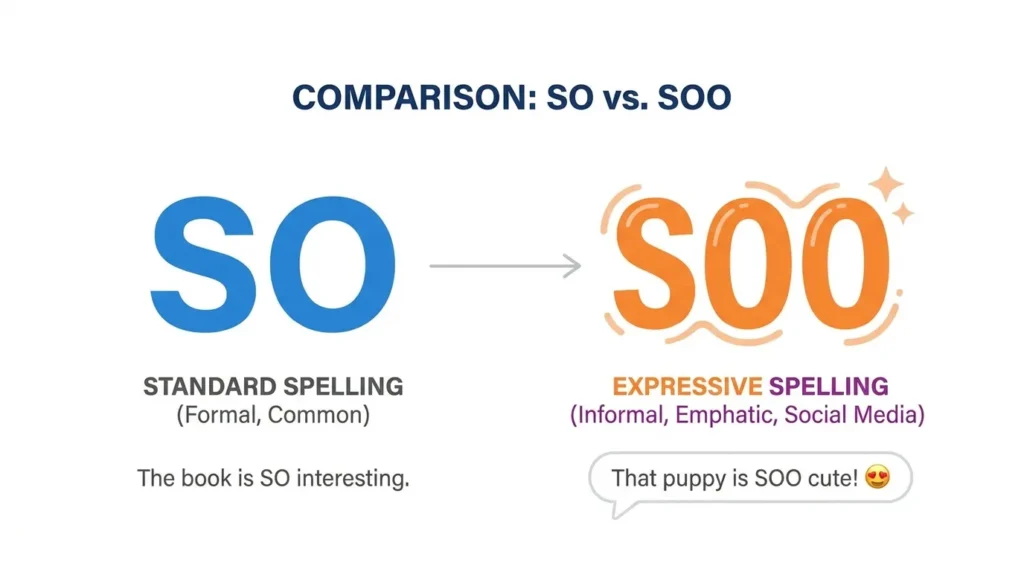
So is the correct standard English spelling. It is used to express degree, emphasis, results, agreement, and purpose. Soo is generally a nonstandard, informal spelling that people use in text messages and social media to stretch the sound of so and express stronger emotions.
For example:
- Correct: I am so excited about the trip.
- Informal: I am soo excited about the trip.
The second version communicates extra enthusiasm, but it is not the standard spelling. If you are writing an email, school assignment, business document, or professional message, choose so.
Soo vs So
So is the correct standard English word, while soo is usually an informal spelling used to exaggerate the pronunciation of so. People write soo in casual messages to communicate excitement, surprise, or emphasis. Although this spelling can work in playful digital conversations, it should not replace so in academic, professional, or formal writing.
What Is the Difference Between Soo and So?
The main difference between soo and so is standard spelling versus expressive spelling.
So is an established English word with several grammatical functions. It can describe the degree of something, connect two ideas, introduce a result, express agreement, or indicate purpose.
Soo, when used as an exaggerated version of so, does not have the same standard grammatical status. It is a creative spelling choice that represents how someone might stretch the word when speaking.
Consider these examples:
- Standard: That movie was so interesting.
- Informal: That movie was soo interesting.
- Standard: I was tired, so I went to bed.
- Incorrect in standard writing: I was tired, soo I went to bed.
Notice that soo can imitate the emphasis in the first example, but it cannot replace the standard conjunction so in the second example.
There is also an important distinction: Soo can appear as a proper name or in other unrelated uses. Therefore, saying that the letter combination never exists in English would be inaccurate. The point is that it is not the standard spelling of the ordinary word so.
Why Does the Difference Matter?
Using the right spelling helps readers understand your intended meaning and recognize the level of formality in your writing.
In casual conversations, an expressive spelling can make a message feel more personal. However, in professional and academic situations, nonstandard spellings may distract readers from your actual message.
For example:
- In a text message, “I’m soo happy for you!” can sound playful and enthusiastic.
- In a professional email, “I am so happy to hear about your promotion” looks more polished.
- In an academic essay, “The results were so significant” follows standard spelling conventions.
The important lesson is that informal spelling is a stylistic choice, not a replacement for standard English.
The Core Rule: When Should You Use Soo or So?

Standard spelling
SO
Use so in everyday writing, formal communication, academic work, and professional documents. It is the correct spelling for the ordinary English word.
Informal spelling
SOO
Use soo only when deliberately creating a playful or exaggerated tone in casual digital communication.
Easy rule to remember: If you are unsure, write so. It works in both formal and informal English.
How to Use So Correctly
The word so is more versatile than many English learners realize. It performs several grammatical functions, and understanding them makes it easier to avoid mistakes.
1. So as an Intensifier
An intensifier is a word that increases the strength or degree of another word.
So commonly appears before adjectives and adverbs to express a high degree of something.
Examples:
- The weather is so beautiful today.
- She looks so happy.
- This question is so difficult.
- He drives so carefully.
- The children were so excited about the holiday.
In these examples, so strengthens the meaning of the adjective or adverb that follows it.
2. So to Show a Result
So can also function as a coordinating conjunction. This means it connects two independent clauses, each of which can form a complete sentence.
Examples:
- It was raining, so we stayed indoors.
- I missed the bus, so I took a taxi.
- She studied regularly, so she passed the examination.
- The restaurant was full, so we went somewhere else.
Here, so means therefore or as a result.
Remember that the standard spelling remains so, regardless of how strongly you want to emphasize the result.
3. So to Express Purpose
So can appear in the expression so that to introduce a purpose.
Examples:
- I saved money so that I could buy a laptop.
- She spoke slowly so that everyone could understand her.
- We left early so that we would not miss the train.
The expression explains why someone does something.
In some contexts, that can be omitted:
– I saved money so I could buy a laptop.
Both versions are standard English.
4. So to Express Agreement
We often use so to agree with or confirm something already mentioned.
Examples:
– “Do you think he will come?”
“I think so.”
– “Will the weather improve?”
“I hope so.”
– “Is this your final decision?”
“I suppose so.”
In these expressions, so refers to an idea already understood from the conversation.
5. So as a Conversation Starter
At the beginning of a sentence, so can introduce a new topic, question, explanation, or discussion.
Examples:
- So, what are your plans for tomorrow?
- So, how did your interview go?
- So, let’s discuss the next project.
- So, where should we begin?
This use is common in everyday spoken English and informal writing.
Correct Examples of So in Everyday English
Here are 12 original examples showing how so works in different situations.
| Situation | Correct example |
|---|---|
| Conversation | I am so glad you came today. |
| Text message | That restaurant was so good! |
| Personal email | I am so happy to hear your news. |
| Business email | Thank you so much for your assistance. |
| Workplace | The meeting was so productive. |
| School assignment | The experiment was so successful. |
| Academic writing | The evidence was so compelling that further investigation was necessary. |
| Social media | This sunset is so beautiful! |
| Interview | I am so interested in this opportunity. |
| Classroom | The explanation was so clear that everyone understood it. |
| Travel | The journey was so comfortable. |
| Everyday conversation | I was so tired that I fell asleep immediately. |
These examples demonstrate that so works naturally in nearly every type of English communication.
Incorrect vs Correct: 12 Common Examples
The following table shows how to replace nonstandard uses of soo with standard English so.
| ❌ Incorrect or nonstandard | ✅ Correct standard English | Why |
|---|---|---|
| I am soo happy. | I am so happy. | So is the standard intensifier. |
| She is soo beautiful. | She is so beautiful. | The extra letter is unnecessary in standard spelling. |
| This movie is soo interesting. | This movie is so interesting. | Use the standard spelling before an adjective. |
| Thank you soo much. | Thank you so much. | This is an established expression. |
| I miss you soo much. | I miss you so much. | The extra letter is only expressive. |
| The food was soo delicious. | The food was so delicious. | Standard spelling is required in polished writing. |
| I am soo tired today. | I am so tired today. | So correctly expresses degree. |
| He was soo late. | He was so late. | The standard spelling is so. |
| It was cold, soo we stayed home. | It was cold, so we stayed home. | The conjunction showing a result is so. |
| I studied hard, soo I passed. | I studied hard, so I passed. | A result clause requires the standard conjunction. |
| I hope soo. | I hope so. | The expression is I hope so. |
| Soo, what happened next? | So, what happened next? | The standard conversation marker is so. |
Important: The nonstandard versions may be understandable in casual digital conversations. They are not necessarily grammatical errors in the same sense as an incorrect sentence structure; they are nonstandard spellings. However, the conjunction examples are especially important because soo cannot function as the standard conjunction.
Why Do People Confuse Soo and So?
There are several reasons people write soo instead of so.
1. Similar Pronunciation
Both spellings are usually intended to represent the same spoken word.
When someone says so with extra emphasis, they may stretch the vowel sound. The written form soo attempts to reproduce that pronunciation.
Because the pronunciation remains similar, people sometimes assume that both spellings are equally acceptable.
2. Informal Digital Communication
Text messages and social media encourage creative spelling.
People frequently use repeated letters to communicate emotions that would otherwise be expressed through voice, facial expressions, or body language.
For example:
- No becomes nooo.
- Yes becomes yesss.
- Please becomes pleeease.
- So becomes sooo.
These forms are expressive rather than standard spelling alternatives.
3. Overgeneralization
Overgeneralization happens when someone applies a familiar language pattern too broadly.
A person might notice that adding letters can express stronger emotions in informal messages and assume that the same spelling convention applies everywhere.
However, creative spelling does not automatically become standard English.
4. Autocorrect and Spellcheck
Spellcheck tools do not always understand the writer’s intended tone or context.
Some tools may flag soo, while others may allow it in certain contexts or fail to identify the intended correction.
A word appearing in a message without a spelling warning does not automatically make it appropriate for formal writing.
5. Translation Interference
English learners sometimes transfer spelling habits from their first language into English.
In languages where repeated letters or vowel lengthening are used differently, learners may assume that adding another vowel is an acceptable way to create emphasis.
The solution is to remember that English distinguishes between standard spelling and playful written pronunciation.
Common Mistakes Checklist
Use this checklist to identify and correct the most frequent mistakes.
- Writing soo in professional emails: The extra letter creates an overly casual impression. Use so instead.
- Using soo in academic assignments: Academic writing generally follows standard spelling conventions. Write so.
- Writing thank you soo much: The conventional expression is thank you so much.
- Using soo as a conjunction: The correct conjunction is so, especially when connecting a result to its cause.
- Assuming soo is a separate grammatical form: When used to exaggerate so, it is an expressive spelling, not a different standard grammatical word.
- Confusing pronunciation with spelling: Stretching a spoken sound does not mean you must add letters in standard writing.
- Thinking autocorrect guarantees correctness: Always consider the context and intended meaning.
- Using repeated letters in formal documents: Save expressive spellings for casual communication.
Soo vs So in Real English
Understanding real English requires more than knowing which spelling is standard. It also means recognizing how people actually communicate in different situations.
Grammatically Correct: “I Am So Excited!”
This is natural, standard English. People use it in conversations, emails, social media posts, and professional communication. The word so expresses a strong degree of excitement without needing extra letters. It is suitable whenever you want to communicate enthusiasm while maintaining conventional spelling.
Informal and Natural in Digital Communication: “I Am Sooo Excited!”
This is an expressive spelling used in casual online communication. The repeated vowel suggests that the speaker is stretching the sound to communicate excitement. It is not standard spelling, but readers commonly understand the intended emotion. It can work in friendly messages, playful comments, and social media captions.
Grammatically Possible but Unnatural in Formal Writing: “I Am Soo Excited!”
Readers can understand this sentence, but the spelling looks informal and inconsistent with standard written English. In a university application, business email, or professional report, it can distract from the message. Replacing soo with so makes the sentence appropriate for a much wider range of readers and situations.
Natural but Informal: “I So Want to Go!”
This example is worth understanding because so does not always have to appear before an adjective or adverb. In informal emphatic English, speakers can place so before a verb phrase to express strong feelings. The sentence is natural in conversational English, although I really want to go may be more neutral.
American vs British English: Is There a Difference?
There is no meaningful spelling difference between American and British English for the ordinary word so.
Both varieties use:
- So happy
- So beautiful
- So much
- I think so.
- It was raining, so we stayed inside.
Neither variety recognizes soo as a standard alternative spelling of so.
You may encounter the capitalized name the Soo in references to Sault Ste. Marie and its surrounding region. This is a separate proper-name usage, not an alternative spelling of the ordinary English word.
Therefore, the same spelling rule applies in American, British, and International English: use so in standard writing.
Formal vs Informal Usage
The choice between so and soo depends partly on the communication setting.
| Writing situation | Recommended form | Reason |
|---|---|---|
| Academic essays | So | Follows standard spelling |
| Business emails | So | Professional and conventional |
| Job applications | So | Maintains a polished tone |
| Workplace reports | So | Appropriate for formal communication |
| School assignments | So | Meets standard writing expectations |
| Personal emails | So | Natural in everyday writing |
| Text messages | So or intentionally soo | Expressive spelling may suit the tone |
| Instagram captions | So or intentionally soo | Playful emphasis is common |
| Friendly conversations | So or intentionally soo | Depends on the speaker’s style |
| Formal presentations | So | Clear and professional |
The practical distinction: So is appropriate in both formal and informal English. Soo is a stylistic choice for casual communication, not a spelling you should use when standard written English is expected.
Comparison Table: Soo vs So
| Feature | So | Soo |
|---|---|---|
| Standard English word | Yes | Not as a spelling of so |
| Standard spelling | Yes | No |
| Expresses degree | Yes | Only imitates so informally |
| Connects clauses | Yes | No |
| Expresses a result | Yes | No |
| Expresses agreement | Yes | No |
| Introduces a conversation | Yes | Can imitate it informally |
| Used in academic writing | Yes | No |
| Used in professional emails | Yes | Generally avoid |
| Used in casual texting | Yes | Yes, as an expressive spelling |
| Suitable for formal documents | Yes | No |
| Recommended when uncertain | Yes | No |
Real-Life Situations: When to Use Soo or So
Understanding the difference becomes easier when you see how the two spellings work in everyday situations.
1. During a Job Interview
Question: Why are you interested in this position?
Better answer: “I am so interested in this opportunity because it matches my experience and career goals.”
Using so keeps the answer professional. Writing soo would look unnecessarily informal.
2. Writing a Business Email
Less appropriate: Thank you soo much for your support.
Better: Thank you so much for your support.
The second version is suitable for professional communication.
3. Sending a Text Message
Playful: “I am sooo excited about our holiday!”
This is acceptable as a deliberate informal writing style. You could also write “I am so excited about our holiday!” without losing the meaning.
4. Completing a School Assignment
Incorrect for standard spelling: The book was soo interesting that I read it twice.
Correct: The book was so interesting that I read it twice.
School assignments should follow standard English spelling conventions.
5. Posting on Social Media
Playful: “This little puppy is sooo adorable!”
This works as an expressive caption. The repeated vowel communicates enthusiasm.
6. Writing an Academic Report
Incorrect for standard spelling: The results were soo important for the study.
Correct: The results were so important for the study.
Academic writing should prioritize clarity and conventional spelling over exaggerated expressions.
ALSO CHECKOUT: Segway vs. Segue: Which Is Correct?
How to Remember the Difference

The easiest way to remember soo vs so is to associate the extra letter with informal expression rather than standard grammar.
Use this simple memory trick:
- SO = Standard: The correct spelling for everyday and formal English.
- SOO = Overstretched: An informal spelling that imitates an exaggerated spoken sound.
Another useful trick is to ask yourself:
“Would I use this spelling in a formal email or school assignment?”
If the answer is no, replace soo with so.
Test Your Understanding: Soo vs So Quiz
Choose the correct answer in each sentence. Remember that the quiz tests standard English spelling.
Quick grammar quiz
0 / 8 answered
1. I am ___ happy to see you.sooso
2. Thank you ___ much for your help.sooso
3. It was raining, ___ we stayed inside.sooso
4. She is ___ beautiful.sooso
5. I hope ___.sooso
6. Which spelling belongs in a formal business email?sooso
7. Which is a playful, nonstandard spelling in a text?sooso
8. She studied hard, ___ she passed the exam.sooso
Check my answers
Quick Summary
The difference between soo and so is mainly a matter of standard spelling and informal expression. So is the correct standard English word. It expresses degree, connects ideas, shows results, introduces purpose, and communicates agreement. Soo is generally a nonstandard spelling used in casual digital communication to exaggerate the sound of so and express emotions such as excitement or surprise. Although it can be appropriate in playful text messages and social media captions, it should be avoided in academic assignments, business emails, professional documents, and formal writing. Both American and British English use so as the standard spelling. When in doubt, remember this simple rule: use so in every situation where standard English is expected.
| Suggested anchor text | Recommended destination |
|---|---|
| So vs Too | Article explaining the difference between so and too |
| So vs Very | Guide to intensifiers and degree words |
| To vs Too vs Two | Commonly confused English words |
| Everyday English Grammar Rules | General English grammar guide |
| Common English Spelling Mistakes | English spelling and proofreading guide |
Additional semantic keywords to incorporate naturally where relevant:
- Is soo a real word?
- Is soo grammatically correct?
- Is so the correct spelling?
- Soo meaning in text messages
- Sooo vs so
- So much vs soo much
- Thank you so much spelling
- Informal English spelling
- Expressive spelling in texting
- Standard English spelling rules
FAQ: Soo vs So
1. Is soo a real English word?
Soo is not the standard spelling of the English word so. It is commonly used as an informal variation to exaggerate pronunciation or communicate emotion in digital conversations. It can also appear independently in proper names and other unrelated contexts.
2. Is soo grammatically correct?
When used as an exaggerated spelling of so, it is nonstandard. Readers may understand it in casual messages, but it should not replace so in standard written English.
3. Should I write so much or soo much?
Write so much in standard English. For example, “Thank you so much for your kindness” is the conventional spelling. Soo much is an informal variation used for emotional emphasis.
4. Is it thank you so much or thank you soo much?
The correct standard expression is thank you so much. It is suitable for personal messages, professional emails, and formal communication.
5. Can I use soo in WhatsApp messages?
Yes. You can deliberately use soo in casual WhatsApp messages to express excitement, affection, surprise, or exaggeration. However, so is also perfectly natural in everyday messages.
6. Is sooo different from soo?
Both are informal, expressive spellings of so. The additional letters suggest a more exaggerated pronunciation or stronger emotion. Neither is a standard alternative spelling, and there is no fixed grammatical rule governing how many extra letters to use.
7. Is so formal or informal?
So works in both formal and informal English. You can use it in academic writing, professional communication, personal conversations, and everyday messages.
8. Can soo be used at the beginning of a sentence?
You may see soo at the beginning of an informal message, such as “Sooo, what happened yesterday?” However, the standard conversation marker is So, what happened yesterday?
9. Why do people write soo instead of so?
People write soo to imitate an exaggerated pronunciation of so. The additional letter helps communicate emotion, excitement, humor, or emphasis when communicating through text.
10. What is the easiest way to remember soo vs so?
Remember that so is the standard spelling and works in every writing situation. Soo is an informal expressive variation. If you are writing for school, work, or professional communication, always choose so.