

Both “appreciate it” and “appreciated it” are grammatically correct, but they express appreciation from different time perspectives. Use “I appreciate it” when expressing gratitude now, and use “I appreciated it” when describing gratitude you felt or expressed in the past. The key is not simply when someone helped you, but whether you are expressing your appreciation in the present or looking back at an earlier situation.
Appreciate It or Appreciated It?
Use “I appreciate it” to express present gratitude, even when the favor has already been completed. Use “I appreciated it” when describing how you felt about something in the past. For example, “Thank you for your help. I appreciate it” expresses gratitude now, while “I appreciated your help during last year’s project” looks back at an earlier experience. Both forms are correct; the surrounding context determines which one fits best.
What Is the Difference Between Appreciate It and Appreciated It?

The difference is verb tense. Tense is the form of a verb that helps show when an action, feeling, or state is being viewed.
- Appreciate it: Present-tense form used to express current gratitude or a general feeling of appreciation.
- Appreciated it: Simple past form used to describe appreciation associated with an earlier time.
The verb appreciate means to recognize the value of something, feel grateful for it, or understand its importance. The word it usually refers to something already mentioned or understood, such as a favor, an act of kindness, a piece of advice, or someone’s effort.
Consider these examples:
- “Thanks for checking my report. I appreciate it.”
- “I appreciated your advice when I was starting my first job.”
In the first sentence, the speaker expresses gratitude in the present. In the second, the speaker describes appreciation connected to a past experience.
The important distinction is that a completed action does not automatically require a past-tense expression of gratitude. You can thank someone today for something they did yesterday and still say, “I appreciate it.”
Why Does the Difference Matter?
Choosing the right form helps readers understand whether you are thanking someone now or describing a past experience.
In everyday conversation, the difference is usually easy to understand. In professional communication, however, tense can affect how a message is interpreted.
For example:
- Current gratitude: “Thank you for reviewing the proposal. I appreciate it.”
- Past reflection: “I appreciated your feedback during the interview.”
- Polite request: “I would appreciate it if you could send the document today.”
These sentences serve different purposes. The first expresses gratitude, the second reflects on a previous experience, and the third politely asks someone to do something.
Using the past tense when you intend to express immediate gratitude is not necessarily grammatically wrong. However, it can shift the focus toward a past feeling rather than the appreciation you are expressing now.
The Core Rule
Use “appreciate it” when expressing gratitude from the present point of view. Use “appreciated it” when describing gratitude from a past point of view.
Remember this simple distinction:
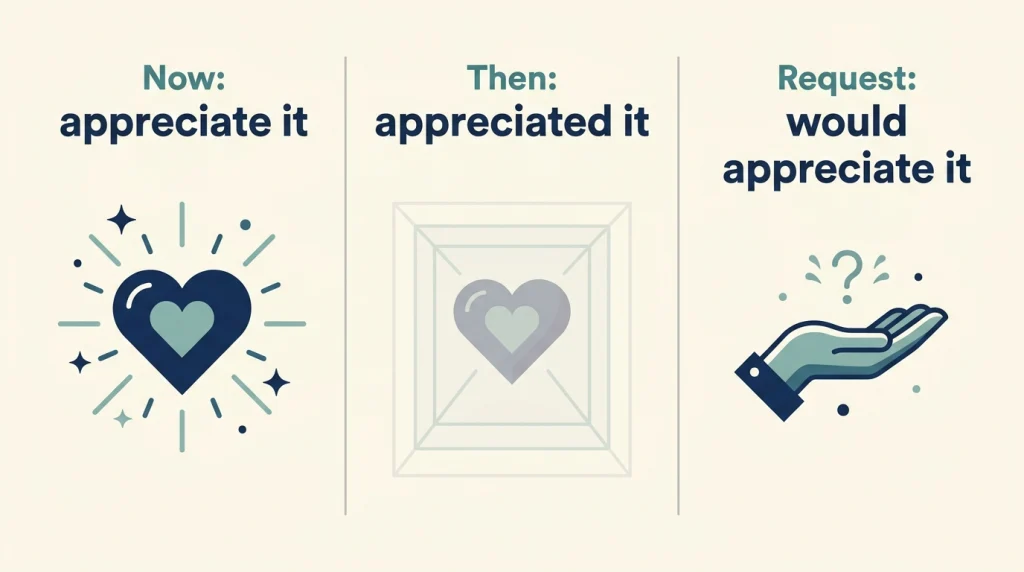
- Now: I appreciate it.
- Then: I appreciated it.
- Polite request: I would appreciate it if you could help.
The time of the original favor does not always determine the tense. What matters is the time perspective of your statement.
How to Use Appreciate It and Appreciated It
1. Use “I Appreciate It” for Current Gratitude
Use “I appreciate it” when you want to thank someone for help, kindness, advice, patience, or effort.
The action you are thanking them for may already be finished. Your gratitude, however, is being expressed now.
Examples:
- “Thanks for picking up my package. I appreciate it.”
- “I appreciate it when you give me advance notice.”
- “Thank you for your patience while we resolve this issue.”
- “I really appreciate everything you’ve done for the team.”
This form works in conversations, emails, text messages, and professional communication.
2. Use “I Appreciated It” for Past Experiences
Use “I appreciated it” when you are describing how you felt about something at an earlier time.
This form is especially useful in storytelling, personal reflections, performance reviews, and discussions about completed projects.
Examples:
- “I appreciated your support when I changed careers.”
- “We appreciated the extra time you gave us last semester.”
- “I appreciated it when my supervisor explained the process.”
- “She appreciated the invitation, although she couldn’t attend.”
The appreciation belongs to the past situation being described. This does not necessarily mean the speaker is no longer grateful; it simply places the statement in a past time frame.
3. Use “Appreciate It” in Casual Conversations
In everyday English, people often shorten “I appreciate it” to “Appreciate it.”
For example:
Person A: “I’ve sent you the meeting notes.”
Person B: “Thanks, appreciate it!”
This shortened expression is common in casual speech, text messages, and quick workplace exchanges. The subject I is understood from the context.
In formal writing, a complete sentence such as “Thank you for sending the meeting notes. I appreciate it” is generally a safer choice.
4. Use “Would Appreciate It” for Polite Requests
The expression “I would appreciate it if…” is commonly used to make a request politely.
Examples:
- “I would appreciate it if you could confirm your availability.”
- “We would appreciate it if you sent the signed form by Friday.”
- “I would appreciate it if you could keep this information confidential.”
Here, the speaker is not simply thanking someone for something already done. The speaker is expressing anticipated gratitude for a possible action.
The phrase “I would appreciate it if you could…” is particularly useful in business emails because it communicates a request without sounding like a direct command.
5. Understand “I Appreciate It” With Past-Time Expressions
You can use “I appreciate it” even when the sentence refers to something that happened earlier.
For example:
“Thank you for helping me yesterday. I appreciate it.”
This sentence is correct because the speaker is expressing gratitude now for yesterday’s help.
Compare it with:
“When you helped me yesterday, I appreciated it.”
This version describes the speaker’s appreciation as part of the past situation.
Both are correct. They simply present the gratitude from different perspectives.
Correct Examples of Appreciate It and Appreciated It
The following examples show how each expression works in different situations.
Everyday Conversation
- “Thanks for holding the door. I appreciate it.”
- “I appreciated it when my neighbor brought my groceries inside during the storm.”
Emails and Workplace Communication
- “Thank you for sharing the updated schedule. I appreciate it.”
- “I appreciated your guidance throughout the client presentation.”
- “I would appreciate it if you could review the attached document before noon.”
School and Education
- “I appreciate it when my teacher explains difficult concepts with examples.”
- “I appreciated the extra feedback my instructor gave me before the final exam.”
Social Media and Text Messages
- “Thanks for the birthday wishes. Appreciate it!”
- “I appreciated everyone who checked in on me during a difficult week.”
Academic and Professional Writing
- “The research team appreciated the participants’ time and cooperation.”
- “I appreciate the opportunity to discuss these findings.”
- “The author appreciated the reviewers’ suggestions when revising the original manuscript.”
Notice that “appreciate it” is not limited to informal communication. The full form is suitable for professional and academic settings, too. Likewise, “appreciated it” is not inherently more formal; it simply expresses appreciation from a past perspective.
Incorrect vs. Correct: 10 Common Usage Problems
Not every sentence containing the “wrong” form is grammatically incorrect. In several examples below, the correction is about matching the intended meaning rather than fixing a strict grammar error.
| ❌ Incorrect or less suitable | ✅ Correct for the intended meaning | Why |
|---|---|---|
| “Thanks for helping me. I appreciated it.” | “Thanks for helping me. I appreciate it.” | If you are expressing gratitude now, the present form communicates that directly. The past form is still possible when you mean past appreciation. |
| “I appreciate it when you helped me yesterday.” | “I appreciated it when you helped me yesterday.” | The sentence describes a specific past event. The past form is more suitable for that intended meaning. |
| “I appreciated your help right now.” | “I appreciate your help right now.” | “Right now” points to the present, so the present form better matches the intended time. |
| “I appreciate it last year when you supported me.” | “I appreciated it when you supported me last year.” | The statement looks back at a past experience, so the past form is appropriate. |
| “I appreciated your help; thank you for helping me today.” | “I appreciate your help; thank you for helping me today.” | If the message expresses current gratitude, the present form keeps the focus on the speaker’s current response. |
| “I would appreciate if you sent the file.” | “I would appreciate it if you sent the file.” | In this standard request pattern, it introduces the clause explaining what would be appreciated. |
| “I appreciated it if you can help me tomorrow.” | “I would appreciate it if you could help me tomorrow.” | The request concerns a possible future action, so the conditional expression is more appropriate. |
| “I am appreciate it.” | “I appreciate it.” | The verb appreciate does not take am in this simple present construction. |
| “I did appreciated your advice.” | “I did appreciate your advice.” | After did, use the base form appreciate, not the past form appreciated. |
| “I appreciate it yesterday.” | “I appreciated it yesterday.” | The word yesterday establishes a past time frame, making the past form suitable for the intended meaning. |
The main lesson is to check both the verb form and the intended meaning. A sentence can be grammatically possible but still communicate a different time perspective from the one you intended.
Why People Confuse Appreciate It and Appreciated It
The Difference Is Only One Ending
The expressions look almost identical. Adding -ed changes the verb from a present-tense form to a simple past form, but the rest of the sentence stays the same.
For learners, this small spelling difference can be easy to overlook, particularly when writing quickly.
The Favor May Be Over, but the Gratitude Is Current
One common mistake is assuming that a completed action always requires the past tense.
That is not how these expressions work.
Someone might finish helping you at 10 a.m. You can thank them at 10:05 a.m. by saying, “I appreciate it.” The help is finished, but the gratitude is being expressed in the present.
The Same Phrase Appears in Different Contexts
People use appreciation language to thank others, remember past experiences, and make polite requests. Because the purpose changes, the appropriate verb form can change, too.
Compare:
- “I appreciate it.” — Current gratitude.
- “I appreciated it.” — Past appreciation.
- “I would appreciate it if you helped.” — A polite request.
Spellcheck Does Not Always Catch the Problem
Both appreciate and appreciated are correctly spelled words. A spellchecker may accept either one without identifying a mismatch between the tense and the intended meaning.
Read the whole sentence rather than relying on spelling tools alone.
Translation Can Affect Tense Choices
Learners whose first languages express gratitude without the same tense distinctions may find the choice difficult. A direct translation can also make the past form seem necessary simply because the favor has already happened.
Instead, identify the perspective you want to express: are you thanking someone now, describing a past feeling, or requesting a future action?
ALSO READ: Puns or Jokes: What Is the Difference?
Common Mistakes Checklist
Use this checklist before sending a message or submitting a piece of writing.
- Mistake: Automatically using the past tense for a completed favor.
Why it happens: The action is finished, so the writer assumes the gratitude must also be past.
How to avoid it: Ask whether you are thanking the person now. If you are, “I appreciate it” is often the natural choice. - Mistake: Treating “appreciated it” as incorrect.
Why it happens: Learners may be taught that the present form is the standard way to say thank you.
How to avoid it: Remember that “I appreciated it” is correct when you are discussing a past experience. - Mistake: Leaving out “it” in a polite request.
Why it happens: The writer transfers a pattern from a different sentence structure.
How to avoid it: Use the standard construction “I would appreciate it if…” when introducing the requested action. - Mistake: Using “did appreciated.”
Why it happens: The writer adds two past-tense markers.
How to avoid it: After did, use the base verb: “I did appreciate it.” - Mistake: Assuming every sentence with “yesterday” must use the past tense.
Why it happens: Time expressions are treated as automatic tense commands.
How to avoid it: Look at the whole meaning. “I appreciate your help yesterday” is usually mismatched, but “I appreciate your help, even though it began yesterday” can be perfectly sensible. - Mistake: Using “Appreciate it!” in every situation.
Why it happens: The shortened form is common in casual conversations.
How to avoid it: Prefer “I appreciate it” in formal emails, academic prose, and situations where a complete sentence is expected. - Mistake: Confusing gratitude with a request.
Why it happens: Both constructions contain the verb appreciate.
How to avoid it: Use “I appreciate it” to express thanks and “I would appreciate it if…” to make a polite request.
Appreciate It or Appreciated It in Real English
Grammatically Correct
“I appreciate it” and “I appreciated it” are both grammatically correct when their verb forms match the intended time perspective. For example, “I appreciate your support” expresses gratitude now, while “I appreciated your support during my first year” describes a past experience. Neither expression is inherently more polite or more correct than the other. The context determines which meaning the reader receives.
Grammatically Possible but Potentially Unnatural
“I appreciated it” can sound unexpected in a message that appears to be thanking someone for a favor just completed, especially when no past context is provided. For example, “Thanks for sending the file. I appreciated it” may sound as though the speaker is recounting an earlier exchange rather than expressing immediate thanks. The sentence is not automatically wrong, but “I appreciate it” is generally the clearer choice for a current thank-you.
Natural, Everyday English
In everyday English, “Thanks, I appreciate it” is a common way to acknowledge a favor, helpful message, or act of kindness. People also use “Appreciate it!” as a shortened response in casual conversations and text messages. When recalling earlier events, they naturally use forms such as “I really appreciated your help last week.” The choice depends on what the speaker wants to communicate, not on a strict rule that past actions require past-tense gratitude.
American vs. British English
There is no major grammatical difference between American and British English in the use of “appreciate it” and “appreciated it.” Both varieties use the present form to express current gratitude and the past form to describe earlier appreciation.
For example, both American and British English speakers can say:
- “Thanks for your help. I appreciate it.”
- “I appreciated your advice during the project.”
- “I would appreciate it if you could reply by Friday.”
The shortened expression “Appreciate it!” is informal and is understood in both varieties. Differences in personal style and workplace conventions may exist, but the basic tense distinction remains the same.
Formal vs. Informal Usage
Both forms are suitable for formal and informal situations. The main difference is tense, not formality.
| Situation | Recommended expression | Reason |
|---|---|---|
| Casual conversation | “Thanks, appreciate it!” | Brief and conversational. |
| Text message | “I appreciate it!” | Friendly and direct. |
| Professional email | “Thank you for your help. I appreciate it.” | Complete and professional. |
| Formal request | “I would appreciate it if you could respond by Friday.” | Polite and clear. |
| Performance review | “I appreciated your leadership during the transition.” | Reflects on a past contribution. |
| Academic reflection | “I appreciated the detailed feedback I received.” | Describes a past experience. |
For professional communication, do not choose the past form merely because it sounds more formal. Choose the form that accurately reflects the meaning you intend.
Comparison Table: Appreciate It vs. Appreciated It
| Feature | Appreciate It | Appreciated It |
|---|---|---|
| Verb tense | Present | Simple past |
| Main purpose | Expresses current gratitude | Describes past appreciation |
| Common example | “I appreciate your help.” | “I appreciated your help last month.” |
| Can refer to a completed favor? | Yes | Yes |
| Suitable for professional emails? | Yes | Yes |
| Suitable for casual conversation? | Yes | Yes |
| Naturally used for a polite request? | Usually in “I would appreciate it if…” | Not for a future request in the simple past |
| Indicates the speaker is no longer grateful? | No | Not necessarily |
| Best memory aid | Gratitude viewed from now | Gratitude viewed from then |
The most important distinction is the speaker’s time perspective. The expressions are not interchangeable in every context, but both can be correct when used appropriately.
ALSO CHECKOUT: Choosing or Chosing: Which Spelling Is Correct?
Real-Life Situations: Which Expression Should You Choose?
Situation 1: A Colleague Sends You a File
Your colleague emails a document you need for a meeting.
Natural response: “Thanks for sending this over. I appreciate it.”
You are expressing gratitude in the present, even though the sending action is complete.
Situation 2: You Reflect on a Previous Job
You are describing the help your former manager gave you several years ago.
Natural response: “I appreciated the guidance my manager gave me during my first year.”
The sentence looks back at a past experience, so the past tense fits.
Situation 3: You Need a Reply From a Client
You are writing a professional email asking for a response.
Natural response: “I would appreciate it if you could confirm the details by Thursday.”
This is a polite request, not simply a statement of gratitude for something already done.
Situation 4: A Friend Helps You Move
Your friend finishes helping you carry furniture into your new apartment.
Natural response: “Thanks for helping me move. I really appreciate it.”
The help is finished, but your gratitude is current.
Situation 5: You Write a Reflection After an Exam
You are describing how your teacher supported you during the previous semester.
Natural response: “I appreciated the extra explanations my teacher provided before the exam.”
The sentence describes a past experience rather than a current exchange.
Situation 6: You Reply to a Quick Text
A friend sends you a useful phone number.
Natural response: “Got it, thanks! Appreciate it.”
The shortened form is suitable for a casual message. In a formal email, the full sentence would generally be preferable.
How to Remember the Difference
Use this simple three-step method whenever you are unsure which expression to choose.
- Identify your purpose. Are you thanking someone, reflecting on an earlier experience, or making a request?
- Choose the time perspective. Use appreciate for present gratitude and appreciated for past appreciation.
- Read the sentence aloud. Check whether the tense communicates what you actually mean.
A useful memory aid is:
Appreciate = gratitude from now. Appreciated = gratitude viewed from then. Would appreciate = a polite request.
Do not focus only on when the favor occurred. Focus on when you are presenting the appreciation.
Quick Practice Quiz
Choose the most suitable expression for each sentence. Some questions test tense, while others test the structure of a polite request.
- Thank you for explaining the instructions. I ___ it.
- A. appreciate
- B. appreciated
- When I worked at that company, I really ___ the support my colleagues gave me.
- A. appreciate
- B. appreciated
- I would ___ it if you could send me the revised schedule.
- A. appreciate
- B. appreciated
- Thanks for checking on me yesterday. I still ___ it.
- A. appreciate
- B. appreciated
- Looking back, we ___ the extra time our teacher gave us before the final exam.
- A. appreciate
- B. appreciated
- Which sentence is best for a quick, casual reply to a helpful text?
- A. “Thanks, appreciate it!”
- B. “Thanks, I appreciated it last week!” (when referring to help just received)
Quiz Answers and Explanations
- A. appreciate — The speaker is expressing gratitude now.
- B. appreciated — The sentence describes a past job and past appreciation.
- A. appreciate — The standard polite request is “I would appreciate it if…”
- A. appreciate — “Still” indicates that the gratitude remains current.
- B. appreciated — “Looking back” establishes a past perspective.
- A. “Thanks, appreciate it!” — This is a natural informal response to help just received.
If you answered all six correctly, you understand the central distinction. If not, focus on the difference between the time of the favor and the time perspective of the gratitude.
Quick Summary
“Appreciate it” and “appreciated it” are both correct English expressions, but they differ in tense and meaning. Use “I appreciate it” when expressing gratitude in the present, even if the favor happened earlier. Use “I appreciated it” when describing appreciation connected to a past experience. For polite requests, use “I would appreciate it if you could…” rather than omitting it. The shortened form “Appreciate it!” is common in casual conversation, while the complete sentence is usually better for formal writing. American and British English follow the same basic rule. When choosing between the two forms, ask yourself whether you are thanking someone now, looking back at an earlier experience, or requesting something politely.
Frequently Asked Questions
Is “appreciate it” or “appreciated it” correct?
Both are correct. “Appreciate it” expresses present gratitude, while “appreciated it” describes appreciation from a past perspective. Choose the form that matches the meaning you intend.
Can I say “I appreciated it” when thanking someone today?
Yes. It is grammatically correct, but it may sound as though you are describing a past experience rather than expressing immediate gratitude. “I appreciate it” is usually the more direct choice for a current thank-you.
Is “I appreciate it” correct if the favor happened yesterday?
Yes. The favor may have happened yesterday, but your gratitude can be current. For example, “Thank you for helping me yesterday. I appreciate it” is perfectly correct.
Does “I appreciated it” mean I am no longer grateful?
No. The past tense places your appreciation in an earlier time frame, but it does not necessarily mean that your gratitude has ended. The wider context determines whether your appreciation continues.
Is “Appreciate it!” a complete sentence?
In casual conversation, “Appreciate it!” is a common shortened expression in which the subject I is understood. In formal writing, “I appreciate it” is generally preferable because it includes the subject.
Is “I would appreciate it if you could” grammatically correct?
Yes. It is a standard and polite way to make a request. For example, “I would appreciate it if you could send the report today.” The word it is an important part of this construction.
Should I write “I appreciate it” or “I am appreciating it”?
For ordinary expressions of gratitude, “I appreciate it” is the natural choice. The verb appreciate commonly describes a state of recognition or gratitude, so the simple present is generally preferred in this meaning.
Can I use “appreciated it” in a professional email?
Yes. Use it when referring to past assistance, feedback, or support. For example, “I appreciated your guidance during last month’s project.” If you are thanking someone for a current interaction, “I appreciate it” is often more suitable.
Is “I appreciate it if you help me” correct?
It may be understood, but it is not the usual form for a polite request. Prefer “I would appreciate it if you could help me” or “I would appreciate your help.” These constructions express the request more naturally.
What is the easiest way to remember the difference?
Think of the perspective rather than the completed action: “I appreciate it” expresses gratitude now, “I appreciated it” describes gratitude in the past, and “I would appreciate it if…” introduces a polite request.