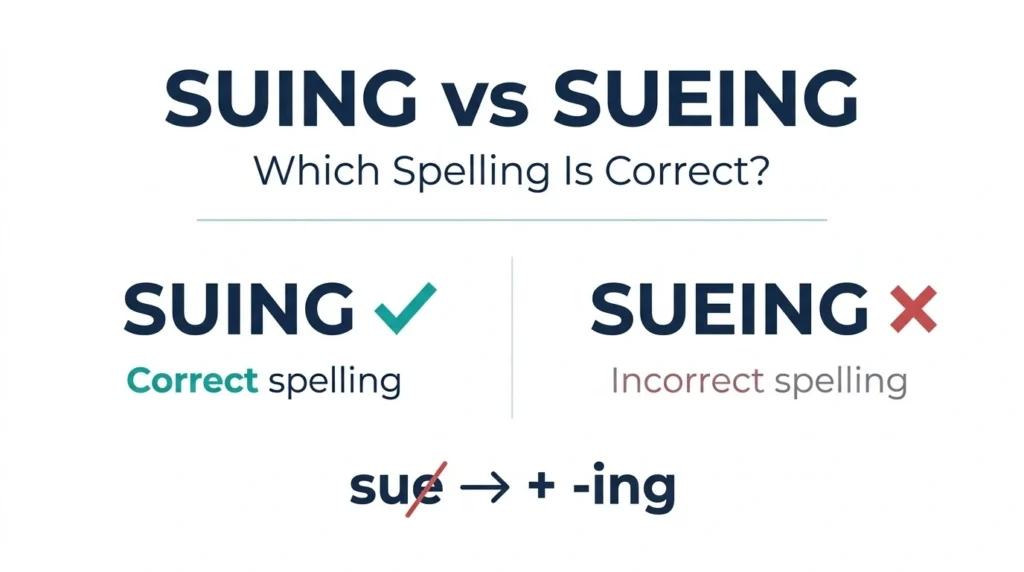

Suing is the correct spelling. Sueing is incorrect in standard English. The verb sue becomes suing when you add the suffix -ing: you drop the final e before adding -ing. For example, “The company is suing its former supplier.” This spelling rule also applies to many other verbs ending in a silent e, such as write → writing and make → making.
Suing or Sueing?
Use suing, not sueing. The word suing is the present participle of sue, meaning to bring a legal case against someone. When a verb ends in a silent e, you usually remove that final e before adding -ing. Therefore, sue + ing = suing. The same pattern appears in argue → arguing and value → valuing. Although sueing may look logical, it is not the standard spelling.
ALSO READ: Appreciate It or Appreciated It: Which Is Correct?
What Is the Difference Between Suing and Sueing?
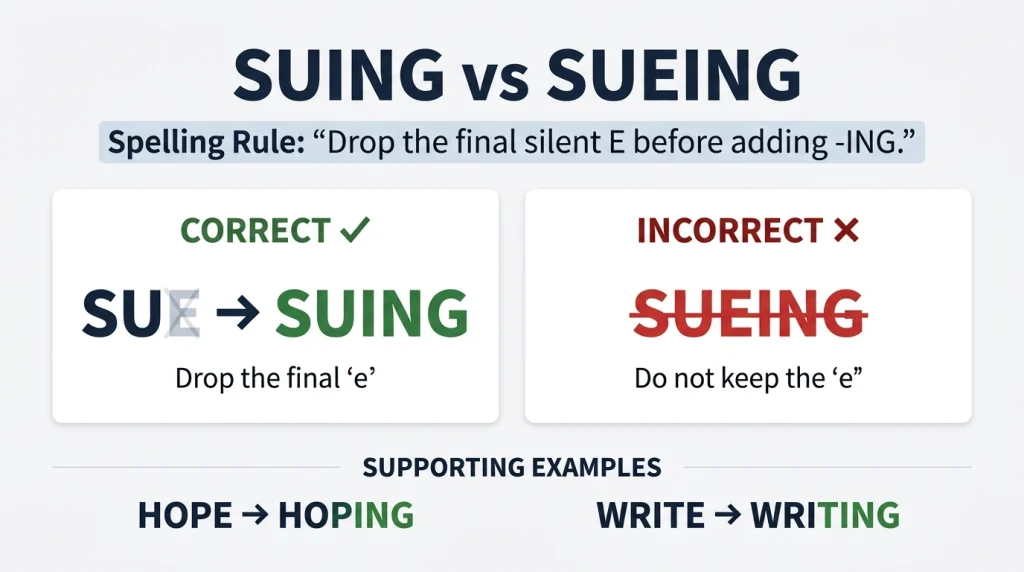
The difference is spelling, not meaning. Suing is the standard English form of the verb sue with the suffix -ing. Sueing is a common spelling error.
The verb sue means to bring legal proceedings against a person, company, or organization. The -ing form can describe an ongoing legal action or function in other grammatical constructions.
Examples:
- “The customer is suing the company over the disputed charge.”
- “Suing a former employer can involve significant legal costs.”
- “The family considered suing after the accident.”
In each sentence, suing is spelled without the final e from sue.
Why Does the Correct Spelling Matter?
Spelling errors can distract readers and weaken the credibility of professional writing, especially in legal, academic, and business contexts.
The word suing often appears in reports, news articles, legal correspondence, and discussions of disputes. Because it relates to legal action, accurate spelling helps keep the writing clear and professional.
For example:
- Incorrect: “The employee is sueing the company.”
- Correct: “The employee is suing the company.”
The intended meaning may still be understandable in the incorrect version, but standard spelling is important in edited writing.
ALSO READ: Puns or Jokes: What Is the Difference?
The Core Rule: Drop the Final E Before Adding -Ing
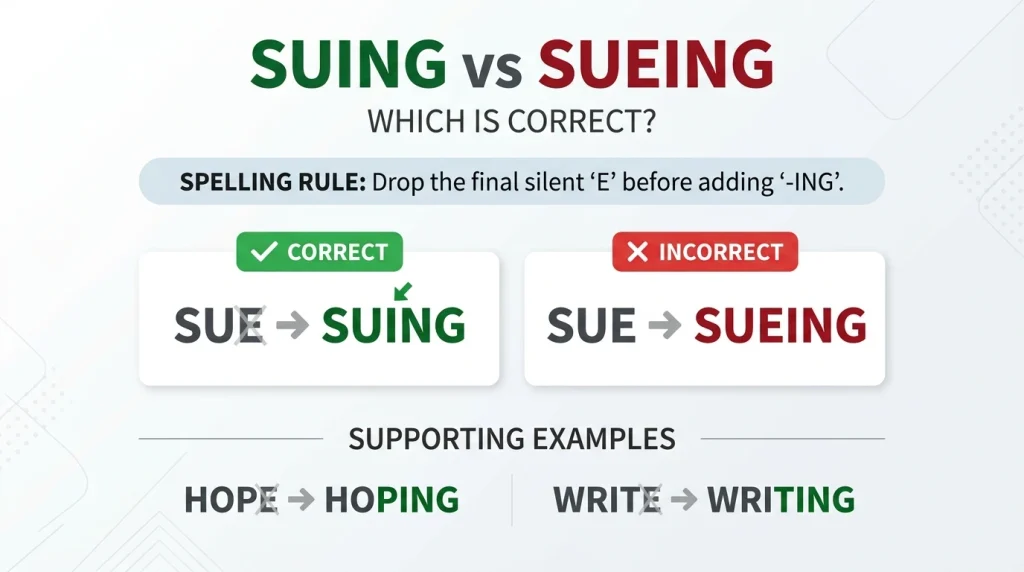
When a verb ends in a silent e, you usually remove the final e before adding -ing.
Rule: Remove the final silent e + add -ing.
- Sue → suing
- Hope → hoping
- Write → writing
- Make → making
- Argue → arguing
- Value → valuing
The spelling changes because English generally does not retain the final silent e when adding -ing to this type of verb.
There are exceptions to the broader spelling pattern. For example, verbs ending in -ee generally retain both es: see → seeing and agree → agreeing. However, sue ends in a single final e, so its correct form is suing.
How to Use Suing Correctly
1. Use Suing for an Ongoing Legal Action
Use suing after forms of be when describing a legal action that is in progress.
Examples:
- “The business is suing its former contractor.”
- “Several residents are suing the property developer.”
- “The musician is suing the publisher over unpaid royalties.”
The structure is:
Subject + am/is/are/was/were + suing + object
The object is the person or organization being sued.
2. Use Suing as a Gerund
A gerund is an -ing form of a verb used as a noun. In this role, suing can refer to the act or process of bringing a legal claim.
Examples:
- “Suing can be expensive.”
- “Suing was not their first choice.”
- “They discussed suing but decided to seek mediation.”
Here, suing does not function as the main action in a continuous verb phrase. Instead, it refers to the activity itself.
3. Use Suing After Prepositions
An -ing form commonly follows a preposition, such as about, before, after, or without.
Examples:
- “They spoke to a lawyer before suing.”
- “The company settled the dispute without suing.”
- “She asked about suing her landlord.”
- “He reconsidered suing after receiving the settlement offer.”
Use suing, not sueing, in all these constructions.
4. Use Suing in Formal and Informal Writing
The spelling does not change according to the level of formality.
Formal: “The claimant is considering suing the manufacturer.”
Informal: “They’re thinking about suing the landlord.”
Both use the same standard spelling. The difference lies in the sentence structure and tone, not in the word itself.
5. Understand the Difference Between Sue, Sued, and Suing
These forms have different grammatical functions:
- Sue: The base form — “They plan to sue.”
- Sues: The third-person singular present form — “She sues for damages.”
- Sued: The simple past and past participle — “They sued last year” and “The company has sued before.”
- Suing: The -ing form — “They are suing the contractor.”
The spelling rule for suing does not change the base verb’s meaning. It simply creates the appropriate grammatical form.
Correct Examples of Suing in Sentences
Here are 12 examples across everyday, professional, academic, and public communication.
Conversation
- “They’re suing the company because the repairs were never completed.”
- “He talked to a lawyer before suing his former business partner.”
Email and Workplace Communication
- “The supplier is suing the retailer over the unpaid invoices.”
- “Our legal team is reviewing the risks before considering suing the contractor.”
- “The company denied the allegations and said it would defend itself against the lawsuit.”
School and Academic Writing
- “The article examines why the residents are suing the local authority.”
- “The case study discusses the financial consequences of suing a large corporation.”
Social Media and Online Discussion
- “The customer says she is suing after the dispute remained unresolved.”
- “Before claiming that someone is suing, check whether a legal case has actually been filed.”
News and Formal Writing
- “The former employees are suing the manufacturer over alleged workplace violations.”
- “Suing the agency was one of several options considered by the affected families.”
- “The report explains why the business is suing its former distributor.”
These examples show that suing can appear in different sentence structures while keeping the same spelling.
Incorrect vs. Correct: Common Spelling Mistakes
| ❌ Incorrect | ✅ Correct | Why |
|---|---|---|
| The company is sueing its supplier. | The company is suing its supplier. | Drop the final e before adding -ing. |
| They are sueing the landlord. | They are suing the landlord. | Sueing is not the standard spelling. |
| Sueing can be expensive. | Suing can be expensive. | The -ing form remains suing when used as a noun. |
| She considered sueing her employer. | She considered suing her employer. | The verb after considered takes the -ing form. |
| He was sueing the contractor. | He was suing the contractor. | The past continuous uses was + suing. |
| They discussed sueing the manufacturer. | They discussed suing the manufacturer. | The verb discuss is followed by an -ing form in this construction. |
| The family is sueing for damages. | The family is suing for damages. | The final e is dropped before -ing. |
| The lawyer advised sueing the company. | The lawyer advised suing the company. | The -ing form is appropriate after advised in this construction. |
| He threatened sueing the business. | He threatened to sue the business. | This correction fixes both the spelling and the more natural verb pattern: threaten to + base verb. |
| Sueing the company was their last option. | Suing the company was their last option. | The gerund must use the standard spelling suing. |
| They are thinking about sueing. | They are thinking about suing. | The preposition about is followed by the -ing form. |
| The article mentions sueing as an option. | The article mentions suing as an option. | Suing is the standard form of the verb sue with -ing. |
Not every incorrect example involves the same kind of error. Most are spelling mistakes, while “threatened sueing” also illustrates a problem with the grammatical pattern used after threaten.
Why Do People Confuse Suing and Sueing?
The Final E Is Easy to Preserve
The base verb is sue, so writers may assume that every form should retain the same spelling. That seems logical, but English spelling rules often change the form of a word when a suffix is added.
The correct transformation is sue → suing, not sue → sueing.
The Rule Can Be Hard to Apply Consistently
English has several ways of forming -ing words. Compare:
- Hope → hoping
- See → seeing
- Agree → agreeing
- Sue → suing
The pattern depends partly on how the verb ends. Learners who memorize only a few examples may overgeneralize and retain the final e in sueing.
Pronunciation Does Not Clearly Show the Spelling
The final e in sue is silent. Because the pronunciation does not provide an obvious spelling cue, writers may preserve the letter when they type the word.
This is a spelling issue rather than a difference in pronunciation between two standard forms.
Spellcheck May Not Catch Every Error
Some writing tools can identify sueing as a misspelling, but spellcheck behavior depends on the software, dictionary, and context. A tool may also miss errors that involve correctly spelled words used in the wrong grammatical structure.
When accuracy matters, apply the spelling rule and proofread the full sentence.
Translation Can Encourage Direct Spelling Patterns
Learners may transfer spelling patterns from another language or assume that an English verb keeps all its letters when a suffix is added. That approach does not always work in English.
Instead of relying on a direct letter-by-letter transformation, learn common spelling patterns together with their examples.
Common Mistakes Checklist
- Keeping the final e: Writing sueing instead of suing. Remember that sue ends in a single silent e, which is dropped before -ing.
- Confusing spelling with pronunciation: Assuming the word should retain the same letters because the pronunciation remains recognizable. Focus on the written pattern, not only on sound.
- Applying one rule to every verb: Assuming all verbs ending in e behave exactly alike. Compare sue → suing with see → seeing.
- Using the wrong verb pattern: Writing “threatened suing” when you mean “threatened to sue.” Check the grammar surrounding the word as well as its spelling.
- Trusting spellcheck completely: Assuming that a word is correct because the software accepts it. Use a reliable dictionary and review the sentence.
- Confusing the verb forms: Using sue, sued, and suing interchangeably. Choose the form required by the tense and sentence structure.
Suing vs. Sueing in Real English
Grammatically Correct
Suing is the correct standard spelling of the -ing form of sue. It works in continuous verb phrases, as in “The company is suing its former partner,” and as a gerund, as in “Suing can be costly.” The spelling remains the same in American and British English. In standard edited writing, sueing should be corrected to suing regardless of whether the sentence is formal or informal.
Grammatically Possible but Unnatural
Sueing may look like a reasonable spelling because it preserves the complete base word sue. However, it is not an accepted alternative spelling in standard English. A reader may understand what the writer intends, but the form will generally be treated as a spelling error rather than a stylistic choice. In edited documents, legal correspondence, academic work, and professional messages, use suing.
Natural, Everyday English
English speakers use suing naturally when discussing a legal claim or the possibility of taking legal action. Examples include “They’re suing the company,” “She’s considering suing,” and “The cost of suing may be too high.” In casual conversation, people may also say “take them to court” or “file a lawsuit,” depending on the situation. These expressions are alternatives in meaning, not alternative spellings of suing.
American vs. British English
There is no spelling difference between American and British English for this word. Both use suing, and both treat sueing as a misspelling in standard writing.
Examples:
- American English: “The company is suing its former distributor.”
- British English: “The company is suing its former distributor.”
Legal terminology and court procedures can vary by jurisdiction, but the spelling of suing does not.
Formal vs. Informal Usage
The spelling remains suing in both formal and informal English. What changes is the surrounding language.
| Context | Example | Why it fits |
|---|---|---|
| Casual conversation | “They’re thinking about suing.” | Direct and conversational. |
| Workplace email | “The company is considering suing the contractor.” | Clear and professional. |
| Academic writing | “The study examines the costs associated with suing.” | Uses a formal analytical style. |
| Legal reporting | “The claimant is suing the manufacturer.” | States the legal action directly. |
| Social media | “They’re suing over the dispute.” | Concise and informal. |
If you are unsure which style to use, choose the wording that suits the audience while keeping the spelling suing.
Comparison Table: Sue, Suing, Sued, and Sueing
| Feature | Sue | Suing | Sued | Sueing |
|---|---|---|---|---|
| Standard spelling? | Yes | Yes | Yes | No |
| Grammatical form | Base verb | -ing form | Past tense / past participle | Nonstandard misspelling |
| Example | “They plan to sue.” | “They are suing.” | “They sued last year.” | Should be corrected |
| Typical use | Plans, instructions, infinitives | Ongoing action or gerund | Past action or perfect constructions | Not recommended |
| Memory aid | Original verb | Drop e, add -ing | Add -d | Avoid this form |
Real-Life Situations: Using Suing Correctly
Situation 1: A Workplace Dispute
An employee believes the company violated an employment agreement.
Correct: “The employee is considering suing the company.”
The word suing describes a possible course of legal action.
Situation 2: A News Report
A reporter describes a dispute involving a business and its supplier.
Correct: “The supplier is suing the business over unpaid invoices.”
The standard spelling remains suing, regardless of the subject.
Situation 3: A School Assignment
A student writes about the costs of legal action.
Correct: “Suing can take time and money.”
Here, suing is a gerund that functions as the subject of the sentence.
Situation 4: A Professional Email
A legal department discusses possible next steps in a dispute.
Correct: “We are reviewing the circumstances before deciding whether to sue.”
In this sentence, to sue is the infinitive. The -ing form is not required because the structure uses whether to + base verb.
Situation 5: A Text Message
Someone asks whether a business intends to take legal action.
Correct: “Yes, they’re talking about suing.”
The word follows the preposition about, so the -ing form is appropriate.
How to Remember the Correct Spelling
Use this three-step method:
- Start with the base verb: sue.
- Remove its final silent e: su.
- Add -ing: suing.
A quick memory aid is: “Sue drops e before ing.”
Compare it with other verbs that follow the same pattern:
- Use → using
- Hope → hoping
- Argue → arguing
- Sue → suing
Remember that this is a spelling rule, not a change in the meaning of the verb. The result is always suing in standard English.
Quick Practice Quiz
Choose the correct answer in each sentence.
- The company is ___ its former supplier.
- A. sueing
- B. suing
- ___ can be costly and time-consuming.
- A. Sueing
- B. Suing
- They discussed ___ the contractor.
- A. sueing
- B. suing
- The correct -ing form of sue is:
- A. sueing
- B. suing
- The family threatened ___ the manufacturer.
- A. suing
- B. to sue
Quiz Answers and Explanations
- B. suing — Drop the final silent e before adding -ing.
- B. Suing — The gerund uses the same standard spelling.
- B. suing — The verb discuss is followed by an -ing form here.
- B. suing — This is the standard spelling.
- B. to sue — The verb threaten commonly takes the infinitive pattern to + base verb in this construction.
Quick Summary
Suing is the correct spelling, while sueing is a misspelling in standard English. The rule is simple: when adding -ing to sue, remove the final silent e first. This gives you suing, as in “The company is suing its former supplier.” The word can describe an ongoing legal action or function as a gerund, as in “Suing can be expensive.” American and British English use the same spelling. To avoid this mistake, remember the pattern sue → suing and compare it with similar forms such as hope → hoping and argue → arguing. Always check the surrounding sentence for the correct grammatical structure, too.
Frequently Asked Questions
Is sueing ever correct?
Not in standard English. The correct spelling is suing. Although sueing may look logical, it is treated as a spelling error.
Why is the e dropped in suing?
English generally drops a final silent e before adding -ing to verbs such as sue, hope, and write. Therefore, sue becomes suing.
Is suing a real word?
Yes. Suing is the standard -ing form of the verb sue. It can appear in continuous verb phrases and as a gerund.
What is the difference between sue and suing?
Sue is the base form of the verb, as in “They plan to sue.” Suing is its -ing form, as in “They are suing.”
What is the past tense of sue?
The simple past tense is sued. For example, “The company sued its former partner last year.”
Is suing spelled the same way in American and British English?
Yes. Both American and British English use suing. There is no regional spelling difference for this word.
Is suing formal or informal?
The spelling is appropriate in both formal and informal contexts. The tone depends on the sentence and the audience, not on the word’s spelling.
Can suing be used as a noun?
Yes. In a sentence such as “Suing can be expensive,” suing is a gerund, an -ing verb form functioning as a noun.
Should I write “thinking about suing” or “thinking about sueing”?
Write “thinking about suing.” The preposition about is followed by the -ing form, and the correct spelling is suing.
How can I check whether suing is spelled correctly?
Remember sue → suing, or consult a reliable dictionary. Spellcheck can help, but understanding the final-e rule makes the spelling easier to remember.