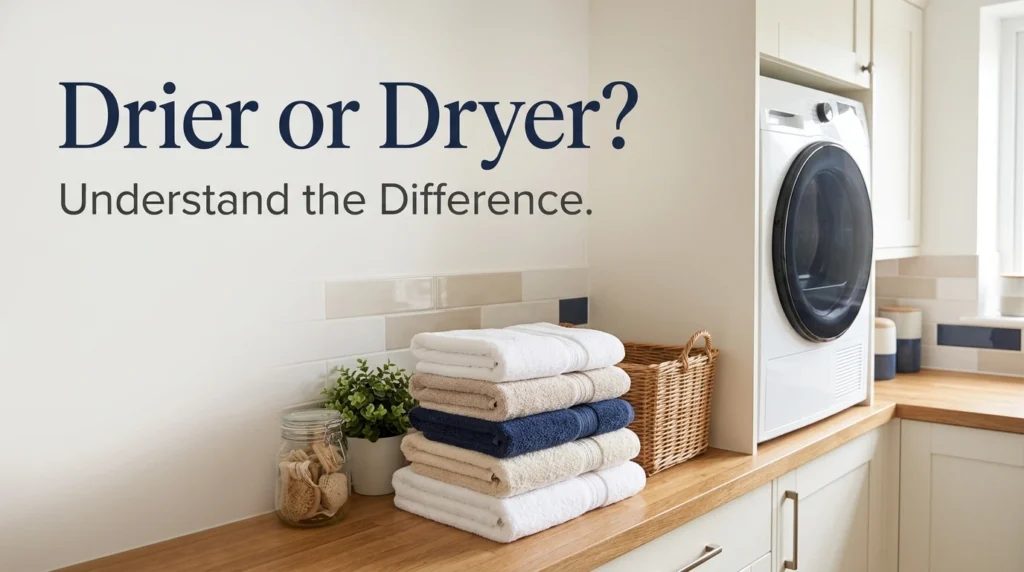

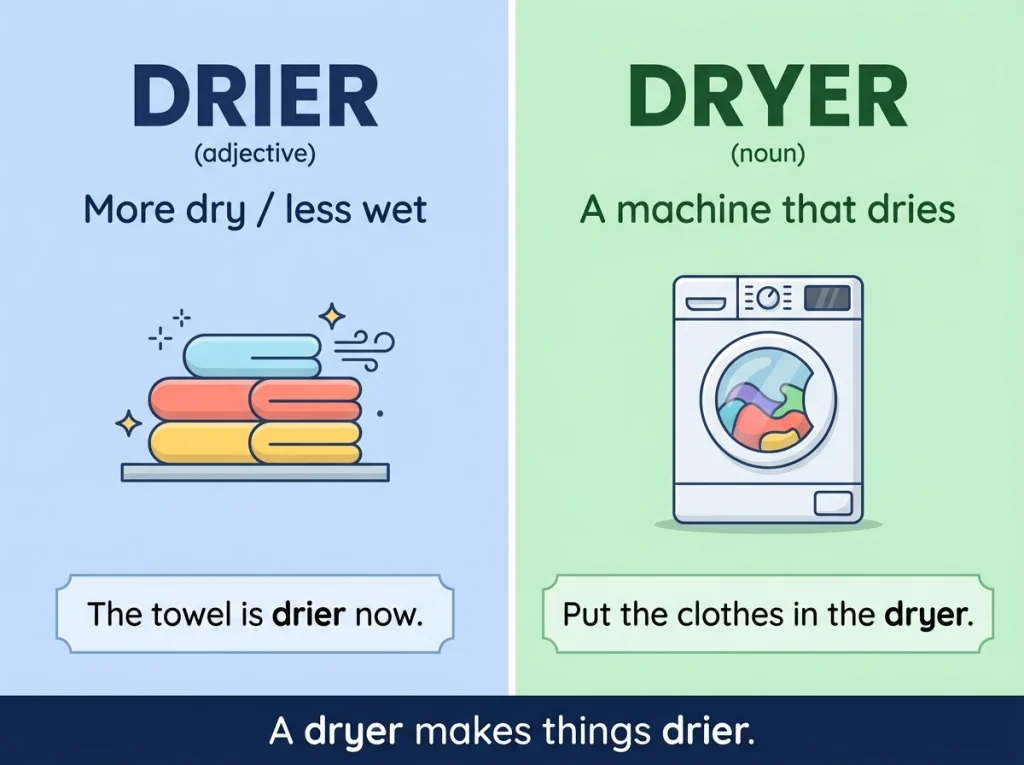
Both drier and dryer are correct English words, but they are generally used for different purposes. Use drier when you mean “more dry” or “less wet,” as in The weather is drier today. Use dryer when referring to a machine or device that removes moisture, as in Put the clothes in the dryer. Although the spellings can overlap in some contexts, this distinction is the clearest choice for everyday writing.
What Is the Difference Between Drier and Dryer?
The difference between drier and dryer is mainly grammatical: one usually describes a condition, while the other usually names a device.
What Does Drier Mean?
Drier is the standard comparative form of the adjective dry. It means that something has less moisture than something else or than it had before.
For example:
- The towels are drier than they were an hour ago.
- The climate here is drier than the climate near the coast.
- My skin becomes drier during winter.
- The ground is drier after several sunny days.
In each sentence, drier describes a condition. It tells the reader that something is less wet or has less moisture.
The normal comparison pattern is:
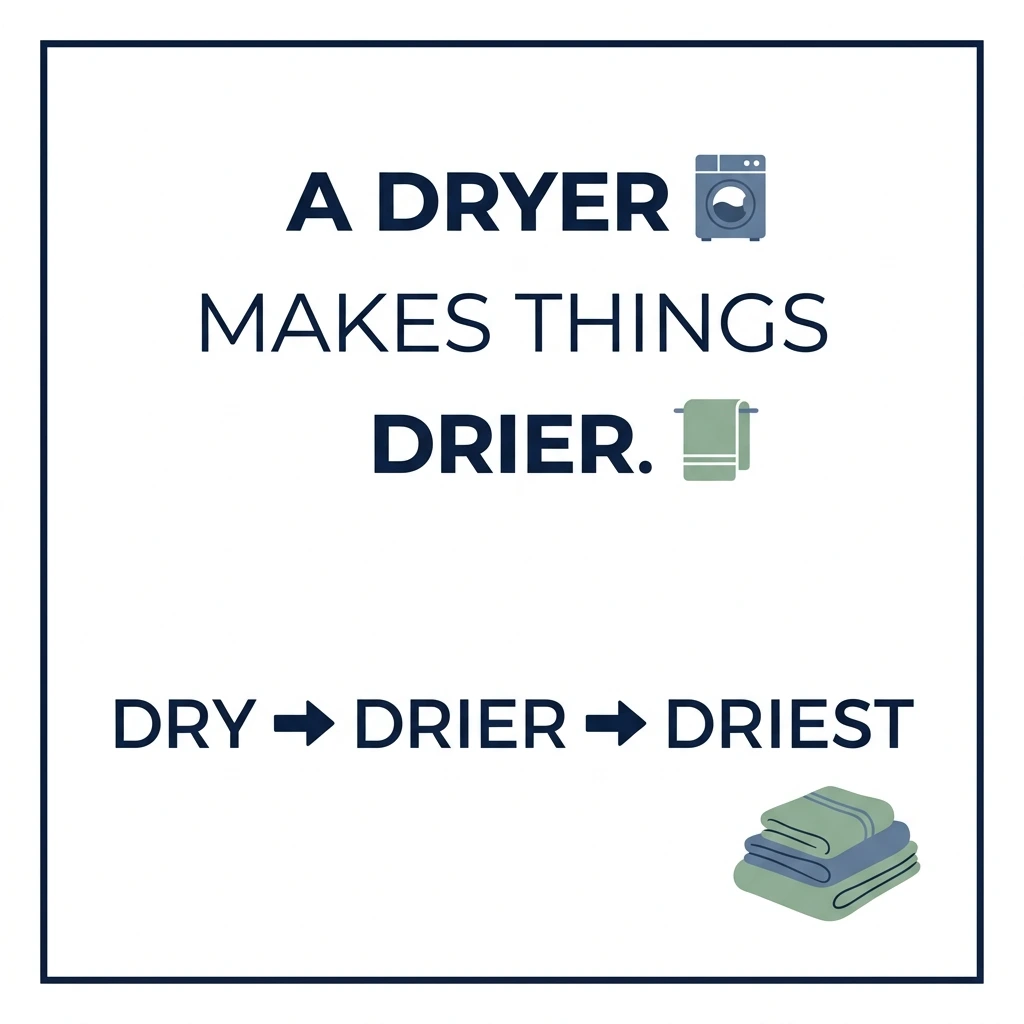
Dry → drier → driest
Use drier when comparing dryness, whether you are talking about clothes, weather, food, soil, skin, or even a person’s sense of humor.
ALSO READ: To Fast or Too Fast? Which Is Correct?
What Does Dryer Mean?
Dryer is usually a noun that refers to a machine or device used to remove moisture from something.
Common examples include:
- Clothes dryer
- Hair dryer
- Hand dryer
- Tumble dryer
- Industrial dryer
For example:
- The dryer stopped working this morning.
- I packed my hair dryer for the trip.
- Please put the wet towels in the clothes dryer.
- The public restroom has an electric hand dryer.
In these examples, dryer names the equipment that performs the drying. It does not compare how dry something is.
There is a small qualification: drier can also be used as a noun for a drying device, so the distinction is not absolute. However, dryer is the conventional spelling for common appliances in everyday American English.
Why Does the Difference Matter?
Choosing between drier and dryer helps readers understand exactly what you mean. The wrong spelling may not prevent someone from understanding your sentence, but it can make your writing look less polished.
Consider these two sentences:
- The clothes are drier now.
- The clothes are in the dryer now.
The first sentence describes the condition of the clothes. The second tells you where the clothes are.
This distinction matters in several situations:
- Everyday messages: You want to explain whether laundry is ready or still inside the machine.
- Workplace writing: You need to describe changes in humidity, product moisture, or drying equipment.
- Academic writing: You are comparing climates, environmental conditions, or material properties.
- Product descriptions: You need to distinguish a product’s drying performance from the appliance itself.
- Exams and language learning: You need to select the correct spelling based on grammatical function.
The key is to consider the meaning of the entire sentence rather than choosing a spelling based on how the word sounds.
The Core Rule: Drier vs. Dryer
Use drier to mean “more dry.” Use dryer to mean “a machine or device that dries something.”
| Word | Usual grammatical role | Meaning | Example |
|---|---|---|---|
| Drier | Comparative adjective | More dry or less wet | The towel is drier now. |
| Dryer | Noun | A machine or device that dries | The towel is in the dryer. |
An easy way to remember the difference is this:
A dryer makes things drier.
The dryer is the machine. Drier describes the result.
This rule works for most everyday writing. Just remember that drier also has a less common noun use, so it is more accurate to treat this as the usual distinction rather than an exception-free rule.
How to Use Drier and Dryer Correctly
When to Use Drier
Use drier when describing something that has less moisture than another thing or than it had previously.
It commonly appears in sentences about weather, food, materials, and physical conditions.
1. Comparing two things
- This towel is drier than the one on the chair.
- The western region has a drier climate than the east.
- This batch of bread is drier than yesterday’s batch.
2. Describing a change over time
- The soil is getting drier because it has not rained.
- My hair feels drier after swimming in the pool.
- The paint is drier than it was this morning.
3. Describing humor or communication
The word dry can also describe humor that is subtle, restrained, or delivered without much visible emotion. Its comparative form is drier.
- His humor is drier than his colleague’s.
- The revised report has a drier, more technical tone.
Here, drier refers to style rather than physical moisture.
Why Is It Spelled Drier Instead of Dryer?
The spelling follows a common English rule for comparative adjectives.
When an adjective ends in a consonant followed by y, the y usually changes to i before the comparative ending -er is added.
Examples:
- Dry → drier
- Happy → happier
- Easy → easier
- Heavy → heavier
- Noisy → noisier
Therefore, drier is the standard comparative spelling of dry.
The word dryer, by contrast, is formed as a noun naming something that dries. The final y remains in the base word dry when the noun-forming ending is added.
When to Use Dryer
Use dryer when you mean a machine or device that removes moisture.
Examples include:
- I need to buy a new clothes dryer.
- The hair dryer is in the bathroom cabinet.
- Our washing machine works, but the dryer needs repairing.
- The hotel installed a faster hand dryer.
- The factory uses an industrial dryer to process the material.
In these sentences, dryer identifies equipment rather than describing how dry something is.
Can Dryer Ever Mean More Dry?
Yes, dryer is occasionally used as an alternative spelling of the comparative adjective dry, and dictionaries record some overlap between the two forms. However, drier is the safer and more conventional choice when describing something as more dry.
For example:
- Preferred: The air is drier today.
- Also encountered: The air is dryer today.
The first spelling follows the usual comparative pattern and is the best choice when you want to avoid confusion.
For the name of a common appliance, use dryer in expressions such as hair dryer and clothes dryer.
Correct Examples of Drier and Dryer
The following examples show how to use both words in different contexts.
Everyday Conversation
- “This towel feels drier than the one you gave me.”
- “Is the dryer finished, or should we wait another ten minutes?”
Emails and Messages
- “The air in the storage room is drier than we expected.”
- “Could you please move the laundry from the washer to the dryer?”
School and Academic Writing
- “The southern region has a drier climate during the summer months.”
- “The experimental samples became drier after exposure to warm air.”
Workplace Communication
- “The production team needs a more efficient dryer for the packaging line.”
- “The material is drier today, so it should be ready for the next stage.”
Social Media and Informal Writing
- “My hair is drier than usual after spending the whole day at the beach.”
- “Finally bought a travel hair dryer that fits in my suitcase!”
Food and Cooking
- “The second cake turned out drier than the first one.”
- “The herbs are drier now, so we can store them in an airtight container.”
Notice that drier describes a condition in examples 1, 3, 5, 6, 8, 9, 11, and 12. Dryer names equipment in examples 2, 4, 7, and 10.
Incorrect vs. Correct: 10 Common Examples
The following table focuses on the intended meaning in each sentence. Some less conventional spellings may occur in actual English, but the recommended forms below are clearer for ordinary edited writing.
| ❌ Incorrect or less preferred | ✅ Correct or preferred | Why |
|---|---|---|
| The weather is dryer today. | The weather is drier today. | Drier is the standard comparative form of dry. |
| This towel is dryer than that one. | This towel is drier than that one. | The sentence compares moisture levels, so drier is preferred. |
| My skin gets dryer in winter. | My skin gets drier in winter. | The word describes a change in skin moisture. |
| The desert has a dryer climate. | The desert has a drier climate. | Drier is the conventional comparative spelling. |
| The cake became dryer after baking. | The cake became drier after baking. | The sentence describes the cake’s condition. |
| Please put the clothes in the drier. | Please put the clothes in the dryer. | Dryer is the conventional appliance name. |
| I bought a new hair drier. | I bought a new hair dryer. | Hair dryer is the usual spelling of the device’s name. |
| The bathroom needs a new hand drier. | The bathroom needs a new hand dryer. | Hand dryer is the standard spelling for the appliance. |
| The washer and drier are in the utility room. | The washer and dryer are in the utility room. | Washer and dryer is the conventional expression in American English. |
| The ground is getting dryer without rain. | The ground is getting drier without rain. | Drier describes the ground’s decreasing moisture. |
Important note: The words in the left column are not all equally wrong. Some appliance-related uses of drier are recognized variants, and dryer occasionally appears as a comparative spelling. The table identifies the preferred forms for clear, conventional writing rather than claiming that every alternative is impossible in English.
Why People Confuse Drier and Dryer
Several features make these words easy to mix up.
1. They Sound the Same in Many Accents
In many varieties of English, drier and dryer are pronounced identically or very similarly. When speaking, listeners rely on context to understand the intended meaning.
For example, the sentence “The room is drier” describes a condition, while “The room has a dryer” refers to equipment. The pronunciation alone may not help you choose the spelling when writing.
How to avoid the mistake: Identify the meaning first, then select the spelling.
2. Their Meanings Are Closely Related
A dryer makes something drier. Because the two words describe related ideas, it is natural to assume that their spellings can be used interchangeably.
However, English often distinguishes between a description and the object responsible for creating that condition.
Compare:
- The clothes are drier. — A description.
- The clothes are in the dryer. — A location.
How to avoid the mistake: Ask yourself whether you are describing dryness or naming drying equipment.
3. English Spelling Rules Can Be Inconsistent
Learners may recognize that happy becomes happier but still hesitate over dry and drier. This happens partly because dryer is also a familiar word.
The comparative spelling follows the y-to-i pattern, while the appliance name follows a different word-formation pattern.
How to avoid the mistake: Memorize the sequence dry, drier, driest separately from the noun dryer.
4. Spellcheck Does Not Always Understand Meaning
Both spellings are legitimate English words. As a result, a spelling checker may accept either one without recognizing that the sentence calls for a particular meaning.
For instance, a program may not flag “The air is dryer today,” even though drier is the conventional choice in edited prose.
How to avoid the mistake: Use grammar and context, not just automatic spelling suggestions.
5. Translation Can Cause Confusion
Some languages use one word or one spelling pattern for both a drying device and the comparative idea of being more dry. Learners may therefore transfer the same distinction, or lack of distinction, into English.
This is a possible source of confusion, although it does not affect every language learner in the same way.
How to avoid the mistake: Learn drier and dryer as separate English vocabulary items, each with its own typical role and example sentence.
Common Mistakes Checklist
Before publishing, submitting, or sending a piece of writing, check for these errors.
- Using dryer when comparing dryness. If you mean “more dry,” prefer drier. For example, write “The climate is drier” rather than “The climate is dryer.”
- Using drier as the default name for an appliance. Write clothes dryer, hair dryer, or hand dryer in ordinary American English.
- Assuming one spelling is always correct. Both words are legitimate, and drier has a recognized noun use in some contexts.
- Forgetting the comparative spelling rule. Remember dry → drier → driest.
- Relying only on pronunciation. The words sound alike in many accents, so speech may not reveal the spelling.
- Trusting spellcheck without reviewing the sentence. A correctly spelled word can still be the wrong choice for the intended meaning.
- Ignoring context in formal writing. When clarity matters, use the conventional spelling for the meaning you intend.
A final check is simple: if you can replace the word with “more dry,” choose drier. If you mean a drying machine, choose dryer in ordinary writing.
Drier or Dryer in Real English
Grammatically Correct: “The Towel Is Drier”
“The towel is drier now” is grammatically correct and natural English. The adjective dry takes its regular comparative form, drier, to describe a reduction in moisture. The sentence works even without an explicit comparison such as “than before,” because the change can be understood from context. This is a straightforward example of the normal comparative spelling rule.
Grammatically Possible but Less Conventional: “The Towel Is Dryer”
“The towel is dryer now” can be encountered because dryer is recorded as an alternative spelling of the comparative adjective in some usage. It is not necessarily incomprehensible or universally treated as an error. Nevertheless, drier is the conventional choice in careful contemporary writing when describing moisture. If your goal is consistent, widely accepted spelling, use “The towel is drier now.”
Natural Everyday English: “Put the Towel in the Dryer”
“Put the towel in the dryer” is a natural, everyday instruction because dryer names the appliance. A speaker might use the sentence when doing laundry, explaining a household task, or asking someone to move wet clothes. Replacing dryer with drier is possible in some recognized usage, but it is not the usual spelling readers expect for this common appliance in American English.
Natural Everyday English: “The Air Is Drier Today”
“The air is drier today” is a natural way to describe a change in humidity or moisture. The same pattern works for weather, skin, soil, food, and other conditions. In a weather report, for example, drier air communicates a comparison with earlier conditions or another location. No machine is implied; the word simply describes the air’s moisture level.
American vs. British English
The basic distinction between drier and dryer is the same in American and British English: drier is the usual comparative form of dry, while dryer commonly names a drying device.
There is, however, a genuine difference in some appliance names.
| Context | American English | British English |
|---|---|---|
| Comparative adjective | Drier weather | Drier weather |
| Hair appliance | Hair dryer | Hairdryer or hair dryer |
| Laundry appliance | Clothes dryer | Tumble dryer or tumble drier |
| Public restroom appliance | Hand dryer | Hand dryer |
In British English, tumble drier is an established alternative to tumble dryer. Both forms can be found, so the spelling is not an absolute regional divide.
For American English writing, clothes dryer and hair dryer are conventional choices. For British English writing, tumble dryer is a familiar term for the laundry appliance.
When describing something as less wet, however, drier remains the safest standard spelling in both varieties.
Formal vs. Informal Usage
The distinction is relevant in both formal and informal writing. The underlying meanings do not change according to the level of formality.
In formal writing, such as reports, academic papers, product specifications, and professional emails, use drier for comparisons and dryer for the usual appliance names.
Examples:
- Formal: “The region experienced drier conditions during the second quarter.”
- Formal: “The laboratory installed a new industrial dryer.”
- Informal: “My hair feels drier today.”
- Informal: “The dryer is making a strange noise.”
In casual messages, readers may understand less conventional spellings from context. However, choosing the conventional form improves consistency and avoids unnecessary ambiguity.
Comparison Table: Drier vs. Dryer
| Feature | Drier | Dryer |
|---|---|---|
| Main function | Describes a condition | Names equipment |
| Usual part of speech | Comparative adjective | Noun |
| Basic meaning | More dry; less wet | A machine or device that dries |
| Related base word | Dry | Dry |
| Common example | Drier weather | Clothes dryer |
| Other examples | Drier skin, drier soil, drier humor | Hair dryer, hand dryer, industrial dryer |
| Standard comparative spelling | Yes | Occasionally recorded as a variant |
| Common appliance spelling | Less conventional in common appliance names | Yes |
| Easiest memory aid | More dry | A thing that dries |
The central distinction is grammatical rather than merely visual. The same base word, dry, gives us a comparative adjective and a noun commonly used for drying equipment.
Real-Life Situations: Choosing the Right Word
Situation 1: Sending a Text Message
You have left your laundry outside, and a friend asks whether it is ready.
Correct: “Almost. The shirts are drier, but the thicker towels still need time.”
Why: You are describing the clothes’ condition, so drier is appropriate.
Situation 2: Writing a Workplace Email
A colleague asks whether a piece of equipment is available.
Correct: “The replacement dryer has arrived and is ready for installation.”
Why: The sentence names a machine, so dryer is appropriate.
Situation 3: Writing a Weather Report
You are comparing the current conditions with those of the previous week.
Correct: “The region is expected to experience drier conditions this week.”
Why: Drier describes a comparative change in moisture conditions.
Situation 4: Completing an English Exam
A question asks you to complete the sentence: “This towel is ___ than the other one.”
Correct: “This towel is drier than the other one.”
Why: The sentence compares the dryness of two towels. The standard comparative form is drier.
Situation 5: Writing a Product Review
You are reviewing a household appliance.
Correct: “The new hair dryer dries my hair faster than my old model.”
Why: Hair dryer is the conventional name of the appliance.
Situation 6: Writing an Academic Report
You are describing soil samples collected from two locations.
Correct: “The second sample was drier than the first sample after 24 hours.”
Why: The adjective describes a difference in moisture between the samples.
Practice Quiz: Drier or Dryer?
Choose the correct or preferred word for each sentence. In the questions about comparative adjectives, select the conventional spelling.
- The air feels ___ after several days without rain. (drier / dryer)
- I left my jacket in the ___. (drier / dryer)
- This bread is ___ than the loaf we baked yesterday. (drier / dryer)
- We need to replace the broken hair ___. (drier / dryer)
- The soil becomes ___ during the summer. (drier / dryer)
- The hotel installed a new hand ___. (drier / dryer)
- My skin feels ___ when the weather gets cold. (drier / dryer)
- Please check whether the clothes are still in the ___. (drier / dryer)
- The western part of the region has a ___ climate. (drier / dryer)
- The factory purchased a larger industrial ___. (drier / dryer)
Answer Key and Explanations
- Drier. It compares the air’s moisture level with an earlier condition.
- Dryer. The word names the appliance holding the jacket.
- Drier. It compares the moisture levels of two loaves of bread.
- Dryer. Hair dryer is the conventional appliance name.
- Drier. It describes a reduction in the soil’s moisture.
- Dryer. Hand dryer is the conventional name for the device.
- Drier. It describes a change in the condition of the skin.
- Dryer. The sentence refers to the laundry appliance.
- Drier. It compares the moisture conditions of two regions.
- Dryer. It names a piece of industrial equipment.
Scoring guide
- 9–10 correct: You understand the distinction well.
- 7–8 correct: Review the examples involving appliances and comparative adjectives.
- 5–6 correct: Practice identifying whether the word describes a condition or names a device.
- 0–4 correct: Start with the core rule and repeat the quiz.
Quick Summary
Drier and dryer are both correct English words, but they usually perform different grammatical jobs. Drier is the standard comparative form of dry, meaning “more dry” or “less wet.” Use it for comparisons involving weather, clothes, skin, food, soil, and other conditions. Dryer is usually a noun for a machine or device that removes moisture, such as a clothes dryer, hair dryer, or hand dryer. Although dictionaries recognize some overlap between the spellings, drier is the safest choice for comparisons, and dryer is the conventional choice for common appliance names. Remember the simple rule: a dryer makes things drier. This distinction works well for everyday conversation, academic writing, professional communication, and English exams.
Frequently Asked Questions
1. Is drier or dryer correct?
Both are correct words. Drier is the standard comparative form of dry, while dryer is usually the noun for a drying machine or device. The intended meaning determines which spelling is most appropriate.
2. Is it drier weather or dryer weather?
Drier weather is the conventional choice in standard edited writing. It means weather with less moisture or humidity than another period or location. Although dryer occasionally appears as a comparative variant, drier is the clearer choice.
3. Is it clothes drier or clothes dryer?
Clothes dryer is the conventional spelling in American English. In British English, tumble dryer is common, and tumble drier is also an established spelling.
4. Why does dry become drier?
The adjective dry ends in a consonant followed by y. In its regular comparative form, the y changes to i before the ending -er is added. The same pattern appears in happy → happier and easy → easier.
5. Can drier be used as a noun?
Yes. Drier is also recognized as a noun meaning a person or thing that dries, including a drying device in some usage. However, dryer is the conventional spelling for common appliances such as hair dryers and clothes dryers.
6. Are drier and dryer pronounced the same?
They are pronounced the same in many varieties of English. This similarity can make the spelling difficult to identify from speech alone. Context and grammatical function are more useful than pronunciation when choosing between them.
7. Is hair drier ever correct?
Hair drier occurs as a variant spelling, but hair dryer is the conventional form most readers expect. Use hair dryer in general-purpose writing, product descriptions, and professional communication.
8. Which spelling should English learners memorize?
Memorize two patterns: dry → drier → driest for comparisons, and hair dryer / clothes dryer for appliances. These patterns cover the most common everyday uses.
9. Can I write “the clothes are dryer now”?
Readers will generally understand the sentence, and dryer is recorded as a comparative variant in some usage. However, the clothes are drier now is the more conventional choice for careful writing.
10. What is the easiest way to remember drier vs. dryer?
Remember this sentence: “The dryer makes the clothes drier.” The first word names the appliance; the second describes the clothes’ condition. It gives you both spellings in a single, natural example.