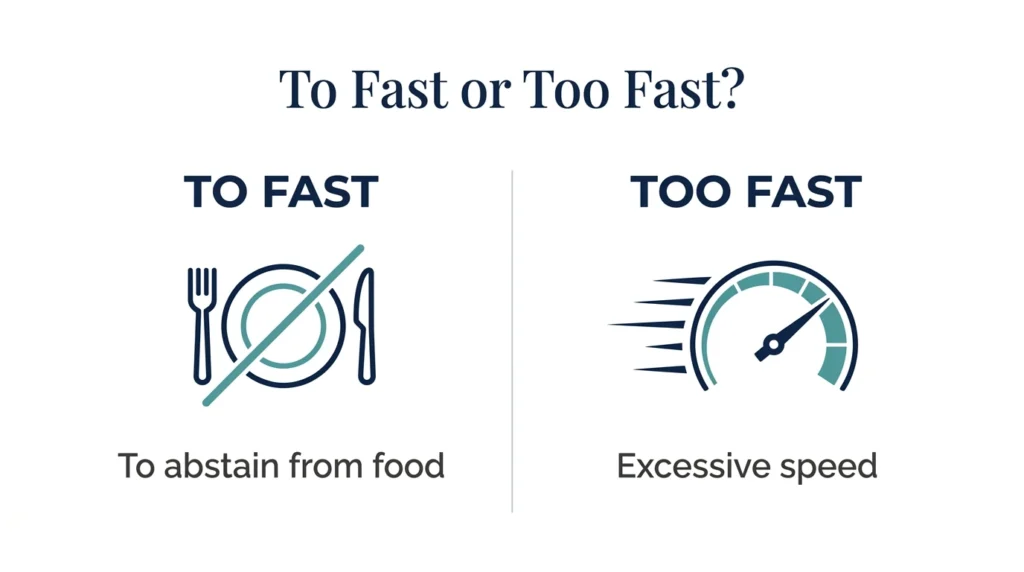

The correct choice depends on what you mean. Use “too fast” when something is happening at an excessive speed. Use “to fast” when fast is a verb meaning to abstain from food for a period of time.
For example, “The car is moving too fast” describes excessive speed, while “She decided to fast before the medical test” describes a decision not to eat.
To Fast or Too Fast?
“Too fast” is correct when you mean faster than is safe, comfortable, necessary, or appropriate. “To fast” is also grammatically correct when fast means to abstain from food. The words sound the same, but their meanings differ. Remember this simple rule: too fast describes excessive speed; to fast describes an action involving abstaining from food.
What Is the Difference Between To Fast and Too Fast?
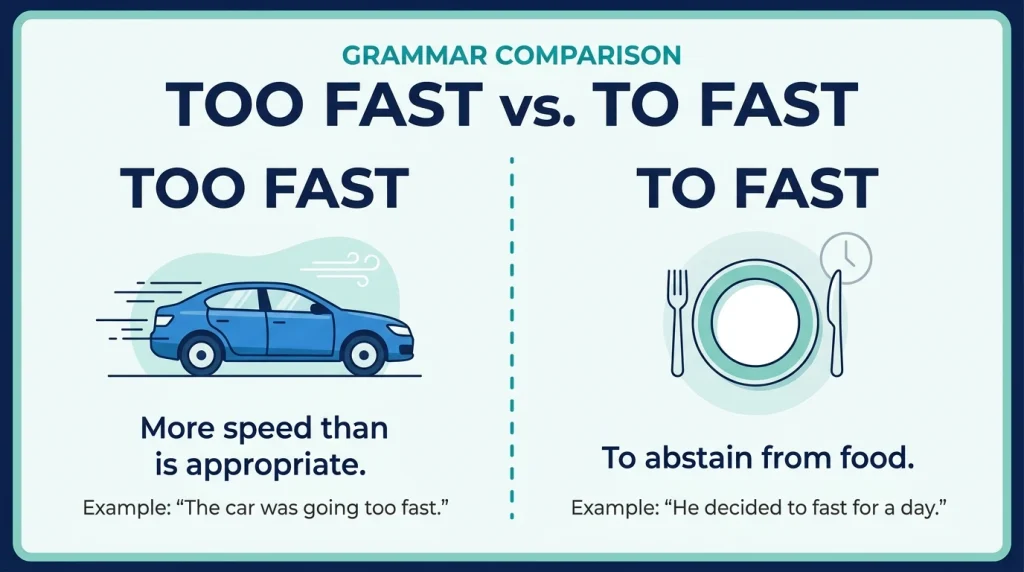
The difference comes from the words to and too. Although they sound alike, they perform different grammatical jobs.
- Too fast: Means excessively fast or faster than is appropriate. Example: “You’re typing too fast for me to follow.”
- To fast: Means to abstain from eating for a period. Example: “The doctor instructed me to fast before the test.”
The first phrase describes speed. The second introduces an action.
ALSO READ: Appreciate It or Appreciated It: Which Is Correct?
What Does “Too Fast” Mean?
Too fast means that something is happening at a speed greater than what is suitable or desired in a particular situation.
Here, too is an adverb that expresses excess. Fast describes speed and can function as either an adjective or an adverb, depending on the sentence.
Examples:
- The driver was going too fast for the wet road.
- You’re speaking too fast for the audience to understand.
- The software processes the files too fast for the progress indicator to update smoothly.
- The meeting moved too fast for everyone to discuss the proposal.
Notice that too fast often suggests a problem. The speed may be unsafe, uncomfortable, difficult to follow, or simply greater than necessary.
However, the phrase does not always imply physical movement. A conversation, lesson, business project, or change in circumstances can also happen too fast.
What Does “To Fast” Mean?
To fast consists of the word to followed by the verb fast. In this context, fast means to abstain from food, usually for religious, medical, or personal reasons.
The word to introduces the verb’s infinitive form. An infinitive is the basic form of a verb used with to, as in to read, to learn, and to fast.
Examples:
- I plan to fast before the medical procedure.
- She decided to fast during the designated religious observance.
- The clinic instructed him to fast before his blood test.
- They discussed whether to fast for a particular period.
In each sentence, fast is an action, not a description of speed.
Context matters because “I need to fast” is grammatically correct but may be misunderstood if the reader expects a sentence about speed. Adding a few words, such as “before my blood test,” makes the intended meaning clear.
Why It Matters
Confusing to with too can make an otherwise correct sentence look careless or change how a reader interprets it.
In professional writing, accuracy matters because small errors can distract from the message. A manager who writes “The presentation is moving to fast” means that the presentation is progressing too quickly, but the spelling error may undermine the message’s polish.
The distinction is especially important in these situations:
- Workplace communication: “The project is moving too fast” signals that the pace may need attention.
- Academic writing: “The argument develops too fast” suggests that more explanation is needed.
- Education: “You’re reading too fast” identifies a pace that may interfere with comprehension.
- Medical instructions: “You need to fast before the test” communicates an instruction about eating, not speed.
- Everyday conversation: “You’re walking too fast” asks someone to slow down.
The meaning comes from the sentence, not from how the words sound.
ALSO READ: Suing vs Sueing: Which Spelling Is Correct?
The Core Rule
Remember this rule
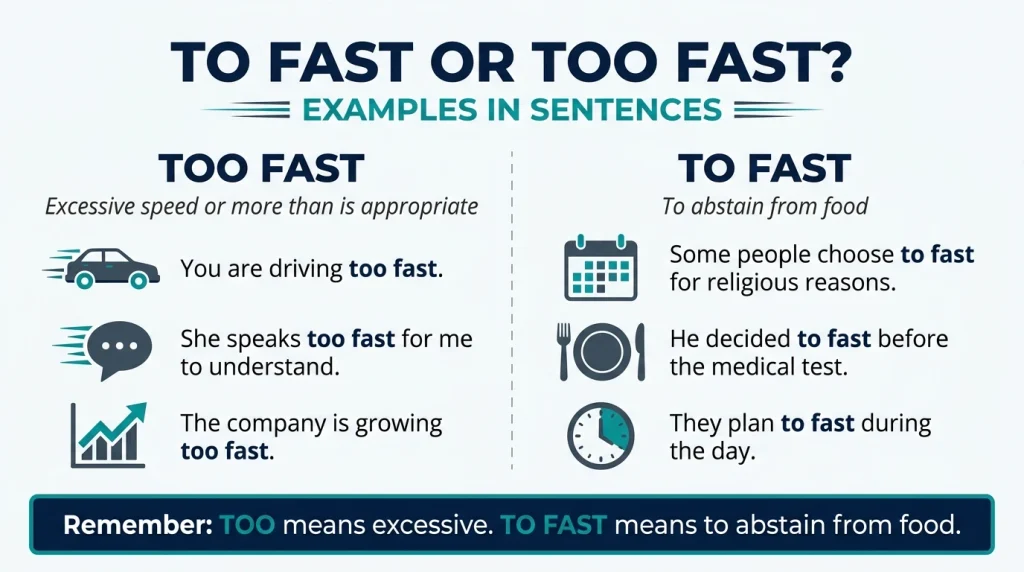
Too fast = excessive speed
Use too when the speed is more than is wanted, needed, or appropriate.
Example: “The speaker is talking too fast.”
To fast = to abstain from food
Use to before the verb fast when referring to the act of not eating.
Example: “I was told to fast before the procedure.”
An easy memory trick is that too has an extra “o” for an extra degree of something. The phrase too fast indicates excess, while to fast introduces an action.
This is a memory aid, not a complete grammar rule. The most reliable method is to check what you intend to say.
How to Use To Fast and Too Fast
When to Use “Too Fast”
Use too fast when speed exceeds an appropriate limit or when something happens more quickly than someone can comfortably manage.
This includes physical speed, speaking, reading, learning, technological processes, and changes over time.
Examples:
- The cyclist was traveling too fast on the narrow path.
- The instructor explained the new procedure too fast.
- The video plays too fast to read the subtitles.
- The company expanded too fast to maintain consistent service.
- The conversation moved too fast for the new employee to participate.
In each case, too communicates excess relative to a standard or expectation.
When to Use “To Fast”
Use to fast when the verb fast means to abstain from food.
The phrase often follows verbs such as decide, plan, need, choose, and instruct.
Examples:
- She chose to fast for a period of religious observance.
- I need to fast before my scheduled blood test.
- They plan to fast during the observance.
- The patient was instructed to fast before the procedure.
The phrase is not a speed expression. Its grammatical structure is the same as in “to exercise” or “to sleep.”
What About “Way Too Fast”?
The natural expression is “way too fast,” not “way to fast,” when you want to emphasize excessive speed.
Here, way is an informal intensifier meaning by a large amount or far. It strengthens the meaning of too fast.
Examples:
- You’re driving way too fast.
- The instructions were explained way too fast.
- That deadline is coming up way too fast.
In formal reports, far too fast or much too fast may be more suitable, depending on the sentence.
What About “Going Too Fast”?
When describing movement or progress, use going too fast.
Examples:
- The car is going too fast.
- The presentation is going too fast.
- The lesson is going too fast for the students.
The word going is the verb, and too fast describes the speed or pace. Writing “going to fast” is incorrect if you mean excessive speed.
However, “going to fast” can appear in a different grammatical structure, such as “I’m going to fast tomorrow,” where going to indicates a future plan and fast is the verb meaning to abstain from food. This sentence is grammatically possible, though “I’m planning to fast tomorrow” may be clearer.
Correct Examples of “Too Fast” and “To Fast”
The following examples show how the two expressions work in different contexts.
Everyday Conversation
- “Could you walk a little slower? You’re moving too fast.”
- “The children ran too fast for us to keep up.”
- “I decided to fast tomorrow morning before my appointment.”
Emails and Workplace Communication
- “The project is progressing too fast for the team to complete its quality checks.”
- “Could you explain the revised process more slowly? The training session moved too fast.”
- “Please confirm whether I need to fast before the scheduled laboratory test.”
School and Education
- “The teacher spoke too fast for several students to take notes.”
- “The reading exercise was completed too fast to allow careful analysis.”
- “The doctor advised the student to fast before the examination.”
Social Media and Digital Communication
- “This tutorial moves too fast for beginners.”
- “The video is playing too fast to understand the instructions.”
- “That year went by way too fast!”
Academic and Formal Writing
- “The argument develops too fast, leaving insufficient room to establish the evidence.”
- “The software processes the incoming data too fast for the existing monitoring system to display each update.”
- “Participants were instructed to fast before the specified medical examination.”
These examples demonstrate that too fast can describe many kinds of speed or pace, while to fast refers to the action of abstaining from food.
Incorrect vs. Correct: Common Examples
Use the following table to identify and correct common mistakes.
| ❌ Incorrect | ✅ Correct | Why |
|---|---|---|
| You’re driving to fast. | You’re driving too fast. | Too indicates excessive speed. |
| She talks to fast. | She talks too fast. | The sentence describes speaking speed. |
| The video is moving to fast. | The video is moving too fast. | Too fast describes excessive playback speed. |
| This lesson is going to fast. | This lesson is going too fast. | The lesson is progressing too quickly. |
| He runs to fast for me. | He runs too fast for me. | The runner’s speed exceeds what the speaker can manage. |
| The music is playing to fast. | The music is playing too fast. | Too modifies the speed at which the music plays. |
| The meeting ended to fast. | The meeting ended too fast. | The speaker means the meeting ended sooner or progressed faster than desired. |
| You typed to fast to notice the error. | You typed too fast to notice the error. | The typing speed is excessive for accurate work. |
| The car was going to fast on the highway. | The car was going too fast on the highway. | The sentence refers to speed, not abstaining from food. |
| I need too finish this report. | I need to finish this report. | To introduces the verb finish. |
| She wants too leave early. | She wants to leave early. | To introduces the infinitive leave. |
| I am going too fast tomorrow. | I am going to fast tomorrow. | If the intended meaning is a planned period of abstaining from food, going to fast can express that plan. |
The final three examples show why you should not replace every to with too. The correct choice depends on grammatical function and intended meaning.
Why People Make This Mistake
1. “To” and “Too” Sound the Same
To and too are homophones: words that share the same pronunciation but have different meanings and spellings.
When speaking, people do not usually notice a spelling difference because both words sound alike. The problem appears when they write the sentence.
How to avoid it: Decide whether you mean direction, an infinitive verb, or excess before choosing the spelling.
2. People Focus on the Sound Instead of the Meaning
When typing quickly, a writer may hear the phrase mentally and choose the wrong word because the pronunciation offers no reliable clue.
For example, “You are moving to fast” sounds the same as “You are moving too fast,” even though only the second expresses excessive speed.
How to avoid it: Read the sentence for meaning rather than sound alone.
3. The Word “Fast” Has More Than One Role
Fast can describe speed or serve as a verb meaning to abstain from food.
Compare:
- “The train is fast.” Here, fast is an adjective.
- “The train moves fast.” Here, fast is an adverb.
- “They decided to fast.” Here, fast is a verb.
How to avoid it: Identify what fast means in the sentence before deciding whether to or too belongs before it.
4. Spellcheck Does Not Always Catch the Error
Both to and too are correctly spelled English words. Basic spellcheck tools may therefore accept the wrong choice if it forms a grammatically plausible sequence or escapes the tool’s contextual checks.
How to avoid it: Use proofreading tools as a second check, not as a replacement for understanding the rule.
5. Translation Can Interfere
Some languages do not distinguish between these English meanings through separate spellings in the same way. Learners may translate the idea first and then select the wrong English word.
How to avoid it: Learn the phrases in context: too fast to follow, too fast to read, and to fast before a test. This builds a stronger connection between grammar and meaning.
Common Mistakes Checklist
Use this checklist when editing your writing.
- Using “to fast” to describe speed. This happens because to and too sound alike. Replace to with too when you mean excessive speed.
- Using “too” before an ordinary infinitive. For example, “I want too leave” should be “I want to leave.” Use to to introduce the verb leave.
- Assuming “too fast” always means dangerously fast. It can also mean too quick to understand, too rapid for a process, or faster than desired. Judge the phrase from the context.
- Assuming “to fast” is always wrong. It is correct when fast means to abstain from food. Add context if readers might misunderstand.
- Trusting spellcheck without reviewing meaning. Both words exist, so automated correction may not catch every error. Read the complete sentence.
- Replacing “too fast” with “very fast” without checking the meaning. Very fast emphasizes high speed; too fast suggests that the speed exceeds an appropriate level. They are not always interchangeable.
“To Fast” and “Too Fast” in Real English
Grammatically Correct: “The Car Is Going Too Fast”
This sentence is grammatically correct and natural in everyday English. It communicates that the car’s speed is excessive for the circumstances. A speaker might use it when the driver is exceeding a safe speed, approaching a sharp turn, or traveling too quickly for the road conditions. The phrase is direct, familiar, and appropriate in both conversation and professional contexts where excessive speed is relevant.
Grammatically Correct but Context-Dependent: “I Need to Fast”
This sentence is grammatically correct when fast means abstaining from food. It is natural when the context involves a medical test, a religious observance, or another reason for fasting. Without that context, a reader might briefly wonder whether the writer intended too fast. The sentence is not grammatically wrong, but adding a detail such as “before my blood test” makes the meaning immediately clear.
Grammatically Incorrect for Speed: “The Speaker Talks to Fast”
When the intended meaning is that the speaker talks excessively quickly, this spelling is incorrect. The natural correction is “The speaker talks too fast.” In everyday English, people commonly use too fast to describe speech that is difficult to follow. In more formal feedback, a writer could say “The speaker’s pace is too rapid,” but the simpler phrase remains clear and idiomatic.
American vs. British English
There is no meaningful American–British spelling difference between to fast and too fast. Both varieties use the same spellings and grammatical distinction.
| Feature | American English | British English |
|---|---|---|
| Excessive speed | too fast | too fast |
| Abstaining from food | to fast | to fast |
| Informal emphasis | way too fast | way too fast |
| Formal alternative | excessively fast | excessively fast |
Writers in both varieties should choose the phrase according to its meaning, not the intended audience’s country.
Formal vs. Informal Usage
Both phrases can appear in formal and informal writing, but the best wording depends on the situation.
| Context | Suitable wording | Reason |
|---|---|---|
| Casual conversation | “You’re going too fast.” | Direct and natural. |
| Workplace feedback | “The presentation is moving too fast.” | Clear and professional. |
| Formal report | “The process is progressing too rapidly.” | More formal and precise. |
| Medical instructions | “Please fast before the test, as instructed.” | Clearly communicates an instruction about food. |
| Informal emphasis | “That was way too fast.” | Adds conversational emphasis. |
In professional writing, too fast is not inherently informal. It is suitable whenever it communicates the point clearly. More formal alternatives may be useful when the subject requires technical precision or a neutral tone.
Comparison Table: To Fast vs. Too Fast
| Feature | To fast | Too fast |
|---|---|---|
| Main meaning | To abstain from food | Excessively fast |
| Grammatical role | To introduces the verb fast | Too modifies fast |
| Refers to speed? | No | Yes |
| Common context | Medical instructions, religious observance | Driving, speech, work, movement |
| Example | I need to fast before the test. | You’re driving too fast. |
| Memory clue | An action | An excessive degree |
| American/British difference | None | None |
A related distinction is “too fast” vs. “very fast.” Both describe high speed, but too fast suggests that the speed exceeds a suitable limit, whereas very fast simply emphasizes that the speed is high.
For example, “The athlete runs very fast” may be praise. “The athlete runs too fast for the conditions” suggests a problem with the pace.
Real-Life Situations: Which Phrase Should You Use?
Situation 1: A Job Interview
You are explaining why a training session was difficult to follow.
Correct: “The trainer explained the software too fast, so I missed a few important steps.”
Why: You are describing a pace that made understanding difficult.
Situation 2: A Workplace Meeting
A colleague introduces several new ideas in a short time.
Correct: “We’re moving too fast to evaluate the risks properly.”
Why: The phrase describes a pace that exceeds what the team can manage effectively.
Situation 3: An Email to a Doctor
You want to confirm instructions before a medical test.
Correct: “Could you confirm whether I need to fast before my appointment?”
Why: Here, fast means to abstain from food, so to fast is correct.
Situation 4: A Text Message
Your friend is walking ahead of you.
Correct: “Wait for me! You’re walking way too fast.”
Why: Way too fast is a natural, informal way to emphasize excessive speed.
Situation 5: An Academic Essay
You are evaluating the development of an argument.
Correct: “The author develops the central argument too fast, leaving several assumptions unexplained.”
Why: The argument progresses more quickly than the reader can comfortably follow.
Situation 6: A School Assignment
You are describing a video lesson.
Correct: “The video moves too fast for beginners to understand every step.”
Why: Too fast describes the pace of the explanation, not the physical speed of an object.
Quick Quiz: Test Your Understanding
Choose the correct word in each sentence. The answers are hidden until you open them.
Practice questions
0 of 6 answered
1. The driver was going ___ fast for the icy road.totoo
2. I was instructed ___ fast before the blood test.totoo
3. Could you speak more slowly? You’re talking ___ fast.totoo
4. She decided ___ fast during the observance.totoo
5. The tutorial is moving way ___ fast.totoo
6. I need ___ finish the report before noon.totoo
Try againShow all answers
Quick Summary
“To fast” and “too fast” sound alike but have different meanings. Use too fast when something is happening at an excessive speed or progressing more quickly than is appropriate. For example, “The car is moving too fast” and “The speaker talks too fast” are correct. Use to fast when fast is a verb meaning to abstain from food, as in “I need to fast before my medical test.” The simplest memory trick is to associate the extra “o” in too with an extra degree or excess. This distinction is the same in American and British English. When proofreading, check the intended meaning rather than relying on pronunciation or spellcheck alone.
FAQ
1. Is “to fast” ever grammatically correct?
Yes. To fast is correct when fast means to abstain from food. For example, “The clinic asked me to fast before the procedure.” It is incorrect only when you use it to describe excessive speed.
2. Is it “going too fast” or “going to fast”?
Use “going too fast” when describing excessive speed, as in “The car is going too fast.” However, “going to fast” can be correct when going to indicates a future plan and fast means to abstain from food: “I’m going to fast tomorrow.”
3. Is “way too fast” correct?
Yes. “Way too fast” is a common informal expression that emphasizes excessive speed. For example, “The video is playing way too fast.” In formal writing, far too fast may be more appropriate.
4. Is “too fast” the same as “too quickly”?
They often communicate the same idea. “The car is moving too fast” and “The car is moving too quickly” are both grammatical. The best choice depends on the sentence and the emphasis you want to convey.
5. Can “too fast” describe someone speaking or reading?
Yes. You can say “You’re speaking too fast” or “I’m reading too fast to understand the details.” The phrase applies to the pace of an activity, not just the speed of a moving object.
6. Does “too fast” always have a negative meaning?
Not necessarily, but it usually suggests that the speed exceeds a relevant limit or expectation. The problem may be practical rather than serious. For example, a presentation can be too fast for an audience even if the speaker is doing nothing dangerous.
7. What is the difference between “fast” and “too fast”?
Fast describes high speed. Too fast means the speed is excessive for a particular situation. “She types fast” describes her ability; “She types too fast for the software to keep up” identifies a problem with that speed.
8. Is “to fast” wrong in American and British English?
No. It is correct in both varieties when fast means to abstain from food. When describing excessive speed, both American and British English use too fast.
9. Why doesn’t spellcheck always correct “to fast”?
Because to and too are both correctly spelled words. Some automated tools may not recognize the intended meaning or may overlook the error in context. Proofreading for meaning is still necessary.
10. How can I remember the difference between “to” and “too”?
Ask yourself what the sentence means. If you mean excessive speed, use too fast. If you mean abstaining from food, use to fast. Remember that too has an extra “o,” which can remind you of an extra degree or excess.