
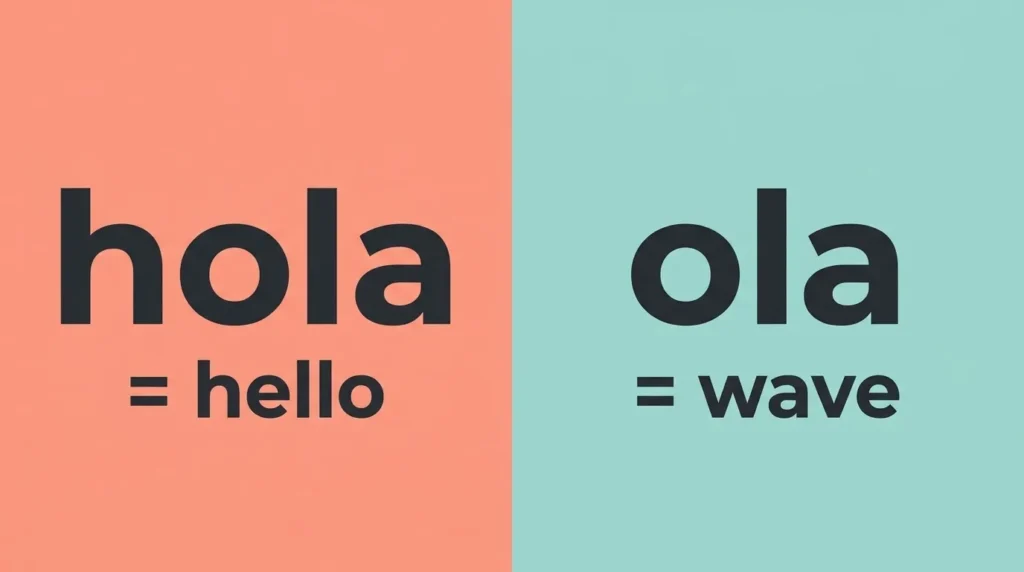

If you want to say hello in Spanish, the correct spelling is hola, with an H. The word ola, without an H, means “wave” in Spanish. Both words are pronounced the same because the Spanish letter H is silent. Portuguese adds another important distinction: olá, with an accent on the final A, means “hello” in Portuguese.
Ola or Hola?
Use hola when greeting someone in Spanish, and use ola when talking about a wave. Although the two words sound alike, they have different meanings and grammatical functions. For example, ¡Hola, María! means “Hello, María!” while La ola es grande means “The wave is big.” If you are writing a Spanish greeting, remember the H in hola.
What Is the Difference Between Ola and Hola?
The difference between ola and hola is their spelling, meaning, and use in Spanish.
- Hola: A greeting that means “hello” or “hi.”
- Ola: A noun meaning “wave,” usually a wave of water but sometimes a figurative wave or surge.
The confusion occurs because Spanish does not normally pronounce the letter H. Consequently, hola and ola sound alike even though they mean different things.
Consider these examples:
- ¡Hola, Carlos! — Hello, Carlos!
- La ola llegó a la playa. — The wave reached the beach.
In the first sentence, hola greets a person. In the second, ola names something that reaches the shore.
Hola vs. Ola: Comparison Table
| Feature | Hola | Ola |
|---|---|---|
| Language | Spanish | Spanish |
| Meaning | Hello or hi | Wave |
| Grammatical function | Greeting or interjection | Noun |
| Pronunciation | Approximately OH-lah | Approximately OH-lah |
| Spanish H | Includes a silent H | No H |
| Used to greet someone? | Yes | No |
| Example | ¡Hola, Ana! | La ola es enorme. |
| English translation | Hello, Ana! | The wave is enormous. |
The easiest rule to remember is that hola is for saying hello, while ola is for describing a wave.
Why Does the Difference Between Ola and Hola Matter?
A single letter can change the meaning of a Spanish word. This matters when you send a message, write an email, complete a language assignment, or communicate with Spanish speakers.
For example, writing Ola, ¿cómo estás? when you mean “Hello, how are you?” is a spelling mistake in Spanish. The intended greeting requires the H in hola.
The reverse mistake can also confuse your reader. If you write La hola es enorme, you have used the greeting hola instead of the noun ola.
These words demonstrate why spelling matters even when pronunciation does not reveal the difference.
The Core Rule: When Should You Use Hola or Ola?

Use hola for a greeting and ola for a wave. Both words sound alike in standard Spanish, so choose the spelling according to the meaning you intend.
Remember these two forms:
- Hola = hello or hi.
- Ola = wave.
There is one additional form worth learning if you communicate across languages: Portuguese uses olá to mean “hello.” The accent is part of the standard Portuguese spelling.
How to Use Hola Correctly
1. Use Hola to Greet Someone
Hola is one of the most common Spanish greetings. You can use it when meeting someone, starting a conversation, or welcoming a person.
Examples:
- ¡Hola! — Hello!
- ¡Hola, Ana! — Hello, Ana!
- Hola, ¿cómo estás? — Hi, how are you?
- Hola, mucho gusto. — Hello, nice to meet you.
- Hola a todos. — Hello, everyone.
In Spanish writing, the greeting may be followed by a comma when you address a person directly. Spanish also commonly uses an opening exclamation mark in an enthusiastic greeting: ¡Hola!
2. Use Hola in Text Messages and Online Chats
Hola works well in everyday messages, social media comments, and friendly online conversations.
Examples:
- Hola, ¿estás disponible?
- ¡Hola! Hace tiempo que no hablamos.
- Hola a todos, gracias por unirse al grupo.
- ¡Hola, equipo! ¿Listos para la reunión?
- Hola, acabo de leer tu mensaje.
These are ordinary examples of greeting someone in Spanish. Informal messages may stretch the spelling for effect, such as holaaa, but hola remains the standard spelling.
3. Use Hola in Emails
You can start an email with Hola when the relationship and situation make a friendly greeting appropriate.
Examples:
- Hola, Marta:
- Hola, equipo:
- Hola, señor García:
The appropriate level of formality depends on your audience and the purpose of the message. A formal business letter may require a more formal salutation, while a friendly message to a colleague may naturally begin with Hola.
4. Use Ola When Talking About Waves
Ola is a Spanish noun. It can describe a wave in the sea or another kind of wave-like movement.
Examples:
- La ola era enorme. — The wave was enormous.
- Una ola golpeó el barco. — A wave hit the boat.
- Las olas llegaron hasta la costa. — The waves reached the shore.
- Vimos una ola gigante. — We saw a giant wave.
- Los niños jugaron entre las olas. — The children played among the waves.
Notice that ola can change to olas when you are talking about more than one wave.
5. Use Ola in Figurative Expressions
Spanish also uses ola to describe a wave or surge of something other than water.
Examples:
- Una ola de calor — A heat wave.
- Una ola de protestas — A wave of protests.
- Una ola de entusiasmo — A wave of enthusiasm.
- Una nueva ola de cambios — A new wave of changes.
In these expressions, ola refers to a spreading or rising movement, not necessarily a physical wave in the sea.
15 Correct Examples of Ola and Hola
The following examples show how each word works in everyday communication and Spanish writing.
| Situation | Correct Spanish | English meaning |
|---|---|---|
| Greeting a friend | ¡Hola, Diego! | Hello, Diego! |
| Starting a chat | Hola, ¿cómo estás? | Hi, how are you? |
| Greeting a group | Hola a todos. | Hello, everyone. |
| Welcoming a visitor | ¡Hola! Bienvenido. | Hello! Welcome. |
| Email to a colleague | Hola, Laura: | Hello, Laura: |
| Team message | Hola, equipo. | Hello, team. |
| Social media comment | ¡Hola! Gracias por compartir. | Hi! Thanks for sharing. |
| Language assignment | Hola significa “hello.” | Hola means “hello.” |
| Greeting a new classmate | Hola, mucho gusto. | Hello, nice to meet you. |
| Greeting someone again | Hola de nuevo. | Hello again. |
| Describing a sea wave | La ola es grande. | The wave is big. |
| Describing a storm | Una ola golpeó la costa. | A wave hit the coast. |
| Talking about several waves | Las olas son altas. | The waves are high. |
| Discussing hot weather | Hay una ola de calor. | There is a heat wave. |
| Discussing a social movement | Se extendió una ola de protestas. | A wave of protests spread. |
The key is to look at what the sentence communicates. When the word greets a person, choose hola. When it names a wave or surge, choose ola.
Incorrect vs. Correct: 10 Common Examples
| ❌ Incorrect | ✅ Correct | Why |
|---|---|---|
| Ola, ¿cómo estás? | Hola, ¿cómo estás? | A greeting in Spanish requires hola, with H. |
| Ola, María. | Hola, María. | Hola is the greeting used before a person’s name. |
| Buenos días, ola. | Buenos días, hola. | If you intend to add a greeting, hola needs H; more naturally, use ¡Hola! Buenos días. |
| Le escribí ola a mi amiga. | Le escribí hola a mi amiga. | The intended word is the Spanish greeting. |
| La hola era enorme. | La ola era enorme. | The noun meaning “wave” is ola. |
| Vi una hola en el mar. | Vi una ola en el mar. | A wave in the sea is ola, without H. |
| Las holas llegaron a la playa. | Las olas llegaron a la playa. | The plural of ola is olas. |
| Una hola de calor afectó la ciudad. | Una ola de calor afectó la ciudad. | The established expression uses the noun ola. |
| La hola golpeó el barco. | La ola golpeó el barco. | The sentence describes a wave, not a greeting. |
| Escribí “ola” para decir “hello” en español. | Escribí “hola” para decir “hello” en español. | The Spanish greeting is spelled hola. |
The important point is not that ola is an incorrect Spanish word. It is correct when it means “wave.” The mistake occurs when you use it where a greeting is intended.
Why Do People Confuse Ola and Hola?
1. The H Is Silent
In standard Spanish, the letter H is normally silent. As a result, hola and ola have the same pronunciation in ordinary speech.
When learners hear either word, they cannot rely on the sound alone to determine the spelling.
2. The Words Differ by Only One Letter
Both words contain the same three letters in the same order after the initial H in hola is removed. This makes the pair easy to confuse when typing quickly.
The spelling difference is small, but the difference in meaning is significant.
3. Learners May Apply English Spelling Habits
English speakers are accustomed to many words in which H represents a sound. They may expect the H in hola to be pronounced or forget it when writing a word they have learned by listening.
The solution is to learn the written word and its meaning together.
4. Spellcheck Does Not Always Catch the Mistake
Both hola and ola are valid Spanish words. A spellchecker may accept either spelling because neither is inherently misspelled.
A basic spelling check may not understand whether you are greeting a person or describing a wave. Proofreading for meaning is therefore important.
5. Translation Can Cause Confusion
Someone who knows that hola means “hello” may assume that removing the silent H creates a casual or shortened version of the same greeting.
It does not. In Spanish, ola already has its own meaning. Portuguese adds another possibility with olá, which is a greeting in that language.
Common Mistakes Checklist
Use this checklist when proofreading Spanish writing.
- Dropping the H in a greeting: Writing ola instead of hola changes the intended word. Check that the greeting includes H.
- Adding H to the word for a wave: Writing hola instead of ola changes the meaning of the noun. Remove H when you mean a wave.
- Assuming both words are alternative spellings: They are separate words, not interchangeable versions of one word. Memorize each meaning.
- Forgetting the plural: The plural of ola is olas, not holas. Check the word’s meaning before forming its plural.
- Ignoring context: Spellcheck may accept both words. Read the full sentence and ask whether it is greeting someone or describing a wave.
- Confusing Spanish and Portuguese: Spanish uses hola for “hello,” while Portuguese uses olá. Identify the language before choosing the form.
- Treating informal spelling as standard spelling: Playful forms such as holaaa may appear in messages, but the standard spelling is hola.
ALSO READ: What Is the Difference Between Hear and Here?
Ola or Hola in Real English and Everyday Language
Grammatically Correct
Both hola and ola are correct Spanish words when used for their proper meanings. Hola functions as a greeting, while ola is a noun referring to a wave or a figurative surge. For example, ¡Hola, Ana! is a correct greeting, and La ola llegó a la costa correctly describes a wave. Neither spelling is universally wrong; the meaning determines which one belongs in a sentence.
Grammatically Possible but Unnatural
Writing Ola, ¿cómo estás? may still communicate your intention to someone familiar with Spanish, particularly in an informal message, but it is not the standard spelling of the greeting. Similarly, using hola in a sentence about an ocean wave is not an alternative grammatical construction; it changes the intended word. Readers may infer your meaning from context, but standard writing should use the appropriate spelling.
Natural, Everyday Usage
In ordinary Spanish conversation, hola is a familiar way to say hello, whether you are greeting a friend, starting a chat, or opening a friendly message. Ola appears when talking about waves, including expressions such as ola de calor. Because both words sound alike, speakers depend on context when listening, while writers must choose the correct spelling. In Portuguese, the corresponding greeting is olá, with an accent.
ALSO CHECKOUT: Posible or Possible: Which Spelling Is Correct?
American vs. British English
There is no meaningful American-versus-British English spelling difference between hola and ola in this comparison. Both forms belong to Spanish, and their meanings do not change according to whether an English writer uses American or British English.
An American English speaker and a British English speaker should both write hola when referring to the Spanish greeting and ola when referring to a Spanish wave. Portuguese olá remains a separate form in either variety of English.
Formal vs. Informal Usage
The difference between hola and ola is about meaning, not formality.
- Hola: Appropriate for everyday greetings, friendly messages, many ordinary workplace interactions, and informal introductions. A more formal greeting may be preferable in a highly formal letter or official communication.
- Ola: Used as a noun in descriptions of physical waves and figurative surges. It is not a greeting in standard Spanish, regardless of whether the conversation is formal or informal.
- Ol á: Portuguese olá is a greeting, not the standard Spanish spelling. The language matters more than the level of formality.
For a Spanish business email, Hola, Ana: may be appropriate when a friendly tone suits the relationship. In a more formal setting, choose a salutation that matches the recipient and local conventions.
Ola vs. Hola vs. Olá
These three spellings are easy to mix up, but they belong to distinct uses.
| Word | Language | Meaning | Example |
|---|---|---|---|
| Hola | Spanish | Hello or hi | ¡Hola, Pedro! |
| Ola | Spanish | Wave | La ola es grande. |
| Olá | Portuguese | Hello | Olá, Pedro! |
The accent in Portuguese olá appears on the final A. Do not remove or add letters simply because the words look similar across languages.
If you are writing in Spanish, use hola for a greeting. If you are writing in Portuguese, olá is the usual corresponding greeting. Use ola in Spanish when you mean “wave.”
Real-Life Situations: Which Word Fits?
Situation 1: Sending a Text Message
You want to greet a Spanish-speaking friend before asking a question.
Correct: ¡Hola! ¿Tienes un momento?
Why: You are opening a conversation, so you need the greeting hola.
Situation 2: Writing a Work Email
You are emailing a colleague with whom you normally use a friendly tone.
Correct: Hola, Marta: Te envío el documento que solicitaste.
Why: Hola is a greeting and can be appropriate in a friendly professional message.
Situation 3: Completing a Spanish Exam
The question asks you to translate “The wave is large.”
Correct: La ola es grande.
Why: The sentence describes a wave, so ola is the correct noun.
Situation 4: Posting a Beach Photo
You want to describe a large wave in your social media caption.
Correct: ¡Qué ola tan grande!
Why: The sentence describes a wave rather than greeting anyone.
Situation 5: Greeting a Portuguese-Speaking Customer
You want to say hello in Portuguese.
Correct: Olá! Como posso ajudar?
Why: Portuguese uses olá as a greeting. Spanish hola and Portuguese olá are not the same spelling.
Practice Quiz: Ola or Hola?
Choose the correct word for each sentence. Think about the meaning before checking the answers.
- ______, ¿cómo te llamas?
- La ______ golpeó la orilla.
- Escribí “______” para saludar a mi compañero.
- Las ______ eran muy altas.
- Portugal uses ______ as a greeting in Portuguese.
- Una ______ de calor afectó la región.
Answer Key
- Hola — The sentence greets someone.
- Ola — The sentence describes a wave reaching the shore.
- Hola — This is the Spanish word for “hello.”
- Olas — This is the plural of ola, meaning “waves.”
- Ol á — The Portuguese greeting is written olá, with an accent on the final A.
- Ola — The expression ola de calor means “heat wave.”
Quick Summary
The difference between ola and hola is simple: hola means “hello” or “hi” in Spanish, while ola means “wave.” Both words sound alike because the H in Spanish hola is silent, but their meanings are different. Use hola when greeting a person, starting a conversation, or opening an appropriate message. Use ola when describing a water wave or a figurative surge, as in ola de calor. Remember that olas is the plural of ola. If you are writing in Portuguese, the standard greeting is olá, with an accent on the final A. When in doubt, identify the language and the meaning before choosing the spelling.
FAQ’S
Is Ola ever correct as a greeting?
Not as the standard greeting in Spanish. Use hola to say “hello.” The spelling ola means “wave” in Spanish, although Ola may also appear as a person’s name or a brand name.
Why is the H in hola silent?
The Spanish letter H is normally silent in standard Spanish pronunciation. Therefore, hola and ola sound alike even though they have different meanings.
Can I write “holaaa” in a text message?
Yes. Holaaa is an informal, playful spelling that stretches the greeting for emphasis or friendliness. In standard Spanish writing, however, the correct spelling remains hola.
What is the plural of ola?
The plural is olas. For example, Las olas son enormes means “The waves are enormous.” The plural of ola does not take an H.
Does ola mean anything besides a water wave?
Yes. Spanish also uses ola figuratively to describe a wave or surge of something. For example, ola de calor means “heat wave,” and ola de protestas means “wave of protests.”
Is hola used throughout the Spanish-speaking world?
Yes. Hola is a widely understood Spanish greeting across Spanish-speaking regions. Local expressions may differ, but hola is a standard way to say hello.
What is the difference between hola and olá?
Hola is the Spanish greeting, while olá is a Portuguese greeting. The Portuguese form has an accent on the final A. Both mean “hello,” but each spelling belongs to its respective language.
Is hola appropriate in a professional email?
It can be. Hola works in friendly professional communication when the relationship and workplace culture suit that tone. A formal letter or a message to an unfamiliar senior official may call for a more formal salutation.
How can I remember the difference between ola and hola?
Connect each spelling with a meaning: H in hola = hello; no H in ola = wave. This is a memory aid rather than a spelling rule, but it can help you recall the correct word quickly.
Does autocorrect always fix ola to hola?
No. Both are valid Spanish words, so spellcheck may accept ola even when you intended to write hola. Read the sentence for meaning rather than relying entirely on autocorrect.


